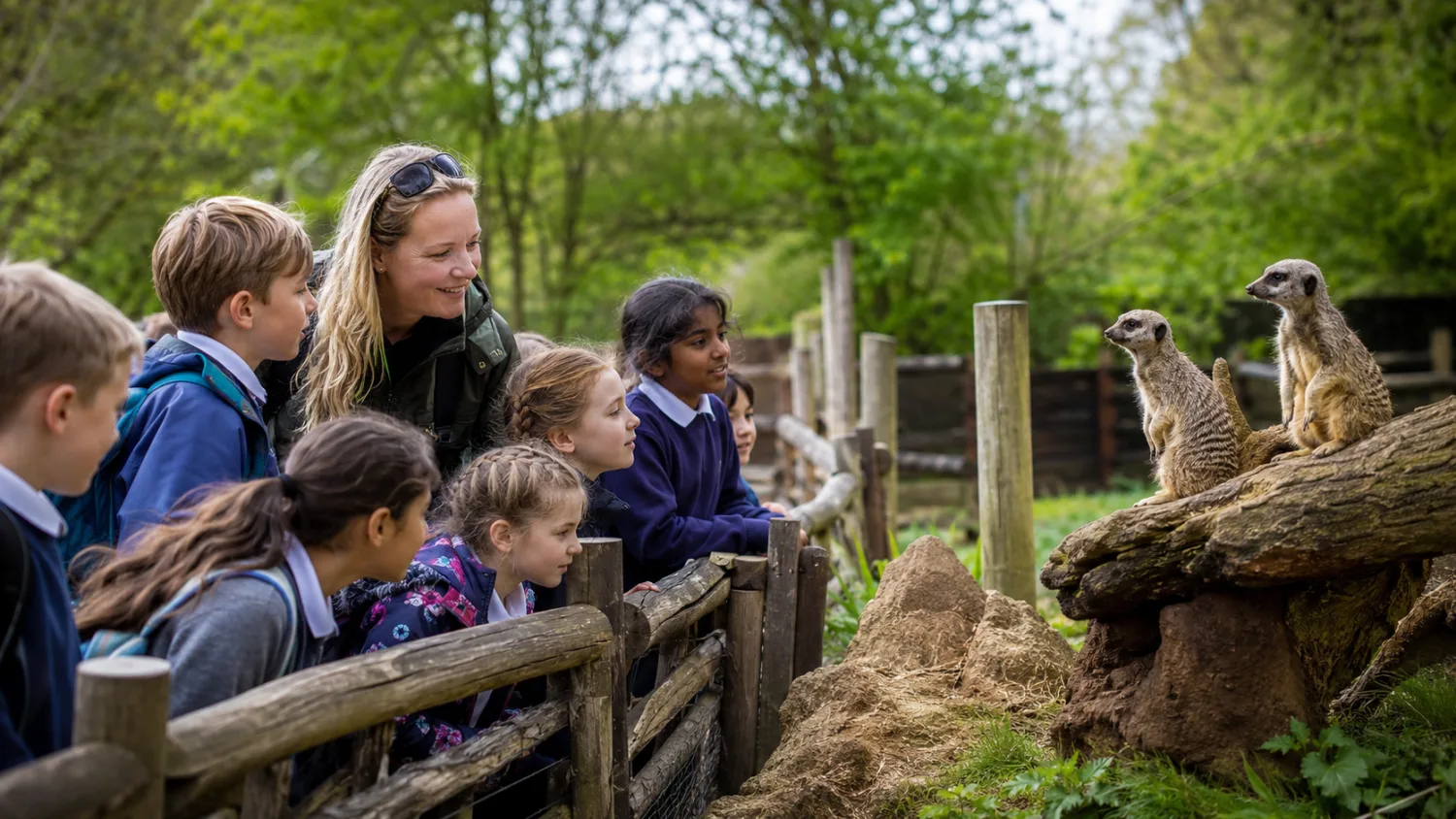
A school trip to a zoo, wildlife park or animal sanctuary can be one of the most memorable visits pupils experience. For many children, seeing animals up close changes the way they understand science, habitats, conservation and the natural world. Adaptation is no longer just a diagram. Food chains are no longer only arrows on a worksheet. Endangered species are no longer distant examples. They become real animals with behaviours, needs and stories.
Large, well-known venues such as Whipsnade Zoo and Woburn Safari Park are often the first places teachers think of, and they can offer excellent education programmes. But they are not the only option. Across the UK, there are smaller private zoos, wildlife parks, rescue centres, bird of prey centres, reptile centres, aquariums, farm parks, conservation projects and animal sanctuaries that may be closer, more affordable, more personal or better suited to a particular class.
These lesser-known venues can be especially valuable for schools because they often offer a more focused experience. Pupils may be able to speak directly with keepers, see conservation work at close range, join a smaller workshop, or learn about animals that are not always the headline species at larger attractions.
For teachers, the key is choosing carefully. A good animal-based school trip should not simply be a day of walking around enclosures. It should have a learning purpose, clear safeguarding arrangements, sensible risk management, inclusive access, good communication and a realistic cost. For venues, the message is just as clear: schools are interested, but they need practical detail before they can book with confidence.
If you are still comparing animal venues with other educational visits, you may also find our guide to the best school trip venues that link to the KS2 curriculum useful. For wider planning advice, our article on how to plan a school trip without the stress covers approvals, transport, supervision, parent communication and risk assessments.
Why animal venues work so well for school trips
Animals naturally hold pupils’ attention. A class that may be restless in the classroom can become quiet and observant when they are watching a meerkat, owl, tiger, lemur, snake, penguin, otter, goat, tortoise or red panda. Pupils notice movement, sound, texture, size, feeding behaviour, camouflage and interaction.
That attention is educationally powerful. Teachers can use it to build vocabulary, encourage observation, develop questioning and connect learning across subjects. A wildlife park visit can support science through habitats, food chains, classification, adaptation, life cycles and conservation. It can support geography through biomes, climate, human impact and global environments. It can support English through explanation, persuasive writing, report writing and debate. It can support PSHE and citizenship through responsibility, animal welfare and ethical discussion.
For primary pupils, animal trips make abstract ideas concrete. A child who sees the beak of a bird of prey, the shell of a tortoise or the teeth of a carnivore can begin to understand adaptation in a more direct way. For secondary pupils, the same visit can lead into more complex questions about conservation, captivity, habitat destruction, breeding programmes, climate change, biodiversity and the role of humans in protecting or damaging ecosystems.
The best animal venues understand this. They do not rely only on the excitement of seeing animals. They help pupils ask better questions.
Why smaller private zoos and wildlife parks are worth considering
When teachers search for “zoo school trip”, they often find the largest and most famous venues first. Those venues can be excellent, but they may not always be the best fit for every school. Travel time, cost, group size, workshop availability, accessibility and the age of pupils all matter.
Smaller private zoos and wildlife parks can offer a different kind of experience. They may be easier to reach, less overwhelming for younger pupils, more flexible with timings, and more able to tailor sessions to a class topic. In some cases, pupils may have more direct contact with education staff or keepers than they would at a very large attraction.
This does not automatically make smaller venues better. It simply means they should be considered seriously. A well-run local wildlife park with strong education sessions, clear safety information and good communication can sometimes provide more value than a larger venue that is harder to organise.
Teachers should look beyond the size of the venue and ask: will pupils learn something meaningful here? Will the day be manageable? Will the venue understand schools? Will the visit work for our budget, timetable and pupils?
Animal sanctuaries and rescue centres: a different kind of learning
Animal sanctuaries and rescue centres can offer a different educational focus from traditional zoos. Rather than presenting animals mainly through the lens of species, habitats and conservation, they often introduce pupils to rescue, welfare, responsible ownership, rehabilitation and the consequences of human choices.
This can be powerful for pupils because the learning feels close to everyday life. A sanctuary may help children understand why exotic pets are not simple to care for, what happens when animals are abandoned, why habitat and diet matter, or how people can make more responsible decisions around animals.
These visits can support science, PSHE, citizenship and ethics. Pupils can explore what animals need to stay healthy, how different species communicate stress, why enrichment matters, and how human behaviour affects animal wellbeing.
However, teachers should check carefully whether the sanctuary is set up for school groups. Some sanctuaries do excellent public education work. Others may be primarily rescue facilities and may not have the staff, facilities or safe group routes needed for a full class visit. A meaningful mission is important, but it does not replace practical organisation.
Bird of prey centres and falconry experiences
Bird of prey centres can be among the most memorable animal-based school trips because pupils are often able to see flight, hunting adaptations and animal behaviour very clearly.
Owls, hawks, falcons, vultures and eagles can support learning about food chains, habitats, adaptation, senses, flight, conservation and the relationship between humans and animals. Pupils can compare wing shape, eyesight, talons, beaks, feathers and hunting strategies. They can also explore how birds of prey appear in history, literature, folklore and local ecosystems.
For schools with limited budgets or transport difficulties, some falconry providers may offer outreach sessions on the school site. This can bring much of the excitement of an animal encounter into school while avoiding coach costs. It still needs proper planning, but it can be an effective alternative to a full-day visit.
If you are looking for more visit inspiration beyond animal venues, our guide to 10 unusual school trip ideas that pupils actually remember includes falconry, farms, craft workshops, workplaces and other memorable educational visits.
Reptile centres, aquariums and specialist animal venues
Not every animal trip needs large mammals. Reptile centres, aquariums, insect houses, butterfly houses and specialist animal venues can be excellent for focused learning.
Reptiles can help pupils explore cold-blooded animals, camouflage, scales, diet, habitats, classification and responsible pet ownership. Aquariums can support learning about oceans, rivers, food chains, adaptation, pollution, climate change and marine conservation. Butterfly houses and insect collections can support lifecycles, pollination, habitats and biodiversity.
Specialist venues are often useful because pupils can spend more time with one type of animal or ecosystem. This can lead to stronger observation and better questions. A child may not remember every animal from a large park, but they may remember the moment they saw a snake shed its skin, watched a butterfly feed, or learned how plastic pollution affects marine animals.
Teachers should check whether handling is involved, whether pupils can opt out, how hygiene is managed, whether staff are trained to work with children, and how pupils with sensory sensitivities can be supported.
Curriculum links for animal-based school trips
Animal venues are especially strong for science, but their curriculum value can reach much further.
In science, pupils can explore animals including humans, living things and their habitats, food chains, lifecycles, classification, adaptation, evolution, inheritance and working scientifically. They can observe behaviour, compare species, record evidence, ask questions and explain how animals are suited to their environments.
In geography, animal venues can support work on biomes, climate zones, rainforests, deserts, oceans, land use, human impact, sustainability and conservation. Pupils can investigate why certain animals live in certain parts of the world and how habitat loss affects species.
In English, the visit can lead to persuasive writing, explanation texts, non-chronological reports, speeches, diary entries, debate, poetry and information leaflets. Pupils might write a conservation campaign, design an enclosure information board, create a visitor guide or debate whether zoos have a role in modern conservation.
In PSHE and citizenship, pupils can discuss responsibility, welfare, ethical choices, careers, volunteering, environmental action and the impact of human behaviour on other living things.
The important thing is to choose the learning question before the visit. “We are going to the zoo” is less powerful than “We are going to investigate how animals are adapted to survive” or “We are going to explore what humans can do to protect endangered species.”
Questions teachers should ask before booking
Animal venues need the same careful questions as any other school trip venue, plus a few that are specific to animals.
Teachers should ask whether the venue regularly hosts schools, which age groups it works with, what education sessions are available, whether workshops are curriculum-linked, and whether the visit can be adapted to the class topic. They should also ask how groups move around the site, how long sessions last, where pupils eat lunch, what happens in bad weather and whether there is a named contact on the day.
Animal-specific questions are just as important. Are pupils ever close to animals? Is handling involved? Can pupils opt out of handling? What hygiene arrangements are in place after animal contact? Are there allergy considerations? Are there loud noises, strong smells or dark spaces that might affect pupils with sensory needs? What behaviour rules must pupils follow near enclosures? What happens if an animal is unavailable on the day?
Teachers should also ask about the venue’s conservation, welfare or rescue work. A good answer does not have to be a long speech, but it should be clear and honest. Schools increasingly want visits that are educationally credible, not just entertaining.
Our guide to questions every teacher should ask before booking a school trip venue gives a wider checklist that can be used when comparing venues.
Safeguarding, supervision and school responsibility
A zoo or animal sanctuary may feel like a family day out, but for a school it is still an educational visit. The school remains responsible for planning, supervision and pupil welfare.
Teachers should be clear about who is leading the visit, who is responsible for each group, who carries medical information, who has emergency contacts, who manages behaviour, and who liaises with the venue. If venue staff lead workshops, school staff still usually remain responsible for pupil supervision and behaviour unless specific arrangements say otherwise.
Safeguarding questions should be discussed before booking. Will pupils be working with venue staff or volunteers? Are school staff expected to remain with pupils at all times? Are toilets shared with the public? Are there areas where pupils could become separated? What is the lost-child procedure? Are there photography or social media rules?
If DBS checks are relevant to the activity or adult roles, schools should follow their own safeguarding policy and ask the venue for clear information. Our article on what a DBS check covers gives useful background for schools and external providers.
Risk assessment for animal venues
Risk assessment for animal venues should be practical and specific. It should not be written only to satisfy a form. It should help staff understand how the day will work.
Animal venues may include hazards such as uneven ground, water, public areas, electric fences, animal contact, allergens, handwashing needs, feeding demonstrations, vehicle routes, play areas, dark indoor exhibits, crowds, weather exposure and pupils becoming separated from the group.
The venue should be able to provide risk assessment information or site guidance. The school should then consider that information in relation to its own pupils. A generic venue document cannot fully account for a class with specific medical needs, anxiety, SEND, behaviour risks or mobility needs.
In simple terms, teachers should ask: what could realistically go wrong, how likely is it, how serious would it be, and what sensible steps will reduce the risk?
For broader visit planning, see our guide to planning safe and educational school trips in the UK.
SEND, accessibility and sensory planning
Animal venues can be exciting, but they can also be challenging for some pupils. There may be noise, smells, crowds, unpredictable movement, uneven paths, dark buildings, sudden animal sounds, long walks, queues or changes to routine.
This does not mean pupils with SEND should be excluded from animal visits. It means planning should begin early.
Ask the venue about step-free routes, accessible toilets, quiet spaces, sensory maps, visual information, seating areas, shorter routes and whether sessions can be adapted. Ask whether pupils can avoid handling activities, whether there are quieter times of day, and whether staff can provide photos or a simple visit outline in advance.
Some pupils may need a visual timetable, a named adult, a quieter lunch area, ear defenders, a clear opt-out option, or preparation around smells and sounds. Others may benefit enormously from the practical, visual nature of the visit and engage more strongly than they do in the classroom.
If you are planning for pupils with additional needs, our guides to SEN Support and EHCPs and sensory-friendly learning environments may help staff think through adjustments before booking.
Animal welfare: a question schools should not ignore
Animal welfare is an important part of any zoo, wildlife park or sanctuary visit. Schools do not need to turn every trip into a debate about captivity, but pupils should be encouraged to think respectfully and critically about the animals they see.
Teachers may want to ask how the venue supports animal welfare, what enrichment animals receive, whether animals are part of breeding or conservation programmes, how rescue animals are cared for, and how the venue educates visitors about responsible behaviour.
This is particularly important for sanctuaries and rescue centres. A genuine rescue mission can provide powerful learning, but schools should still expect professionalism. Compassion for animals should be matched by safe, clear arrangements for pupils.
Animal welfare can also become part of the classroom follow-up. Pupils might discuss what animals need to live well, whether different species have different needs, how enrichment works, and how human behaviour can help or harm animals. Older pupils can debate the role of modern zoos, the difference between conservation and entertainment, and the responsibilities of visitors.
Cost: how animal venues can fit school budgets
Animal venues vary widely in cost. Some large venues have structured school pricing. Smaller wildlife parks may offer group rates, off-peak rates, free adult places or workshop packages. Sanctuaries may ask for donations or charge for education sessions. Outreach visits may be cheaper than coach travel, depending on distance and group size.
Teachers should compare the full cost, not only the ticket price. Transport is often the largest expense. A lower-cost venue far away may be more expensive than a slightly higher-cost venue nearby. A free visit without education support may require more teacher preparation than a paid workshop that provides clear learning materials.
Ask what is included in the price. Does it include entry, a workshop, guided tour, lunch space, teacher resources, activity sheets, animal talks or use of an education room? Are adults free? Is there a charge for parking? What happens if pupil numbers change? What is the cancellation policy?
If affordability is a concern, our guide to school trips on a tight budget includes ideas for making visits more realistic without reducing educational value.
How to prepare pupils before the visit
Pupils get more from animal visits when they arrive with a purpose.
Before the trip, introduce key vocabulary such as habitat, adaptation, conservation, endangered, predator, prey, nocturnal, herbivore, carnivore, omnivore, camouflage, enrichment and ecosystem. Show pupils where the animals come from on a map. Discuss how to behave near animals. Explain that animals may not always do what pupils expect, and that observation often means patience.
It can help to give pupils one enquiry question. For example: how are animals adapted to their habitats? What do animals need to stay healthy? How do humans affect wildlife? What does conservation look like in practice? How should visitors behave around animals?
A clear question gives pupils a reason to look closely. It also makes follow-up work easier when they return to school.
What pupils can do during the visit
A zoo or wildlife park visit should not be passive. Pupils should be encouraged to observe, compare, record and ask questions.
Younger pupils might draw an animal and label adaptations, sort animals by diet, look for evidence of habitats, describe movement or compare two animals. Older pupils might record behaviour over a fixed time, evaluate enclosure design, investigate conservation messages, compare species from different biomes, or consider how a venue communicates with visitors.
Keep recording tasks simple. If pupils spend the whole visit filling in worksheets, they may miss the animals. A few well-chosen questions are usually better than pages of boxes.
Teachers can also build in moments of quiet observation. Ask pupils to watch one animal for two minutes without talking. What does it do? How does it move? What does it notice? What do pupils notice only when they slow down?
Follow-up ideas after an animal venue visit
The follow-up is where the trip becomes lasting learning.
Pupils might write a non-chronological report about an animal, create a conservation campaign, design an improved enclosure, write a persuasive speech, produce a visitor information board, compare two habitats, map where different species come from, write a keeper diary, or debate whether wildlife parks are important for conservation.
They could also write to the venue with questions or thank-you letters, create a class display, prepare an assembly, or design a guide for next year’s pupils.
The best follow-up tasks ask pupils to use what they saw. “Write about your favourite animal” is fine, but “Explain how one animal was adapted to its habitat” is stronger. “Describe the zoo” is fine, but “How did the venue teach visitors about conservation?” asks pupils to think more deeply.
What animal venues should show schools clearly
For private zoos, wildlife parks and sanctuaries that want more school bookings, the message is simple: make the teacher’s job easier.
Schools need to see school-specific information quickly. A strong venue page should explain which age groups the venue supports, what curriculum links are available, what workshops or talks are offered, how long visits last, what the price includes, whether risk assessment information is available, where pupils eat lunch, how SEND needs are supported, and who teachers should contact.
It is also helpful to provide example timetables, teacher notes, pre-visit vocabulary, follow-up ideas, photos of facilities, coach parking information, accessibility information and a clear cancellation policy.
Venues do not need to sound like schools, but they do need to understand school pressures. Teachers are not only choosing an exciting day out. They are choosing a provider they can trust with pupils, public money, curriculum time and parent expectations.
Our article on requirements for businesses working with schools is useful for venues that want to understand what schools look for before approving an external provider.
When a smaller animal venue may be the best choice
A smaller private zoo, wildlife park or sanctuary may be the right choice when it is closer to school, offers a more personal experience, provides focused workshops, supports a specific topic, or gives pupils access to staff who can answer questions in detail.
It may also be better for younger pupils who would find a large site tiring, or for classes where a shorter, calmer visit would work better than a full-day trip. Smaller venues can sometimes be more flexible with group sizes, timings and local school relationships.
However, teachers should still expect professional arrangements. A venue being small or independent does not reduce the need for safeguarding, risk information, insurance, hygiene, accessibility, clear pricing and good communication.
The best smaller venues combine warmth with professionalism. They feel personal, but they are still organised.
FAQ: school trips to private zoos, wildlife parks and animal sanctuaries
Are private zoos and wildlife parks suitable for school trips?
Many private zoos and wildlife parks can be suitable for school trips, especially when they offer education sessions, clear risk information, good supervision arrangements and facilities for school groups. Teachers should check whether the venue regularly works with schools and whether the visit can be linked to the curriculum.
What subjects can a zoo or wildlife park trip support?
Zoo and wildlife park visits are especially useful for science topics such as habitats, adaptation, classification, food chains, lifecycles and conservation. They can also support geography, English, PSHE, citizenship, art and careers learning when the visit is planned around a clear question.
What should teachers ask before booking an animal venue?
Teachers should ask about curriculum links, risk assessment information, safeguarding, staff roles, animal contact, handwashing, allergies, lunch areas, toilets, SEND access, wet-weather plans, transport arrangements, costs and cancellation terms. Animal-specific questions should include whether handling is involved and how pupils are expected to behave near animals.
Do pupils need to handle animals for the trip to be worthwhile?
No. Animal handling can be memorable, but it is not essential. Many excellent animal-based visits focus on observation, keeper talks, conservation, behaviour, habitats and adaptation. If handling is offered, pupils should usually have a clear opt-out option, and hygiene arrangements should be explained in advance.
Are animal sanctuaries different from zoos?
Yes. Zoos and wildlife parks often focus on public education, conservation, species knowledge and visitor experience. Animal sanctuaries and rescue centres may focus more on welfare, rescue, rehabilitation and responsible ownership. Both can be educational, but teachers should check that the venue has suitable facilities and processes for school groups.
How can schools make animal trips affordable?
Schools can compare local venues, ask about school rates, use off-peak dates, consider outreach sessions, choose self-led options where appropriate, and factor in transport before committing. Sometimes a smaller local wildlife park or sanctuary may offer better overall value than a larger venue further away.
How should pupils prepare for a zoo or wildlife park visit?
Pupils should understand the learning purpose of the visit, key vocabulary, behaviour expectations and any important safety rules. It helps to give pupils one enquiry question, such as how animals are adapted to their habitats or what conservation looks like in practice.
What should animal venues provide for schools?
Animal venues that want to attract schools should provide clear school visit information, curriculum links, prices, example timetables, risk assessment details, safeguarding information, SEND and accessibility guidance, coach parking details, lunch arrangements and a named contact for teachers.
Final thought
School trips to private zoos, wildlife parks and animal sanctuaries can be far more than enjoyable days out. They can help pupils understand living things, habitats, adaptation, conservation, responsibility and the relationship between humans and the natural world.
The most successful visits are not necessarily the biggest or most famous. They are the ones where pupils are encouraged to observe carefully, ask better questions and connect what they see to what they are learning in school.
For teachers, the challenge is to choose venues that are safe, purposeful, inclusive and realistic for the school budget. For animal venues, the opportunity is clear: schools are looking for places that can offer memorable learning, but they need clear information and professional organisation before they book.
When that balance is right, an animal-based school trip can stay with pupils for years. Not just because they saw an animal, but because they understood something new about the living world and their place within it.