A good KS2 school trip does more than give pupils a day away from the classroom. It gives them something concrete to attach their learning to. A fossil behind glass, a riverbank under their feet, a Victorian street they can walk through, a rainforest biome they can feel, or a working farm they can smell and hear can make curriculum content much easier to understand.
For teachers, the best venues are not simply the biggest or most famous. They are the places that help pupils think, question, compare, observe and remember. A strong visit should support the curriculum, but it should also feel alive. It should give pupils a reason to care about the topic when they return to school.
Key Stage 2 is an ideal age for educational visits because pupils are old enough to ask better questions, make connections across subjects and reflect on what they have seen. A single visit can support science, history, geography, English, art, design and technology, PSHE and careers-related learning if it is planned carefully.
This guide looks at some of the best types of school trip venues for KS2 pupils, with examples of established UK venues and the curriculum links teachers can draw from them. If you are still at the planning stage, you may also find our practical guide to planning a school trip without the stress useful alongside this article.
Start with the curriculum question, not the coach destination
The easiest way to choose a KS2 trip is not to ask, “Where should we go?” but “What do we want pupils to understand better?”
If the answer is adaptation, habitats, evolution or rocks, a natural history museum, zoo, fieldwork centre or coastal site may be the right choice. If the answer is local history, Victorian Britain, the Industrial Revolution or changes in everyday life, a living history museum, heritage site or local archive may work better. If the answer is rivers, land use, settlements or environmental change, an outdoor fieldwork site may be stronger than a traditional attraction.
A venue becomes valuable when it helps pupils answer a question they could not answer as well from the classroom alone.
That question could be simple. How do animals adapt to survive? How did people live in the past? Why do rivers change landscapes? Where does our food come from? How do artists respond to place? How does a community use its local environment? The clearer the question, the easier it is to plan the visit, brief staff, prepare pupils and design follow-up work.
Natural history museums for science, evolution and working scientifically
Natural history museums are among the strongest KS2 trip choices because they connect directly to science while also supporting vocabulary, observation, writing and enquiry.
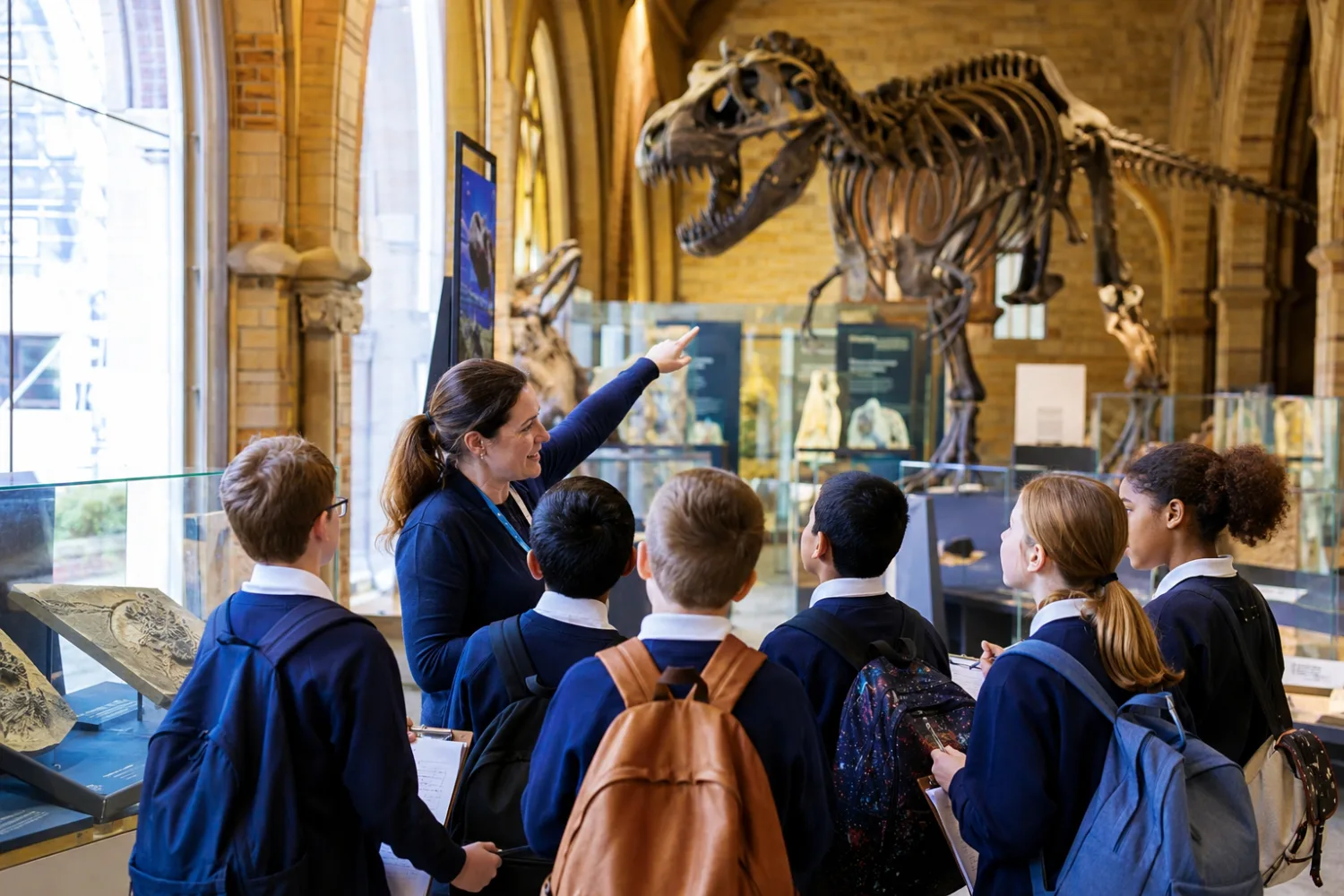
A visit to a natural history museum can support topics such as animals including humans, living things and their habitats, rocks, fossils, evolution, inheritance and classification. Pupils can see the scale of skeletons, compare animal structures, examine fossils, notice patterns and begin to understand how scientists use evidence.
The Natural History Museum in London is an obvious example, with school visits, learning resources and programmes connected to nature, biodiversity and scientific enquiry. For many pupils, seeing fossils, specimens and large-scale displays in person helps science feel more real and less abstract.
Smaller regional museums can be just as valuable, especially when they offer handling collections or guided workshops. The Oxford University Museum of Natural History, for example, describes KS2 school visits that include handling workshops and museum trails linked to the national curriculum.
The best follow-up work after this kind of visit often asks pupils to behave like young scientists. They might classify specimens, explain how a fossil gives evidence about the past, compare skeletons, write a museum label, create a fact file, or answer the question: “What can we learn from evidence that is not alive anymore?”
Zoos, safari parks and conservation centres for habitats and adaptation
Zoos and safari parks can be memorable KS2 venues when the visit is framed around science rather than simply “seeing animals”.
For Years 3 and 4, pupils can explore habitats, food chains, animal groups, life cycles and the needs of living things. For Years 5 and 6, the visit can go deeper into adaptation, evolution, inheritance, conservation and environmental change. Pupils can compare body structures, movement, diet, camouflage, behaviour and the ways different species survive in different environments.
Venues such as Whipsnade Zoo and Woburn Safari Park offer school visit information and education-focused opportunities, making them useful examples for teachers looking for animal, habitat and conservation links.
A strong zoo visit should give pupils a job to do. Instead of walking around with no focus, pupils might investigate how animals are adapted to different habitats, compare herbivores and carnivores, look for evidence of conservation work, or decide which species would be most vulnerable if its habitat changed.
These visits also work well for persuasive writing. Pupils can write a conservation appeal, design an information board, debate the role of modern zoos, or explain why protecting one animal often means protecting a whole ecosystem.
If you are looking for a more unusual version of this kind of experience, our guide to unusual school trip ideas that pupils actually remember includes falconry, farms, workplaces and other visits that can bring science and real-world learning to life.
Living history museums for local history, chronology and historical enquiry
KS2 history becomes easier to understand when pupils can step inside a setting rather than only read about it.
Living history museums, reconstructed streets, heritage villages, industrial sites and historic houses can help pupils understand how people lived, worked, dressed, travelled, learned and made decisions in the past. They are especially useful for chronology, historical interpretation, local history and changes in everyday life.
Beamish Museum is a strong example of a venue where pupils can encounter different historical periods through streets, buildings, costumed interpretation and school visit activities. For KS2 pupils, this kind of immersive setting can make Victorian life, mining communities, shops, homes, transport and schooling feel much more tangible.
The value of this kind of visit is not simply that pupils “see old things”. It is that they begin to ask historical questions. What was life like for children? Who had power? Who had fewer choices? How did work affect family life? How did transport, industry or technology change a place? What evidence can we trust?
After the visit, pupils might write from the perspective of a child in the past, compare two homes, create a timeline, write a newspaper report, build a museum display, or explain how one invention changed daily life.
This also gives teachers a chance to link history and English naturally. Pupils write better when they have details to draw on. A reconstructed classroom, shop, mine or street can give them those details.
Industrial heritage sites for science, history, geography and design technology
Industrial heritage venues are particularly useful for upper KS2 because they connect several subjects at once. Pupils can explore invention, materials, trade, transport, local geography, energy, working conditions, design and social change.
A venue such as Ironbridge Valley of Invention can support learning about the Industrial Revolution, engineering, manufacturing and how landscapes change when people use natural resources. It can also help pupils understand that history is not only about kings, battles or dates. It is also about technology, work, money, families and places.
These trips work especially well when pupils are asked to notice connections. Why did industry develop here? What materials were available? How did transport help? What changed for workers? What changed for children? What impact did industry have on the environment?
Industrial venues can also support design and technology. Pupils can think about how objects are made, why materials are chosen, how tools improve a process, and how inventions solve one problem while sometimes creating another.
Rivers, coasts and outdoor fieldwork sites for geography
Geography is one of the subjects that benefits most from leaving the classroom. Pupils can learn about rivers, coasts, settlements, land use and environmental change from books and maps, but fieldwork helps them understand that geography is something they can observe directly.
A KS2 fieldwork visit might take pupils to a river, canal, beach, woodland, local park, town centre, nature reserve, farm, hill, village or coastline. The venue does not need to be famous. It needs to give pupils something worth investigating.
Pupils might measure river flow, sketch land use, compare human and physical features, map noise levels, count traffic, identify evidence of erosion, observe habitats, survey local services or ask how a place has changed over time.
Local fieldwork can be especially powerful because pupils already have a relationship with the place. They may walk past it, live near it or think they know it. A good geography visit teaches them to look again.
It can also be more affordable than a major coach trip. For schools working with limited budgets, local outdoor learning can offer strong curriculum value without the same pressure on families. Our article on creative fundraising ideas for schools may also help if your school wants to make educational visits more accessible.
Rainforest, garden and sustainability venues for science and geography
Climate, habitats and sustainability can be difficult for KS2 pupils to understand if they remain abstract. A well-chosen venue can make those ideas physical.
The Eden Project is one of the best-known examples in the UK. Its school trips use the Biomes and gardens to support curriculum-linked learning about plants, ecosystems, climate, sustainability and the relationship between people and the natural world.
This kind of venue can support plant science, habitats, adaptation, weather and climate, biomes, food production, sustainability and global connections. Pupils can feel the difference between environments, observe plant structures, compare growing conditions and think about how human choices affect ecosystems.
A sustainability visit is strongest when pupils come back with a practical question for their own school. How could we reduce waste? Could we improve biodiversity on the school site? How do our lunch choices affect the environment? What would make our playground more nature-friendly?
This helps the trip become more than a one-day experience. It can lead into eco-council work, science investigations, persuasive writing, design projects, assemblies or pupil-led campaigns.
Art galleries and sculpture parks for art, English and personal response
Art galleries and sculpture parks can be excellent KS2 venues because they encourage pupils to slow down and look properly.
In school, art can sometimes become a task: draw this, paint that, copy this technique. A gallery visit can show pupils that art is also about ideas, choices, materials, emotion, place, identity and interpretation.
The curriculum link may be art and design, but the visit can also support English. Pupils can describe a painting, write a poem in response to a sculpture, create a character based on a portrait, debate what an artwork means, or write a review of an exhibition.
Sculpture parks and outdoor art venues can be especially accessible for pupils who find quiet galleries difficult. They allow movement, scale, weather and landscape to become part of the experience.
The key is not to rush. A class does not need to see every room. Pupils often learn more from spending ten minutes with one artwork than from being hurried past thirty. Ask what they notice, what they wonder, what they feel, what the artist might have chosen deliberately, and what title they would give the piece.
Theatres and performance venues for English, drama and confidence
A theatre visit can be a powerful KS2 curriculum link, especially when pupils are studying storytelling, playscripts, poetry, performance or Shakespeare.
For many pupils, the important realisation is that plays are not meant to sit silently on a page. They are meant to be spoken, moved, staged and heard. A theatre visit can help pupils understand character, voice, atmosphere, audience and interpretation in a way that classroom reading alone may not.
Organisations such as the Royal Shakespeare Company provide school-focused learning opportunities and resources that can help pupils experience Shakespeare and drama as performance.
Local theatres can be just as valuable. A backstage tour, workshop, Q&A or technical session can introduce pupils to lighting, sound, costume, stage management, set design and the many careers involved in performance.
Back at school, pupils can write reviews, perform scenes, rewrite a moment from another character’s point of view, design a set, create a trailer, or discuss how performance choices changed their understanding of the story.
Farms and food education venues for science, geography and PSHE
Working farms can be extremely valuable for KS2 because they connect everyday life to science, geography, health, sustainability and economics.
Pupils may know that food comes from farms, but many do not fully understand what that means. Seeing crops, animals, machinery, soil, polytunnels, composting, milking, harvesting or food preparation can help them understand the journey from land to plate.
For science, farm visits can support plants, animals, lifecycles, habitats and nutrition. For geography, they can support land use, rural environments, weather, food miles and human impact. For PSHE, they can lead into healthy eating, responsibility, work and care for living things.
A farm visit can also support writing and speaking. Pupils can explain a process, write instructions, create an information leaflet, interview a farmer, or debate questions around food choices, sustainability and animal welfare.
Teachers should check practical arrangements carefully, especially around handwashing, allergies, animal contact, uneven ground, clothing, toilets and wet-weather plans. The venue should be used to school groups and able to explain how it manages risk.
Religious buildings and cultural sites for RE, history and community understanding
Visits to churches, mosques, synagogues, temples, gurdwaras and other places of worship can help KS2 pupils understand religion and belief in a respectful, concrete way.
These visits are not only about identifying objects or learning vocabulary, although that matters. They are also about understanding how belief shapes community, routine, celebration, architecture, music, charity, family life and identity.
A well-planned visit can support RE, history, art, music, geography and citizenship. Pupils might explore symbols, sacred texts, prayer spaces, festivals, local history, community service or the way buildings are designed for worship.
Preparation is important. Pupils should understand expectations around behaviour, clothing, photography, shoes, quiet spaces and respectful questions. The aim is not tourism. It is learning through encounter.
Visits like this can also support wider school work around respect, belonging and community. They help pupils understand that the local area may include many histories, beliefs and traditions.
Workplaces and local businesses for careers, maths, English and real-world learning
Workplace visits are sometimes associated more with secondary schools, but they can be highly effective for KS2 when planned at the right level.
A local newspaper, bakery, design studio, recycling centre, theatre workshop, council office, veterinary practice, farm shop, library, engineering business or university department can help pupils see how learning connects to adult life.
These visits can support English through interviewing, reporting and persuasive writing. They can support maths through measurement, money, data and problem-solving. They can support science through materials, health, animals, technology or the environment. They can support citizenship by showing how local services and organisations work.
They are also useful for broadening aspirations. Pupils may discover jobs they did not know existed. They may begin to understand that workplaces need communication, teamwork, planning, accuracy and creativity.
Schools should still treat workplace visits with the same care as any other external visit. Safeguarding, supervision, insurance, restricted areas, photography and emergency arrangements need to be clear. Our guide to how schools vet external providers is helpful here, as is our article on requirements for businesses working with schools.
Libraries, archives and local museums for English, history and research skills
Not every valuable KS2 trip needs to be large or expensive. Libraries, archives and local museums can give pupils rich learning experiences close to school.
A library visit can support reading for pleasure, author studies, research skills, information literacy and confidence using public services. Pupils can learn how books are organised, how to choose texts, how to use catalogues and how libraries support communities.
Archives and local museums are especially useful for history. Pupils can work with photographs, maps, letters, newspapers, census records, objects and oral histories. This helps them understand that history is built from evidence, and that their own local area has a story.
These venues can also support writing. Pupils might create a local history guide, write a diary entry based on an archive source, compare old and new maps, or produce a class exhibition about the area around the school.
Local visits can be particularly useful for schools that want strong curriculum links without a large cost. They also help pupils see learning as something rooted in their own community.
How to choose the right KS2 venue
A good KS2 venue should make learning easier to see, discuss and remember. It should not rely only on excitement. It should help pupils understand something important more clearly than they did before.
Before booking, ask whether the venue links clearly to your current curriculum, whether it offers age-appropriate sessions, whether pupils will be active rather than passive, and whether the visit will work for the specific needs of your class.
It is also worth checking practical details early: coach access, toilets, lunch spaces, accessibility, risk assessment information, wet-weather options, staff experience, safeguarding arrangements, medical needs, cancellation policies and payment deadlines.
If pupils with SEND may need adjustments, discuss this with the venue before booking rather than after the plan is fixed. Our guide to SEN Support and EHCPs may help teachers think about what different pupils may need to access the visit successfully.
Turning the visit into lasting learning
The best KS2 trips do not end when pupils return to school. The follow-up is where much of the learning becomes visible.
Pupils might write an explanation, create a poster, produce a report, design a museum label, give a presentation, make a map, write a persuasive letter, record a podcast, create a timeline, perform a scene, or answer an enquiry question using evidence from the visit.
The most useful follow-up tasks ask pupils to use what they saw, not simply describe where they went. “What did you learn about adaptation?” is stronger than “What did you do at the zoo?” “How did this place change over time?” is stronger than “What was your favourite part of the museum?”
This is where the curriculum link becomes real. Pupils are not just remembering the day. They are using the day to think.
Final thought
The best KS2 school trip venues are not always the most obvious ones. A major museum, a local river, a farm, a theatre, a heritage site, a workplace or a small archive can all be excellent if the visit is planned around a strong learning purpose.
For teachers, the question is not simply “Will pupils enjoy this?” Enjoyment matters, but it is only part of the answer. The better question is: “Will this help pupils understand something they will remember?”
When the answer is yes, a school trip becomes much more than a day out. It becomes a shared experience that gives pupils language, knowledge, confidence and curiosity they can bring back into the classroom.