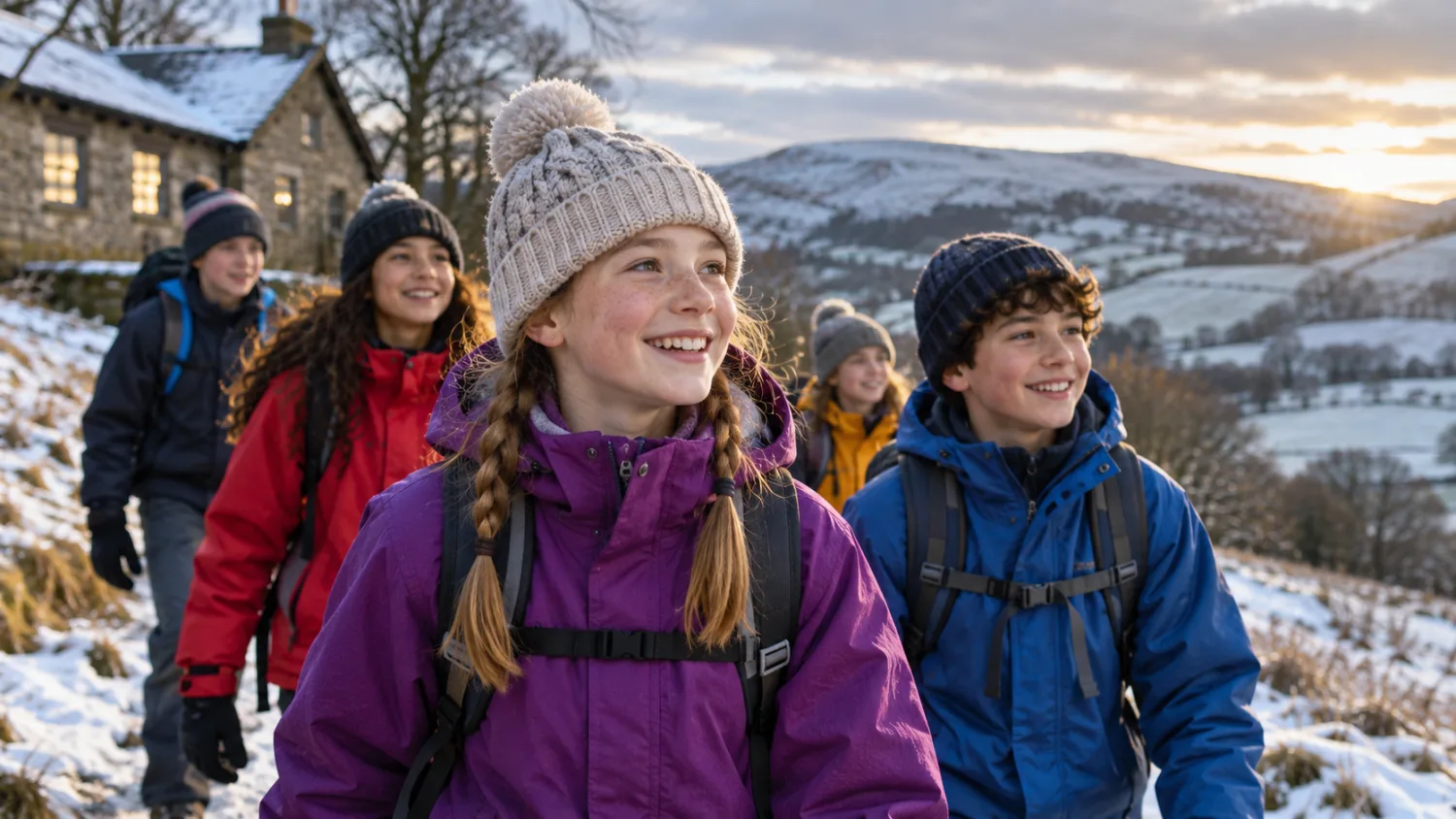
A residential school trip in winter can be one of the most memorable experiences pupils have.
There is something very different about staying away from home with classmates, spending time outdoors in cold weather, eating together, managing kit, sharing rooms and taking part in activities that would be difficult to run at school.
Winter can make those experiences even more distinctive.
It can also make the planning less forgiving.
A delayed coach in June may be inconvenient.
A delayed coach on a freezing January evening can become a welfare issue.
Wet clothing that would dry naturally on a summer residential can remain cold and damp overnight.
A programme that looked straightforward when booked may need to change because of ice, snow, high winds, flooding or very limited daylight.
That does not mean schools should avoid winter residentials.
The Health and Safety Executive actively encourages schools to take a sensible, proportionate approach to educational visits rather than avoiding worthwhile activities because of unnecessary bureaucracy. The important thing is to manage the real risks involved.
For a winter residential, that means looking beyond the normal booking questions and asking how the centre, staff, transport and pupils will cope if conditions are considerably colder, wetter or more disrupted than planned.
Start with the residential centre, not just the activity programme
Schools understandably focus on what pupils will do.
Climbing.
Orienteering.
Fieldwork.
Team challenges.
Outdoor adventure.
But on a residential trip, pupils spend far more time at the centre than they do in formal activities.
They sleep there.
Eat there.
Change clothes there.
Spend evenings there.
And may need to remain there for much longer than planned if weather changes the programme.
Current OEAP guidance on residential visits specifically highlights accommodation suitability, accessibility, structural integrity, fire safety, group security and welfare, night-time arrangements and catering as issues schools should consider.
That makes the accommodation itself part of the risk planning.
Before booking, schools should understand what the bedrooms, bathrooms, communal areas and drying facilities are actually like.
A beautiful activity programme is less impressive if thirty pupils come back from a wet afternoon and there is nowhere sensible to dry their coats and boots.
If you are still comparing providers, see Best Residential School Trip Centres in the UK and Questions Every Teacher Should Ask Before Booking a School Trip Venue.
Check how the centre manages cold, wet kit and indoor comfort
This is one of the most practical winter questions and one of the easiest to overlook.
Pupils may return from outdoor activities with:
- wet coats;
- damp socks;
- muddy boots;
- gloves that need drying before morning.
Ask the centre where those items go.
Is there a drying room?
Is it large enough for a school group?
Can boots be dried overnight?
Are bedrooms warm enough without pupils trying to dry everything over radiators?
Also check what happens if a pupil becomes cold during an activity.
Can they return indoors easily?
Is there a warm indoor space close to the activity area?
Can the programme be shortened without leaving the rest of the group stranded?
Winter comfort is not merely about making pupils happier. Once people are cold and wet, concentration falls and an otherwise manageable day can become much harder to supervise.
Plan around daylight, not just the timetable
A programme may say:
“Outdoor activity: 3pm to 5pm.”
In summer, that tells you almost everything you need to know.
In December, it does not.
Depending on location, much of that session may take place in fading light or darkness.
The school should understand whether activities are intended to continue after dark and whether that is a normal, deliberately managed part of the programme.
Some activities may be perfectly suitable at night with appropriate leadership and equipment.
Others may need to finish earlier.
The same applies to movement around the site.
Paths between accommodation blocks, dining areas and activity spaces may feel very different after dark.
Check lighting, surfaces and supervision arrangements before assuming pupils can move around the centre in the same way they would during daylight.
The broader principles in Planning an Autumn School Trip: Weather, Daylight and Backup Plans become even more important in winter.
Ask exactly what weather would change the programme
“Activities are weather dependent” is not enough detail for a residential.
Ask what that actually means.
Will climbing stop in high winds?
Will forest activities continue in heavy rain?
What happens if roads around the centre become icy?
What does the provider do during snow?
HSE guidance stresses that visit leaders should use sensible precautions, understand when contingency plans need to be used and pay attention to advice from people with local or specialist knowledge.
That makes the centre's local experience extremely valuable.
A provider that operates throughout the winter should already know which activities become unsuitable first and what it normally substitutes.
The important question is whether the alternative still makes the residential worthwhile.
If the main attraction is two days of outdoor adventure, replacing everything with films in a common room is not an equivalent contingency.
A stronger centre might have indoor climbing, workshops, problem-solving activities, local fieldwork or alternative programmes ready to use.
Think about the journey home before you leave school
Residential transport deserves more contingency planning than an ordinary day trip because disruption can leave a group many hours from home.
Before departure, know what happens if:
the coach cannot reach the centre;
the return journey is delayed by several hours;
a road is closed;
or conditions mean travelling home that evening is no longer sensible.
DfE guidance says schools should have an emergency response plan for incidents away from school and a communications plan covering routine and emergency contact. Visit leaders should be familiar with those arrangements.
On a winter residential, that plan should include the possibility of an extended stay.
Would the centre have space for another night?
Who would contact families?
What medication would run short?
Would staff have what they need to remain away longer?
This sounds dramatic, but it is much easier to answer those questions calmly before the trip than during a major weather disruption.
For the transport side, see Coach Travel for School Trips: Questions to Ask Before Booking.
Review staffing as a 24-hour plan
Residential staffing is not simply:
“How many adults are on the coach?”
Those adults must remain effective across the entire stay.
During daytime activities, the provider's instructors may take the lead in particular sessions.
But school staff still have responsibilities outside those sessions.
Evenings and nights can be the points when staff are most stretched.
A pupil may become homesick.
Another may feel unwell at midnight.
Someone may need medication.
Meanwhile, the rest of the group still needs supervision.
OEAP guidance on residentials specifically treats night-time supervision and group welfare as separate planning issues rather than assuming daytime arrangements simply continue unchanged.
Ask whether the staff team still works if one adult has to accompany a pupil to hospital or remain awake with somebody who is ill.
The answer should influence your staffing before departure.
There is no single national adult-to-pupil ratio that works for every visit. Staffing should reflect the group, the activity, individual needs and the level of supervision actually required. See How Many Adults Do You Need on a School Trip?.
Give medical planning extra depth on a winter residential
A pupil who manages a medical condition easily during a six-hour school trip may need a more detailed plan when staying away for several nights.
Medication has to be stored correctly and accessible when needed.
Staff need to know who is responsible for it.
The school also needs to understand what happens if the group is delayed returning home.
Cold conditions can matter for some pupils, while physically demanding activities may affect others differently from an ordinary school day.
Statutory guidance on supporting pupils with medical conditions says schools should actively support pupils with medical needs to participate in school trips and residentials, making reasonable adjustments and planning around the individual child's needs.
This should not become a reason to exclude pupils unnecessarily.
It is a reason to prepare properly.
Ask families for current information, confirm the arrangements with the centre and make sure the people supervising activities know what they genuinely need to know.
Our guide How to Plan a School Trip for Pupils With Medical Needs covers this in more detail.
Think about SEND at bedtime as well as during activities
Residentials can be challenging for pupils who manage school well during the day but rely heavily on familiar routines at home.
The difficult part may not be abseiling.
It may be sleeping in an unfamiliar room with five classmates.
Or coping with a noisy dining hall.
Or not knowing exactly what will happen after dinner.
Winter can add extra sensory demands through wet clothing, bulky coats, colder rooms, darkness and more time spent indoors with other pupils.
Schools should therefore think beyond physical accessibility.
Would a visual timetable help?
Can the pupil see photographs of the bedrooms beforehand?
Is there a quieter room they can use briefly if communal time becomes overwhelming?
Could a familiar bedtime routine be preserved in some form?
The most useful adjustments often come from asking the pupil and family what is likely to be difficult rather than guessing.
See How to Make a School Trip Work for Pupils With SEND.
Check accommodation safety and security in person where possible
For residentials, accommodation deserves a more detailed check than:
“The rooms look nice on the website.”
DfE guidance says that when schools use outside organisations they should consider issues including safeguarding, emergency procedures, insurance, risk assessments and accommodation.
OEAP's current residential guidance also covers fire safety, group security, night-time arrangements and an accommodation arrival checklist.
If possible, staff should know how bedrooms are arranged in relation to staff rooms, how pupils would evacuate at night and whether there are shared areas used by members of the public or other groups.
Ask how external doors are controlled.
Find out whether several school groups will be staying at once.
Know where staff will sleep.
And on arrival, check that the accommodation actually matches what was expected.
A residential venue is effectively the school's operating environment for several days. It deserves the same attention you would give any other important part of the visit.
Plan for winter illness spreading through the group
Residential visits naturally involve closer contact.
Pupils share bedrooms, bathrooms, dining areas and transport.
During winter, when respiratory and gastrointestinal illnesses may already be circulating, one unwell pupil can quickly become several.
UK Health Security Agency guidance notes that residential educational visits involve shared living environments where infections can spread more easily because people are in close contact.
That does not require excessive medical procedures.
It does mean the centre and school should have a workable response.
Where can an unwell pupil rest?
Who supervises them?
When would parents be asked to collect?
What happens if collection is difficult because the centre is three hours away?
Good handwashing, sensible hygiene and appropriate handling of illness become especially important when a whole group is living together.
Be clear with parents about what winter actually means
Parents cannot prepare pupils properly if the school sends only:
“Please bring warm clothing.”
Be more useful.
If pupils need waterproof trousers, say so.
If walking boots are essential, explain why.
If two pairs of gloves are sensible because one pair may become soaked, say that too.
At the same time, avoid turning the kit list into an expensive outdoor-equipment catalogue.
Where specialist clothing can be borrowed from school or the centre, make that clear.
Families should also understand the likely activity programme, sleeping arrangements, communication expectations and how the school will respond to major weather changes.
Medical details and emergency contacts should be current rather than copied automatically from an old school record.
See School Trip Consent Forms: What Information Should Schools Collect? for the wider information schools may need.
Decide what would make you change or cancel the trip
A good winter residential plan includes an answer to a difficult question:
“At what point would we decide not to go?”
That decision should not be left until the coach is waiting outside school.
The threshold will depend on the circumstances.
Snow on its own does not automatically make a residential unsafe.
But severe road disruption, unsafe activity conditions or a venue that cannot operate essential facilities may change the picture completely.
DfE and HSE guidance both emphasise proportionate decisions based on real risks rather than blanket avoidance.
The school should know who has authority to make the final decision and what information they will use.
That may include:
- Met Office warnings;
- road conditions;
- advice from the centre;
- transport-provider information.
The same applies once the group is away.
If weather deteriorates, the plan should be flexible enough to replace an activity rather than press ahead simply because it appeared on the original itinerary.
Review the trip afterwards while the details are still fresh
Winter residentials often reveal planning issues that would never appear on a normal day visit.
Perhaps the drying room was too small.
The coach pickup location was difficult in the dark.
Staff bedrooms were too far from pupils.
Or the indoor fallback programme was much better than expected.
Record those details.
DfE guidance recommends evaluating visits after they finish and keeping records of incidents, accidents and near misses so future planning improves.
The useful question is not simply:
“Did the pupils enjoy it?”
Ask whether the residential was worth the time, money and staff effort—and what should change before the school books it again.
See How to Evaluate Whether a School Trip Was Worthwhile.
Frequently asked questions
Are winter residential school trips safe?
They can be. Winter adds factors such as cold, reduced daylight, wet conditions and transport disruption, but these can normally be managed through sensible planning, suitable providers and effective contingency arrangements.
Do schools need a separate winter risk assessment?
Not necessarily a completely separate document, but the school's planning should reflect the actual conditions expected on the visit. DfE guidance says planning should be proportionate and focused on genuine risks.
Should schools cancel a residential because snow is forecast?
Not automatically. Consider the severity and timing of the forecast, road conditions, advice from the centre, transport arrangements and whether the planned activities remain safe. The decision should be based on actual risk rather than snow alone.
What should schools check about accommodation?
Check suitability, heating, drying facilities, accessibility, fire safety, security, staff sleeping locations, night-time supervision and how pupils would be managed in an emergency. OEAP's current residential guidance covers these issues in detail.
What happens if pupils get soaked?
The centre should have a practical way to dry wet clothing and footwear. Schools should also advise families to provide suitable waterproof clothing and enough spare items where appropriate.
How many staff do we need on a residential?
There is no universal ratio for all residential trips. Staffing should reflect pupil age, individual needs, the activities, environment and the need to maintain supervision if one member of staff becomes unavailable.
Do residential centres need special accreditation?
Schools should check the provider's safety arrangements, insurance, safeguarding and relevant licences. DfE guidance recommends checking whether providers hold the Learning Outside the Classroom Quality Badge or carrying out suitable checks where they do not.
What if the centre changes activities because of weather?
That can be entirely appropriate. The school should understand the alternative programme in advance and be satisfied that it is suitably supervised and still provides worthwhile educational or developmental value.
What should we do if bad weather delays the journey home?
The school's emergency and communications plans should cover transport disruption. Consider additional medication, family communication and whether the centre could accommodate the group longer if necessary.
How should medical needs be handled on a residential?
Use individual plans where appropriate, ensure medication remains available and make reasonable adjustments so pupils can participate safely. Statutory guidance expects schools to actively support pupils with medical conditions to participate in school visits and residential activities.
Should pupils with SEND be excluded if the winter conditions make the trip harder?
No. Schools should consider reasonable adjustments based on the individual pupil's needs. Extra preparation, staffing, quieter spaces or changes to particular activities may make participation possible.
What should parents know before the trip?
They should receive clear information about the programme, clothing and equipment, sleeping arrangements, medical information, communication and any significant winter-specific arrangements.
What is the most important question to ask a winter residential centre?
Ask:
“What happens here when the weather is genuinely bad?”
The answer will tell you a great deal.
A strong provider should be able to explain how activities change, how pupils stay warm and dry, how transport disruption is handled and what alternatives are available.
Winter residentials can be outstanding school experiences.
They give pupils independence.
Shared memories.
Time outdoors.
Opportunities to develop confidence away from the familiar school environment.
The winter season does not remove those benefits.
It simply makes good planning more important.
Check the accommodation as carefully as the activity list.
Understand how wet clothing is managed.
Plan around limited daylight.
Know what weather changes the programme.
Build resilience into staffing and transport.
Prepare properly for medical and SEND needs.
And make sure the contingency plan is something more useful than:
“We'll decide on the day.”
For the wider process, see School Trips and Educational Visits: Complete Planning Guide for UK Schools and How to Plan a School Trip Without the Stress.