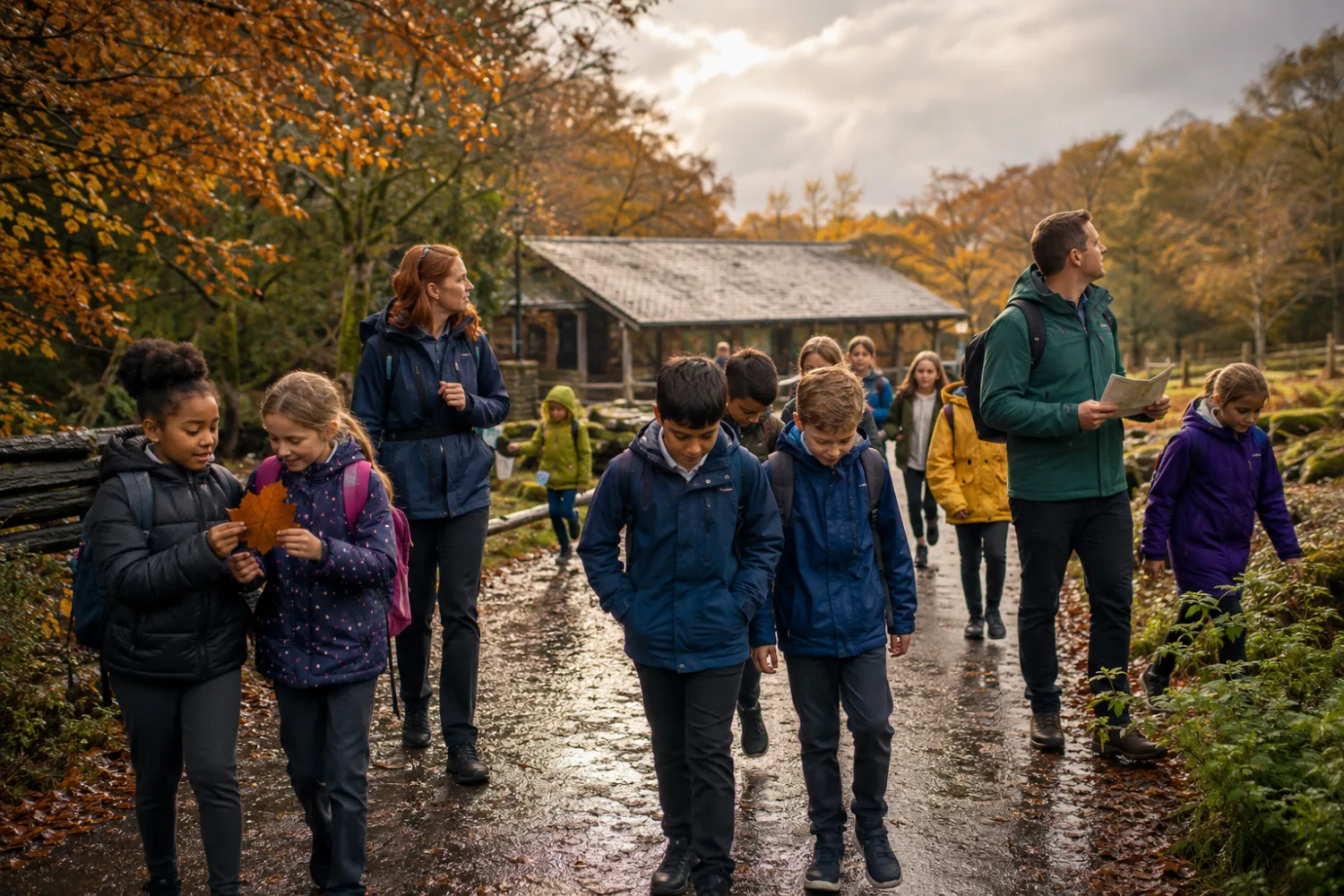
Autumn can be an excellent time for a school trip. Museums, heritage sites and outdoor centres are often quieter than during the summer term. Woodland, parks and local landscapes provide opportunities to study seasonal change, while an early visit can give a class a shared experience near the beginning of the school year.
However, an autumn visit needs more than the summer plan with an extra coat added. Daylight shortens quickly, weather can change within hours and wet ground can turn a straightforward route into a slower and more demanding one. Transport disruption, flooded paths, high winds and pupils arriving without suitable clothing can all affect whether the planned day remains safe and educationally worthwhile.
The aim is not to cancel a trip whenever rain is forecast. It is to understand which conditions the group can manage, what would require the plan to change and who has authority to make that decision.
A strong autumn contingency plan protects the purpose of the visit as well as the pupils. It allows staff to respond calmly rather than improvising once the group is already away from school.
Begin with the purpose, not the season
Before planning for rain, mud or fading daylight, be clear about why the visit is taking place.
What should pupils learn, experience or practise that would be difficult to achieve in the classroom? Which parts of the visit are essential to that purpose, and which are enjoyable additions?
This distinction matters when conditions change. If the main objective is to investigate habitats, moving from an exposed hillside to sheltered woodland may preserve the learning. If the visit depends on observing coastal processes at a particular location and tide, changing the route may alter the purpose completely.
A visit should not continue in unsuitable conditions simply because it has been booked and paid for. Equally, it should not be abandoned automatically when a sensible alternative can retain its educational value.
Write the learning purpose in a few clear sentences and share it with accompanying adults. If a contingency is used, staff can then judge whether the revised activity still meets the objective or has become little more than somewhere to wait for the coach.
Our complete guide to school trips and educational visits covers the wider planning process, including approval, supervision, communication and evaluation.
Autumn weather is variable, not simply wet
The obvious autumn concern is rain, but several conditions may affect a visit.
Heavy or prolonged rain can create slippery surfaces, standing water, reduced visibility and rising water levels. Even after the rain stops, paths may remain muddy or flooded. A route that was easy during a summer preview may take considerably longer with a large group in autumn.
High winds create different risks. Trees and woodland may be affected by falling branches. Temporary structures, outdoor exhibits and exposed viewpoints may close. Ferry services, bridges, cable cars or other transport can also be disrupted.
Fog and low cloud can reduce visibility on roads, open countryside and higher ground. Cold rain combined with wind can chill pupils more quickly than the temperature alone suggests. Unseasonably warm days create their own concerns if pupils arrive in heavy clothing and do not carry enough water.
The Health and Safety Executive identifies wet or contaminated surfaces as an important cause of slips. Its guidance on slips and trips in education is not specific to visits, but the principle is directly relevant: surface conditions, pedestrian movement and environmental factors all need active management.
Consider how the weather affects the specific location and activity rather than writing “wet weather” as one general hazard. Rain inside a covered heritage attraction is mainly a transport and clothing issue. The same rain beside fast-flowing water, on steep ground or during fieldwork can change the risk significantly.
Check daylight as carefully as the weather forecast
Daylight reduces noticeably through the autumn term. A visit planned from an early September timetable may be unsuitable at the same time in late November.
Do not look only at the scheduled finish time. Consider when the group must leave the final activity, walk back to the coach or station, complete headcounts and deal with any delay. Sunset is not a useful target arrival time; staff need a margin before light becomes poor.
Woodland, valleys, narrow streets and heavily built-up areas may become dim earlier than open ground. Cloud, rain and fog can reduce usable light further. Pupils may also move more slowly at the end of a tiring day.
For each outdoor stage, estimate:
- the normal walking or activity time;
- the time required for a large pupil group;
- additional time in wet or muddy conditions;
- the effect of mobility, sensory or medical needs;
- headcounts and toilet stops;
- and a realistic delay allowance.
If the group would have little daylight in reserve, shorten the route, move the outdoor element earlier or choose another date. Carrying torches may be a useful emergency measure, but it should not make an unsuitable daytime plan acceptable.
Staff should know the latest time at which the group must leave a location. This creates a clear decision point rather than relying on a vague feeling that there is “probably enough time”.
Use forecasts as part of a staged decision process
An autumn forecast viewed a week before the visit is useful for identifying possibilities, but it is not the final answer. Weather forecasts become more specific as the date approaches, and conditions may still change on the day.
Build several checks into the planning process.
During initial planning, consider the typical conditions for the location and season. Ask the venue which areas close in poor weather, whether surfaces become difficult and what sheltered alternatives are available.
Several days before the visit, review the forecast and any weather warnings. This is the point to discuss likely changes with the venue, transport provider and school leadership.
The day before, make the planned go, modify or cancel decision using the best available information. Confirm communications, clothing advice and any revised timings.
On the morning, check current conditions, warnings, transport and venue status. A final dynamic assessment may still be required at the location.
Use authoritative information such as the Met Office weather warnings alongside location-specific information from the venue, transport operators and relevant local bodies.
A weather warning does not provide the complete decision for a school. Its colour, timing, location and likely impact need to be considered against the planned activity and group. Conditions may be acceptable at the indoor venue but unsuitable along the route used to reach it.
Record significant decisions and the information used. The record does not need to become an essay, but another responsible person should be able to understand why the visit continued, changed or was cancelled.
Turn the risk assessment into a plan staff can use
A risk assessment is valuable only when it influences what people do.
For an autumn trip, avoid filling the document with generic statements such as “weather may be bad” followed by “pupils will be supervised”. Identify the practical effect and the control.
For example:
- Wet leaves on a steep path: use an alternative surfaced route when conditions are poor, place staff at the front and rear, prevent running and allow additional time.
- Reduced daylight after the final activity: set a fixed departure time and shorten the programme if earlier stages overrun.
- High winds in woodland: check site advice before departure and use the indoor programme if the woodland area closes.
- Pupils becoming cold and wet: give clear clothing requirements, carry emergency spare layers where appropriate and identify a heated shelter.
- Transport delay: maintain contact with school, carry emergency details and confirm supervision, food, medication and collection arrangements.
The Department for Education’s guidance on health and safety on educational visits says schools should have an emergency response plan and a communications plan, and that trip leaders should be familiar with them. Schools must also follow the policies and approval arrangements of their employer, local authority or academy trust.
Use the school’s established visit procedures rather than creating a separate autumn system. The seasonal assessment should add relevant detail to the existing planning and approval process.
Our guide to writing a school trip risk assessment explains how to focus on significant hazards, practical controls and the needs of the actual group.
Create a real Plan B, not just an indoor room
Many trip plans state that an indoor alternative will be available. That is a start, but it is not a complete contingency.
Find out exactly what the alternative involves. Is the space large enough for the whole group? Is it available throughout the visit or only at certain times? Does it need to be booked? Are there toilets, seating and appropriate access? Who provides the activity and resources?
Most importantly, does it still offer worthwhile learning?
A good Plan B might involve a different guided session, object handling, an indoor investigation, a workshop or a shorter outdoor activity combined with sheltered learning. The alternative should be planned with almost as much care as the preferred programme.
Schools may need more than one level of contingency:
- Minor adjustment: change the order of activities to use the driest part of the day outdoors.
- Modified visit: shorten or relocate the outdoor element and use a prepared indoor activity.
- Alternative venue or route: use a pre-agreed safer location that still supports the learning.
- Postponement or cancellation: use when the risks or disruption cannot be controlled adequately.
Agree in advance who can activate each option. A trip leader should not need to negotiate from the beginning while supervising pupils in deteriorating conditions.
Ask the venue what happens if it closes part or all of the site. Clarify refunds, rebooking and cancellation terms before confirming the visit. This information also matters when explaining the financial arrangements to parents.
Plan clothing for the activity, not an ideal autumn day
“Bring a coat” is often too vague. Families may interpret it as anything from a thin shower jacket to a heavy winter coat that is unsuitable for active walking.
Explain what pupils will actually be doing and which conditions they may encounter. Depending on the visit, guidance may include a waterproof outer layer, warm layers, suitable footwear, spare socks, a hat, gloves or a small bag that can be carried comfortably.
Avoid requiring specialist outdoor equipment when ordinary affordable clothing will do. If particular footwear or waterproofs are genuinely necessary, consider how the school will support pupils whose families cannot provide them.
Check clothing discreetly before departure, particularly for visits where unsuitable equipment would create a significant risk. A pupil should not discover at the venue that fashion trainers are unsafe on a muddy hillside.
Schools may keep a small supply of spare waterproofs, layers or footwear where appropriate. These need to be clean, correctly sized and managed without embarrassing pupils.
Remember that some pupils experience clothing differently. Waterproof materials may be noisy or uncomfortable, hoods may affect hearing or vision, and multiple layers may be difficult for pupils with physical or sensory needs. Adjustments should be discussed in advance rather than improvised at the school gate.
Parents should receive the information early enough to ask questions or request help. A final reminder can be useful when the forecast becomes clearer, but it should not introduce expensive new requirements the night before.
Include every pupil in the autumn plan
Weather and reduced daylight may affect some pupils more than others.
A pupil with limited mobility may take longer on wet or uneven surfaces. Cold conditions can affect some medical conditions, while rain covers or heavy clothing may change how mobility equipment is used. A pupil with a visual impairment may find low light or glare particularly difficult.
Some autistic pupils and pupils with sensory differences may be distressed by wet clothing, strong wind, crowded indoor alternatives or sudden changes to the programme. Other pupils may find the uncertainty itself difficult.
Review individual healthcare plans, support information and agreed adjustments. Speak with the pupil and family where necessary. Useful questions include:
- How will the pupil access the planned and alternative routes?
- What happens if conditions make movement slower?
- Is there a suitable place to rest, regulate or change wet clothing?
- Will medication remain accessible and within its required temperature range?
- How will a programme change be explained?
- Does the contingency activity remain accessible?
Do not create a Plan B that includes most pupils but leaves one child without meaningful participation. The alternative is part of the visit and needs the same inclusive thinking.
Our detailed guide to making school trips work for pupils with SEND covers communication, transport, supervision, sensory needs and reasonable adjustments.
Prepare for transport delays and a late return
Autumn weather may affect the journey even when the venue remains open. Heavy rain, fallen branches, road collisions, rail disruption and poor visibility can all delay a group.
Allow realistic journey times and avoid creating a timetable in which a ten-minute delay removes the lunch break or pushes the final walk into darkness.
Confirm how the group will communicate with the school if transport is delayed. Staff should have the appropriate emergency contacts, medical information and means of communication, in line with school policy and data-protection requirements.
A late-return plan should consider:
- who at school receives updates;
- how parents and carers will be informed;
- where pupils will be supervised on arrival;
- what happens if a parent cannot reach the collection point immediately;
- medication or food needed during the delay;
- and how staff maintain appropriate supervision if the delay is lengthy.
Do not rely on pupils’ personal phones as the main communication system. Batteries may fail, reception may be poor and not every pupil will have a device or data.
If travelling by coach, discuss weather-related arrangements with the operator. Confirm the collection point, driver contact procedure, access for the group and what happens if the vehicle cannot reach the original location.
For public transport, identify possible alternatives and which member of staff will lead the group if the journey changes. Moving a large group across an unfamiliar station is not the moment to begin researching another route.
Know the difference between an inconvenience and a reason to stop
Rain, mud and cool weather are not automatically reasons to cancel an autumn trip. With appropriate clothing, supervision and planning, they may become part of valuable outdoor learning.
The key question is whether the changed conditions can be managed with the controls, competence, equipment and time available.
A trip may need to change or stop when:
- an official warning or local condition creates a significant risk to the route or activity;
- the venue or transport provider closes or advises against travel;
- wind, flooding, poor visibility or ground conditions exceed the planned controls;
- the group cannot complete the activity and return in adequate daylight;
- a substantial number of pupils lack essential clothing or equipment;
- the contingency is unavailable or unsuitable;
- or staff can no longer maintain effective supervision.
There may also be a point during the visit when continuing is no longer sensible. Trip leaders need permission and confidence to shorten the activity, turn back or use the alternative plan without feeling they have failed.
The DfE guidance on health and safety responsibilities for schools describes risk assessments as tools for identifying hazards, how people could be harmed and the controls required. It also stresses that assessments should be reviewed when circumstances change or there is reason to believe they are no longer valid.
A dynamic decision on the day does not replace earlier planning. It works because staff already understand the hazards, alternatives and decision thresholds.
Communicate the contingency without creating unnecessary alarm
Parents need enough information to prepare their child, understand possible changes and know how the school will communicate. They do not need every line of the risk assessment.
The trip letter or information page should explain:
- the main activities and how much time will be spent outdoors;
- the clothing and equipment required;
- the expected departure and return times;
- that the programme may change because of weather or site conditions;
- how late-return information will be shared;
- and any relevant cancellation or rebooking arrangements.
Be careful about promising that the trip will proceed “whatever the weather”. This may sound reassuring, but it removes important professional judgement. A better message is that the school will monitor conditions and may modify, postpone or cancel the visit if necessary.
Brief accompanying adults as carefully as parents. They should know the group arrangements, clothing expectations, route, headcount system, emergency procedure and their role if the plan changes. Avoid giving volunteers essential information for the first time while pupils are boarding the coach.
Pupils also benefit from an age-appropriate explanation. Tell them what weather is expected, what they need to bring and how the day could change. This is especially important for pupils who find unexpected changes difficult.
If you are still comparing venues, our guide to questions to ask before booking a school trip venue includes weather arrangements, accessibility, supervision and practical facilities.
Review the plan after the visit
Once the group returns, record what the autumn conditions changed in practice.
Did the route take longer than expected? Were the clothing instructions clear? Did the indoor alternative work? Was the communication system effective? Did any pupil face a barrier that had not been anticipated?
Near misses and small difficulties are useful evidence. A slippery entrance that caused no injury still deserves attention. A coach delay managed successfully may reveal that emergency food or medication arrangements need improvement next time.
Ask staff for concise feedback while the experience is fresh. Pupil feedback can also show whether they understood the learning and felt prepared for the conditions.
Update future planning rather than keeping a generic risk assessment unchanged. Autumn conditions vary between dates and groups, but real experience from the venue can make the next visit more accurate.
Evaluation should also return to the original purpose. If the contingency plan was used, did pupils still achieve the intended learning? If not, consider what follow-up teaching is needed and whether the alternative should be redesigned.
Frequently asked questions
Should a school trip be cancelled because rain is forecast?
Not necessarily. The decision depends on the intensity and duration of the rain, the location, activity, ground conditions, group and available controls. An indoor museum visit may proceed with minor changes, while heavy rain beside water or on steep ground may require a different route, alternative activity or cancellation.
How far in advance can schools rely on a weather forecast?
Longer-range forecasts are useful for identifying possible conditions, but decisions should be reviewed as the visit approaches. Check several days before, again the day before and on the morning of the trip. Continue monitoring when conditions are changing or the activity is weather-sensitive.
Does every autumn trip need an indoor alternative?
Not every visit requires a fully indoor programme, but every visit should have a workable response to foreseeable weather changes. This might be a sheltered activity, shorter route, changed timetable, alternative location, postponement or cancellation. The appropriate contingency depends on the purpose and setting.
What should pupils wear for an autumn school trip?
Requirements depend on the activity. Schools should give specific, affordable guidance about waterproof layers, warmth and footwear rather than simply saying “dress appropriately”. Families need enough notice to ask for help, and schools should consider how to support pupils who cannot provide specialist items.
Who decides whether the trip should go ahead?
The decision should follow the school’s educational-visit policy and employer or trust arrangements. Responsibilities may involve the visit leader, educational visits coordinator, headteacher and relevant adviser. The decision-making authority and thresholds should be clear before the day.
What if the weather deteriorates after the trip has started?
The visit leader should reassess conditions, use the agreed contingency and communicate with the school as required. This may mean changing the order, moving indoors, shortening the activity, taking another route or returning early. Staff should not continue merely to preserve the original timetable.
How much extra time should be allowed before sunset?
There is no universal margin. It depends on terrain, group size, pupil needs, weather, familiarity with the route and access to transport. Plans should include normal travel time, a realistic group pace and a meaningful delay allowance, with a fixed latest departure time that leaves the group safely back before light becomes inadequate.
Autumn weather does not have to make school trips timid or unambitious. It does require planning that recognises the difference between a manageable change and a condition that fundamentally alters the visit.
When schools monitor forecasts, protect daylight margins and prepare a credible alternative, staff can make calm decisions without losing sight of why the trip was planned in the first place. The best contingency is not an admission that the day may fail. It is what allows valuable learning to continue when autumn does what autumn often does.