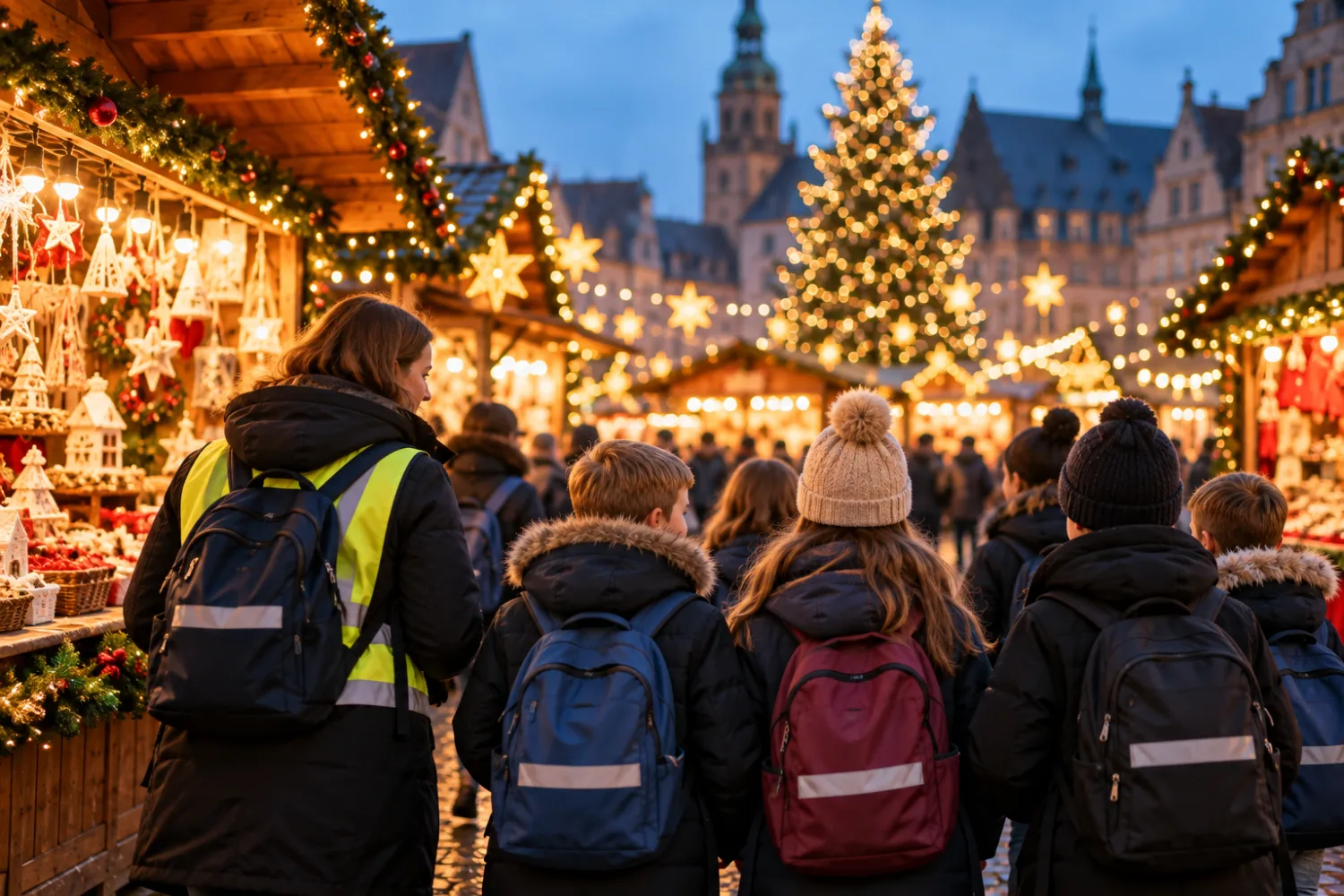
A Christmas market can look like a simple school trip.
Walk around the stalls.
Look at decorations.
Buy something small.
Perhaps practise a language, investigate local history or study how businesses attract customers.
But Christmas markets are very different from museums, galleries and other venues designed around school groups.
They can be:
- busy;
- open to the general public;
- spread across streets and squares;
- dark during part of the school day;
- full of queues, food stalls and temporary structures.
The educational value can be excellent.
But the visit needs to be planned as a trip into a busy public event rather than treated as an ordinary shopping excursion.
Department for Education guidance for England says educational-visit planning should be proportionate and sensible, with schools focusing on genuine risks rather than unnecessary paperwork. Visits that fall outside normal school routines may need a specific risk assessment and additional planning.
For Christmas markets, the important questions are usually straightforward:
- Why are pupils going?
- How busy will it be?
- How will groups stay together?
- What happens if a pupil becomes separated?
- How will weather, darkness and public transport affect the trip?
This guide explains how to answer those questions without turning a festive educational visit into an exercise in paperwork.
Start with a clear learning reason for going
A Christmas market does not need to be an exam-focused field trip to have educational value.
But pupils should have a better reason for being there than:
“It is nearly Christmas.”
A market can support several curriculum areas
For example:
Business and enterprise:
- pricing;
- branding;
- product presentation;
- customer service;
- competition;
- temporary retail.
Geography:
- tourism;
- urban land use;
- pedestrian flows;
- place identity;
- local economic activity.
Languages:
- seasonal vocabulary;
- food and drink;
- prices;
- European Christmas traditions.
Design and technology:
- packaging;
- product design;
- display;
- craft production.
History and culture:
- local traditions;
- historic market places;
- changing Christmas customs;
- connections with European market traditions.
Decide what pupils should notice
Without a purpose, pupils may remember mostly:
- hot chocolate;
- decorations;
- souvenirs.
With a simple enquiry question, they begin observing differently.
For example:
“How do market traders persuade people to stop and buy?”
or:
“How does the Christmas market change the way this part of the city is used?”
Choose the market and time carefully
The same market can be a very different place at 11am on a Tuesday and 6pm on a Saturday.
Ask the organiser about quieter periods
If possible, find out:
- which weekdays are quieter;
- when coach groups commonly arrive;
- whether school groups need to book;
- whether special events increase attendance.
Avoid peak crowd periods where you can
The most popular evening sessions may provide more atmosphere.
They can also make supervision significantly harder.
Health and Safety Executive crowd guidance highlights arrival, movement around the site and departure as the three key phases where crowd controls matter.
Consider the layout
A compact market within a controlled venue may be easier for younger pupils than one spread across:
- several city streets;
- multiple squares;
- busy road crossings.
For any public venue, the AllSchools guide Questions Every Teacher Should Ask Before Booking a School Trip Venue provides a useful broader checklist.
Treat crowds as a real planning issue
Crowds do not automatically make a visit unsafe.
They do change how supervision needs to work.
Christmas-market crowd risks can include
- pupils becoming separated;
- pinch points between stalls;
- queues spilling across walkways;
- people stopping suddenly;
- busy entrances and exits;
- pedestrians sharing space with vehicles.
HSE event guidance specifically identifies congestion around stalls, poor pedestrian routes, vehicles sharing space with pedestrians and local overcrowding as issues that event organisers need to consider.
Your school does not manage the market crowd
But staff do need to manage how their own pupils move through it.
Do not let one large group stretch across the market
Thirty pupils moving together can become difficult to supervise.
Several smaller groups with named adults may be easier.
How small those groups should be depends on:
- age;
- SEND;
- independence;
- the market layout;
- the level of public crowding.
Create a clear lost-pupil procedure
Do not wait until somebody is missing before deciding what everyone should do.
Pupils should know
- who their supervising adult is;
- that they should not wander between groups;
- what to do if separated;
- where the agreed meeting point is.
Choose a meeting point carefully
It should be:
- easy to identify;
- away from heavy crowd flow;
- unlikely to move or disappear.
A temporary inflatable snowman may be memorable.
It is not necessarily the best emergency rendezvous point.
Agree what staff will do
If a pupil is missing:
- who stays with the group?
- who searches?
- who contacts event security?
- when is the school emergency procedure activated?
DfE educational-visit guidance says schools should have an emergency response plan for incidents away from school and that trip leaders should be familiar with it.
Plan how much independence pupils will have
A Christmas market can tempt schools into one of two extremes.
Either pupils remain in a tightly controlled crocodile for the entire visit.
Or older pupils are told:
“Meet us back here in an hour.”
The right approach depends on the group.
For younger pupils
Close adult supervision will normally make sense.
For older pupils
Some independent exploration may support:
- fieldwork;
- business research;
- language tasks;
- personal responsibility.
If pupils have independent time, set boundaries
Make clear:
- which area they may use;
- minimum group size;
- where staff will be;
- when and where to return;
- what happens if plans change.
Do not assume all pupils have the same confidence in an unfamiliar crowded public space.
Think carefully about money, shopping and food
Buying something may be part of the experience.
It can also quickly dominate it.
Set a sensible spending rule
You might:
- set a maximum amount;
- allow one planned shopping period;
- make spending entirely optional.
Do not create unnecessary pressure
Some families may not want or be able to provide spending money.
The educational visit should still work for pupils who buy nothing.
Plan food carefully
Christmas markets can include:
- nuts;
- dairy;
- gluten;
- unlabelled or unfamiliar products.
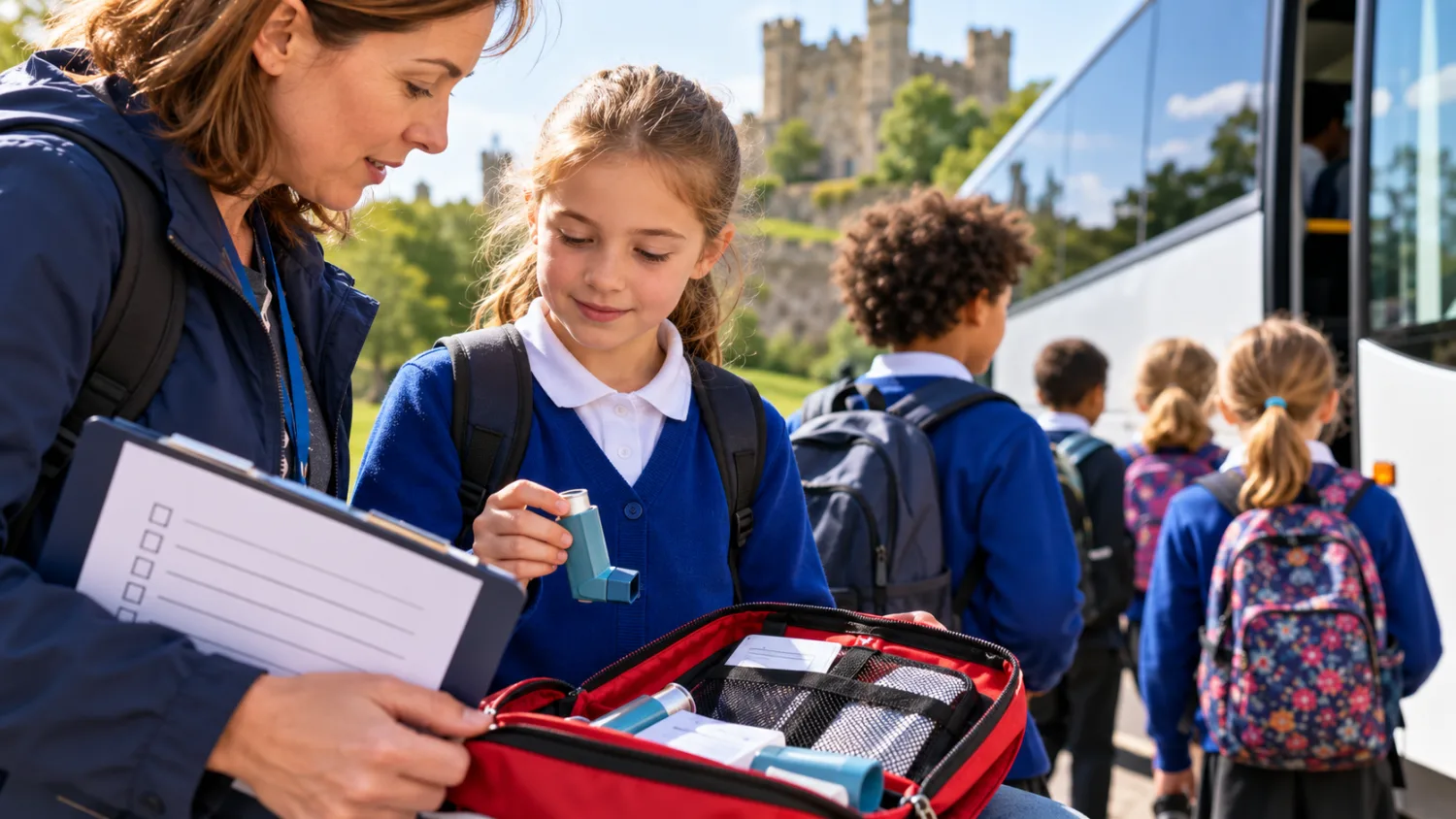
Where pupils have allergies or medically required diets, do not rely on spontaneous purchases from stalls.
If medical needs affect the trip, see How to Plan a School Trip for Pupils With Medical Needs.
Plan for SEND and sensory overload
Christmas markets can be intense environments.
They may contain:
- loud music;
- flashing lights;
- strong food smells;
- crowds;
- narrow walkways;
- unexpected physical contact.
Prepare pupils beforehand
It may help to explain:
- what the market will look like;
- how crowded it may be;
- how long the visit lasts;
- where quieter spaces are.
Ask the organiser about quieter areas
A nearby:
- library;
- museum;
- visitor centre;
- indoor space
may provide a useful break from the crowd.
Adjust the itinerary rather than excluding pupils
Possibilities include:
- shorter market time;
- a quieter arrival;
- smaller groups;
- additional adult support.
See How to Make a School Trip Work for Pupils With SEND.
Take winter weather and darkness seriously
Christmas markets are designed for winter.
Your school trip therefore has to be designed for winter too.
Check
- forecast temperature;
- rain;
- ice;
- wind;
- sunset time.
Clothing matters
Pupils may spend far longer outside than they expect.
Parents should know whether pupils need:
- warm coats;
- waterproof clothing;
- suitable footwear;
- gloves and hats.
Darkness changes supervision
It may become harder to:
- recognise pupils at distance;
- read street signs;
- see uneven surfaces;
- monitor group movement.
HSE crowd guidance specifically notes that visitors can become disorientated when arriving in daylight and leaving after dark and stresses the importance of suitable lighting.
For a fuller seasonal checklist, see Planning an Autumn School Trip: Weather, Daylight and Backup Plans.
Plan transport and collection for a busy city centre
The coach may not be able to stop beside the market.
Christmas events can change:
- road access;
- parking;
- pedestrian routes;
- coach drop-off arrangements.
Ask exactly where the group will be dropped off
Then check:
- walking distance;
- road crossings;
- whether the route remains open during the event.
Confirm the return meeting point
The coach may need to collect from somewhere different.
Add extra time
A busy festive city centre can slow:
- traffic;
- boarding;
- walking;
- toilet stops.
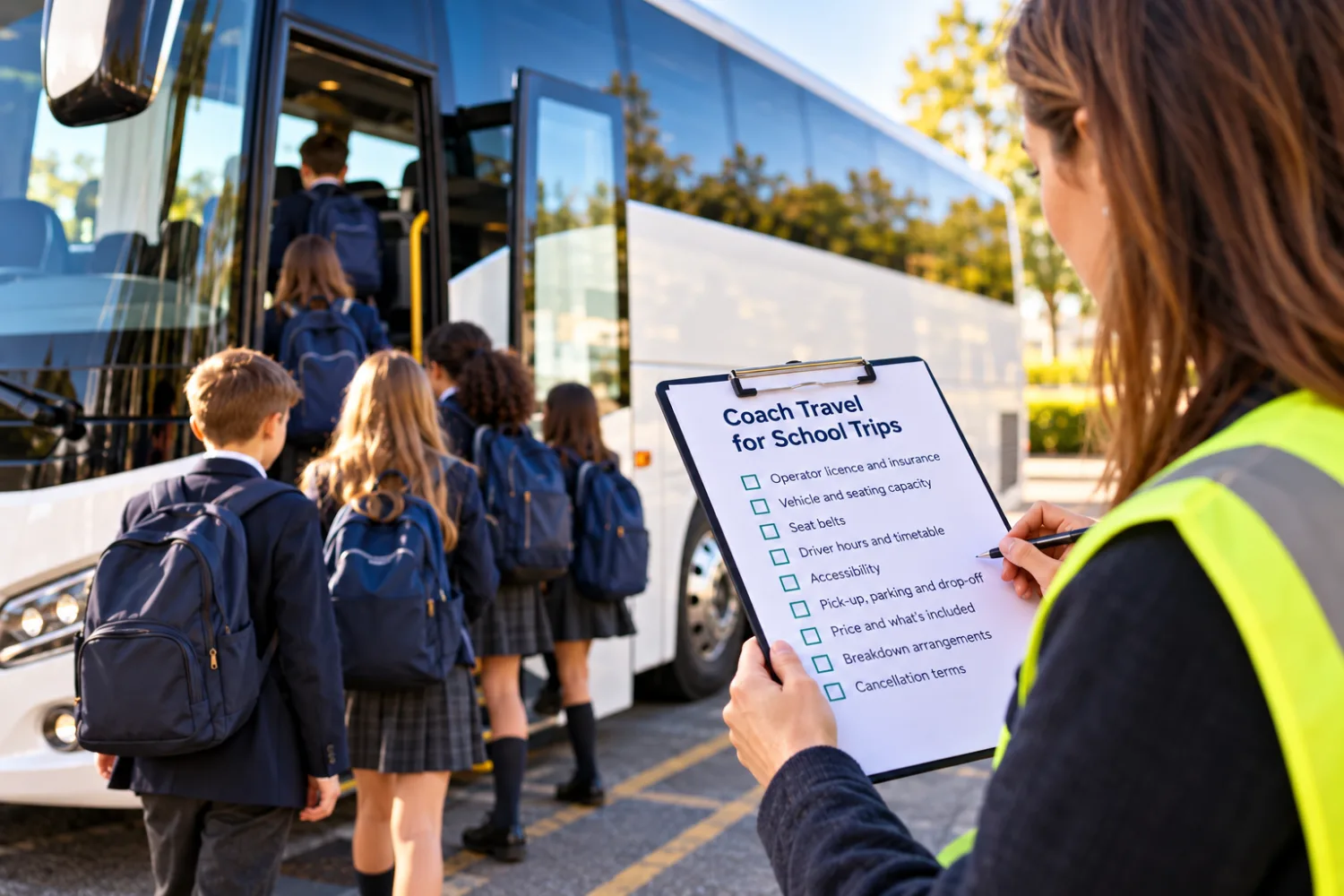
If travelling by coach, see Coach Travel for School Trips: Questions to Ask Before Booking.
Have a clear threshold for changing the plan
A risk assessment is useful only if staff are willing to respond when conditions are different from those expected.
Ask before departure
“What would make us change the visit?”
Possible reasons include
- severe weather;
- transport disruption;
- unexpectedly dense crowds;
- sections of the market closing;
- a local security incident.
The alternative does not always have to be cancellation
You might:
- shorten the visit;
- skip the busiest section;
- move groups into an indoor venue;
- leave earlier.
HSE guidance for events emphasises monitoring crowd conditions so emerging overcrowding can be identified and acted on early.
Staff should know who makes the decision
On the day, somebody needs clear authority to say:
“This is becoming too crowded. We are leaving.”
That is better than staying simply because the original itinerary says another hour.
Keep the learning task simple enough to survive the real trip
A Christmas market is not a quiet classroom.
A six-page worksheet is unlikely to improve the experience.
Use observation tasks
For example:
- find three different pricing strategies;
- identify how stalls attract attention;
- record examples of local products;
- compare permanent shops with temporary traders;
- photograph examples where school policy permits.
Do most of the writing afterwards
The market should provide:
- examples;
- observations;
- questions;
- experiences.
Pupils can analyse them back at school.
Use a clear follow-up
This might be:
- a business pitch;
- fieldwork analysis;
- a persuasive design task;
- a language presentation;
- a comparison of Christmas traditions.
The same principle applies to other public cultural visits. See Museum School Trips: How to Turn a Visit Into Meaningful Learning.
A Christmas market school-trip checklist
Learning
- What is the educational purpose?
- What should pupils notice or investigate?
- What will happen after the visit?
Market
- What are the opening times?
- When is it quietest?
- Do school groups need to book?
- Are there controlled entrances or completely open streets?
Crowds
- How will pupils be grouped?
- Who supervises each group?
- Where are likely bottlenecks?
- What happens if it becomes too busy?
Emergency
- What is the main meeting point?
- What should a separated pupil do?
- How will staff contact each other?
- Who has emergency information?
Individual needs
- Are there SEND adjustments?
- Are allergies or medical needs relevant?
- Is essential medication accessible?
Winter
- What is the weather forecast?
- When will it become dark?
- What clothing is required?
- Is there an indoor fallback?
Transport
- Where is drop-off?
- Where is pickup?
- Are roads affected by the event?
- Is enough delay time built in?
Frequently asked questions
Are Christmas markets suitable for school trips?
Yes, where there is a clear educational purpose and the school's planning reflects the fact that the market may be a crowded public event rather than a controlled education venue.
What subjects can a Christmas market trip support?
Christmas markets can support business studies, geography, languages, design and technology, history, cultural studies and cross-curricular enterprise projects.
Do schools need a risk assessment?
Schools should follow their normal educational-visit procedures. DfE guidance says visits outside routine arrangements may require additional risk assessment and planning, with controls focused proportionately on genuine risks.
What is the biggest risk at a Christmas market?
This depends on the location and group, but crowding, separation from the group, traffic, weather and darkness commonly deserve attention.
Should pupils be allowed to explore independently?
This depends on their age, maturity, the market layout and school policy. Older pupils may sometimes work in small groups within clearly defined boundaries and times.
How should schools deal with very large crowds?
Choose quieter times where possible, use manageable pupil groups and avoid obvious pinch points. If conditions are significantly busier than expected, staff should be prepared to alter or shorten the visit.
Should pupils have spending money?
That is a school decision. If money is allowed, consider a modest limit and ensure pupils who bring no money can participate fully in the visit.
Can pupils buy food from market stalls?
This may be possible, but schools should consider food allergies, dietary requirements, hygiene and whether parents understand the arrangements. Pupils with significant food allergies may need a more controlled plan.
Do we need written parental consent?
This depends on the nature and timing of the visit and the school's existing consent arrangements. DfE guidance says written consent is not required for most curriculum trips for pupils above nursery age, although parents should still be informed; higher-risk or out-of-hours visits commonly require specific consent.
What should pupils do if they become separated?
Tell them before the trip. They should know whether to remain where they are, approach an identifiable event steward or go to a predetermined meeting point, depending on the school's plan.
Should schools visit the market beforehand?
A prior visit can be particularly useful for complex city-centre markets because staff can identify entrances, road crossings, meeting points, toilets and likely congestion areas.
What if severe weather is forecast?
Review whether the planned visit remains sensible. Heavy rain, ice, strong wind or other severe weather may change transport, walking conditions and whether temporary market areas remain open.
What if there is a security alert or major incident?
Follow event staff and emergency-service instructions and activate the school's own emergency response and communication procedures. Schools should ensure visit leaders understand these arrangements before leaving.
A Christmas market can be an excellent educational visit.
Pupils can see real businesses operating in temporary spaces.
They can investigate tourism.
Use languages.
Study design.
Explore local history and culture.
And experience a place in a way no classroom slide can reproduce.
But the market atmosphere that makes the visit memorable is also what makes the planning different.
There are crowds.
Public streets.
Food stalls.
Traffic.
Winter weather.
And sometimes darkness.
Choose the time carefully.
Keep groups manageable.
Give pupils clear boundaries.
Agree meeting points.
Prepare for winter conditions.
And be willing to change the itinerary if the market becomes significantly busier than expected.
The goal is not to remove the atmosphere from the visit.
It is to plan well enough that pupils can enjoy that atmosphere while still being safe, supervised and engaged in something worth learning.