
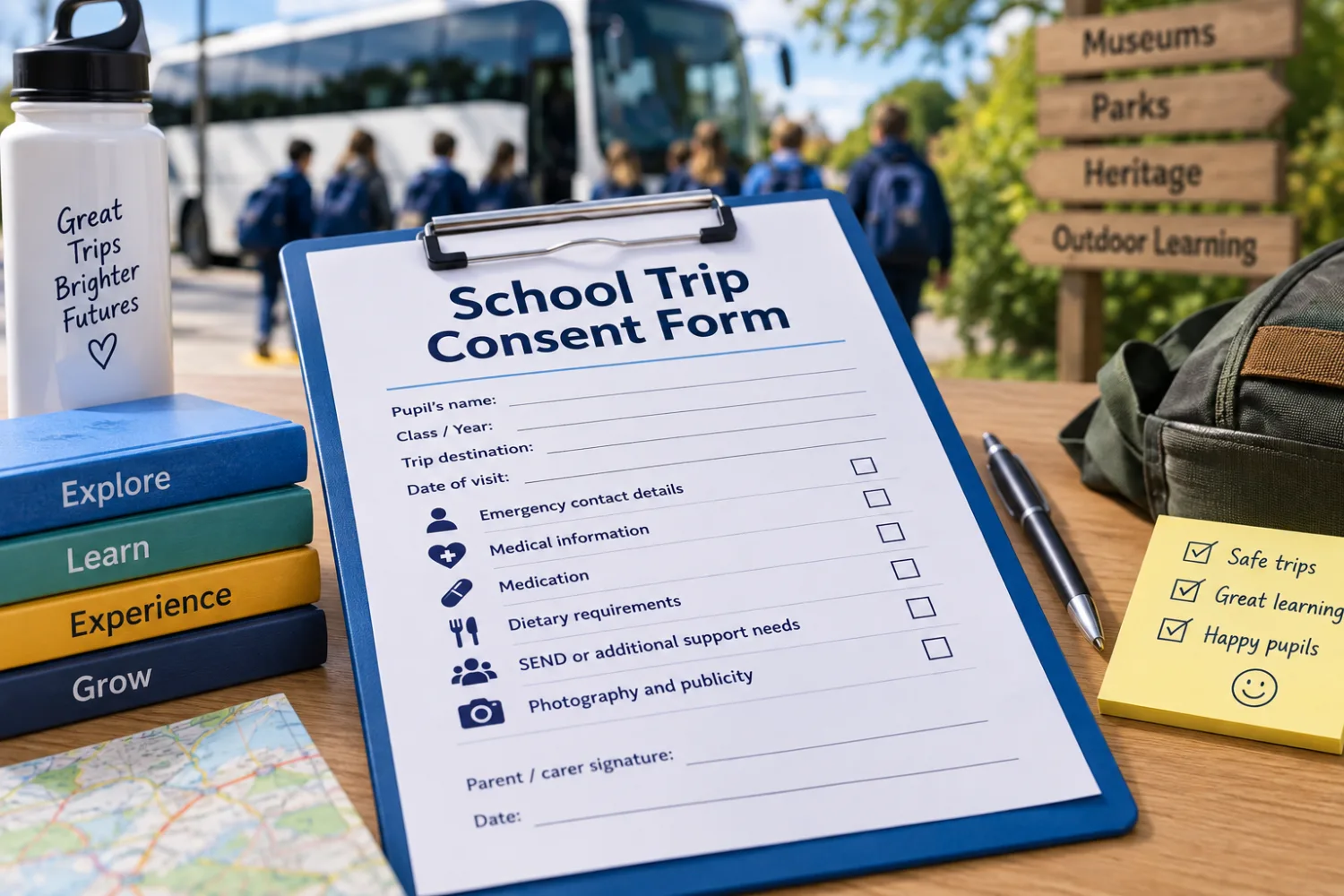
A school trip consent form can become surprisingly long.
It starts with a pupil's name and a parental signature.
Then somebody adds emergency contacts.
Medication.
Allergies.
Dietary requirements.
Swimming ability.
Photography.
Travel sickness.
Behaviour.
Medical treatment.
Before long, a straightforward museum visit has produced a two-page form asking families to provide information the school may already hold elsewhere.
Good trip paperwork should do something more useful.
It should collect the information staff genuinely need to plan the visit safely, communicate clearly with families and respond if something goes wrong.
It should also avoid asking for unnecessary personal or medical information simply because the school's previous form has always included it.
There is another important point: not every school trip actually requires a new written consent form.
Department for Education guidance for England says written consent is always required for nursery-age children. For pupils over nursery age, written consent is not normally required for most routine curriculum trips, although parents should still be informed. Written consent is usually needed where a visit requires a higher level of risk assessment or takes place outside normal school hours. Schools can also use a suitable consent arrangement completed when a child enrols.
So before designing the form, schools should first ask:
“What information do we actually need for this particular visit?”
This guide explains what to collect, what may already exist in school records, how to handle medical information, what parents need to know before consenting and how to keep school trip forms proportionate.
First decide whether fresh written consent is actually required
Not every off-site activity needs a new signature.
Routine curriculum visits
DfE guidance describes routine visits as activities involving no more than everyday levels of risk and already covered by the school's policies and procedures.
For pupils older than nursery age, most such visits do not require separate written parental consent. Parents should still be told about them and given the opportunity to withdraw their child.
Examples might include, depending on school policy:
- a local library visit;
- a short curriculum walk;
- a nearby place of worship;
- a familiar local sports facility.
Trips needing additional planning
Written consent is usually appropriate for visits involving factors such as:
- higher levels of risk;
- adventurous activities;
- residential stays;
- longer or more complex journeys;
- activities outside normal school hours.
Schools should follow their own educational-visits policy and any requirements set by their employer, trust or local authority.
Do not confuse information with consent
Even where a fresh signature is not needed, parents still need enough information to understand:
- where their child is going;
- when;
- why;
- how travel will work;
- anything unusual they need to prepare for.
A school may therefore need a trip information notice without needing a traditional consent form.
Tell parents exactly what they are agreeing to
If consent is required, the form should not simply say:
“I give permission for my child to attend the school trip.”
Parents need enough information to make that decision meaningfully.
The accompanying information should usually identify
- the destination;
- date;
- departure time;
- expected return time;
- purpose of the visit;
- main activities;
- transport arrangements;
- cost where relevant;
- food arrangements;
- important clothing or equipment requirements.
Highlight anything significantly different from an ordinary school day
For example:
- water activities;
- climbing;
- late return;
- overnight accommodation;
- significant walking;
- unusual environmental conditions.
Consent should relate to the activity parents have actually been told about.
For wider planning, see How to Plan a School Trip Without the Stress.
Collect the minimum pupil identification information you need
A form needs to identify the pupil clearly.
It usually does not need to recreate the admissions record.
Basic information may include
- pupil's full name;
- class, form or year group;
- the specific visit concerned.
Depending on the trip, that may be enough.
Think before asking again for information already held
The school probably already knows:
- date of birth;
- home address;
- parent names;
- usual contact numbers.
If those records are reliable and available to the visit leader, there may be little value in repeatedly asking families to enter them on every trip form.
UK GDPR's data-minimisation principle requires organisations to collect personal information that is adequate, relevant and limited to what is necessary for the purpose.
A useful form is not necessarily a longer form.
Make emergency contact information usable on the day
Schools need a reliable way to contact a parent or another appropriate person if something happens during the visit.
Check whether existing records are current
Rather than asking families to recreate all contact information, a form might ask:
“Are the emergency contact details currently held by school correct for the date of this visit?”
If not, provide a way to supply updated information.
Consider whether the normal contact will be available
For longer, residential or overseas visits, it may be useful to confirm an emergency contact who will actually be reachable during the trip.
Staff need access to the information
Emergency details are not useful if they remain inaccessible in the school office while pupils are 80 miles away.
The visit leader should know:
- how to access relevant contacts;
- who the school's emergency contact is;
- what procedure to follow if a serious incident occurs.
That should form part of the wider visit planning and risk management.
Medical information should focus on what staff need to keep the pupil safe
Medical information is one of the most important parts of trip planning.
It is also sensitive personal information.
Under UK GDPR, health information is special category data.
That makes it particularly important to collect and handle it carefully.
Useful questions may cover
- medical conditions relevant to the visit;
- allergies;
- medication required during the visit;
- emergency medication;
- recent medical changes the school does not yet know about;
- anything that could affect participation safely.
Do not ask for an entire medical history
The relevant question is:
“What do staff need to know to support this pupil safely on this visit?”
Not:
“What medical information can we collect just in case?”
The ICO emphasises that organisations should not collect more health information than is genuinely necessary for their stated purpose.
Use existing healthcare plans
If a pupil already has an individual healthcare plan, staff should use that rather than asking a parent to compress an important condition into a tiny box on a trip form.
DfE statutory guidance on supporting pupils with medical conditions includes specific expectations around pupils participating in school trips and school activities, and provides templates relating to healthcare plans and parental agreement for administering medicine.
Be precise about medication arrangements
A tick box saying:
“Does your child take medication?”
is often not enough.
Where medication is relevant, staff may need to know
- what the medication is;
- when it is required;
- dosage;
- how it is administered;
- whether the pupil carries it themselves;
- who will supervise or administer it;
- what happens in an emergency.
Follow the school's medicines policy
A trip form should not invent a separate medication system.
The school's existing procedures for:
- authorisation;
- storage;
- administration;
- recording;
should continue to apply away from the school site.
Check medication before departure
For pupils who need:
- inhalers;
- adrenaline auto-injectors;
- insulin;
- other essential medicine;
the visit team should confirm that the necessary medication and arrangements are actually in place before leaving.
This belongs in trip preparation, not merely on the form.
Collect SEND and accessibility information that changes the plan
A general box labelled:
“Special needs: yes/no”
is usually too blunt to be useful.
Ask about relevant support needs
Depending on the visit, schools may need to consider:
- mobility;
- sensory needs;
- communication;
- toileting;
- anxiety;
- food;
- transitions;
- supervision;
- safe participation in specific activities.
But much of this may already be known
The class teacher, SENCO and support staff should not depend on a parent re-entering information that is already central to the pupil's support.
Instead, use the consent or information process to check:
“Is there anything new or specific to this visit that we need to know?”
Plan adjustments before the day
If a pupil needs:
- a quieter travel arrangement;
- an accessible route;
- a particular adult;
- visual preparation;
- a planned break;
that should be identified early enough for the school and venue to make appropriate arrangements.
See How to Make a School Trip Work for Pupils With SEND for a fuller inclusion checklist.
Dietary information should match what the visit involves
Schools often ask about dietary requirements automatically.
That makes sense when:
- food is being provided;
- the trip is residential;
- the venue supplies lunch;
- allergies affect catering arrangements.
It may be unnecessary for a two-hour local walk where no food is involved.
Separate preference from medical need
It may help to distinguish:
- food allergy;
- medical dietary requirement;
- religious or cultural requirement;
- vegetarian or vegan preference.
The practical response may differ.
Tell families what food is actually planned
Parents are better able to provide useful information when they know:
- whether school provides lunch;
- whether pupils bring packed lunches;
- whether the venue supplies food;
- whether pupils will buy anything.
Do not bundle unrelated permissions into one vague signature
A school-trip form sometimes becomes a convenient place to ask:
“I consent to the trip, medical treatment, photographs, video, publicity, website use and anything else associated with the visit.”
That is not always good practice.
Separate different decisions where they are genuinely separate
For example:
- participation in the visit;
- participation in a particular optional activity;
- photography for school use;
- external publicity.
A family might be perfectly happy for their child to attend the museum while not wanting their photograph used in promotional material.
Check existing school permissions
If the school already has a valid and appropriate photography arrangement, there may be no need to collect the same decision again for every visit.
Equally, if the venue intends to use images for its own purposes, schools should establish what that means before the visit rather than assuming the school's normal photo arrangements automatically cover an external organisation.
Think carefully about emergency treatment wording
Older consent forms sometimes contain very broad wording giving staff blanket authority to approve any emergency treatment.
Schools should use wording that matches their current policy and legal advice rather than copying an old template indefinitely.
The important practical issue is emergency information
Staff should know:
- the child's relevant medical information;
- emergency contacts;
- what medication is available;
- the school's emergency procedure.
If urgent treatment is required, healthcare professionals will act according to the circumstances and applicable consent rules.
Do not make families believe a signature transfers responsibility entirely
A parental signature does not replace the school's duty to plan and manage the visit appropriately.
Risk assessment, supervision and emergency planning remain school responsibilities.
The DfE's educational-visits guidance stresses proportionate planning around genuine risks and competent management of visits.
For further guidance, see How to Write a School Trip Risk Assessment.
Store and share forms securely
A school trip form may contain:
- names;
- phone numbers;
- medical information;
- allergies;
- SEND information.
That information should not be treated like an ordinary worksheet.
Only relevant staff need access
Information may need to be available to:
- the visit leader;
- staff responsible for medication;
- other supervising staff where relevant;
- the school's emergency contact.
That does not mean every adult helper needs a complete copy of every pupil's medical information.
Plan how information travels
If forms are electronic, ask:
- Can the visit leader access them without school Wi-Fi?
- What happens if a device loses power?
If paper information is carried:
- who holds it?
- how is it kept secure?
- what happens to it after the visit?
Do not retain duplicate trip information indefinitely
Data-protection principles require personal information to be kept only as long as necessary for the purpose for which it was collected.
Schools should follow their own retention schedule and data-protection policy.
A simple school trip consent form structure
For a visit that genuinely requires individual written consent, a clear form could be much simpler than many traditional templates.
Trip information
- Visit name and destination
- Date
- Departure and return time
- Main activities
Pupil
- Name
- Class or form
Consent
“I have read the information provided and give permission for my child to participate in this visit and the activities described.”
Health and support update
“Does the school already hold accurate information about your child's medical, allergy, medication and support needs?”
If no:
“Please provide any new or changed information relevant to this visit.”
Emergency contact
“Are the emergency contact details currently held by school correct?”
If not, provide an update field.
Signature
- Parent or carer name
- Signature or approved electronic confirmation
- Date
Additional sections should be added because the trip requires them—not simply because they appeared on last year's form.
Frequently asked questions
Do schools need parental consent for every school trip?
No. In England, the DfE says written consent is always required for nursery-age children, but it is not normally needed for most routine curriculum trips involving older pupils. Written consent is usually required for visits needing a higher level of risk assessment or taking place outside normal school hours.
Should parents still be told about a trip if written consent is not required?
Yes. DfE guidance says it is good practice to inform parents, and they should have the opportunity to withdraw their child from the visit.
Can schools use one consent form for several trips?
DfE guidance says schools may ask parents for consent when a child enrols, covering relevant activities during their time at the school. Schools should ensure the arrangement matches their own policy and the types of visits being covered.
What medical information should a school collect?
Collect information relevant to safe participation, such as medical conditions, allergies, medication and recent changes that staff need to know about. Avoid collecting unnecessary medical history. Health information is special category data under UK GDPR.
Should parents complete medical information for every trip?
Not necessarily. Schools can use reliable information already held and ask parents to confirm whether anything relevant has changed. Particular trips may require additional information.
Should the form ask for the child's GP details?
Only where the school has identified a genuine need for that information. Do not collect fields simply because they appeared on an old template.
Should schools ask about dietary requirements?
Where food will be provided or dietary arrangements are relevant, yes. For a short trip involving no food, the information may not be necessary.
Should SEND information be included?
Relevant support information should form part of trip planning, but schools should use information already held wherever possible and ask families particularly about new or visit-specific needs.
Should photography consent be on the same form?
It can be administratively convenient, but photography is a different issue from attending the trip. Schools should avoid making unrelated permissions appear conditional on agreeing to the visit.
Can the school share medical information with the venue?
Only where there is an appropriate reason and data-protection basis to do so, and only the information genuinely needed. Schools should not routinely send complete pupil medical records to external providers.
Do volunteer helpers need pupils' medical information?
Only information necessary for the role they are performing should be shared. The visit leader should decide who needs to know what, in line with school policy.
What should happen if a parent reports a new medical condition on the form?
Do not leave the information sitting on the trip form. Update the appropriate school records and involve the relevant staff so that arrangements are properly planned before departure.
What if the consent form is not returned?
If individual written consent is required for that visit, the school should follow its policy rather than assuming silence means consent.
Should schools keep consent forms after the trip?
Schools should follow their records-retention and data-protection policies. Personal information should not be retained longer than necessary simply because the form exists.
A good school trip consent form is not the one with the most boxes.
It is the one that gives parents enough information to understand the visit and gives staff the information they genuinely need to run it safely.
Start by deciding whether fresh written consent is required at all.
Then collect only what the visit needs.
Use existing school records where they are reliable.
Ask families to update medical, emergency and support information rather than repeatedly recreating it.
Keep separate permissions separate where appropriate.
And make sure sensitive information can reach the staff who need it without being shared more widely than necessary.
The purpose of the form is not to create paperwork.
It is to make sure that when the group leaves the school gate, the adults responsible have the right information, the families understand what is happening and no important question has been left until the morning of the trip.