
The venue is booked.
The date is in the calendar.
You know roughly how many pupils are going.
Then comes a surprisingly important part of the school trip:
getting everybody there.
For many visits, coach travel is the simplest option.
Pupils can travel together, staff can supervise one group and the coach can often collect directly from school.
But the cheapest quotation is not automatically the best booking.
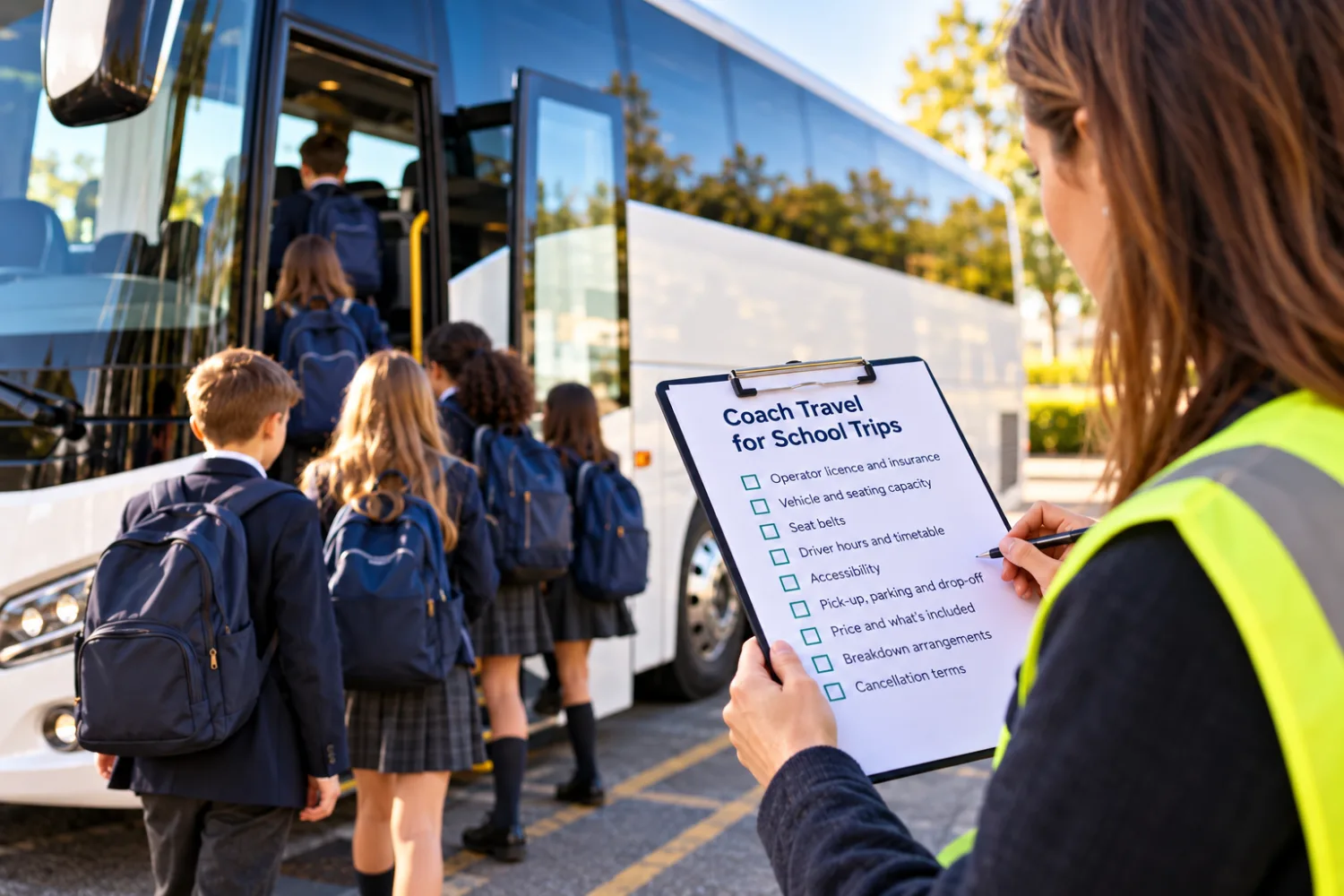
Schools need to know whether the operator is appropriately licensed, whether the vehicle suits the group, how seat belts are handled, what happens if the coach breaks down and whether the timetable is realistic once driver-hours rules, traffic and venue access are considered.
Department for Education guidance for England says that when schools use outside organisations for educational visits, they should satisfy themselves that the provider has appropriate safety standards and meets relevant legal requirements. Checks can include insurance, vehicles, staff competence, emergency arrangements and licences where required.
The aim is not to turn teachers into transport inspectors.
It is to ask a sensible set of questions before paying the deposit so that avoidable problems do not appear at 7:45am on the day of the trip.
Start by checking exactly what the quotation includes
Coach quotes are difficult to compare when they are not quoting the same thing.
One company may give you an all-inclusive figure.
Another may quote the basic journey before adding parking, waiting time or additional driver costs.
Ask for a written quotation
It should make clear:
- collection location;
- destination;
- date;
- planned departure time;
- planned return time;
- number and size of vehicles;
- total price;
- whether VAT or other charges apply;
- what waiting time is included.
Ask about additional charges
These might include:
- parking;
- tolls;
- congestion or clean-air charges;
- ferry costs;
- driver accommodation for residential visits;
- additional driver requirements;
- late-return charges.
A quotation that is £100 cheaper can become more expensive once exclusions are added.
Check the cancellation terms
Find out:
- how much deposit is required;
- whether the deposit is refundable;
- when the full balance becomes due;
- what happens if the school cancels;
- what happens if the operator cancels.
This becomes especially important for visits booked months in advance.
Check that the operator is properly licensed
A commercial coach company carrying passengers for payment will normally require a Public Service Vehicle operator's licence.
GOV.UK states that a PSV operator's licence is required to operate vehicles carrying nine or more passengers for hire or reward, subject to the relevant licensing rules.
Ask the operator to confirm its licence details
You can also check registered PSV operators through the government's vehicle operator search service.
Do not feel awkward asking
A professional operator should be accustomed to schools, businesses and organisations carrying out due diligence.
You might ask:
“Could you confirm your PSV operator licence details for our educational-visit records?”
Check insurance too
Ask whether the company has suitable insurance for the service it is providing.
The DfE specifically tells schools using external providers to check appropriate safety standards and public liability insurance.
This sits alongside the school's wider checks on external providers.
See What Schools Need From a School Trip Provider Before They Book for a broader supplier checklist.
Ask what vehicle will actually arrive
“A coach” can describe very different vehicles.
Confirm the seating capacity
Count everyone who needs a seat:
- pupils;
- teachers;
- teaching assistants;
- other staff;
- approved volunteers.
Leave enough capacity for the group actually travelling rather than relying on an approximate pupil count from months earlier.
Ask whether the quoted vehicle may be substituted
Coach operators sometimes need to change vehicles because of maintenance or operational requirements.
Ask:
“If the booked coach is unavailable, will any replacement provide equivalent seating, accessibility and safety features?”
Think about the journey rather than appearances
For a 30-minute journey, pupils may not need:
- toilets;
- USB charging;
- entertainment screens.
For a five-hour journey, some of those features become more relevant.
Prioritise what materially affects:
- safety;
- accessibility;
- comfort;
- the practical running of the trip.
Ask clearly about seat belts
Do not simply assume every seat on every coach will have the restraint arrangement you expect.
GOV.UK states that passengers must wear a seat belt where one is fitted, subject to limited exceptions. It also notes that the rules for children travelling in coaches differ from ordinary car-seat rules and that coach operators do not have to provide child car seats.
Before booking, ask
- Are seat belts fitted to all passenger seats?
- What type of seat belts are fitted?
- Will the same standard apply if the vehicle is substituted?
Schools can set expectations above the legal minimum
The fact that a particular journey may legally be possible without a particular restraint does not mean a school has to choose that arrangement.
Your school, trust, local authority or educational-visits adviser may have its own transport requirements.
Plan how pupils will use them
Before the vehicle moves, staff should have a clear routine for:
- seating pupils;
- checking belts;
- keeping pupils seated while travelling.
Do not leave this to an argument once the coach is already leaving the school gate.
Ask how driver hours affect your timetable
A coach cannot simply keep driving because the school trip is running late.
Bus and coach drivers are subject to rules governing driving time, breaks, working time and rest. Which regime applies depends on factors including the vehicle and journey.
Give the operator the complete timetable
Do not request a quote using only:
“School to London and back.”
Provide:
- desired departure;
- journey destination;
- venue arrival requirement;
- planned departure from the venue;
- expected school return;
- any additional stops.
Ask whether a second driver is required
For longer journeys, the operator may need:
- a driver break;
- a second driver;
- a vehicle or driver change.
Those arrangements can affect both price and timing.
Build in realistic margins
A timetable that assumes:
10:00 museum finish → 10:00 coach departure
is not realistic.
You need time to:
- use toilets;
- count pupils;
- walk to the coach;
- load belongings;
- seat everyone.
For long or complex visits, ask the operator directly whether your proposed timings work within its driving-hours obligations rather than trying to calculate the driver's legal schedule yourself.
Confirm pickup, parking and drop-off arrangements
Many coach problems are not about the journey.
They are about where a 12-metre vehicle is supposed to stop.
Check collection at school
Ask:
- Can the coach access the school road?
- Is there a safe boarding location?
- Will pupils cross traffic?
- Can the vehicle wait there legally?
Check the venue
Do not assume the coach can pull up outside the entrance.
Some venues have:
- dedicated coach parks;
- remote drop-off areas;
- booking systems;
- height restrictions;
- limited waiting times;
- city-centre access restrictions.
Ask who arranges parking
Will:
- the school book it?
- the coach operator?
- the venue?
A coach arriving without the required parking reservation can cause substantial delay.
When booking the venue itself, the AllSchools guide Questions Every Teacher Should Ask Before Booking a School Trip Venue can help uncover these practical details.
Check accessibility before accepting the quote
If a pupil or staff member has mobility or additional access needs, discuss them before the vehicle is booked.
Ask specific questions
Depending on the group:
- Is wheelchair access available?
- Is there a lift or ramp?
- Can a wheelchair remain occupied and secured during travel?
- How many accessible spaces are available?
- Can mobility equipment be stored?
- Are steps steep or numerous?
Do not accept “accessible” without understanding what it means
A vehicle may accommodate one type of mobility need but not another.
Describe what the pupil actually requires.
Include the journey in SEND planning
Accessibility is not only physical.
Some pupils may find coach travel difficult because of:
- noise;
- travel sickness;
- anxiety;
- unfamiliar seating;
- changes in routine;
- long periods of sitting.
You may need to consider:
- where a pupil sits;
- which adult is nearby;
- whether a visual timetable helps;
- whether planned breaks are required.
See How to Make a School Trip Work for Pupils With SEND for more detailed inclusion planning.
Ask what happens if the coach breaks down or does not arrive
Transport failure is uncommon enough to be overlooked and disruptive enough to deserve a plan.
Ask the operator
- What is your breakdown procedure?
- Do you operate replacement vehicles?
- How quickly could support normally be arranged?
- Who does the school call outside office hours?
Think about both directions
A breakdown at school before departure is inconvenient.
A breakdown at 7pm, 100 miles from school, creates a different problem.
Have emergency contact arrangements
The DfE says schools should have an emergency response plan for incidents away from school and a communications plan for handling information and reassuring relevant people. Trip leaders should understand these arrangements.
Your transport plan should fit into that wider process.
Clarify supervision and driver responsibilities
Hiring a coach does not transfer pupil supervision to the driver.
School staff remain responsible for the group
Plan:
- where staff sit;
- who checks pupils on and off;
- who carries the register;
- who manages behaviour;
- who checks belongings after disembarking.
Do not distract the driver
If pupil behaviour becomes difficult, school staff should manage it.
The driver's responsibility is safely operating the vehicle.
Agree stops in advance
For longer journeys, ask:
- whether rest stops are planned;
- where they are likely to be;
- how long they will last.
This helps staff plan toilets, food and pupil supervision.
Ask about luggage, food and practical restrictions
The amount of storage required varies enormously between a theatre visit and a five-day residential.
Tell the operator what you are carrying
This may include:
- rucksacks;
- suitcases;
- packed lunches;
- sports equipment;
- mobility equipment;
- medical equipment.
Ask about luggage capacity
Fifty seats do not automatically mean enough storage for fifty residential suitcases.
Check food rules
Ask whether pupils may:
- eat on board;
- drink water;
- bring hot drinks;
You may decide to impose stricter school rules than the operator requires.
Ask about toilets for longer journeys
If the coach has a toilet, find out whether it will actually be available for the journey.
If not, plan suitable stops.
Put the important details in writing
A telephone conversation is useful.
A written booking confirmation is better.
Before paying the final balance, confirm
- date;
- collection location;
- departure time;
- destination;
- return pickup time;
- vehicle capacity;
- seat-belt arrangements;
- accessibility requirements;
- price;
- included charges;
- contact details.
For complex visits, also confirm
- driver changes;
- planned rest stops;
- ferry or tunnel arrangements;
- parking;
- overnight arrangements;
- luggage requirements.
Check again shortly before the visit
A week or several days before departure, reconfirm the essentials.
This is particularly worthwhile when the coach was originally booked many months earlier.
A coach booking checklist for schools
Before committing to a coach operator, ask:
Company
- Do you hold the appropriate PSV operator licence?
- Can we confirm your operator details?
- What relevant insurance do you hold?
Vehicle
- How many passenger seats are provided?
- Are seat belts fitted to each seat?
- Could the vehicle be substituted?
- Does it meet our accessibility needs?
- Is there enough luggage capacity?
Journey
- Are our timings realistic?
- Are driver breaks required?
- Will a second driver be needed?
- Where will rest stops take place?
Destination
- Where will the coach drop us?
- Where will it park?
- Who arranges parking?
- Where exactly will we meet it for the return?
Problems
- What happens if the coach breaks down?
- What happens if the scheduled vehicle becomes unavailable?
- Who can we contact during the journey?
Price
- What is included?
- Are parking, tolls and other charges included?
- What are the deposit and cancellation terms?
These questions can form part of the transport section of your wider school trip planning checklist and school trip risk assessment.
Frequently asked questions
Does a coach company need a licence to carry pupils?
Commercial operators carrying passengers for hire or reward in vehicles with nine or more passenger seats will normally need an appropriate PSV operator's licence. Schools can check registered operators using GOV.UK's vehicle operator service.
Should schools ask to see the coach company's insurance?
Schools should satisfy themselves that external organisations have appropriate insurance and safety standards. What documentation your school needs to retain should follow its own educational-visits or procurement procedures.
Do school pupils have to wear seat belts on a coach?
Where a seat belt is fitted, passengers are generally required to use it, subject to specific legal exceptions. The rules for child restraints in coaches differ from those for private cars, so schools should check both legal requirements and their own policy.
Do coaches have to provide child car seats?
No. GOV.UK states that minibus and coach operators do not have to provide child car seats. If a particular child requires one, the school and family should clarify arrangements in advance.
Should a teacher check the coach mechanically?
No. Teachers are not expected to perform a professional vehicle inspection. Use an appropriately licensed operator, follow school or trust procedures and raise any obvious concern rather than attempting to take over the operator's legal responsibilities.
Can a coach driver drive all day if the group spends several hours at a venue?
Driver-hours and rest rules are more complicated than simply counting the time the coach is moving. The applicable rules depend on the journey and vehicle. Give the operator your complete itinerary and let it plan lawful driver arrangements.
When might a school trip need two drivers?
Longer journeys or timetables that cannot be covered lawfully and safely by one driver's permitted hours may require a second driver or other arrangements. The coach operator should identify this when given the full itinerary.
Should the school book coach parking?
Sometimes. At some venues the operator arranges parking; elsewhere the school or venue must reserve it. Confirm responsibility before the day.
What should we ask for a pupil using a wheelchair?
Explain the pupil's actual requirements and ask about lift or ramp access, wheelchair spaces, restraint arrangements, transfer requirements and storage for mobility equipment. Do not rely only on the word “accessible”.
What happens if the coach breaks down?
Ask the operator about its recovery and replacement arrangements before booking. The school should also have its own educational-visit emergency and communication procedures.
Should staff sit together on a coach?
Usually it is more useful to position adults where they can supervise the group effectively rather than placing all staff together. The exact arrangement will depend on pupil age, needs and the vehicle layout.
How early should the coach arrive at school?
Agree a time that leaves enough margin for loading, registers, medication checks, seating and unexpected delay. A planned departure at 8:00am should not normally depend on the coach arriving at exactly 8:00am.
What if the trip returns later than expected?
Have a communication process for families and the school emergency contact. Also remember that major delays can affect driver-hours arrangements, so the visit leader should communicate with the operator rather than assuming the original return journey can simply be extended indefinitely.
Coach travel should be one of the least memorable parts of a successful school trip.
The vehicle arrives.
Pupils board.
Seat belts go on.
The group reaches the venue on time.
And the coach is waiting where expected when it is time to come home.
Achieving that usually depends on questions asked weeks or months earlier.
Check the operator.
Confirm the vehicle.
Discuss seat belts and accessibility.
Give the company the complete itinerary.
Check driver-hours implications.
Agree the pickup and parking arrangements.
Ask what happens if something goes wrong.
And get the important details in writing.
The purpose is not to create another layer of school-trip paperwork.
It is to make sure that once forty pupils are standing at the school gate with packed lunches and backpacks, the transport is already the part of the day you do not need to worry about.