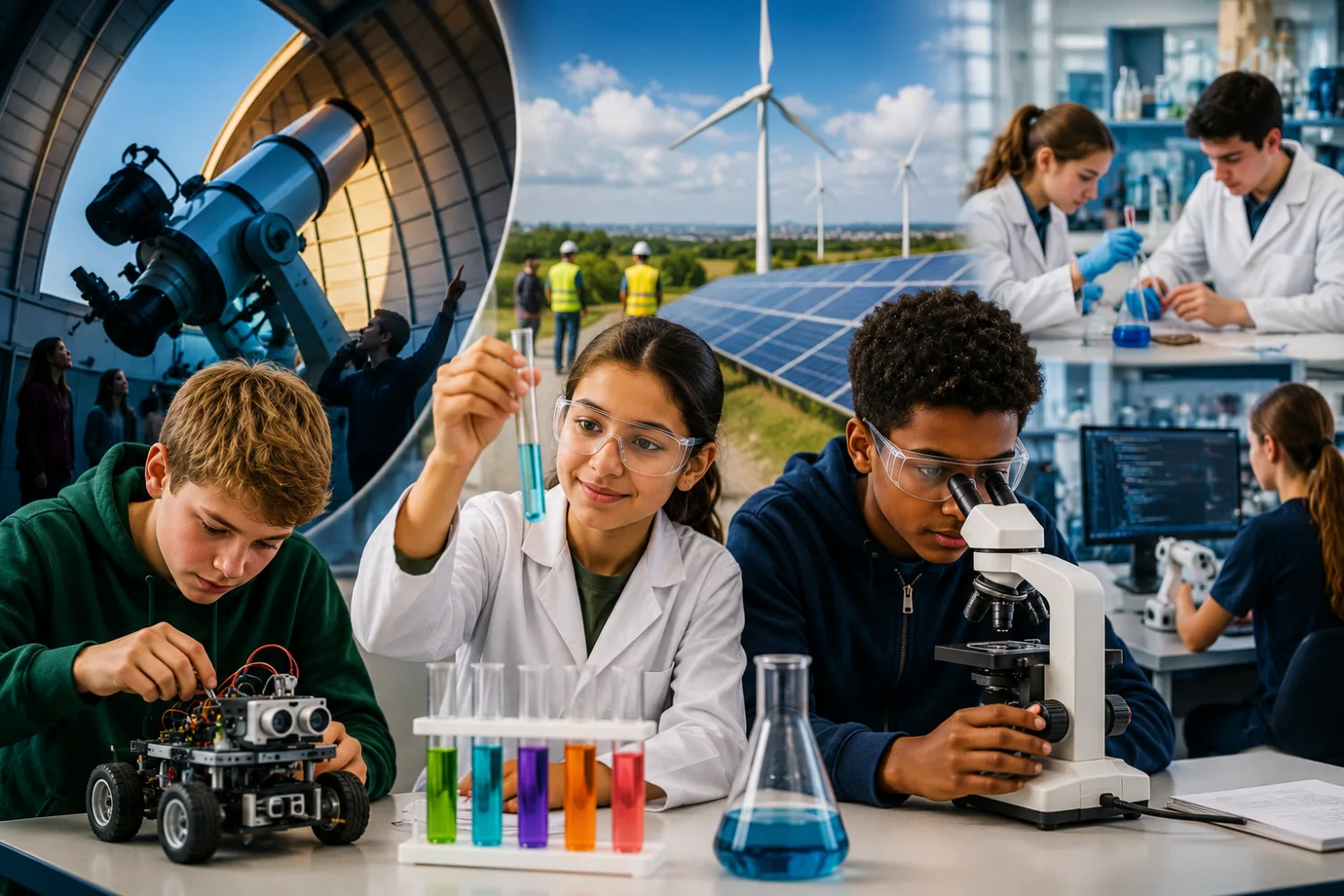
STEM and science school trips can do something that classroom lessons often struggle to do on their own: they show pupils that science, technology, engineering and maths are not just subjects on a timetable. They are used in laboratories, hospitals, observatories, factories, energy sites, farms, museums, design studios, robotics workshops, universities, transport systems and everyday problem-solving.
A good STEM trip can make pupils curious, challenge stereotypes, build confidence and help them see possible futures. A pupil who thinks physics is only equations may become interested when they see engineering in action. A pupil who enjoys gaming may discover coding, animation or cybersecurity. A pupil who likes helping people may see how biology, chemistry, data and technology connect to healthcare. A pupil who is not yet confident in science may engage when the learning becomes practical, visual and hands-on.
For schools, the challenge is choosing STEM venues that are age-appropriate, curriculum-linked, inclusive and worth the time away from lessons. For science centres, STEM workshop providers, universities, employers, observatories, technology companies and mobile science presenters, the opportunity is clear: schools are actively looking for memorable STEM experiences, but teachers need clear information before they can book.
This guide explores the best types of STEM and science school trip venues in the UK, what pupils can gain from them, what teachers should ask before booking, and how STEM providers can make their offer more attractive to schools.
If you are also planning wider educational visits, you may find our guides to the best school trip venues for secondary schools, KS2 curriculum-linked school trip venues and questions to ask before booking a school trip venue useful alongside this article.
What makes a good STEM school trip?
A good STEM school trip should help pupils understand something more clearly than they could from a textbook, worksheet or video alone. It should give them a chance to observe, test, design, build, measure, question, solve or meet people who use STEM in real work.
The best STEM trips are not only “wow” experiences. Excitement matters, but it should lead somewhere. A dramatic demonstration, planetarium show, robot challenge or engineering workshop is most valuable when pupils understand the science behind it and can connect it back to what they are learning in school.
Teachers should look for three things: clear learning, practical engagement and age-appropriate challenge. A Year 3 visit about magnets, a Year 8 engineering day, a Year 10 GCSE physics workshop and a sixth form medical science session should not feel the same. The venue should be able to adapt the depth, vocabulary and task design to the pupils.
Strong STEM venues also help pupils see careers. Many children and teenagers have a narrow view of STEM jobs. They may know about doctors, vets and engineers, but not technicians, data analysts, environmental scientists, biomedical engineers, software testers, lab managers, energy specialists, robotics designers, radiographers, food scientists or water quality specialists.
A good STEM trip does not need to push every pupil towards a STEM career. It simply helps pupils see that STEM belongs in the real world, and that real people use it in many different ways.
1. Science centres and discovery museums
Science centres and discovery museums are often the first venues teachers consider for STEM school trips. They can work well for primary and secondary pupils because they usually combine interactive exhibits, demonstrations, workshops and educational resources.
For younger pupils, science centres can make everyday ideas visible: forces, light, sound, magnets, electricity, materials, space, weather, bodies, plants and animals. Pupils can push, pull, build, test and observe rather than only listen.
For secondary pupils, the strongest science centre visits go beyond pressing buttons. They may offer lab-style workshops, GCSE-linked sessions, planetarium shows, medical demonstrations, engineering challenges, forensic science activities, coding tasks or talks from STEM professionals.
Teachers should ask whether workshops are linked to specific key stages, how much time pupils spend in guided sessions compared with self-led exhibits, whether learning resources are available, and how the venue manages large groups. A science centre can be exciting, but it can also become noisy and unfocused if the visit is not structured.
The best science centres give pupils time to experiment properly, not just rush from one exhibit to the next.
2. Observatories, planetariums and space education venues
Space remains one of the most powerful hooks for science learning. Observatories, planetariums and space education centres can help pupils understand the solar system, stars, planets, gravity, light, telescopes, satellites, orbits, space exploration and the scale of the universe.
For primary pupils, a space visit can support topics such as Earth and space, light, day and night, seasons and scientific observation. For secondary pupils, it can link to physics, maths, engineering, computing, optics, forces, waves, data and careers in space science.
Planetarium sessions can be especially useful because they create an immersive experience. Pupils can see the night sky, follow the movement of planets, understand scale and ask questions that are difficult to answer using diagrams alone.
Teachers should ask about age suitability, session length, darkness, seating, sensory considerations, accessibility and whether the visit includes an interactive workshop or mainly a show. Some pupils may find dark spaces, loud sound or immersive projection overwhelming, so preparation may be needed.
3. Engineering and design challenge venues
Engineering trips are valuable because they show pupils that STEM is about solving problems, not simply remembering facts. Pupils can design bridges, test structures, build vehicles, solve electrical challenges, create towers, explore materials, investigate forces or understand how real engineers make decisions.
These visits can link strongly to science, maths, design and technology, computing, geography, sustainability and careers. They can also support teamwork, communication, creativity and resilience.
A good engineering workshop should include a problem, constraints, testing and improvement. Pupils should not only build something once. They should test it, see what failed, change the design and understand why the change matters.
Teachers should ask whether pupils work in teams, what materials are used, whether the challenge is linked to real-world engineering, and whether the session can be adapted for different year groups. For older pupils, it is useful if the venue can explain careers, apprenticeships, university routes and technician roles as well as engineering degrees.
4. Coding, robotics and digital skills workshops
Coding and robotics visits are increasingly popular because digital skills now connect to almost every sector. Pupils may learn programming, robotics, sensors, algorithms, drones, app design, cybersecurity, artificial intelligence, game design, web development or data handling.
These visits can support computing, maths, design and technology, science and careers education. They can also engage pupils who may not think of themselves as traditional scientists but enjoy solving puzzles, building systems or creating digital products.
The best digital workshops are hands-on and carefully paced. Pupils should be able to make something work, understand why it works, debug problems and experience the satisfaction of improvement.
Teachers should ask what devices are provided, whether pupils need prior knowledge, how tasks are differentiated, whether internet access is required, how safeguarding is managed online, and whether the provider can work with mixed-ability groups.
Digital providers should avoid overpromising. A one-hour workshop will not make pupils “AI experts” or “professional coders”. It can, however, give them a positive first experience, introduce key concepts and build confidence.
5. University STEM departments and research facilities
Universities can offer some of the most inspiring STEM visits, especially for secondary pupils and sixth form students. Pupils may visit laboratories, engineering departments, medical schools, observatories, robotics labs, environmental research facilities, computing departments or science outreach centres.
A university visit can do two things at once. It can deepen subject knowledge and raise aspirations. Pupils can see advanced equipment, meet researchers or student ambassadors, attend a taster lecture, take part in a workshop and understand what studying STEM beyond school might look like.
These visits can be particularly valuable for pupils who have not considered university or who have no family background in higher education. Seeing the environment and meeting approachable students can make future routes feel more real.
Teachers should ask whether the session is designed for the year group, whether pupils will do practical work, how much time is spent on subject learning compared with general campus touring, and whether routes into STEM careers are explained clearly.
6. Healthcare, medical science and life science venues
Healthcare and life science visits can be powerful because pupils can see how biology, chemistry, physics, maths, data and technology connect to human health.
Suitable experiences might include medical simulation centres, university healthcare departments, hospital outreach programmes, biomedical science workshops, anatomy sessions, pharmacy education, public health activities, sports science labs, dental education or laboratory demonstrations.
These visits can support biology, chemistry, physics, PE, health education and careers. Pupils can learn about diagnosis, imaging, infection, medicine, rehabilitation, nutrition, movement, genetics, lab testing, patient care and medical technology.
A strong healthcare STEM trip should also show the range of roles involved. Healthcare science is not only doctors and nurses. Pupils may learn about radiographers, biomedical scientists, pharmacists, physiotherapists, lab technicians, clinical engineers, data analysts, paramedics and many other roles.
Teachers should check safeguarding, patient privacy, age suitability, sensitive content, infection control, practical activities and whether pupils will meet real professionals.
7. Energy, climate and sustainability sites
Energy and sustainability venues are increasingly important for STEM learning. Pupils can visit renewable energy sites, eco-centres, water treatment works, recycling facilities, environmental centres, farms, conservation projects, climate education centres or sustainable buildings.
These visits can connect science, geography, engineering, maths, citizenship and design. Pupils can investigate how electricity is generated, how water is cleaned, how waste is sorted, how buildings reduce energy use, how habitats are protected, or how organisations make difficult decisions about resources.
For older pupils, these visits can lead to serious questions. How do we balance energy demand and environmental protection? What does net zero mean in practice? How can engineers design better systems? What data do scientists use to monitor environmental change?
Teachers should ask whether the site is safe for school groups, whether the visit includes real data or demonstrations, how technical explanations are pitched, and whether there are links to careers in energy, engineering, environmental science or sustainability.
If your school is also considering rural and food-related sustainability visits, our guide to farm school trips and rural education centres may be useful.
8. Factories, manufacturing sites and engineering employers
Manufacturing and engineering employers can provide excellent STEM visits because pupils see science and maths being used in real production environments.
Suitable visits might include factories, food production sites, aerospace companies, automotive firms, construction companies, electronics manufacturers, design studios, materials labs, logistics centres or precision engineering businesses.
These visits can help pupils understand design, testing, quality control, automation, robotics, materials, forces, energy, measurement, data, safety, efficiency and teamwork. They also show that STEM careers include apprenticeships, technical roles, operations, maintenance, design, management and problem-solving.
Businesses that host schools need to plan carefully. A workplace visit should not be an improvised tour. Pupils need a safe route, clear safeguarding arrangements, age-appropriate explanations, a structured task, time for questions and practical careers information.
For schools, employer visits can support careers education as well as curriculum learning. For employers, they are a way to build relationships with local schools and inspire future talent.
Our guide to bringing the real world into the classroom through business partnerships explores this wider school-business opportunity.
9. Mobile science shows and visiting STEM workshops
Not every STEM trip has to involve travelling to a venue. Mobile science shows, visiting STEM workshops, coding clubs, robotics providers, planetarium domes, chemistry demonstrations, engineering challenges and science presenters can bring STEM enrichment into school.
This can be useful when transport is expensive, timetables are tight, or schools want a whole-year experience without taking multiple classes off site.
Visiting providers can support science weeks, careers days, topic launches, enrichment weeks, STEM clubs, transition events or revision sessions. They may be especially useful for primary schools that want memorable science input but do not have easy access to large STEM venues.
Teachers should ask what space is needed, whether equipment is provided, how long setup takes, what safety arrangements are required, whether the session is interactive, how groups are managed, and whether the provider has experience working with the relevant age group.
Providers should make curriculum links, setup requirements, prices, safeguarding information and age suitability easy to find.
10. Museums with specialist science collections
Some museums are not branded as science centres but still offer excellent STEM learning. Natural history museums, transport museums, industrial heritage museums, medical museums, maritime museums, aviation museums and local museums with science collections can all support STEM topics.
Pupils might learn about fossils, evolution, anatomy, engines, flight, ships, railways, materials, mining, electricity, medicine, weather, engineering, communication, navigation or local industry.
These venues can be especially useful because they show the human history of science and technology. Pupils can see how inventions changed lives, how engineering shaped towns, how medicine developed, or how transport connected communities.
Teachers should ask whether the museum offers STEM-focused workshops, object handling, trails, demonstrations or enquiry activities. A general museum visit can become much stronger when pupils are given a clear STEM question to investigate.
STEM trip ideas by key stage
STEM trips should be matched carefully to pupils’ age and prior knowledge.
For KS1, the best STEM visits are practical, sensory and simple. Pupils might explore materials, plants, animals, weather, magnets, floating and sinking, sound, light or everyday machines. They need short sessions, clear instructions and plenty of time to observe and talk. Our guide to the best school trip ideas for KS1 includes more ideas for young learners.
For KS2, STEM visits can become more structured. Pupils can investigate electricity, forces, space, habitats, lifecycles, materials, engineering, coding, environmental science and scientific enquiry. They can begin to collect evidence, compare results and explain what they notice.
For KS3, STEM trips can help pupils see subjects as connected. A robotics workshop may combine computing, maths and engineering. A climate visit may combine science and geography. A medical workshop may combine biology, chemistry, physics and careers.
For GCSE pupils, trips should be more focused. They may support required practical understanding, fieldwork, exam topics, careers guidance or motivation. Pupils need clear links to what they are studying.
For sixth form and post-16 pupils, STEM visits should offer depth, realism and future pathways. University labs, employer visits, medical simulations, engineering companies and research centres can help students connect advanced study to real careers.
STEM trips for careers education
STEM trips are not only about subject knowledge. They can also help pupils understand careers and future routes.
Many pupils have limited ideas about STEM careers. Some imagine that science means becoming a doctor, engineer, scientist or teacher. Those are important roles, but STEM reaches much further. It includes technicians, apprentices, analysts, designers, programmers, energy specialists, lab staff, healthcare professionals, environmental consultants, data scientists, manufacturing specialists, construction professionals, researchers and many other routes.
A strong STEM visit should include real people where possible. Pupils benefit from hearing what employees actually do, what subjects helped them, what qualifications or apprenticeships they took, what skills matter, and what surprised them about their work.
This is especially important for pupils who may not see themselves represented in STEM. Meeting a diverse range of professionals can challenge assumptions about who belongs in science, technology, engineering and maths.
Schools should ask venues and employers whether careers links are built into the session. A short Q&A with staff, a careers trail, an apprenticeship explanation or a “day in the life” activity can add real value.
Planning STEM trips for pupils with SEND
STEM trips can be highly engaging for pupils with SEND because they often involve practical tasks, visual demonstrations and hands-on learning. However, they can also include sensory challenges such as noise, flashing lights, crowds, dark planetarium spaces, strong smells, busy workshops, long instructions or unpredictable demonstrations.
Teachers should ask about accessibility, quiet spaces, seating, lighting, sound, workshop pace, written instructions, practical adaptations, toilets, lifts, walking distances and whether pupils can opt out of certain activities.
Some pupils may benefit from visual timetables, photos of the venue, a known adult, ear defenders, a quieter lunch space, a shorter route, alternative recording methods or extra time during practical tasks.
Providers should be ready to explain how they adapt sessions. Can pupils work in pairs? Can a task be simplified or extended? Can instructions be given visually? Can a pupil observe before joining in? Can the session avoid unnecessary sensory overload?
Our guide to making a school trip work for pupils with SEND gives more detailed planning advice.
What teachers should ask before booking a STEM trip
STEM trips can vary widely in quality. Before booking, teachers should ask practical and educational questions.
- Which key stages and year groups is the session designed for?
- What curriculum topics does it support?
- Is the visit hands-on, demonstration-based, self-led or a mixture?
- How much scientific explanation is included?
- Can the session be adapted to the class topic?
- Are pupils working individually, in pairs or in teams?
- What equipment or devices are provided?
- Are there any safety requirements or restrictions?
- Does the visit include careers information or employer encounters?
- Are resources available before or after the visit?
- How are pupils with SEND supported?
- Is there a quiet space or alternative activity if needed?
- What are the toilets, lunch and bag storage arrangements?
- What risk assessment information is available?
- What is included in the price?
- What happens if pupil numbers change?
- What is the cancellation or rearrangement policy?
The best STEM venues welcome these questions. They understand that teachers are not only booking an exciting activity. They are organising a safe, purposeful educational visit that must justify time, cost and staffing.
How STEM providers can attract more school bookings
STEM providers often have excellent content, but their websites do not always make the school offer clear enough. Teachers are busy. They need to see quickly whether a provider is suitable.
A strong school visits page should explain the age range, curriculum links, session length, group sizes, hands-on activities, equipment, staff qualifications, safeguarding arrangements, risk information, SEND support, pricing, location, travel details and what teachers need to prepare.
Providers should also explain the learning outcomes in school-friendly language. Instead of saying “immersive innovation experience”, say what pupils will do: build a robot, test bridge designs, investigate forensic evidence, program a sensor, explore the night sky, analyse water samples, meet engineers or design a solution to an energy problem.
Example timetables are very useful. Teachers need to picture the day: arrival, toilets, workshop, break, second activity, lunch, final Q&A and departure.
Providers should also include photos of learning spaces, practical activities, equipment, lunch areas, entrances and accessibility features. Photos help schools prepare pupils and reassure parents.
For businesses and STEM organisations that want to work with schools, our guide to requirements for businesses working with schools explains what schools often look for before approving an external provider.
What makes a STEM venue stand out?
A strong STEM venue does not simply impress pupils for a moment. It helps them understand something better, ask better questions or imagine a future they had not considered.
The best venues combine clear teaching with hands-on experience. They avoid making science feel like magic tricks with no explanation. They avoid overwhelming pupils with jargon. They pitch the session to the right age group and give pupils a role in the learning.
They also show real-world relevance. Pupils should leave with a better sense of where STEM is used: in healthcare, energy, transport, farming, climate work, engineering, digital technology, medicine, architecture, manufacturing, sport, food, space, construction and everyday life.
Most importantly, good STEM venues make pupils feel that STEM is something they can take part in, not something reserved for a small group of “naturally clever” people.
FAQ: STEM and science school trip venues
What are the best STEM school trip ideas?
Good STEM school trip ideas include science centres, observatories, planetariums, engineering workshops, coding and robotics sessions, university labs, medical science workshops, energy sites, environmental centres, manufacturing visits and mobile science shows.
Are STEM trips suitable for primary schools?
Yes. STEM trips can work very well for primary schools when they are practical, visual and age-appropriate. Younger pupils benefit from hands-on activities linked to materials, forces, light, sound, plants, animals, space, weather, coding or simple engineering.
What STEM trips work best for secondary schools?
Secondary schools often benefit from STEM trips with more depth, such as engineering challenges, university visits, medical science workshops, robotics sessions, geography and environmental fieldwork, employer visits, science museums and energy or manufacturing sites.
How can STEM trips support careers education?
STEM trips can introduce pupils to real professionals, workplaces, apprenticeships, university routes and technical careers. They help pupils see how science, technology, engineering and maths are used in real jobs.
What should teachers ask before booking a STEM venue?
Teachers should ask about age suitability, curriculum links, hands-on activities, session length, equipment, safety, SEND support, quiet spaces, careers content, resources, toilets, lunch arrangements, risk assessment information and pricing.
Can STEM providers visit schools instead of schools travelling?
Yes. Mobile science shows, planetarium domes, robotics workshops, coding providers, engineering challenges and STEM presenters can bring enrichment into school. This can reduce transport costs and make whole-year group activities easier.
How can STEM trips support pupils who lack confidence in science?
Practical STEM trips can help pupils see that science is not only about memorising facts. Building, testing, observing, designing, debugging and asking questions can give pupils a more positive and active experience of STEM.
How can STEM venues attract more school bookings?
STEM venues can attract more school bookings by providing clear curriculum links, age suitability, example timetables, prices, risk information, SEND guidance, practical activity descriptions, careers links, facility photos and a named contact for teachers.
Final thought
STEM and science school trips can change how pupils see a subject. They can turn science from something abstract into something visible, practical and connected to real life.
The best STEM visits are not only exciting. They are purposeful. They help pupils understand ideas, meet people, solve problems, test designs, explore evidence and imagine future pathways.
For teachers, the aim is to choose venues that match the age, curriculum and needs of the pupils. For STEM venues, employers and workshop providers, the opportunity is clear: schools want rich, practical STEM experiences, but they need clear information before they can book.
If you run a science centre, STEM workshop, observatory, coding provider, engineering venue, university outreach programme, employer visit, mobile science show or similar school trip provider and would like your venue to be considered for future AllSchools resources or listings, contact us at info@allschools.co.uk. We are always interested in hearing about useful, school-friendly STEM and science trip venues across the UK.