
Selling to schools is different from selling to most other organisations. A school may genuinely need what you offer, understand its value and still be unable to buy immediately. The budget may not be available yet. The decision may belong to another member of staff. A senior leader, school business manager, multi-academy trust team or governing body may need to approve the purchase. Where pupils, personal data or school premises are involved, safeguarding, insurance, risk assessments and data protection may also need to be considered.
This can make the education market feel slow, particularly for businesses accustomed to quicker commercial sales. However, the same caution can create valuable long-term relationships. Schools usually prefer dependable suppliers that understand their environment, communicate clearly and deliver consistently. Once a supplier has earned that confidence, the relationship may continue across several academic years or expand to other schools within a trust.
This guide explains how to sell products and services to UK schools more effectively. It covers the structure of the school market, buying responsibilities, school budgets, compliance, targeting, outreach, meetings, proposals, multi-academy trusts and long-term visibility. It is designed for established education companies as well as tutors, wellbeing providers, school trip venues, IT businesses, uniform suppliers, CPD providers, caterers, cleaning contractors, consultants and other organisations entering the schools market.
Why selling to schools requires a different approach
Schools are not ordinary commercial customers. They are responsible for children, staff, public money, educational outcomes, safeguarding and parental trust. As a result, a purchasing decision is rarely based only on whether a product looks useful or whether a price appears competitive.
A school may need to establish whether an offer supports an existing priority, whether staff have the capacity to implement it and whether the result can justify the cost. Leaders may also consider reliability, safeguarding, data security, accessibility, staff workload and the consequences if the supplier fails to deliver.
In practical terms, schools are likely to ask questions such as:
- Which pupils, staff members or operational problems will this help?
- How will it work within the school day?
- What will staff need to do?
- What evidence supports the claims being made?
- What is included in the price?
- Are there additional or recurring costs?
- What safeguards and controls are in place?
- What happens if the service is delayed or does not work as expected?
This is why broad sales language performs poorly in the education market. Statements about being innovative, passionate or market-leading mean little without a clear explanation of what the supplier does and why it matters to that particular school.
A strong school-facing message connects the offer to a recognisable educational or operational need. It explains who the service is for, how it is delivered, what staff involvement is required and what the school can reasonably expect to gain.
How schools, academies and trusts buy
There is no single purchasing process used by every school. The route depends on the value and complexity of the purchase, the type of school, the source of the budget and the level of risk involved.
A teacher or subject leader may be able to approve a small classroom purchase. A headteacher or school business manager may decide on a larger service. Software, catering, cleaning, estates, recruitment or IT contracts may require several quotations, contract review or a formal procurement exercise. Within a multi-academy trust, some decisions may be made centrally even when the service will be delivered within individual schools.
Suppliers should therefore understand the differences between maintained schools, academies and multi-academy trusts before beginning outreach. Our guide to maintained schools, academies and MATs explains how their structures can affect budgets, decision-making and supplier relationships. You can also read who buys products and services in UK schools for a more detailed explanation of common buyer roles.
The Department for Education provides official Buying for schools guidance. Schools and trusts can also use the DfE’s Get help buying for schools service to explore approved buying options and obtain procurement support.
These formal routes do not prevent smaller companies from winning work. Many schools actively use local and specialist suppliers. However, a supplier should be prepared to provide clear pricing, suitable documentation and enough information for the school to justify its choice.
Make the purchase easy to understand. Clearly distinguish between one-off and recurring charges, state what is included and explain whether the school will need to provide equipment, staff time, premises or technical access. Our guide to making your business easier for schools to buy from examines how pricing, quotations, purchase orders, contracts and onboarding can reduce unnecessary friction.
Define the schools and buyers you should target
One of the most common mistakes in school marketing is assuming that a larger contact list will automatically produce more sales. In practice, relevance matters more than volume. A carefully selected group of schools with a genuine reason to consider the offer will usually be more valuable than thousands of poorly matched contacts.
Begin by defining your ideal school customer. Consider phase, school size, location, trust structure, pupil profile, available facilities and delivery requirements. A programme designed for small primary schools may need different positioning from one intended for large secondary academies. A local face-to-face provider will require a different outreach strategy from a national software company.
The article How to Define Your Ideal School Customer provides a fuller framework for identifying the schools most likely to benefit from your offer.
You should then identify the person most likely to understand or approve the purchase. Depending on the service, this could be:
- a headteacher or deputy headteacher;
- a school business manager or finance manager;
- a SENCO or inclusion lead;
- a subject, curriculum or key-stage leader;
- an IT, network or data lead;
- an estates, premises or operations manager;
- a safeguarding, wellbeing or pastoral lead;
- a trips, enrichment or extracurricular coordinator;
- a central trust director or procurement team.
Job titles are not completely consistent between schools, so research is important. Review the school website, trust structure, staff pages, policies, recent news and published priorities. How to Research a School Before Contacting It explains what to look for, while How to Find the Right Contact at a School covers common school and trust roles.
Once the target market is defined, create an outreach list that reflects it. Divide schools by characteristics that genuinely change your message, such as phase, region, trust membership or service need. Avoid collecting information simply because it is available. Every field should help you decide whether to contact the school or how to make the approach more relevant.
For a practical process, see How to Build a School Outreach List That Matches Your Offer.
Position your offer for the school market
A product that works well in another sector may still need to be repositioned before it is presented to schools. Schools need to see how the offer fits their priorities, constraints and working environment.
Start with the problem rather than the product. A headteacher is unlikely to be interested in a long description of your platform’s features. They may be interested in reducing administrative work, improving attendance, helping pupils catch up, strengthening safeguarding, managing compliance or giving teachers better information.
Good positioning connects four elements: the relevant school problem, the people affected, the practical result and the evidence that makes the claim credible. How to Position Your Product or Service for UK Schools explores this process in more detail.
Be careful not to overstate educational outcomes. A supplier can describe what its product is designed to support, but should avoid promising guaranteed improvements that depend on many factors outside its control. Schools are more likely to trust balanced explanations than dramatic claims.
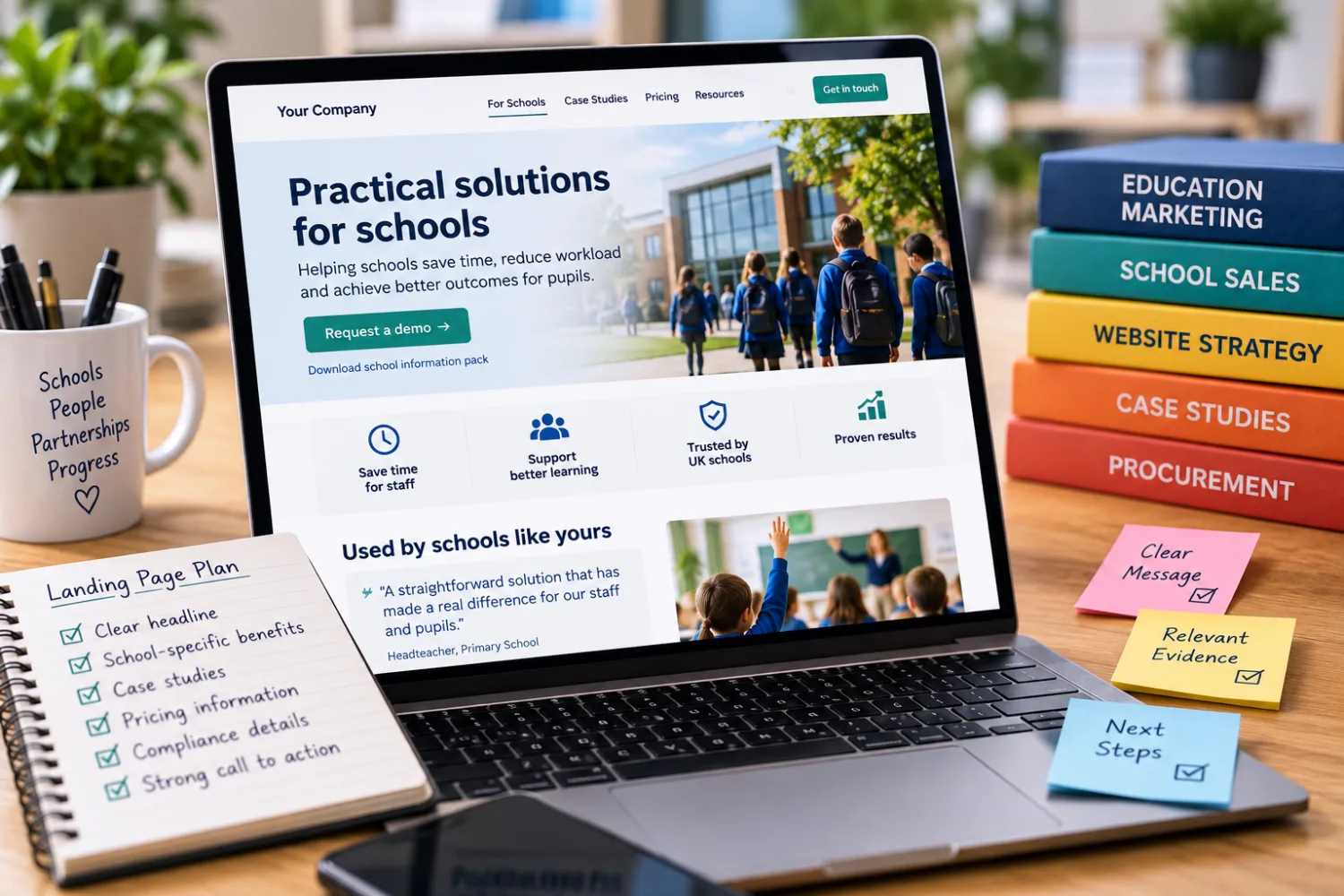
Your website should reinforce the same message. A visitor should be able to understand what you offer, which schools you serve, how delivery works, what the likely costs are and what happens next. Relevant evidence, implementation details and compliance information should be easy to find.
Use What Schools Expect to See on a Supplier Website as a checklist for your main school-facing pages.
It is also worth creating a concise one-page summary or supplier sales pack. A useful one-pager does not attempt to reproduce the entire website. It gives a busy leader enough information to decide whether a conversation is worthwhile. How to Write a One-Pager That a Headteacher Will Actually Read explains how to keep it focused.
For larger or more considered purchases, prepare a fuller collection of pricing, evidence, delivery information and compliance documents. See What to Include in a School Supplier Sales Pack.
Prepare your compliance, safeguarding and evidence
Schools buy confidence as well as products. Before approving a supplier, they may need reassurance that the company is safe, reliable, appropriately insured and capable of fulfilling its commitments.
The precise requirements depend on the work. A stationery supplier will not face the same checks as a counselling provider, residential trip venue or company processing pupil data. Suppliers should therefore avoid treating compliance as a universal tick-box exercise.
Documents commonly requested by schools can include:
- public liability and employer’s liability insurance;
- a safeguarding or child protection policy;
- risk assessments and method statements;
- DBS information where the work and role make it relevant;
- health and safety documentation;
- data protection and security information;
- food hygiene or allergen procedures;
- professional qualifications or accreditations;
- references, testimonials or school case studies;
- terms, cancellation conditions and complaints procedures.
The government’s eligibility guidance for Enhanced DBS checks can help organisations understand which work may be eligible. Suppliers should not assume that every person entering a school needs the same type of check, nor that holding a DBS certificate removes the school’s wider safeguarding responsibilities.
What a DBS Check Covers explains what the certificate can and cannot establish. For a broader overview, read DBS Checks, Insurance and Safeguarding Requirements for Businesses Working With Schools.
It is sensible to organise the main documents before outreach begins. You do not need to attach a large compliance bundle to an introductory email, but you should be able to provide the relevant information promptly when requested.
There is some overlap between what a supplier should prepare and what a school will review. The School Supplier Compliance Checklist focuses on preparing your business, while How Schools Vet External Providers explains the process from the school’s perspective. You can also review What Documents Should a School Supplier Have Ready? for a practical document list.
Evidence should be prepared with the same care. A specific case study is usually stronger than several vague testimonials. Explain what the school needed, what was delivered and what changed, while respecting confidentiality and obtaining permission where required. How to Get a Case Study or Testimonial From a School provides a useful process.
Plan around school calendars, budgets and buying cycles
A school’s interest and its ability to purchase are not always aligned. A leader may recognise a need but be unable to fund it until the next budget period. A department may have available funding but lack the time to implement something new. A trust may be interested but tied into an existing contract.
This is why suppliers should distinguish between rejection and timing. A response such as “not this term” may be genuine. Record when the school expects to review the issue and follow up at an appropriate point rather than restarting the conversation from the beginning.
The academic year also affects attention. September is operationally intense. Autumn may be useful for establishing priorities and preparing future projects. Spring can be important for interventions, exams, attendance, wellbeing and planning. The summer term may bring supplier reviews and September decisions, but it also contains assessments, reports, transitions, trips and end-of-year pressures.
The best contact period therefore depends on what you sell. A school trip venue may need to be visible long before teachers select dates. A uniform provider may need to begin conversations before a contract review. A CPD provider may need to align with inset days and improvement planning. A software supplier may need time for technical review, data protection checks and onboarding before the intended launch.
Use The School Year Calendar Every Supplier Should Plan Around to map your campaigns across the academic year. Best Times of Year to Contact Schools focuses more specifically on outreach timing.
Budget planning requires separate attention. Schools can use different funding sources, and money allocated for one purpose may not be available for another. Price your offer clearly, but do not assume that an apparent lack of funds reflects a lack of interest.
Understanding School Budget Cycles explains when schools commonly plan and approve spending. Suppliers preparing for the next academic year should also read How Schools Decide Their September Budget in the Summer Term and How Schools Choose Suppliers for September.
Sales cycles vary considerably. A low-cost, urgent purchase may be approved quickly. A trust-wide platform or outsourced service may take months. How Long Does It Take to Sell to a School? examines the main causes of delay and can help you set more realistic expectations.
Contact schools with relevant and responsible outreach
Email remains a practical way to reach schools, but it works best when it is targeted, concise and useful. Access to a school email address does not justify repeated generic campaigns. Every message should have a clear reason for reaching that particular school or category of schools.
The Information Commissioner’s Office provides guidance on business-to-business marketing. Suppliers should understand how data protection and electronic marketing rules apply to the addresses they use, identify themselves clearly and provide a straightforward way for recipients to object to future marketing.
A strong introductory email usually does four things quickly. It identifies the relevant problem, explains the offer in practical language, gives one reason to believe the supplier and proposes a low-friction next step.
For example, this message is too broad:
“We are a leading provider of innovative education solutions. We would like to arrange a meeting to discuss how our services could benefit your school.”
A more useful message would be:
“We help primary schools run after-school STEM clubs without asking teachers to prepare the sessions. We provide the equipment, session plans, risk information and parent-facing materials. May I send a one-page overview for the person responsible for clubs or enrichment?”
The second version gives the recipient enough information to understand the service and forward it to the right person. It also asks for a proportionate next step rather than demanding a meeting before interest has been established.
How to Write a School Outreach Email That Gets a Reply includes further guidance on subject lines, message structure and follow-up. Before building a campaign, also read Can You Email Schools Legally in the UK? and School Email Lists in the UK: What Businesses Should Know.
Follow-up should be persistent enough to be useful but never aggressive. Schools may be dealing with absences, inspections, safeguarding matters, deadlines or urgent operational problems. A delayed reply does not necessarily indicate a negative view of the supplier.
Use each follow-up to make the decision easier. Restate the relevance briefly, answer a likely question, offer a useful document or suggest a clearer next step. Why Schools Ghost Suppliers — and How to Follow Up Professionally explains how to do this without creating pressure.
Turn interest into meetings, demonstrations and proposals
When a school responds, the objective is not to deliver the longest possible sales presentation. It is to understand the need accurately and establish whether the offer is a realistic fit.
Research the school before the meeting and consider who should attend. A conversation about teaching practice may require different participants from one involving data security, finance or estates. Where possible, involve the people who understand the need, the implementation and the approval process.
How to Prepare for Your First Sales Meeting With a School covers preparation, participants, budget discussions and next steps. During the meeting, use thoughtful discovery questions rather than moving immediately into a rehearsed presentation. Discovery Questions to Ask a School Before Making a Proposal provides examples covering needs, budgets, procurement and delivery.
Product demonstrations should reflect the school’s use case. Do not spend most of the session showing features the audience will never use. Demonstrate the relevant workflow, explain onboarding and show what teachers, leaders or administrators will need to do. For a structured approach, see How to Run a Product Demo for Teachers and School Leaders.
A free trial or pilot can reduce uncertainty, but only when it is properly designed. An open-ended free service may use significant resources without producing a decision. Define the participating schools or users, the period, the support included, the success criteria and what will happen at the end. Should You Offer Schools a Free Trial or Pilot? compares free trials, paid pilots and proofs of concept.
When the school requests a proposal, write for the people who will evaluate and approve it. Explain:
- the school’s requirement;
- the proposed solution;
- the scope and delivery timetable;
- responsibilities on both sides;
- safeguarding, security or compliance arrangements;
- pricing and payment terms;
- evidence and relevant experience;
- implementation and support;
- the recommended next step.
How to Write a Proposal That Wins School Contracts examines this structure in more depth.
A quote should be equally clear. Include quantities, VAT treatment, delivery, recurring charges, payment terms and exclusions. Avoid presenting an attractive headline price that omits costs the school will later discover. See What to Include in a School Supplier Quote.
Do not assume the lowest bid will always win. Schools need value for money, but value includes reliability, quality, implementation, support and reduced risk. How to Price Your Services for Schools Without Underselling Yourself explains how to present sustainable pricing without ignoring school budget pressures.
Approach multi-academy trusts strategically
Multi-academy trusts can offer access to several schools, but they should not be treated simply as larger individual prospects. A trust may have central functions covering finance, IT, HR, estates, procurement, safeguarding, curriculum, professional development and school improvement.
Some decisions remain with individual academies, while others are centralised or shared. The correct approach depends on the service and the trust’s operating model.
A tutoring or intervention provider might need school leaders as well as a central education team. An IT company may need to work with the trust technology director. A catering or cleaning company may need estates, operations and procurement. A CPD provider may need a director of education or professional development lead.
Research the trust before making contact. Review its academies, phases, geographical reach, central team, published priorities, growth plans and existing arrangements where these are publicly visible. Do not present a trust-wide proposal unless your business can genuinely deliver consistently across the required schools.
The comparison in MATs vs Individual Schools: Who Should Suppliers Target First? can help you choose an appropriate starting strategy.
Some trusts maintain preferred or approved supplier arrangements, but the terminology can be misleading. Approval may confirm that a supplier has passed checks; it does not necessarily guarantee referrals, exclusivity or future purchases. Read What Approved Supplier Status Actually Means in a MAT before treating approval as the end of the sales process.
Businesses seeking these opportunities should also review How to Get Onto a MAT Preferred Supplier List, which covers procurement readiness, evidence, pricing and trust-level outreach.
Build visibility beyond cold email
Outbound email can create opportunities, but it should not be the entire marketing strategy. The most resilient suppliers become visible before a school is ready to purchase. They appear when staff research a problem, compare providers, ask colleagues for recommendations or search for a local specialist.
Your website should contain clear pages for the types of schools and problems you serve. A generic services page may not be enough. A school visitor should quickly find relevant delivery information, pricing guidance, evidence, compliance details and an obvious route to make an enquiry.
Useful content can support this visibility. Instead of publishing broad promotional articles, answer the questions schools ask before buying. Explain implementation, costs, safeguarding, common mistakes and how the service fits into the school day. Good educational content can support search visibility while also giving outreach contacts a useful resource to review.
LinkedIn can help suppliers reach school business professionals, trust leaders and other education decision-makers, particularly when used to share genuinely useful information rather than repeated sales pitches. See How to Use LinkedIn to Reach UK School Business Managers and Headteachers.
Education trade shows can also work, but attendance alone does not guarantee a return. Suppliers need a relevant offer, a method for qualifying visitors and a structured follow-up process. How to Exhibit at UK Education Trade Shows and Make It Worth the Investment covers planning, lead capture and measurement.
Referrals and case studies remain particularly important in education. Schools frequently ask peers about suppliers and may be reassured by evidence from similar settings. Stay in contact with satisfied customers, request feedback at the right time and make it easy for them to recommend you.
For a broader inbound strategy, read How to Get Your Business in Front of UK Schools Without Cold Calling.
You can also improve your visibility through a supplier profile on AllSchools. A detailed profile gives schools another way to discover your business and understand its services. The wider For School Suppliers and Education Businesses resource hub contains guidance on outreach, procurement, compliance, proposals, MATs and sector-specific school marketing.
A practical school sales process
Selling to schools becomes easier to manage when it is treated as a repeatable process rather than a sequence of unrelated campaigns.
Begin by identifying the type of school where your offer has the strongest fit. Clarify the problem, decision-maker, buying route and likely implementation requirements. Prepare the school-facing website pages, evidence, pricing and essential compliance documents before generating a large list of contacts.
Research each school or segment sufficiently to make the message relevant. Use a brief introductory email with one clear next step. Record replies, objections, timing information and follow-up dates instead of relying on memory.
When a school shows interest, use the first conversation to understand the need rather than force an immediate sale. Demonstrate only the relevant parts of the offer. Provide a proposal or quote that can be understood by both the service user and the budget holder.
Be transparent about implementation. Schools need to know what will happen after approval, how much staff time is required and how problems will be handled. A sale that creates confusion during onboarding is less likely to become a long-term relationship.
After delivery begins, communicate consistently and resolve problems early. Ask for feedback, measure the result where practical and seek permission to create a testimonial or case study. A successful first school can provide the evidence needed to win the next one.
Above all, be patient without becoming passive. School sales often require several points of contact across an academic year. Continue improving the offer, evidence and visibility while following up at sensible intervals. The aim is not to pressure a school into buying. It is to become a credible option when the need, budget and timing align.
Frequently asked questions
How do I start selling to schools in the UK?
Start by defining the schools most likely to need your product or service. Identify the likely decision-maker, the problem you solve and the evidence you can provide. Prepare a clear school-facing website page or one-page overview before beginning outreach. A specific offer aimed at a relevant group of schools will usually perform better than a generic message sent to a very large list.
Who makes purchasing decisions in schools?
The decision-maker depends on the purchase. Headteachers may approve whole-school priorities, while school business managers often oversee budgets, contracts and operations. SENCOs, IT managers, subject leaders, estates teams and pastoral leaders may recommend or evaluate specialist services. In a multi-academy trust, some decisions may belong to a central trust team.
Can businesses legally email schools?
Businesses can use email for school outreach, but they must understand the data protection and electronic marketing rules that apply to the recipient and address being used. Messages should identify the sender, have a relevant business purpose and provide a clear way to object to future marketing. Suppliers should consult current ICO guidance and obtain professional advice where necessary.
What documents do schools ask suppliers to provide?
Requirements depend on the service. Common requests include insurance certificates, safeguarding information, risk assessments, DBS information where relevant, data protection details, references, contracts and health and safety documents. Services involving food, transport, personal data, healthcare or overnight stays may require additional information.
Does every supplier working with a school need a DBS check?
No. Eligibility depends on the role, activity, frequency, supervision arrangements and relevant legal definitions. Suppliers should check current official guidance rather than assuming that every visitor needs the same type of check. Schools may also need to consider supervision, safeguarding procedures and other checks beyond the DBS certificate itself.
How long does it take to win a school customer?
A small and urgent purchase may be approved quickly. Larger contracts, subscriptions, new pupil-facing services and trust-wide projects can take several months. Timing may be affected by budgets, procurement, data protection, safeguarding, contract review and implementation planning.
What is the best time of year to contact schools?
There is no universal best month. The right time depends on the service and when schools plan, budget or implement it. September is often very busy, while the summer term can be important for decisions relating to the next academic year. Suppliers should map their sales activity to the specific buying cycle of their offer.
Should I target individual schools or multi-academy trusts?
Individual schools may be more accessible for local, specialist or relationship-led services. MATs may suit scalable offers that solve trust-wide operational or educational needs. The better starting point depends on your capacity, delivery model, evidence and the people who control the relevant budget.
Should suppliers publish prices on their websites?
Schools generally benefit from some indication of cost, even when a final quotation depends on pupil numbers, locations or scope. Clear starting prices, example packages or an explanation of how pricing is calculated can help schools decide whether an enquiry is worthwhile. Avoid hiding every reference to price unless there is a genuine reason.
How many times should I follow up with a school?
There is no fixed number suitable for every campaign. A small number of spaced, useful follow-ups is usually more appropriate than frequent reminders. Stop when the school asks you to, maintain an accurate suppression list and avoid repeatedly contacting recipients who have shown no interest.
How can a new supplier build trust without school case studies?
Use relevant professional experience, qualifications, demonstrations, pilot projects, documented processes and references from comparable work. Be honest that the business is new to the schools market. A well-managed initial project can then become the first school case study, subject to the school’s permission.
How can AllSchools help businesses selling to schools?
AllSchools provides school data, supplier listings and practical resources for businesses entering or expanding within the education market. Suppliers can use the platform to understand school structures, improve targeting, strengthen school-facing marketing and create a profile that helps schools discover their services.