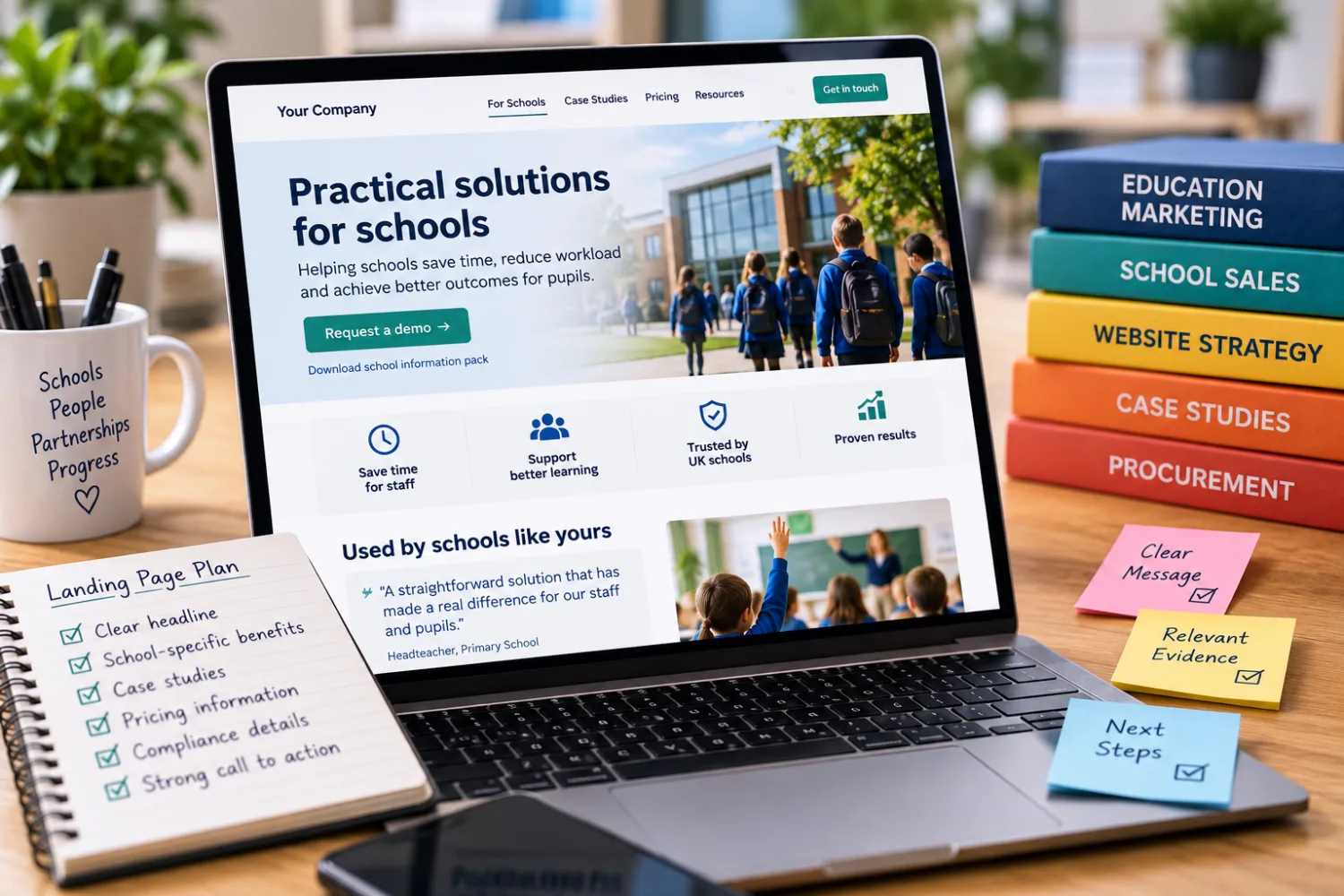

A good school proposal does more than describe your service. It helps a headteacher, school business manager, trust lead or governor understand why your offer is needed, why now, why you, and why the price is justified.
Many suppliers lose school opportunities not because their service is weak, but because their proposal is too vague, too long, too salesy or too hard to approve. Schools are busy. They need clear information that supports responsible decision-making.
If your proposal makes the school work harder, it slows the decision down. If your proposal answers the questions the school is already asking internally, you become easier to trust.
This guide explains how to write a school supplier proposal that is clear, credible and more likely to win contracts.
If you are still working out what schools expect before approving suppliers, read DBS checks, insurance and safeguarding requirements for businesses working with schools. If you need help setting prices before writing proposals, read How to price your services for schools without underselling yourself.
What makes school proposals different?
A school proposal is not the same as a normal sales brochure.
Schools are usually spending public money, trust money, grant funding, parent contributions or carefully managed school budgets. They may need to show value for money, compare suppliers, meet procurement rules, reassure governors or trustees, and check safeguarding and insurance before approving the work.
That means your proposal has two jobs.
First, it needs to persuade the person who wants the service. That might be a headteacher, SENCO, subject leader, pastoral lead, IT manager, estates manager or club coordinator.
Second, it needs to reassure the person who approves the spending. That might be a school business manager, finance officer, trust operations lead, procurement manager, governor or trustee.
A proposal that only excites the first person may still fail if it does not help the second person justify the decision.
The biggest mistake: writing about yourself before writing about the school
Many school proposals begin like this:
“We are an award-winning provider with over 15 years’ experience delivering high-quality services across the UK.”
There is nothing wrong with experience, but schools do not begin by caring about your history. They begin by caring about their problem.
A stronger opening sounds like this:
“This proposal sets out a practical programme to support Year 6 pupils who need additional confidence and structured practice before transition to secondary school.”
Or:
“Following our conversation, we understand the school is looking for a reliable provider to deliver after-school sports sessions from September, with clear safeguarding processes, consistent staffing and minimal admin for school staff.”
The difference is simple. The weak opening says, “Look at us.” The strong opening says, “We understand what you need.”
Before writing: understand what kind of school contract you are bidding for
Not every school opportunity needs the same kind of proposal.
A one-off £500 workshop does not need a 20-page tender response. A £30,000 annual service probably needs more detail. A trust-wide contract may need a formal bid, method statement, implementation plan, references, insurance evidence, safeguarding processes, data protection information and pricing schedule.
Before writing, identify the type of opportunity:
- Informal quote: usually for low-cost or simple purchases.
- Short proposal: useful for workshops, programmes, training, small projects or first-time school relationships.
- Formal tender response: often used for higher-value contracts, MAT opportunities, services across multiple schools or more complex procurement.
- Framework or preferred supplier application: used when schools or trusts want pre-approved suppliers.
- Renewal proposal: used when you already work with the school and want to continue or expand the relationship.
The Department for Education’s buying guidance encourages schools to get value for money and follow the right buying route. Its procurement guidance also explains that schools may need specifications, quotes, frameworks or more formal routes depending on what they are buying and the value of the purchase. You should therefore make your proposal proportionate: detailed enough to support approval, but not bloated for a small decision.
What schools are really looking for in a proposal
Schools may not always say it directly, but they are usually looking for answers to these questions:
- What problem does this solve?
- Why is this the right solution for our pupils, staff or site?
- How will it work in practice?
- What will it cost?
- What exactly is included?
- What evidence shows this supplier can deliver?
- Will this create extra work for staff?
- Are safeguarding, DBS and insurance requirements covered?
- Are data protection and confidentiality issues addressed?
- Does this represent value for money?
- What happens if something goes wrong?
- What is the next step if we want to proceed?
Your proposal should answer those questions clearly and early.
A winning school proposal structure
You do not need to reinvent the structure every time. Most school supplier proposals can follow this order:
- Proposal title and summary
- Understanding of the school’s need
- Recommended solution
- What is included
- Delivery plan and timeline
- Roles and responsibilities
- Safeguarding, DBS, insurance and compliance
- Evidence, experience and case studies
- Pricing and options
- Expected outcomes and success measures
- Terms, assumptions and next steps
This structure works because it follows the way schools think. It starts with need, moves into practical delivery, deals with risk, proves credibility, explains cost and ends with a clear decision route.
1. Proposal title and summary
Your title should be specific. Avoid generic titles like “Proposal for Services”. Use something that helps the school understand the purpose immediately.
Examples:
- “Proposal for Year 11 Maths Intervention Support — Spring Term”
- “School Grounds Maintenance Proposal for 2026–2027”
- “Cybersecurity Audit and Staff Awareness Training Proposal”
- “After-School Drama Club Proposal for Key Stage 2 Pupils”
- “Trust-Wide Catering Review and Mobilisation Proposal”
Then add a short summary. This should be no more than a few paragraphs.
A good summary might include:
- what the school needs;
- what you recommend;
- when it can happen;
- the main benefit;
- the total cost or pricing options;
- what the school needs to do next.
Busy school leaders may skim the whole document. Your summary should still give them the story.
2. Understanding of the school’s need
This is one of the most important sections. It proves that your proposal is not a copy-and-paste document.
Use what you know from the school’s enquiry, call, website, inspection priorities, phase, pupil age range or trust context. Be careful not to overstate what you know. If you are making assumptions, say so.
For example:
“Based on our conversation, we understand that the school is looking for a provider who can deliver weekly lunchtime sports activities for pupils in Years 3 to 6, with a focus on participation, behaviour support and inclusive activities rather than elite performance.”
Or:
“We understand that the trust is reviewing its approach to IT support across several schools and wants a clearer picture of current risk, response times, asset management and future infrastructure needs.”
This section does not need to be long. It needs to be accurate.
3. Recommended solution
Now explain what you propose to do.
Do not list everything your business offers. Recommend the best-fit option for this school.
For example, instead of:
“We offer workshops, assemblies, staff training, online resources, parent sessions and consultancy.”
Write:
“For this school, we recommend beginning with a half-term pilot for Year 8, combining two pupil workshops with one staff briefing. This gives the school a low-risk way to test pupil engagement before committing to a full-year programme.”
Schools value judgement. A proposal that explains why you recommend a particular route is stronger than one that simply presents a menu.
4. What is included
This is where many proposals fail. They describe the service in broad terms but do not make the deliverables clear.
Schools need to know exactly what they are buying.
Include details such as:
- number of sessions, days, visits, audits, reports, licences or workshops;
- year groups or staff groups included;
- maximum pupil numbers;
- whether planning calls are included;
- whether travel is included;
- whether materials or equipment are included;
- whether follow-up resources are included;
- whether reporting is included;
- whether training is included;
- what support is available after delivery.
Use a simple table if that makes it easier.
| Included | Details |
|---|---|
| Planning call | One 30-minute call with the school lead before delivery |
| Pupil sessions | Six weekly sessions for up to 20 pupils per group |
| Resources | Printable follow-up resources for school staff |
| Safeguarding documents | Insurance, DBS information and safeguarding policy provided before start date |
| Review | Short end-of-programme summary and review call |
Clear deliverables reduce confusion and make pricing easier to justify.
5. Delivery plan and timeline
Schools need to know how your proposal will fit around the school calendar.
Do not simply say “delivery to be agreed”. Give a realistic outline.
For example:
| Stage | Timing | What happens |
|---|---|---|
| Approval and booking | Week 1 | School confirms package, purchase order and preferred dates |
| Preparation | Week 2 | Planning call, safeguarding documents, pupil group information if needed |
| Delivery | Weeks 3 to 8 | Weekly sessions delivered on agreed day and time |
| Review | Week 9 | Summary, feedback and next-step recommendations |
This helps the school understand what needs to happen internally. It also shows that you have delivered in school environments before.
Timing is especially important if your work needs to be planned around budget cycles, exam periods, school holidays, INSET days, transition weeks or trust approval meetings. For more on timing, read Understanding school budget cycles: when UK schools actually spend money.
6. Roles and responsibilities
A good proposal explains not only what you will do, but what the school needs to do.
This prevents misunderstandings later.
You might include a simple split:
| Supplier responsibilities | School responsibilities |
|---|---|
| Provide trained delivery staff | Confirm the named school contact |
| Prepare session materials | Provide suitable room or space |
| Provide safeguarding and insurance documents | Share relevant pupil needs or access requirements |
| Deliver agreed sessions | Ensure school staff supervision where agreed |
| Provide a short review summary | Give feedback after delivery |
This is particularly useful for workshops, clubs, therapy services, facilities projects, IT implementations, transport services and anything involving pupil data or school site access.
7. Safeguarding, DBS, insurance and compliance
This section can make or break a school proposal.
You do not need to include every certificate in the proposal itself, but you should reassure the school that the right documents are available and that you understand school requirements.
Depending on your service, mention:
- DBS checks and whether they are basic, standard or enhanced where relevant;
- whether barred list checks apply for regulated activity;
- safeguarding policy;
- staff safeguarding training;
- public liability insurance;
- employers’ liability insurance;
- professional indemnity insurance;
- risk assessments;
- health and safety procedures;
- data protection and GDPR documents;
- image consent arrangements where photography or filming is involved;
- subcontractor checks where relevant.
A strong compliance paragraph might say:
“Before delivery, we will provide the school with our safeguarding policy, public liability insurance certificate, staff DBS details where required, risk assessment and named safeguarding contact. Our staff will follow the school’s signing-in, visitor and safeguarding procedures while on site.”
That kind of wording is practical and reassuring.
For a deeper guide, read DBS checks, insurance and safeguarding requirements for businesses working with schools.
8. Evidence, experience and case studies
Schools want to know that you can deliver in a real school environment, not just that your service sounds good.
Evidence might include:
- similar schools you have worked with;
- case studies;
- testimonials;
- before-and-after examples;
- pupil, parent or staff feedback;
- renewal rates;
- relevant qualifications;
- professional memberships;
- inspection or compliance experience;
- measurable outcomes.
Do not overload the proposal with every testimonial you have. Choose the most relevant evidence.
For example, if you are pitching to a small primary school, a case study from a similar primary school may be more persuasive than a big-name secondary trust. If you are pitching a MAT, evidence of multi-site delivery matters more.
A strong case study summary might look like this:
“In 2025, we delivered a six-week programme with a two-form-entry primary school facing similar lunchtime behaviour challenges. The school reported smoother transitions after lunch, positive staff feedback and chose to continue the programme for a second term.”
Notice that this is specific but concise. It gives the school confidence without turning the proposal into a brochure.
9. Pricing and options
Your proposal should make pricing easy to understand.
Avoid vague statements such as:
“Prices depend on requirements.”
Instead, give clear options.
| Option | Includes | Price |
|---|---|---|
| Pilot package | Two sessions, planning call and basic feedback summary | £X + VAT |
| Core package | Six sessions, resources, review call and summary report | £X + VAT |
| Full-year package | Termly delivery, staff briefing, resources and termly review | £X + VAT |
Three options often work well because they give schools flexibility without overwhelming them. The middle option is usually your recommended package.
Be clear about VAT, travel, materials, cancellation terms and whether the price is valid for a set period.
If the school has a fixed budget, do not simply cut your price. Adjust the scope. For example:
“If the school needs to remain within a lower budget, we recommend reducing the programme to four sessions rather than removing the planning and safeguarding elements that support safe delivery.”
This protects your value and helps the school make a responsible choice.
For more on this, read How to price your services for schools without underselling yourself.
10. Expected outcomes and success measures
Schools need to know what success will look like.
Be careful not to promise outcomes you cannot control. A tutoring provider should not guarantee exam grades. A wellbeing provider should not promise to “fix” anxiety. A facilities contractor should not promise zero disruption if the school has not confirmed access arrangements.
Instead, use realistic success measures.
Examples:
- pupils attend agreed sessions consistently;
- staff receive practical resources they can continue using;
- the school receives a written summary of findings;
- the project is delivered within the agreed timeline;
- equipment is installed and tested before pupils return;
- staff report increased confidence after training;
- the school has a clearer action plan after the audit;
- parents receive booking information by the agreed date;
- handover documentation is completed.
Good outcomes are specific, honest and relevant to the service.
11. Terms, assumptions and next steps
Every proposal should end with a clear next step.
Do not finish with a vague line such as:
“Please let us know what you think.”
Use something more practical:
“To proceed, please confirm your preferred option and issue a purchase order. We will then agree dates, arrange the planning call and send the safeguarding documents required before delivery.”
You should also include key assumptions, such as:
- prices are valid for 30 days;
- delivery dates are subject to availability;
- school staff supervision is required;
- travel is included within a certain area;
- additional sessions are charged separately;
- cancellation terms apply;
- the school must provide access, rooming or pupil information by a certain date;
- data processing terms must be agreed before access to systems or pupil data.
Clear terms reduce awkward conversations later.
How long should a school proposal be?
The proposal should be as long as it needs to be, and no longer.
As a general guide:
- One-off workshop or low-cost service: 1 to 3 pages is often enough.
- Termly or annual school service: 3 to 6 pages may be appropriate.
- MAT, facilities, IT, catering or higher-value contract: a longer formal proposal or tender response may be needed.
- Formal tender: follow the buyer’s requested format exactly.
If the school has provided a tender document, do not ignore its structure. Answer the questions in the order requested, provide the documents requested and stay within word limits. A beautifully written proposal can still lose if it does not follow instructions.
How to make your proposal easy to skim
School leaders and business managers may read your proposal between meetings, during a busy day or while comparing several suppliers. Make it easy for them.
Use:
- clear headings;
- short paragraphs;
- tables for pricing and deliverables;
- bold text sparingly;
- bullet points where helpful;
- plain English;
- specific examples;
- a short summary at the beginning;
- a clear next step at the end.
Avoid:
- long company history sections;
- generic education buzzwords;
- unexplained acronyms;
- huge blocks of text;
- over-designed PDFs that are hard to print;
- claims without evidence;
- prices hidden in the small print.
Language that helps school buyers say yes
The best school proposals use calm, practical language. They sound confident without sounding pushy.
Useful phrases include:
- “Based on the school’s priorities...”
- “To reduce admin for staff...”
- “This option gives the school a lower-risk starting point...”
- “The package can be scaled if the school wants to extend delivery...”
- “Documents can be provided before the booking is confirmed...”
- “This supports planning for the next academic year...”
- “The price includes preparation, delivery and follow-up...”
- “The school will have one named contact throughout...”
- “We recommend this option because...”
Less helpful phrases include:
- “Act now before prices rise.”
- “This is a no-brainer.”
- “We are the best in the market.”
- “Schools love us.”
- “You cannot afford not to do this.”
- “Use up your remaining budget.”
Schools are more likely to respond to professionalism than pressure.
How to write proposals for different types of school suppliers
For tutoring and intervention providers
Focus on pupil need, delivery model, group size, safeguarding, reporting, attendance, curriculum alignment and realistic outcomes. Explain whether sessions are one-to-one, small group, online, in person or hybrid. Be clear about what feedback the school receives.
For wellbeing, therapy and SEND providers
Focus on qualifications, safeguarding, referral process, confidentiality, supervision, boundaries, reporting and how your work fits alongside school staff. Avoid overpromising emotional or clinical outcomes.
For after-school clubs and enrichment providers
Focus on pupil experience, staffing, ratios, safeguarding, booking process, parent communication, equipment, behaviour expectations and what the school needs to provide.
For IT, edtech and cybersecurity companies
Focus on implementation, data protection, technical support, training, integration, security, access control, downtime, onboarding and renewal terms. Schools need to understand both the educational value and the operational risk.
For facilities and maintenance contractors
Focus on site survey findings, method, health and safety, timing, disruption management, insurance, materials, warranties, access requirements and handover. Schools will care about safety and reliability as much as price.
For catering, transport, uniform and photography suppliers
Focus on parent experience, reliability, safeguarding, communication, complaints handling, affordability, operational process and service continuity. These services affect families directly, so schools will want confidence that you can manage relationships professionally.
What to include in a formal tender response
If a school or trust issues a formal tender, your proposal needs to follow the buyer’s instructions exactly. Do not rely on a generic sales proposal.
Formal tender responses may ask for:
- company information;
- financial standing;
- insurance levels;
- DBS and safeguarding processes;
- health and safety documents;
- data protection information;
- method statement;
- implementation plan;
- service levels;
- quality assurance;
- business continuity;
- references;
- pricing schedule;
- social value or sustainability information;
- conflict of interest declarations.
Read the evaluation criteria carefully. If the tender says quality is worth 60% and price is worth 40%, do not spend all your energy being the cheapest and neglect the quality response. If safeguarding is scored, answer it thoroughly. If mobilisation is scored, show a credible timeline.
How to improve a weak proposal
Here is an example of a weak proposal paragraph:
“We can provide high-quality workshops for your pupils. Our sessions are fun, engaging and educational. We have lots of experience and can tailor the workshop to your needs. Please contact us for more information.”
It sounds positive, but it does not help the school approve anything.
Here is a stronger version:
“We recommend a half-day workshop for up to 60 Year 5 pupils, delivered in two groups of 30. The session will support the school’s enrichment week by giving pupils a practical, age-appropriate introduction to creative problem-solving. The price includes a planning call, delivery by two trained facilitators, all materials, public liability insurance and a follow-up resource for class teachers.”
The stronger version gives the school detail, confidence and a reason to take the next step.
How to follow up after sending a proposal
Do not send a proposal and then chase vaguely.
A useful follow-up should help the school make progress.
For example:
“I wanted to check whether the proposal gives you everything needed for internal approval. If helpful, I can also send a one-page summary with the pricing options and safeguarding documents listed.”
Or:
“You mentioned the proposal may be discussed at the next SLT meeting. Would it help if I provided a shorter version focused on cost, timing and expected outcomes?”
Or:
“If budget is the main issue, we can keep the core outcomes but reduce the first phase to a smaller pilot.”
Good follow-up is not pestering. It removes friction.
Proposal checklist for school suppliers
Before sending your next school proposal, check that it answers these questions:
- Is the school’s need clearly described?
- Is the recommended solution specific?
- Have you explained why this option is right?
- Are deliverables clearly listed?
- Is the timeline realistic?
- Are school responsibilities clear?
- Is the price easy to understand?
- Have you said whether VAT is included or excluded?
- Have you included safeguarding, DBS and insurance information where relevant?
- Have you addressed data protection if pupil data is involved?
- Have you included relevant evidence or testimonials?
- Have you explained expected outcomes?
- Are assumptions and terms clear?
- Is there a simple next step?
- Can a busy school leader understand the proposal in five minutes?
Useful external resources
- DfE Buying for Schools — official guidance on DfE-approved buying options and value for money.
- Buying procedures and procurement law for schools — guidance on specifications, routes to buy and school procurement processes.
- Route 3: get at least 3 quotes from suppliers — DfE guidance for low or medium value purchases where schools compare suppliers.
How All Schools can help you get considered by schools
A strong proposal helps once a school is already interested. But schools also need to find your business in the first place.
A clear supplier profile can help schools discover you when they are researching options, comparing providers or planning future contracts. You can explore the All Schools supplier directory or learn how to join the school suppliers directory.
You may also find these guides useful:
- How to start selling to schools in the UK
- What schools ask before approving a new supplier
- How schools vet external providers
- MATs vs individual schools: who should suppliers target first?
The bottom line
A winning school proposal is not the longest proposal or the most polished design. It is the proposal that makes the decision easier.
It shows that you understand the school’s need. It explains what you will do. It proves you can deliver. It makes the price clear. It addresses safeguarding, insurance and compliance. It gives the school a simple route to say yes.
Schools are under pressure. They do not have time to decode vague offers or chase missing information. If your proposal is clear, practical and school-ready, you immediately stand out from suppliers who only send a brochure and hope for the best.
The best proposal does not just sell your service. It helps the school feel confident choosing you.
FAQs
How long should a proposal for a school be?
It depends on the value and complexity of the work. A small workshop or one-off service may only need 1 to 3 pages. A termly or annual service may need 3 to 6 pages. A formal MAT or higher-value tender may require a much longer response following the buyer’s format.
What should I include in a school proposal?
Include the school’s need, your recommended solution, what is included, delivery timeline, pricing, safeguarding and insurance information, relevant evidence, expected outcomes and clear next steps. The proposal should help the school justify the decision internally.
Should I include prices in the proposal?
Yes. Schools need clear pricing to compare options and seek approval. If the final cost depends on scope, provide pricing options or typical ranges. Be clear about VAT, travel, materials and any additional costs.
How do I make my proposal stand out from other suppliers?
Show that you understand the specific school, not just the sector. Use relevant evidence, clear deliverables, realistic outcomes and a practical implementation plan. Make compliance and onboarding easy for the school.
Do I need to include DBS and safeguarding information in every proposal?
If your work involves pupils, school sites or sensitive information, you should include a short compliance section. You do not need to attach every document immediately, but you should say what checks, policies and insurance are available.
What is the difference between a quote and a proposal?
A quote mainly gives a price for specific goods or services. A proposal explains the need, recommended solution, delivery plan, evidence, compliance and price. For simple purchases, a quote may be enough. For higher-value or more complex work, a proposal is usually stronger.
Should I send a PDF proposal or put it in an email?
For small opportunities, a well-structured email may be enough. For larger opportunities, a PDF can look more professional and is easier to share internally. The key is that it must be easy to read, print and forward.
How soon should I follow up after sending a school proposal?
Give the school a reasonable amount of time, usually several working days unless they gave you a specific date. Follow up with a helpful question, such as whether they need a shorter summary, safeguarding documents or adjusted pricing options for approval.
What should I do if the school says the proposal is too expensive?
Do not immediately discount the same package. Ask what budget they are working with and whether scope can be adjusted. You may be able to offer a pilot, reduce sessions, phase delivery or remove optional extras while protecting your core value.
Can one proposal template work for every school?
You can use a repeatable structure, but the content should be tailored. Schools can usually spot generic proposals. At minimum, customise the need, recommended solution, timeline, evidence and pricing to match the school’s context.