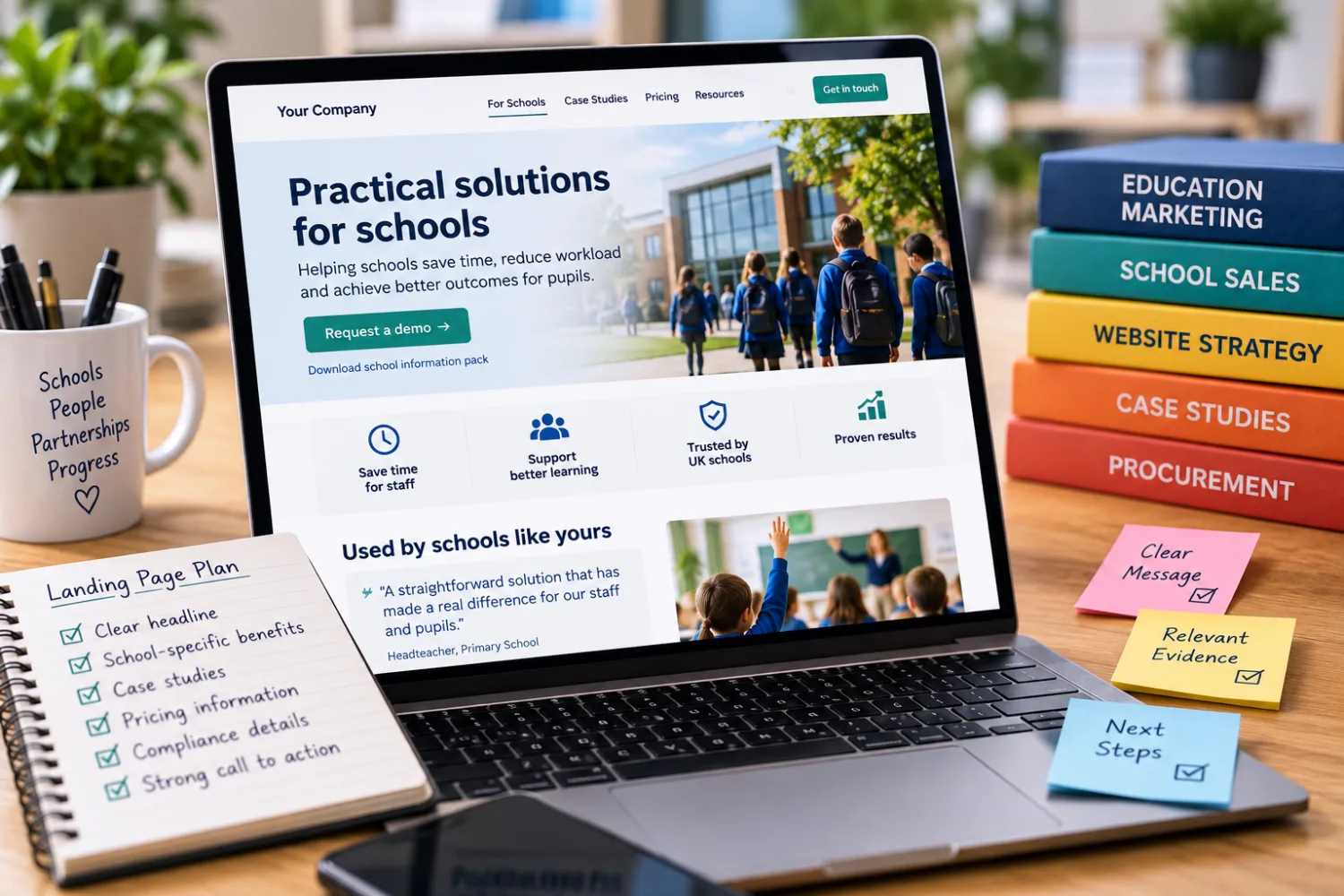

Headteachers do not have time to decode long supplier brochures. They are managing pupils, staff, safeguarding, parents, budgets, behaviour, attendance, inspections, governors, trust priorities and the daily interruptions of school life. If your first document asks them to work too hard, they will probably not read it.
That is why a good one-pager matters. It is not a mini brochure. It is not a sales poster. It is not a compressed version of your whole website. A strong one-pager gives a school leader just enough information to understand the problem you solve, who you help, what the offer involves, why it is credible, what it costs and what the next step is.
For school suppliers, a one-pager can be one of the most useful assets you create. It can support cold outreach, follow-up emails, MAT approval conversations, event meetings, referrals, procurement discussions and internal forwarding. But only if it is written for the reader, not for the supplier.
This guide explains how to write a one-pager that a headteacher will actually read, what to include, what to leave out, how to structure it and how to avoid the common mistakes that make school leaders close the attachment after five seconds.
What is a one-pager?
A one-pager is a short, focused document that explains your offer clearly on a single page. For schools, it should usually be designed to answer a practical question:
Is this relevant enough for us to consider further?
It is not supposed to close the whole sale. It is supposed to earn the next conversation.
A good one-pager helps a headteacher, school business manager, SENCO, subject leader, trust lead or governor quickly understand:
- what you do;
- which school problem you solve;
- who it is for;
- how it works;
- what makes it credible;
- what the school would need to do next;
- how much time, money or effort it may require.
If your one-pager does not answer those questions quickly, it is not doing its job.
Why headteachers ignore most supplier material
Most supplier documents are ignored for one of four reasons.
First, they are too long. A school leader opens a PDF and sees six pages of background, founder story, brand language and product features. They close it.
Second, they are too vague. They say things like “transform outcomes”, “empower learners”, “support wellbeing” or “raise standards” without explaining what actually happens in school.
Third, they create work. They make the school leader wonder: Who would run this? How much does it cost? Is safeguarding covered? Will IT need to approve it? How long does setup take? Is this for primary, secondary or both?
Fourth, they are not written for the right person. A headteacher does not need the same level of technical detail as an IT manager. A school business manager does not need the same emotional pitch as a parent. A SENCO does not need generic claims about “all learners” when they need specifics about needs, support and evidence.
A one-pager works when it respects the reader’s role and time.
The golden rule: make the decision easier
The best one-pagers reduce uncertainty. They do not try to impress through length, design or buzzwords. They make it easier for a school leader to decide whether to continue the conversation.
Your one-pager should help the reader think:
- “I understand what this is.”
- “I know which problem it addresses.”
- “I can see whether it fits our school.”
- “I know what it would involve.”
- “I can forward this to the right colleague.”
- “I know what to ask next.”
If a headteacher has to reply with basic questions such as “What age group is this for?” or “How much does it cost?” your one-pager has probably failed.
Start with the school problem, not your company
Many suppliers start with themselves:
We are an award-winning provider of innovative educational solutions with a passion for helping schools succeed.
This sounds polished, but it does not tell the school anything useful.
Start with the problem instead:
A six-week reading fluency programme for Year 7 pupils who can decode accurately but read too slowly to access the secondary curriculum confidently.
Or:
A practical attendance mentoring service for pupils at risk of persistent absence, designed to support schools before absence patterns become entrenched.
Or:
On-site IT network health checks for schools preparing for summer upgrades, trust audits or recurring connectivity issues.
These examples work because they tell the reader what the offer is, who it is for and why it matters.
Use a clear headline
Your headline should make the offer obvious. Avoid clever slogans. Headteachers do not have time to interpret them.
Weak headline:
Unlocking Potential Through Innovation
Better headline:
Small-Group Maths Intervention for Year 5 Pupils Below Expected Standard
Weak headline:
Empowering Tomorrow’s Learners
Better headline:
STEM Workshops for Primary Schools, Delivered On Site With Full Risk Assessments
A good headline should pass the skim test. If the reader only sees the title, they should still understand the offer.
Include a one-sentence summary
Under the headline, add one sentence that explains the offer in plain English.
Use this formula:
We help [type of school or role] achieve [specific outcome] through [specific service or product].
Examples:
- “We help primary schools improve reading fluency through short, structured small-group sessions delivered by trained tutors.”
- “We help secondary schools reduce low-level disruption by training staff to use consistent routines across tutor time, corridors and lessons.”
- “We help MAT IT teams identify network risks before summer upgrade projects through a one-day technical audit and written action plan.”
If you cannot summarise your offer in one sentence, the offer may not be clear enough yet.
Show who it is for
Schools need to know quickly whether your offer fits them. Be specific.
Include details such as:
- primary, secondary, special school, sixth form or MAT;
- year groups;
- subject area;
- pupil group;
- staff group;
- school problem;
- delivery location;
- whether it is for one school or multiple schools.
For example:
Best suited for: primary schools with pupils in Years 3 to 6 who need additional fluency and comprehension support after assessment.
Or:
Best suited for: secondary schools and MATs reviewing behaviour routines before September.
Specificity helps the right schools say yes and the wrong schools opt out quickly. That is a good thing.
Explain the outcome, not just the activity
Schools are not buying activities. They are buying improvement, capacity, reassurance, compliance, time, confidence or support.
Do not only say what you do. Say what changes because of it.
Instead of:
We deliver six workshops.
Write:
Pupils complete six workshops and leave with a finished project, improved subject vocabulary and teacher feedback notes for follow-up lessons.
Instead of:
We provide CPD for staff.
Write:
Staff leave with a shared routine, classroom scripts and a two-week implementation plan that leaders can review.
Headteachers care about what happens after the supplier has left.
Use a simple structure
A strong school one-pager can use this structure:
- Headline: what the offer is.
- One-sentence summary: who it helps and how.
- The problem: the school issue it addresses.
- The offer: what is included.
- Why it works: evidence, experience or rationale.
- What schools need to know: time, cost, safeguarding, setup or requirements.
- Best fit: who it is most suitable for.
- Next step: what the reader should do.
This structure is easy to scan and easy to forward internally.
Do not hide the practical details
Suppliers often avoid practical details because they want the school to book a call first. That can backfire. School leaders may not have time for a call if they do not already know whether the offer is plausible.
Include practical details such as:
- session length;
- programme length;
- delivery format;
- age range;
- staff required;
- room or equipment needed;
- whether it is online or in person;
- lead time;
- setup process;
- price or price range;
- safeguarding documents available;
- data protection status, if relevant.
You do not need to include every contract detail, but you should remove obvious uncertainty.
Be brave enough to mention price
Some suppliers avoid pricing entirely. They worry that a school will reject them before a conversation. But vague pricing can be just as damaging.
Headteachers and school business managers need to know whether your offer is roughly affordable. If you cannot give an exact price because the work varies, give a starting point or typical range.
For example:
- “From £450 for a half-day workshop.”
- “Typical school package: £1,200 to £1,800 depending on pupil numbers.”
- “Trust pricing available for three or more schools.”
- “Annual licence from £2.50 per pupil, minimum school fee applies.”
If pricing is complex, say what affects it. Do not force the school to book a meeting just to discover that the offer is far outside budget.
For more help, read How to Price Your Services for Schools.
Make safeguarding and compliance visible where relevant
If your service involves pupils, school sites, data, technology, trips, mentoring, tutoring, wellbeing, coaching, photography, clubs or SEND work, schools will think about risk.
Your one-pager does not need to include every policy, but it should reassure the reader that you understand school requirements.
You might include a small section called “Compliance ready” or “Documents available”, listing:
- safeguarding policy;
- DBS information;
- public liability insurance;
- risk assessments;
- data protection information;
- cyber security information;
- staff training records;
- references from schools.
This is especially important if you are approaching MATs or hoping to become an approved supplier. See What “Approved Supplier” Status Actually Means in a MAT and What a DBS Check Covers — and What Schools Still Need to Verify Themselves.
Write for forwarding
Your first reader may not be the final decision-maker. A headteacher might forward your one-pager to the SENCO. A school business manager might send it to the headteacher. A trust procurement lead might send it to an education director. A subject leader might send it to SLT.
That means your one-pager must make sense without your email attached.
Include:
- your organisation name;
- what you do;
- who it is for;
- contact details;
- website;
- pricing or pricing route;
- next step;
- date or version, if the offer changes over time.
A one-pager that can be forwarded easily is much more useful inside a school.
Use evidence carefully
Evidence matters, but it must be believable. Avoid huge claims unless you can support them properly.
Weak evidence:
Our programme transforms outcomes and guarantees progress.
Better evidence:
In a 2025 pilot with three primary schools, participating pupils improved their reading fluency scores over six weeks. Schools also reported stronger pupil confidence in reading aloud.
Or:
Used by 28 schools across two MATs. References available from primary, secondary and special school settings.
Or:
Built around evidence-informed principles: explicit instruction, guided practice, retrieval and regular feedback.
Schools do not expect every small supplier to have a randomised controlled trial. They do expect honesty, clarity and no overclaiming.
Use a short case study
A tiny case study can be more persuasive than a list of claims.
Keep it to three lines:
Example: A two-form-entry primary school used our Year 5 maths fluency programme with 18 pupils over one half-term. Teachers reported improved recall and greater confidence in multi-step problem solving. The school now uses the model each spring for pupils identified through assessment.
This works because it shows context, action and result.
If you need help building stronger school proof, read How to Get a Case Study or Testimonial From a School and Use It to Win More Work.
Avoid “award-winning” unless it matters
Awards, accreditations and partnerships can help, but only if they are relevant. Do not lead with “award-winning” if the reader still does not know what you actually do.
If you include credibility markers, keep them brief:
- “Used by 40 UK primary schools.”
- “Delivered across four academy trusts.”
- “Developed by qualified teachers and speech and language specialists.”
- “Cyber Essentials certified.”
- “References available from similar schools.”
Credibility should support the offer, not replace it.
Make the design clean, not decorative
A one-pager should be easy to scan. Design matters, but clarity matters more.
Use:
- a clear headline;
- short sections;
- simple headings;
- enough white space;
- bullet points where useful;
- one or two visual elements at most;
- consistent fonts;
- clear contact details.
Avoid:
- tiny text;
- too many icons;
- large blocks of text;
- busy backgrounds;
- stock images that take half the page;
- multiple competing colours;
- QR codes with no written link;
- design that looks nice but hides the actual offer.
Headteachers are not judging your design portfolio. They are trying to understand whether your offer is useful.
Use plain English
Education writing often becomes full of abstract language. Avoid phrases that sound impressive but do not say much.
Replace:
- “bespoke solutions” with “tailored support for Year 7 literacy groups”;
- “holistic provision” with “academic mentoring plus weekly attendance check-ins”;
- “stakeholder engagement” with “parent workshops and staff briefing materials”;
- “transformational outcomes” with “improved reading fluency and confidence”;
- “innovative platform” with “online tool for tracking homework completion”.
Plain English is not simplistic. It is respectful.
Tailor the one-pager by audience
You may need more than one version. A headteacher one-pager should not be identical to a school business manager one-pager or a MAT procurement one-pager.
For headteachers
Focus on school priorities, pupil outcomes, workload, implementation, evidence and fit.
For school business managers
Focus on pricing, procurement, insurance, contracts, timing, renewals and value for money.
For SENCOs
Focus on pupil need, referral criteria, qualifications, reports, safeguarding, parent communication and impact.
For MAT leaders
Focus on scalability, consistency, compliance, trust pricing, implementation across schools and reporting.
For subject leaders
Focus on curriculum fit, subject outcomes, teacher workload, resources and assessment.
The core offer may be the same, but the emphasis should change.
Match the one-pager to the school calendar
A one-pager is more likely to be read if it fits the timing of the school year.
For example:
- In spring, focus on budget planning and September readiness.
- In June, focus on implementation before September.
- In October, focus on early-year problems that are now visible.
- In November, focus on January interventions.
- Before exam season, focus on revision, confidence and targeted support.
- Before transition periods, focus on Year 6 to Year 7 or new starter support.
Do not send the same one-pager all year with no timing context. Schools work to a rhythm. Your materials should too.
For more on timing, read The School Year Calendar Every Supplier Should Plan Around and How Schools Decide Their September Budget in the Summer Term.
Include a clear next step
Many one-pagers end weakly. They explain the offer, then stop.
Tell the reader what to do next. Keep it low-pressure.
Good next steps include:
- “Reply to request a 15-minute school-fit call.”
- “Ask for the full compliance pack.”
- “Request sample materials.”
- “Book a short demo for your SENCO or literacy lead.”
- “Send us your preferred term and pupil numbers for a quote.”
- “Forward this to your school business manager for pricing and procurement details.”
A good next step should feel easy. Do not ask for a one-hour meeting when a 15-minute call or sample pack would be enough.
Do not make the one-pager do too many jobs
A one-pager should not try to be:
- a full brochure;
- a contract;
- a safeguarding policy;
- a detailed technical specification;
- a pricing catalogue;
- a case study library;
- a company history;
- a lesson plan;
- a procurement submission.
It should open the door. Other documents can follow once the school is interested.
A practical one-pager template
You can use this structure for most school supplier one-pagers.
[Offer headline]
One-sentence summary: We help [school type/role] with [specific problem] through [specific service/product].
The problem this solves
- Short description of the school challenge.
- Why it matters now.
- Which pupils, staff or systems are affected.
What is included
- Item 1
- Item 2
- Item 3
- Optional follow-up or reporting
Best suited for
- School phase or type
- Year groups or staff group
- Specific need or context
What schools need to know
- Delivery format
- Time required
- Staff involvement
- Setup or lead time
- Safeguarding, insurance or data documents available
Evidence or experience
- Short case study, school reference, impact summary or relevant expertise
Pricing
From £[amount] / Typical package £[range] / Quote based on [factor].
Next step
Reply to [email] to request [sample pack / 15-minute call / quote / compliance pack].
Example one-pager wording for a tutoring provider
Targeted Maths Tutoring for Year 6 Pupils Close to Expected Standard
Summary: We help primary schools provide short, focused maths tutoring for Year 6 pupils who are close to expected standard but need extra fluency and reasoning practice.
The problem: Some pupils understand the main curriculum content but lose marks because number facts, problem-solving language or multi-step reasoning are not secure.
What is included:
- Six-week small-group tutoring programme.
- Initial gap check using school assessment information.
- Two 40-minute sessions per week.
- Short progress summary for class teacher.
- Optional parent update template.
Best suited for: Year 6 pupils who are close to expected standard but need targeted practice before summer assessment.
School requirements: Quiet room, group of four to six pupils, class teacher contact for initial gap discussion.
Compliance: Safeguarding policy, DBS information, insurance and references available.
Pricing: From £950 for a six-week group programme.
Next step: Reply to request a sample intervention plan and availability for next half-term.
Example one-pager wording for a CPD provider
Practical Behaviour Routines CPD for Secondary Schools
Summary: We help secondary schools strengthen consistency by training staff in simple, shared routines for lesson starts, transitions and low-level disruption.
The problem: Behaviour systems often fail when staff use different routines in different classrooms. Pupils receive mixed messages and leaders spend more time responding to incidents.
What is included:
- Two-hour twilight or half-day INSET session.
- Practical routines staff can use immediately.
- Behaviour scripts and implementation checklist.
- Leader follow-up guide for the first two weeks.
- Optional coaching visit after implementation.
Best suited for: Secondary schools reviewing behaviour consistency before September or after a behaviour policy update.
Evidence: Developed by former senior leaders and used with secondary schools in mixed urban and suburban contexts.
Pricing: From £750 for twilight CPD. Trust pricing available.
Next step: Request the session outline and implementation checklist.
Example one-pager wording for an edtech provider
Homework Tracking Dashboard for Secondary Pastoral Teams
Summary: We help secondary schools identify homework patterns quickly so tutors and heads of year can intervene before missed work becomes persistent.
The problem: Homework concerns are often visible to individual teachers before pastoral teams can see the wider pattern across subjects.
What is included:
- Dashboard showing missed homework by pupil, subject and year group.
- Weekly tutor summary.
- Parent communication export.
- Setup support for school administrators.
- Staff training video and helpdesk support.
Best suited for: Secondary schools using homework as part of behaviour, parental engagement or academic support strategy.
School requirements: MIS or homework platform integration discussion required before setup.
Compliance: Data processing agreement, cyber security information and technical specification available.
Pricing: Annual licence from £2.80 per pupil, minimum school fee applies.
Next step: Book a 20-minute technical fit call with your IT or data lead.
Common mistakes to avoid
Most weak one-pagers make at least one of these mistakes:
- They start with the company rather than the school problem.
- They use vague claims such as “raise standards” without specifics.
- They hide pricing completely.
- They do not say who the offer is for.
- They include too many services on one page.
- They rely on design instead of clarity.
- They include too much founder story.
- They do not mention safeguarding or data where relevant.
- They make the next step too big.
- They cannot be forwarded easily.
- They are not tailored to the school calendar.
- They sound like every other supplier.
The fix is usually not better graphics. It is sharper thinking.
How to send the one-pager
The email matters too. Do not attach a one-pager to a long, generic message. Keep the email short and make the attachment feel useful.
Example:
Hello [Name],
I know schools are currently planning support for September. We help secondary schools run short reading fluency interventions for Year 7 pupils who are finding the curriculum hard to access.
I have attached a one-page summary with the offer, timings, pricing and safeguarding documents available. Would it be useful to send sample materials for your literacy lead?
Best wishes,
[Name]
This is short, relevant and easy to answer.
For more on outreach, read How to Build a School Outreach List That Matches Your Offer and How to Follow Up Schools Professionally.
How to test whether your one-pager works
Before sending it to schools, test it. Ask someone who does not know your business to read it for 30 seconds, then ask:
- What do we offer?
- Who is it for?
- What problem does it solve?
- What would the school need to do?
- Is the next step clear?
- What is confusing?
If they cannot answer, a busy headteacher probably will not either.
When a one-pager is not enough
A one-pager is usually an early-stage document. Some situations need more detail after initial interest.
You may later need:
- a full proposal;
- case studies;
- safeguarding pack;
- data protection documents;
- technical specification;
- risk assessments;
- sample resources;
- implementation timeline;
- contract terms;
- references.
That is fine. The one-pager’s job is to make the school want the next document or conversation.
For the next stage, see How to Write a Proposal That Wins School Contracts.
A final checklist before you send
Before sending your one-pager to a school, check:
- Can the offer be understood in 10 seconds?
- Does the headline say what it is?
- Is the school problem clear?
- Does it say who the offer is for?
- Does it explain what is included?
- Does it mention practical requirements?
- Is pricing clear enough?
- Are safeguarding, insurance or data documents referenced where relevant?
- Is there evidence or school experience?
- Is the next step easy?
- Can it be forwarded internally without explanation?
- Is it genuinely one page?
Final thoughts
A one-pager that a headteacher will actually read is clear, specific and useful. It does not try to impress with jargon. It does not hide the practical details. It does not make the reader hunt for the point.
The best one-pagers show that you understand schools. They start with a real problem, explain the offer simply, show who it is for, give enough practical detail, provide credibility, and make the next step easy.
For suppliers, this is more than a marketing document. It is a test of whether your offer is clear. If you can explain it well on one page, a school leader is far more likely to give you the next conversation.
Frequently Asked Questions
What should a school supplier one-pager include?
It should include a clear headline, one-sentence summary, the school problem, what is included, who it is for, practical requirements, evidence or experience, pricing guidance and a clear next step.
How long should a one-pager be?
It should fit on one page. If it needs more than one page, it is probably a short proposal rather than a one-pager.
Should I include pricing on a one-pager?
Yes, where possible. If exact pricing varies, include a starting price, typical range or explanation of what affects the quote. Schools need to know whether the offer is broadly affordable.
Should a one-pager include images?
Images can help, but they should not take over the page. A clear layout with useful information is more important than decorative graphics.
What is the biggest mistake suppliers make?
The biggest mistake is making the one-pager about the supplier instead of the school’s problem. Headteachers need to know what issue you solve and why it matters for their school.
Can I use the same one-pager for every school?
You can use the same core structure, but the best one-pagers are tailored by audience, school phase, timing or problem. A MAT leader, SENCO, headteacher and school business manager may need different emphasis.
Should I mention safeguarding and DBS?
Yes, if your work involves pupils, school sites or sensitive activity. You do not need to include full policies, but you should state that relevant documents are available.
How should I send a one-pager to a headteacher?
Send it with a short, relevant email. Explain why the offer may be useful now, attach the one-pager, and suggest a small next step such as sending sample materials or arranging a brief call.
Is a one-pager enough to win school work?
Usually, no. A one-pager is designed to earn attention and open a conversation. Larger decisions may need a full proposal, references, compliance documents, pricing detail and procurement review.
How can I make my one-pager stand out?
Be specific. Name the school problem, the pupil or staff group, the outcome, the practical details and the next step. Clear and useful beats flashy and vague.
Should I include testimonials?
A short testimonial or mini case study can help, especially if it comes from a similar school. Keep it brief and relevant.
How do I know if my one-pager is clear enough?
Ask someone to read it for 30 seconds and explain what you offer, who it is for and what the next step is. If they cannot, simplify it before sending.