
For many businesses, schools are an attractive but confusing market.
There are thousands of schools across the UK. They buy services, book suppliers, plan trips, use software, arrange training, maintain buildings, run clubs, commission support and work with external providers. If you sell something genuinely useful to schools, it is understandable to ask: can I get a school email list and contact them?
The answer is not as simple as “yes” or “no”.
School email lists can be useful, but they can also create problems if they are badly sourced, poorly targeted or used without care. A list of school email addresses is not a magic shortcut to sales. It is only useful if the data is accurate, relevant, lawful to use, and matched to a message schools actually want to receive.
This guide explains what UK businesses should know before using school email lists, buying school contact data, building their own outreach list, or emailing schools for the first time.
This article is general information, not legal advice. If you are planning a large campaign, using named personal data, buying third-party data or working in a sensitive sector, speak to a data protection professional before sending.
What is a school email list?
A school email list is a collection of email addresses and related information used to contact schools, academy trusts or education decision-makers.
A basic list might include:
- school name;
- school email address;
- telephone number;
- postal address;
- school phase, such as primary or secondary;
- local authority area;
- region or postcode;
- website address.
A more detailed list might also include:
- academy trust name;
- school type;
- pupil age range;
- number of pupils;
- senior leadership contacts;
- business manager or office contact details;
- SENCO, department or role-based contacts;
- procurement or trust-level contacts;
- notes about the school’s needs, location or suitability.
Some lists contain mostly generic addresses such as office@, admin@ or enquiries@. Others include named staff addresses such as first.last@schoolname.sch.uk. That difference matters because named staff emails are personal data.
A school email list is not automatically good or bad. Its value depends on how it was collected, how accurate it is, how relevant it is to your offer and how responsibly you use it.
Why businesses want school email lists
Businesses want school email lists because schools can be difficult to reach.
Most suppliers quickly discover that “selling to schools” is not like selling to ordinary consumers. The decision-maker is not always obvious. A headteacher may influence one purchase, a school business manager another, a trust central team another, and a department lead another. Some schools buy independently. Others follow trust-level procurement rules. Some decisions are made quickly; others sit inside annual budget planning.
A well-built school email list can help a business:
- identify relevant schools;
- avoid wasting time on unsuitable prospects;
- focus on the right region or school type;
- contact schools at the right time of year;
- build a more professional outreach process;
- track who has been contacted and who has opted out;
- measure which types of schools respond best.
This can be especially useful for businesses such as:
- school suppliers;
- school trip venues;
- tutoring and intervention providers;
- after-school club providers;
- CPD and training providers;
- SEND and therapy services;
- school photographers;
- catering companies;
- cleaning and facilities businesses;
- IT, software and edtech companies;
- sports coaching and wellbeing providers.
But the biggest mistake is thinking that a bigger list is always better. It usually is not.
A list of 500 highly relevant schools may be more valuable than a spreadsheet of 25,000 addresses that includes the wrong phases, wrong regions, wrong contacts and outdated details.
Are school email lists legal in the UK?
School email lists are not automatically illegal in the UK. Businesses can hold and use school contact data in many legitimate situations.
However, legality depends on several things:
- what data is included;
- where the data came from;
- whether it identifies individuals;
- what the data is used for;
- whether the marketing rules apply;
- whether recipients can opt out;
- whether opt-outs are recorded and respected;
- whether the communication is fair, relevant and transparent.
In the UK, two areas are especially important:
- PECR — the Privacy and Electronic Communications Regulations, which cover electronic marketing such as emails and texts.
- UK GDPR — which applies when you process personal data, including named work email addresses.
The Information Commissioner’s Office has useful guidance on business-to-business marketing and electronic mail marketing.
The practical point is this:
You may be allowed to email schools in many business-to-business situations, but you still need to use the data responsibly.
If you are unsure about the email marketing rules themselves, read this related guide first: Can You Email Schools Legally in the UK?
Generic school emails and named staff emails are not the same
One of the most important things to understand is the difference between generic school addresses and named staff addresses.
Generic or role-based addresses might include:
- office@schoolname.sch.uk
- admin@schoolname.sch.uk
- info@schoolname.sch.uk
- enquiries@schoolname.sch.uk
- bursar@schoolname.sch.uk
- headteacher@schoolname.sch.uk
Named addresses might include:
- jane.smith@schoolname.sch.uk
- m.patel@schoolname.sch.uk
- sarah.jones@academytrust.org
A generic school email is usually attached to the organisation or a role. A named staff email identifies a person, so it is personal data. This does not mean you can never use named work emails, but it does mean UK GDPR applies.
If you collect and use named staff emails, you should be able to explain:
- where the data came from;
- why you are using it;
- why the person is relevant to your offer;
- what lawful basis you rely on;
- how the person can object or opt out;
- how long you will keep the data;
- how you will keep it accurate and secure.
For many first-time school outreach campaigns, generic school addresses can be a sensible starting point. They are often less intrusive and may be enough if your message is clearly relevant and can be forwarded internally.
For specialist services, a named or role-specific contact may sometimes be more appropriate. For example, a SEND therapy provider may need to reach a SENCO, while an IT infrastructure provider may need to reach a trust IT lead or school business manager.
The key is not just “can we find the email address?” The better question is: is this the right person or route for this message?
Where do school email lists come from?
School email lists can come from different sources. Some are official, some are public, some are built manually, and some are sold by third-party data providers.
Common sources include:
- official government school data;
- school websites;
- academy trust websites;
- local authority directories;
- education directories;
- event and exhibition leads;
- existing customers and enquiries;
- LinkedIn and professional networks;
- manually researched contact lists;
- third-party school data providers.
In England, the official public source many businesses look at is the Department for Education’s Get Information About Schools service, often known as GIAS. It allows users to search and download information about schools, trusts and other education establishments.
Public data can be useful, but public does not mean unlimited. If you use public school data for marketing, you still need to think about relevance, fairness, privacy, opt-outs and data protection rules.
For example, if a school publishes an email address for safeguarding concerns, it would not be appropriate to use that address for a sales campaign. If a school publishes a general office email for enquiries, a relevant supplier introduction may be more reasonable.
Data source matters. So does context.
Should you buy a school email list?
Buying a school email list may be tempting. It looks quick. It promises access. It can feel easier than researching schools manually.
But buying data is not automatically safe or effective.
Before buying a school email list, ask the provider serious questions:
- Where did the data come from?
- When was it last updated?
- Does it include generic emails, named emails or both?
- Which countries does it cover?
- Does it separate England, Wales, Scotland and Northern Ireland?
- Does it identify school phase and type?
- Does it include academy trust data?
- How are opt-outs handled?
- What rights do you have to use the data?
- Has the data been collected fairly?
- Are there any restrictions on marketing use?
- What happens if a recipient complains?
Be cautious if a provider makes vague claims such as “GDPR compliant school emails” without explaining what that actually means. GDPR compliance is not a label that magically attaches to a spreadsheet. Compliance depends on how data is collected, shared, documented, stored and used.
Also be cautious with very cheap, very large lists. School data changes frequently. Staff move. Schools merge. Trusts change. Email formats change. Generic addresses stop working. Named contacts become outdated. A stale list can damage deliverability and make your business look careless.
A bought list may still have value, but only if it is accurate, transparent, well-segmented and used responsibly.
What makes a good school email list?
A good school email list is not simply a long list. It is a usable, targeted and well-maintained dataset.
For most businesses, a strong school email list should include:
- Accurate school names — including current school status and correct spelling.
- Correct contact details — checked and updated regularly.
- School phase — primary, secondary, all-through, special, nursery, sixth form or alternative provision.
- Location data — postcode, town, county, local authority or region.
- School type — maintained school, academy, free school, independent school, special school, etc.
- Trust information — especially where decisions may be made by a multi-academy trust.
- Relevant role data — only where appropriate and responsibly sourced.
- Segmentation fields — so you can filter the list properly.
- Opt-out records — so you do not keep contacting people who have objected.
- Source and update notes — so you know where the information came from and when it was reviewed.
Segmentation is especially important.
A school trip venue does not need every school in the UK. It may need primary schools within 45 miles, plus special schools where accessibility is strong. A school uniform supplier may need local schools and academies. An edtech platform may need secondary schools, MATs or curriculum leads. A cleaning company may need schools in a specific service area.
Good data helps you send fewer emails, not more.
That may sound strange, but it is true. The best school outreach list helps you remove unsuitable schools before you contact them.
How to build your own school outreach list
Many businesses are better off building a smaller list themselves instead of buying a huge one.
A simple process might look like this:
1. Define your ideal school
Start with the schools most likely to need your offer. Do you work with primary schools, secondary schools, special schools, independent schools, nurseries, MATs or colleges? Are you local, regional or national? Is your offer linked to a specific age group, curriculum area or budget holder?
2. Decide who the right contact is
Do not assume the headteacher is always the best person. Depending on your offer, the right contact may be the office manager, business manager, SENCO, trips coordinator, PE lead, trust procurement lead, IT manager, HR lead or department head.
3. Use reliable public sources
Use official data, school websites, academy trust websites and local authority directories. For England, Get Information About Schools is a useful starting point.
4. Record why each school is relevant
Add a note explaining why the school is on your list. For example: “primary school within 30 miles”, “secondary school with sixth form”, “special school suitable for SEND workshop”, or “MAT with central procurement team”.
5. Keep the first version small
Start with 50 to 200 well-matched schools rather than thousands. Test your message. Measure replies. Improve the list before scaling.
6. Track opt-outs and responses
Use a CRM, spreadsheet or email platform to record who has replied, who is interested, who asked not to be contacted, and who should be followed up later.
If you want a deeper guide on this stage, read How to Build a School Outreach List That Matches Your Offer.
How to use a school email list responsibly
Once you have a school email list, the next challenge is using it well.
A responsible school outreach process should include the following.
Use clear sender details
Recipients should know who is contacting them. Use a real business name, real domain and real contact details. Avoid hidden identities or confusing sender names.
Make the subject line honest
Do not use fake “Re:” subject lines, false urgency or misleading phrases. A simple subject line is usually better.
Examples:
- “School trip visits for KS2 pupils”
- “Local sports coaching for primary schools”
- “IT support for academy trusts”
- “Mental health workshops for secondary schools”
Explain why the email is relevant
Do not make the school do all the work. Explain the connection quickly:
- because they are local;
- because they teach the relevant age group;
- because the service fits their school type;
- because the offer supports a common school need;
- because the timing is linked to school planning.
Include an opt-out
Every marketing email should include a simple way to opt out. For a small one-to-one campaign, this might be a reply such as “no thanks”. For larger campaigns, use a proper unsubscribe link and suppression list.
Respect opt-outs immediately
This is essential. If someone asks not to be contacted, record it and stop. Do not re-import the same contact later from another spreadsheet and email them again.
Do not over-follow-up
One polite follow-up may be reasonable. Repeated chasing is rarely a good idea. Schools are busy, and silence often means the timing, offer or recipient is not right.
Avoid unnecessary attachments
Many schools are cautious about attachments. In a first email, it is usually better to link to a relevant page, one-page summary, supplier profile or booking information page.
For more on the message itself, read How to Write a One-Pager That a Headteacher Will Actually Read and How to Follow Up Schools Professionally.
What school suppliers often get wrong
The biggest problem with school email lists is not the list itself. It is how businesses use the list.
Common mistakes include:
- emailing every school with the same generic message;
- contacting schools outside the realistic service area;
- emailing the wrong role or department;
- using outdated or unverified data;
- sending long emails with too much detail;
- making exaggerated claims;
- failing to include an opt-out;
- continuing to email after an opt-out;
- sending large attachments in the first email;
- following up too many times;
- emailing during obviously bad periods, such as exam pressure or school holidays, without considering timing.
Another mistake is thinking that schools only care about price. Price matters, but schools also care about risk, reliability, safeguarding, evidence, workload, value, procurement and whether the supplier understands how schools operate.
This is why your list and your message need to work together.
A cleaning company should not sound like an edtech startup. A school trip venue should not sound like a software provider. A wellbeing provider should not sound like a facilities contractor. Each audience has different concerns.
If you want schools to take your business seriously, show that you understand their world.
These guides may help:
- What Schools Ask Before Approving a New Supplier
- Requirements for Businesses Working With Schools
- Understanding School Budget Cycles
School email lists are only one route to schools
Email can be useful, but it should not be your only route into the school market.
Schools often need to trust a supplier before they reply. A cold email works better when the recipient can quickly check who you are, what you offer and whether you look credible.
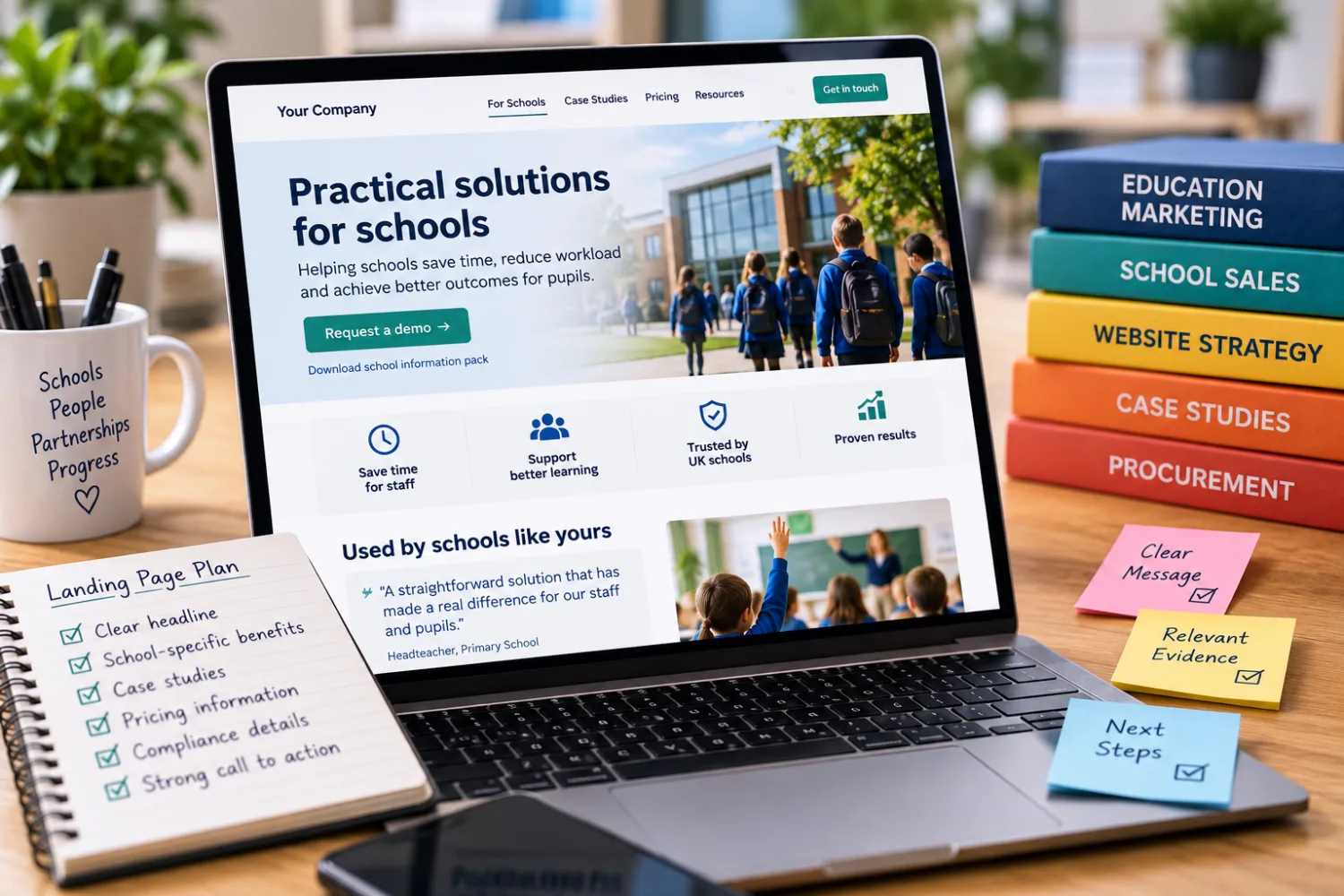
That means your outreach should be supported by:
- a clear website page for schools;
- case studies or testimonials;
- pricing or at least clear buying information;
- safeguarding and insurance information where relevant;
- risk assessment details for school trip venues;
- downloadable teacher or school information packs;
- directory listings;
- LinkedIn activity;
- education events and local networks;
- useful content that answers school questions.
If a school receives your email and searches your business name, what will they find?
If they find a thin website, no school-specific information and no proof that you understand education, the email is less likely to work. If they find a clear school page, useful details, examples and a professional supplier profile, the same email becomes stronger.
If you want your business to be easier for schools to discover, you can create a profile here: Join the School Suppliers Directory.
If you run a school trip venue or educational visit provider, this may be more relevant: Join School Trips & Educational Visits.
So, should your business use a school email list?
A school email list can be useful if your offer is genuinely relevant to schools and you use the data responsibly.
But a list will not fix a weak offer, poor timing or a vague message.
Before using any school email list, ask yourself:
- Do we know exactly which schools are a good fit?
- Do we know who is likely to make or influence the decision?
- Is our message relevant to this school type?
- Can we explain where the data came from?
- Are we using named personal data or generic school data?
- Have we included a clear opt-out?
- Can we record and respect opt-outs?
- Does our website support the email?
- Are we contacting schools at a sensible time?
The best school email strategy is not about sending as many emails as possible. It is about contacting the right schools with the right message at the right time.
Used badly, a school email list can make your business look careless. Used well, it can help you build real conversations with schools that genuinely need what you offer.
FAQ: School email lists in the UK
Are school email lists legal in the UK?
School email lists are not automatically illegal. However, how they are collected, stored and used matters. If the list includes personal data, such as named staff email addresses, UK GDPR applies. If you use the list for marketing, PECR may also apply. You should use the data fairly, include opt-outs and respect objections.
Can I buy a list of school email addresses?
You can buy school data, but you remain responsible for how you use it. Before buying a list, ask where the data came from, how recently it was updated, whether it includes personal data, what rights you have to use it, and how opt-outs are handled.
Can I email schools without consent?
In many business-to-business situations, you may be able to email schools without prior consent, especially when contacting corporate or organisational addresses. However, you must still follow the rules, identify yourself clearly, provide an opt-out and process personal data lawfully where UK GDPR applies.
Is a school office email personal data?
A generic email such as office@ or admin@ is usually less likely to identify an individual. A named email such as jane.smith@schoolname.sch.uk is personal data. Role-based addresses can depend on context, especially if they clearly relate to one person.
What is the best source of school data in England?
The Department for Education’s Get Information About Schools service is an official public source for information about schools, academy trusts and education establishments in England. Businesses may also use school websites, trust websites and other public sources, but should still use the data responsibly.
Should I email headteachers?
Not always. Headteachers are busy and may not be the right contact for every offer. Depending on your service, a school business manager, office manager, SENCO, department lead, trips coordinator, trust procurement lead or IT manager may be more suitable.
How big should a school email list be?
Big is not always better. A smaller list of highly relevant schools is usually more useful than a large generic list. Start with the schools most likely to need your offer and expand once you know your message works.
Do I need an unsubscribe link?
You should always provide a clear way to opt out. For larger campaigns, an unsubscribe link and suppression list is best. For smaller direct outreach, allowing recipients to reply “no thanks” may be workable, but you must record and respect the request.
Can I use school website emails for marketing?
Sometimes, but be careful. Publicly available does not mean unrestricted. Consider why the email was published, whether your message is relevant, whether personal data is involved and whether the recipient can opt out easily.
What should I include in a first email to a school?
Include who you are, why the school is relevant, what you offer, how it helps, where they can find more information and how they can opt out. Keep it short and specific.
Why do schools ignore supplier emails?
Schools often ignore emails because they are too generic, sent to the wrong person, badly timed, too long, unclear or not relevant. They may also be cautious about unknown suppliers. Better targeting and a clearer school-specific offer usually improve results.
What is better than buying a school email list?
Often, the best approach is to build a smaller targeted list from reliable sources, combine it with a strong school-specific website page, create useful content, add your business to relevant directories and follow up professionally.