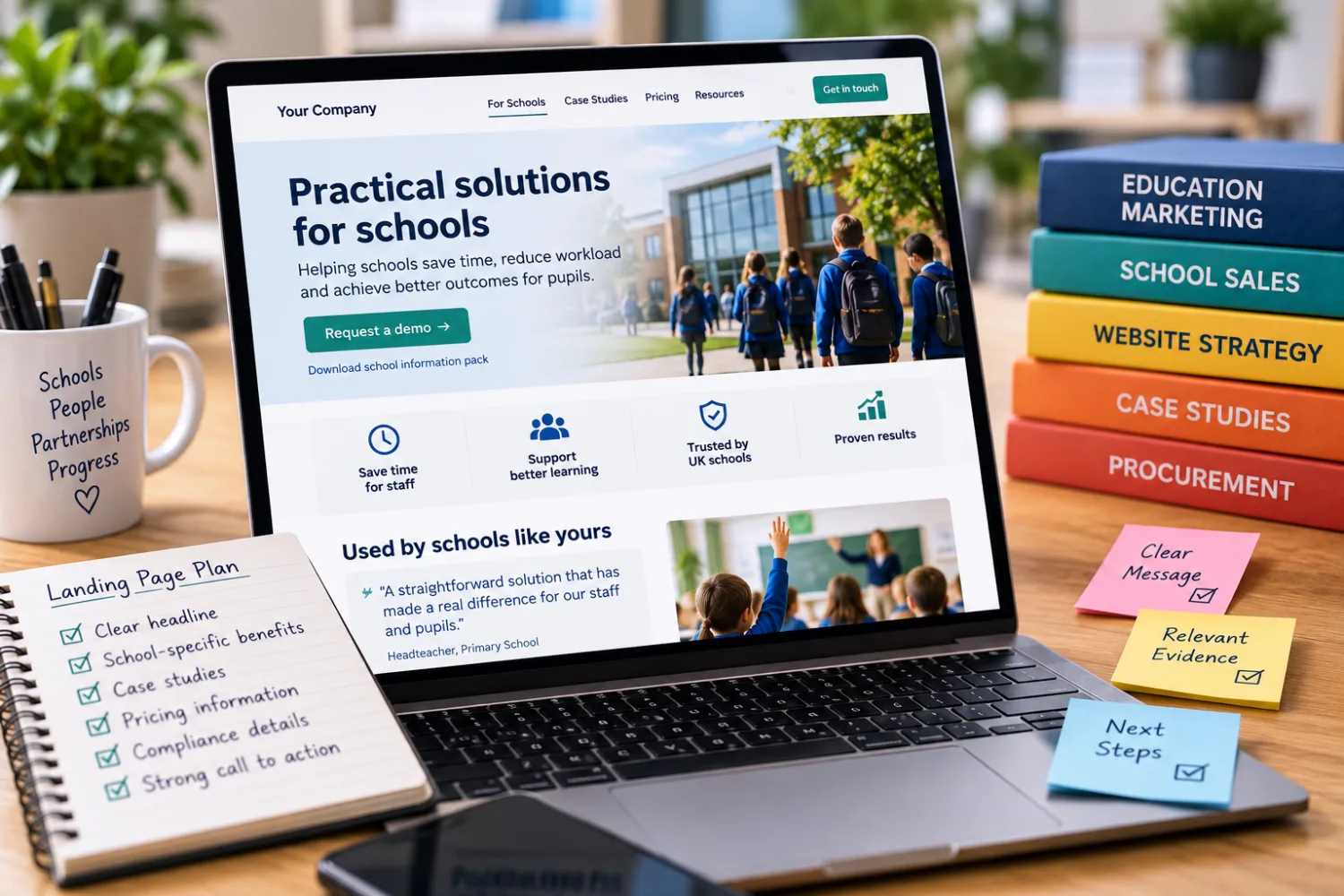

A good school testimonial can do what a sales email cannot. It shows that a real school trusted you, worked with you and found value in what you delivered.
For businesses selling to schools, this matters. Schools are cautious buyers. They want to know whether you understand the school environment, whether your service works in practice, whether you are safe and reliable, and whether other schools would recommend you.
A case study or testimonial gives them that reassurance.
But many suppliers either never ask for one, ask at the wrong time, or collect vague comments that do not help win future work. A line like “Great service, thank you” is nice, but it rarely moves a school closer to buying.
This guide explains how to get useful testimonials and case studies from schools, how to ask professionally, what to include, and how to use them in your marketing without creating extra work or compliance concerns for the school.
Why school testimonials are so powerful
Schools trust evidence from other schools because school staff understand each other’s pressures.
A headteacher wants to know whether your service will be worth the time and money. A school business manager wants to know whether you are organised and easy to deal with. A SENCO wants to know whether you understand pupils’ needs. A trust lead wants to know whether you can deliver consistently across more than one setting.
Your own marketing can make claims. A school testimonial supports those claims with experience.
For example, you can say:
“We reduce admin for school staff.”
But it is stronger when a school says:
“The provider handled the setup, parent communication and session resources clearly, which meant our staff did not have to chase or manage the process.”
That kind of quote answers a real buying concern. It tells another school, “This supplier will not create extra work for you.”
The difference between a testimonial and a case study
A testimonial is usually a short quote from a school contact. It might be one sentence, a short paragraph or a few bullet points. It is useful for websites, proposals, emails, social media and supplier directory profiles.
A case study is more detailed. It explains the school’s starting point, what you delivered, how the work went and what changed afterwards. It may include quotes, outcomes, photos, data or a short story of the project.
Both are useful, but they serve slightly different purposes.
| Type | Best for | Typical length |
|---|---|---|
| Short testimonial | Website pages, proposals, email follow-ups, supplier profiles | 1 to 4 sentences |
| Detailed testimonial | Proposal evidence, sector pages, service pages | 1 to 3 short paragraphs |
| Mini case study | Sales emails, one-page PDFs, LinkedIn posts | 200 to 500 words |
| Full case study | Website resource, tender evidence, MAT conversations | 600 to 1,200 words |
If you are new to selling to schools, start with short testimonials. They are easier to collect and still valuable. As you build stronger relationships, turn your best projects into case studies.
When to ask a school for a testimonial
Timing matters. Ask too early and the school may not have seen the benefit yet. Ask too late and the detail may be forgotten.
The best time is usually shortly after a successful delivery moment.
That might be:
- after a workshop has gone well;
- after a termly programme ends;
- after staff give positive feedback;
- after pupils respond well to a session;
- after a project is completed on time;
- after a renewal is agreed;
- after the school refers you to another school;
- after a review meeting where impact is discussed;
- after a problem has been handled professionally and resolved.
The easiest moment is when a school has already said something positive. If a teacher emails “The pupils loved it”, or a business manager says “Thanks, that was really smooth”, do not just reply with “Thank you”. Ask whether you may turn that feedback into a short testimonial.
For example:
“Thank you — that is lovely to hear. Would you be comfortable with us using that as a short testimonial? I can draft a version for you to approve so it does not create extra work.”
This works because you are not asking the school to start from a blank page.
Who should you ask?
Ask the person who can speak honestly about the value of the work.
Depending on your service, that might be:
- headteacher;
- deputy headteacher;
- assistant headteacher;
- school business manager;
- SENCO;
- pastoral lead;
- subject leader;
- office manager;
- IT manager;
- estates manager;
- trust operations lead;
- club coordinator;
- teacher who worked directly with you.
The best person is not always the most senior person. A quote from a SENCO may be more useful for a SEND service than a generic quote from a headteacher. A quote from a school business manager may be more useful for a supplier selling operational services because it speaks to reliability, admin and value for money.
If you can, collect different types of testimonials for different buyers. A headteacher quote may help with strategic value. A business manager quote may help with approval. A teacher quote may help with delivery confidence.
Make it easy for the school to say yes
School staff are busy. If your request feels like another task, it may get ignored even when the school is happy with your work.
Do not send a message like this:
“Could you send us a testimonial when you get a chance?”
That puts all the work on the school.
Instead, make the request specific and low effort.
“Would you be happy to provide a short testimonial about the programme? Two or three sentences would be perfect. To make it easier, I have included three prompt questions below.”
Or:
“I know time is tight, so I can draft a short quote based on your feedback and send it for approval before using it anywhere.”
Schools are more likely to help when you respect their time.
Use prompt questions instead of asking for a generic quote
Generic requests create generic testimonials. Better questions create better evidence.
Instead of asking “Can you give us a testimonial?”, ask questions that help the school describe the real value.
Useful prompt questions include:
- What problem or need were you trying to address?
- Why did you choose our service?
- What was the delivery process like?
- How did pupils, staff or parents respond?
- What difference did the work make?
- What did we make easier for the school?
- What would you say to another school considering us?
- Would you work with us again?
You do not need to ask all of these. Three well-chosen questions are usually enough.
A simple testimonial request email you can use
Here is a practical template you can adapt.
Subject: Quick testimonial request
Hi [Name],
Thank you again for working with us on [project/service]. We really enjoyed supporting [school name], and it was great to hear that [specific positive feedback or result].
Would you be happy to provide a short testimonial we could use on our website, proposals or school supplier profile?
Two or three sentences would be perfect. If helpful, you could answer any of these:
- What were you hoping to achieve?
- What was it like working with us?
- What would you say to another school considering the service?
We would not publish anything without your approval. If you prefer, I can draft a short version based on your feedback and send it to you to edit or approve.
Best wishes,
[Your name]
This is clear, polite and easy to respond to.
A stronger version for a case study request
If you want a fuller case study, ask for permission first and make the process feel manageable.
Subject: Would you be open to a short case study?
Hi [Name],
We are putting together a few short school case studies to help other schools understand how our work runs in practice.
Would [school name] be open to being featured in a short case study about [project/service]?
We would keep the process simple. I can draft the case study based on what we delivered and send it to you for review. Nothing would be published until you approve the final version.
The case study would cover:
- the need or challenge;
- what we delivered;
- how the process worked;
- any feedback or outcomes you are happy to share;
- a short approved quote if suitable.
If you would prefer the school not to be named, we can also create an anonymised version, such as “a two-form-entry primary school in the South West”.
Best wishes,
[Your name]
The final line is important. Some schools may be willing to help but unable to be publicly named. An anonymised case study is still useful if it is specific enough to be credible.
What makes a school testimonial useful?
A useful testimonial is specific. It says something another school cares about.
Weak testimonial:
“Excellent service. Highly recommended.”
Better testimonial:
“The sessions were well organised, age-appropriate and easy for staff to manage. Pupils were engaged throughout, and the provider handled the planning clearly from start to finish.”
Even better:
“We needed a reliable provider who could deliver Year 7 confidence-building workshops with minimal disruption to the school day. The team planned carefully with staff, adapted to our timetable and delivered sessions pupils genuinely responded to.”
The best testimonials usually mention one or more of these:
- the problem the school had;
- why your approach worked;
- how pupils responded;
- how staff responded;
- how easy you were to work with;
- reliability and communication;
- value for money;
- reduced workload for staff;
- evidence of impact;
- willingness to work with you again.
How to turn feedback into a polished testimonial
Schools may send feedback that is useful but messy. That is normal. You can turn it into a polished quote, but you must not change the meaning.
For example, a teacher might email:
“Just wanted to say today went really well. The pupils were really into it and your team managed the group brilliantly. It was nice not having to sort lots of extra resources.”
You could draft this for approval:
“The pupils were really engaged, and the team managed the group brilliantly. The session was easy for staff to support, with resources prepared clearly in advance.”
Then send it back:
“Would you be happy for us to use the following version as a testimonial? Please feel free to edit it.”
This makes the quote cleaner while still keeping the school in control.
What should a school case study include?
A strong school case study should tell a simple story. It does not need to be dramatic. It needs to be clear.
Use this structure:
- School context
- The challenge or need
- The solution
- How delivery worked
- Results or feedback
- What happened next
- Approved quote
1. School context
Briefly describe the school. For example:
- primary, secondary, special school or alternative provision;
- single school or part of a MAT;
- approximate size if relevant;
- region if the school agrees;
- year group or department involved.
If the school is not being named, keep the context useful but not identifying.
2. The challenge or need
Explain why the school was looking for support. Keep this respectful. Do not make the school look weak.
For example:
“The school wanted to strengthen transition support for Year 6 pupils before secondary transfer.”
That is better than:
“The school was struggling with anxious pupils and needed help.”
Schools will not approve case studies that embarrass them.
3. The solution
Explain what you delivered. Be specific.
Include:
- number of sessions or days;
- year groups or staff involved;
- delivery format;
- resources or reports provided;
- timeline;
- any adaptations made for the school.
4. How delivery worked
This is where you show reliability. Schools want to know what the process was like.
Mention things such as:
- planning call;
- clear communication;
- safeguarding documents provided;
- risk assessment;
- timetable flexibility;
- staff briefing;
- minimal admin;
- smooth setup;
- professional conduct on site.
This part is often more persuasive than the headline outcome because it answers the school’s fear: “Will this supplier make life harder?”
5. Results or feedback
Use honest evidence. This might be qualitative or quantitative.
Examples include:
- pupil attendance;
- staff feedback;
- parent comments;
- number of pupils reached;
- improved confidence reported by staff;
- reduced admin time;
- project completed on schedule;
- renewal for another term;
- extension to another year group;
- referral to another school.
Do not exaggerate. Schools can spot inflated claims. A modest but credible result is better than a dramatic claim without evidence.
6. What happened next
If the school booked again, expanded the work or recommended you, mention it with permission.
For example:
“Following the pilot, the school booked a second programme for the next term and asked us to adapt the materials for a younger year group.”
Renewals are powerful evidence because they show the school valued the work enough to continue.
7. Approved quote
End with a quote that summarises the value.
Keep it specific, natural and not too polished. A quote should sound like a real school person, not a marketing slogan.
Named vs anonymised case studies
A named case study is usually stronger because it gives credibility. “St Mark’s Primary School” feels more concrete than “a school”.
However, not every school will agree to be named. That is fine.
An anonymised case study can still work if it includes useful detail:
- “a two-form-entry primary school in Kent”;
- “a large secondary academy in the Midlands”;
- “a special school supporting pupils aged 7 to 16”;
- “a five-school multi-academy trust in the North West”;
- “a rural primary school with mixed-age classes.”
Make sure the detail does not accidentally identify the school if they have asked to stay anonymous.
Get permission before publishing
Always get permission before using a school’s name, logo, staff quote, pupil feedback, photographs, data or identifiable details.
This is not just about politeness. It is about trust, data protection and the school’s own policies.
A testimonial may include personal data if it uses a staff member’s name, job title, school name, photograph or other identifying information. If you are using that material for marketing, you need to be clear about what you will use, where you will use it and whether the person or school can withdraw permission later.
At minimum, confirm:
- the exact wording of the quote;
- the name and job title to be used;
- whether the school name can be used;
- whether the school logo can be used;
- where the testimonial or case study may appear;
- whether photos or pupil work will be included;
- who has approved publication;
- how the school can request changes or removal.
For official guidance on consent and data protection, see the ICO guidance on consent and ICO guidance on marketing and data protection.
A simple permission wording template
Use clear approval wording so there is no confusion.
“Please confirm that you are happy for [business name] to use the quote below in our marketing materials, including our website, proposals, social media and supplier directory profiles. We will attribute the quote as: [name, job title, school name]. We will not make changes to the quote without approval. You can contact us at any time if you would like us to amend or remove it.”
If the school prefers anonymity:
“Please confirm that you are happy for [business name] to use the anonymised quote below in our marketing materials. We will attribute it as: [role], [type of school/region if approved]. We will not name the school or include identifying details.”
Keep a record of the approval.
Be careful with pupil comments
Pupil comments can be powerful, but they need extra care.
For example:
“I used to be nervous about speaking in class, but the workshop helped me feel more confident.”
That kind of quote may be useful, but you should not publish it without appropriate school approval and, where needed, consent arrangements. Avoid identifying pupils unless the school has explicitly managed the permissions.
Often, the safest approach is to use pupil feedback in aggregated or anonymised form:
- “Pupils described the session as enjoyable and easy to understand.”
- “Several pupils said they felt more confident asking questions afterwards.”
- “The school reported strong engagement from pupils across the year group.”
This still gives useful evidence without creating unnecessary risk.
Be careful with school logos
Do not add a school logo to your website just because you worked with the school. A logo is not the same as a testimonial.
Some schools and trusts have strict rules about logo use. Some may allow a written quote but not logo use. Others may allow their name in a case study but not their crest or branding.
Ask directly:
“Are you happy for us to include the school name and logo, or would you prefer the case study to use the school name only?”
If in doubt, leave the logo out.
Use testimonials in your proposals
Testimonials are especially powerful inside proposals because they help the school imagine working with you.
Do not place all testimonials at the end. Put them near the part of the proposal they support.
For example:
- use a quote about smooth admin near your delivery plan;
- use a quote about pupil engagement near your programme description;
- use a quote about reliability near your implementation timeline;
- use a quote about value for money near your pricing;
- use a quote about safeguarding professionalism near your compliance section.
If you are writing proposals for school contracts, read How to write a proposal that wins school contracts.
Use case studies to answer objections
The best case studies are not just success stories. They are objection-handling tools.
Think about the doubts schools may have before buying from you:
- Will this fit our timetable?
- Will pupils engage?
- Will staff need to do lots of extra work?
- Is this worth the money?
- Can this supplier handle safeguarding requirements?
- Can they work with a school like ours?
- Can they deliver across multiple sites?
- Will parents understand the process?
- Will the project be completed on time?
Then build case studies that answer those doubts.
For example, if schools worry that your service creates too much admin, write a case study focused on how you handled setup, communication and follow-up. If schools worry about cost, use a case study showing value, renewal or clear outcomes. If MATs worry about consistency, use a case study showing multi-school delivery.
Where to use school testimonials
Once approved, testimonials can be used in many places.
Useful locations include:
- your homepage;
- service pages;
- sector-specific school pages;
- proposal documents;
- email follow-ups;
- LinkedIn posts;
- one-page PDFs;
- tender responses;
- supplier directory profiles;
- sales presentations;
- webinar slides;
- exhibition materials;
- renewal conversations.
If you are listed in the All Schools supplier directory, a strong testimonial can make your profile more convincing. You can also learn how to join the school suppliers directory if your business is not yet listed.
Use different testimonials for different audiences
One testimonial will not persuade every school buyer.
A headteacher may care about whole-school impact. A business manager may care about value, reliability and admin. A SENCO may care about pupil needs and communication. A trust lead may care about consistency, reporting and scalability.
Organise your testimonials by theme:
- Pupil impact: engagement, confidence, learning, wellbeing.
- Staff experience: easy to manage, useful resources, clear communication.
- Operational reliability: punctual, organised, professional, low admin.
- Safeguarding and compliance: documents ready, procedures followed.
- Value for money: clear pricing, good outcomes, renewal.
- MAT delivery: consistency across multiple schools.
Then choose the right quote for the right opportunity.
How to use a case study in a sales email
Do not attach a long case study to a cold email and expect a busy school leader to read it. Use a short version in the email and link to the full case study if available.
For example:
“We recently supported a two-form-entry primary school with a six-week confidence programme for Year 6 pupils. The school wanted support that was easy for staff to manage before transition. After the pilot, they booked a second programme for the following term. I can send the short case study if helpful.”
This is more effective than saying, “Please see attached brochure.”
For more on outreach, read How to get your business in front of UK schools without cold calling.
How to use case studies on LinkedIn
LinkedIn can work well for reaching school business managers, headteachers, trust leaders and education professionals, but only if your posts are useful rather than self-congratulatory.
A good case study post might follow this structure:
- Start with the school problem.
- Explain what you delivered.
- Share one useful lesson or result.
- Include an approved quote if you have one.
- End with a gentle next step.
Example:
“A primary school we worked with wanted Year 6 pupils to feel more confident before transition. Instead of adding extra work for staff, we designed a short programme with ready-to-use resources and a simple review at the end. The biggest lesson: transition support works best when it is practical, calm and easy for teachers to embed. The school has now booked the programme again for next year.”
This is better than:
“Another amazing school loved working with us!”
Useful posts build trust. Boastful posts are easy to ignore.
How to build case studies into your delivery process
The best time to think about case studies is before the project ends.
Build evidence collection into your normal delivery process:
- ask what success would look like at the start;
- record what you delivered;
- collect feedback during or immediately after delivery;
- note practical details such as pupil numbers, timelines and adaptations;
- ask for a testimonial after a positive moment;
- request permission while the work is still fresh;
- store approved quotes and usage permissions carefully.
This makes testimonials easier because you are not trying to reconstruct the story months later.
A simple case study template
You can use this structure for your own website or proposal documents.
School context: [Type of school, phase, location or anonymised description]
The need: [What the school wanted to improve, solve or provide]
What we delivered: [Sessions, service, project, product, timeline]
How it worked: [Planning, communication, safeguarding, delivery process]
Outcome: [Feedback, result, renewal, reduced workload, pupil response]
School quote: “[Approved quote]”
Next step: [What the school did next, if relevant]
This format is simple, but it covers what future school buyers need to know.
What if the school says no?
Sometimes a school will not be able to provide a testimonial. That may be because of policy, workload, internal approval, sensitivity, staff changes or a simple preference not to be used in marketing.
Do not push.
You can reply:
“No problem at all — thank you for letting me know. We really appreciate the opportunity to work with the school.”
If appropriate, you can ask whether an anonymised version would be acceptable, but only once and without pressure.
“Would an anonymised version be possible, or would you prefer us not to refer to the project at all?”
If the answer is still no, respect it. Protecting the relationship is more important than getting the quote.
What if the feedback is positive but not polished?
This is common. School staff may write quickly and informally.
Your job is to preserve the meaning while making the quote usable. You can lightly edit for grammar, remove repetition and shorten it, but always send the edited version back for approval.
Never turn a mild comment into a stronger claim.
For example, do not turn:
“The workshop was useful and pupils seemed engaged.”
into:
“This was a transformational workshop that changed pupil outcomes.”
That damages trust.
What if you do not have any school testimonials yet?
If you are new to the school market, you can still build evidence.
Start with:
- pilot projects;
- small first bookings;
- feedback forms;
- quotes from relevant non-school clients;
- professional references;
- evidence of qualifications or experience;
- examples of resources or delivery plans;
- anonymous feedback from early school conversations;
- before-and-after project photos where appropriate and approved.
You can also ask your first school clients upfront whether they would be open to giving feedback after the work, without making it a condition of the service.
For example:
“As we are building our school case studies, we may ask for feedback after delivery. There is no obligation, and we would only use anything publicly with your approval.”
For help getting those first conversations, read How to start selling to schools in the UK.
How testimonials support pricing
Strong testimonials make it easier to charge properly because they show value beyond the headline price.
If a school testimonial says your service saved staff time, improved pupil engagement, reduced admin or delivered reliably, future schools are less likely to judge you only on cost.
Use testimonials near your pricing when they support value.
For example:
“The provider was not the cheapest option, but the planning, communication and quality of delivery made the programme excellent value for money.”
That kind of quote is powerful because it addresses the exact moment when a school is deciding whether your price is justified.
For more on sustainable pricing, read How to price your services for schools without underselling yourself.
How testimonials support safeguarding confidence
If your work involves pupils, schools will care about safeguarding and professionalism. A testimonial can help reassure them.
For example:
“The team provided all safeguarding and insurance documents in advance, followed our school procedures and worked professionally with pupils and staff throughout.”
This quote may not sound exciting, but to a school buyer it is extremely valuable. It says you are safe, organised and easy to approve.
For more on compliance expectations, read DBS checks, insurance and safeguarding requirements for businesses working with schools.
How to organise your testimonial library
As you collect more quotes, keep them organised. Do not leave them scattered across emails, forms, PDFs and social media messages.
Create a simple testimonial tracker with:
- school name;
- contact name;
- job title;
- date received;
- approved quote;
- where you are allowed to use it;
- whether the school can be named;
- whether the logo can be used;
- service or project type;
- theme of the quote;
- permission record;
- review or expiry date if agreed.
This helps you choose the right quote quickly when writing a proposal or updating your website.
Common mistakes to avoid
1. Asking for a testimonial too vaguely
“Could you write us something?” is too open-ended. Give prompts and make the task easy.
2. Asking months after the work
By then, the detail may be forgotten and staff may have moved on. Ask while the experience is still fresh.
3. Publishing without approval
Never assume informal praise can be used publicly. Always get permission.
4. Using pupil names or photos carelessly
Pupil information needs particular care. Work through the school’s consent and safeguarding procedures.
5. Making the school look bad
A case study should not embarrass the school. Frame challenges respectfully.
6. Over-editing quotes
Light editing is fine if approved. Changing the meaning is not.
7. Only collecting generic praise
Future buyers need evidence about reliability, outcomes, admin, safeguarding and value — not just “great service”.
8. Forgetting to use the testimonial
Many suppliers collect good quotes and then leave them unused. Add them to proposals, web pages, follow-up emails and supplier profiles.
How All Schools can help you show credibility
Once you have strong school testimonials, use them where schools are already looking for suppliers.
A complete supplier profile on the All Schools supplier directory can help schools understand what you offer, who you help and why they should trust you. If your business is not listed yet, you can learn more about how to join the school suppliers directory.
You may also find these guides useful:
- How to write a proposal that wins school contracts
- What schools ask before approving a new supplier
- How schools vet external providers
- Understanding school budget cycles: when UK schools actually spend money
The bottom line
School testimonials and case studies are not just nice extras. They are proof.
They show that you understand schools, deliver reliably, handle safeguarding and admin properly, and create value that another school can recognise.
The key is to ask at the right moment, make it easy for the school, get clear permission and use the evidence strategically. A short, specific quote in the right proposal can be more persuasive than a full page of your own claims.
If you want to win more school work, do not wait until you desperately need proof. Build testimonial collection into your normal delivery process. Every successful school project should give you something useful: feedback, evidence, a quote, a referral, a renewal or a case study.
Over time, that evidence becomes one of your strongest sales assets.
FAQs
When should I ask a school for a testimonial?
Ask shortly after a positive delivery moment, such as a successful workshop, completed project, renewal, review meeting or positive email from school staff. Do not wait months, as the detail may be forgotten.
Who should I ask for a school testimonial?
Ask the person who can best speak about the value of your work. This might be a headteacher, school business manager, SENCO, pastoral lead, teacher, IT manager, estates lead or trust contact, depending on your service.
How do I ask without creating extra work for the school?
Keep the request short, give two or three prompt questions, and offer to draft a quote for approval. Make it clear that nothing will be published without their permission.
Can I use a school’s name in a testimonial?
Only if the school has approved it. Always confirm whether you can use the school name, staff name, job title, logo and quote. Keep a record of that approval.
Can I use a school logo on my website?
Do not use a school logo without permission. Some schools and trusts have strict branding rules. Ask directly and use the logo only if approval is clearly given.
Can I publish pupil comments in a case study?
Be careful. Pupil comments may require school approval and appropriate consent arrangements, especially if pupils can be identified. Anonymised or summarised pupil feedback is often safer.
What if the school does not want to be named?
You can ask whether an anonymised case study is acceptable. For example, “a large secondary academy in the Midlands” or “a two-form-entry primary school in the South East”. Make sure the description does not identify the school if anonymity was requested.
What makes a good school case study?
A good case study explains the school context, the need, what you delivered, how the process worked, what changed and what the school said afterwards. It should be specific, respectful and easy for another school to relate to.
Where should I use school testimonials?
Use them on your website, service pages, proposals, email follow-ups, LinkedIn posts, tender responses, supplier directory profiles and sales documents. Match each quote to the concern it addresses, such as value, safeguarding, pupil engagement or reliability.
Do testimonials help with winning school contracts?
Yes. Testimonials reduce risk for school buyers by showing that another school has already trusted you and benefited from your work. They are especially useful in proposals, tender responses and follow-up conversations.