
School catering can be a valuable market, but it is not an easy one to enter.
Schools need reliable meals every day. They need food that pupils will actually eat, menus that meet school food standards, safe allergen management, clear pricing, dependable staffing, good communication, and a provider that understands how schools work.
For catering companies, that creates both opportunity and pressure. A school meal contract can bring regular income, long-term relationships and local visibility. But schools are cautious buyers. They are spending public money, feeding children, managing parent expectations, following procurement rules and trying to balance quality, cost and uptake.
Winning school catering work is not just about saying you can cook good food. You need to show that you understand compliance, service delivery, pupil needs, school budgets, contract timing and the decision-making process.
This guide explains how catering companies can position themselves, approach schools professionally and improve their chances of winning school meal contracts.
Understand what schools are really buying
Schools are not just buying food. They are buying a daily service that affects pupils, parents, staff, budgets and the school’s reputation.
A school catering provider may be expected to help with:
- healthy and balanced school meals;
- compliance with school food standards;
- breakfast clubs or after-school food provision;
- free school meals and universal infant free school meals;
- special diets, allergies and cultural requirements;
- menu planning and meal uptake;
- food safety and hygiene;
- staffing and absence cover;
- ordering, stock control and waste reduction;
- parent and pupil communication;
- value for money;
- smooth day-to-day service.
That means your pitch should not only talk about food quality. It should talk about the whole school catering operation.
A weak message says:
“We provide delicious, healthy meals for schools.”
A stronger message says:
“We provide compliant school meal services for primary schools, including menu planning, allergen management, free school meal processes, pupil-friendly dishes, clear reporting and support to improve meal uptake.”
The second version is more useful because it speaks to the school’s actual responsibilities.
Before approaching schools, make sure your offer is clearly designed for them. A catering company that serves offices, events or care homes may still be able to serve schools, but the school market has its own rules, expectations and daily pressures.
Know the rules around school food standards
Any catering company wanting to work with schools must understand school food standards.
In England, food served in maintained schools and academies must meet school food standards so that pupils receive healthy, balanced diets. These standards cover what food should be provided, what should be limited and how schools should plan meals across the school day.
This matters because a school cannot simply choose a caterer based on taste, convenience or price. It needs confidence that the provider can deliver food that is suitable, compliant and appropriate for children.
As a catering company, you should be ready to explain:
- how your menus meet school food standards;
- how you design healthy, balanced menus;
- how often menus rotate;
- how you handle fruit, vegetables, protein, starchy foods and dairy;
- how you manage foods high in fat, salt and sugar;
- how you support pupils with allergies and special diets;
- how you document ingredients and allergens;
- how you train staff;
- how you review meal uptake and pupil feedback.
Do not treat compliance as an afterthought. Schools will want reassurance that you know the rules before they risk changing catering provider.
It is useful to have a school-specific menu pack or sample menu that makes this easy to assess. Instead of sending a generic catering brochure, create a version specifically for schools. Include sample weekly menus, allergen approach, special diets, food safety credentials and how you support school staff.
This is especially important because school food standards and expectations can change over time. A good school caterer should be able to adapt, not just deliver the same menu year after year.
Understand how schools buy catering services
School catering contracts can be more complex than ordinary commercial catering work.
Some schools manage catering in-house. Some outsource to a catering company. Some are part of multi-academy trusts where decisions may be made centrally. Some use local authority arrangements. Some use procurement frameworks or request quotes from several providers.
The Department for Education advises schools to understand existing contract end dates, notice periods, buying timescales and the steps needed before changing catering services. This is important for suppliers because schools may need months, not days, to make a change.
When approaching schools, you need to understand:
- whether they currently outsource catering;
- when their current contract ends;
- what notice period applies;
- whether the decision is made by the school or trust;
- whether they need quotes, a tender or framework route;
- who leads the catering decision internally;
- what problems they have with the current service;
- what success would look like for the school.
Many catering companies make the mistake of emailing schools as though they can switch provider immediately. In reality, the school may be locked into a contract for another year, but open to gathering information for the next procurement cycle.
That is why timing matters. If you contact schools only when you need new contracts, you may be too late. A better approach is to build relationships before schools are actively tendering.
For timing guidance, read Best Times of Year to Contact Schools and The School Year Calendar Every Supplier Should Plan Around.
Decide which schools are the right fit
Not every school is a good prospect for your catering company.
Before contacting schools, define the type of contract you actually want. This will help you avoid wasting time on schools that are too far away, too small, too complex or not aligned with your service model.
Consider:
- Do you want primary schools, secondary schools or both?
- Can you serve special schools or alternative provision?
- Do you work with independent schools?
- Can you support nurseries or early years settings?
- What is your realistic travel or delivery area?
- Do you need an on-site kitchen?
- Can you provide transported meals?
- What minimum meal numbers make the contract viable?
- Can you handle multiple schools in one trust?
- Do you have capacity for breakfast clubs, after-school food or events?
This matters because schools can tell when an email is generic. A small rural primary school, large secondary academy and special school may all need catering, but they do not need the same message.
A primary school may care about lunch uptake, parent confidence, younger children trying new foods and simple communication.
A secondary school may care more about speed of service, grab-and-go options, queues, meal deals, cashless systems and keeping pupils on site.
A special school may need careful attention to dietary needs, sensory preferences, eating support and communication with staff and families.
A multi-academy trust may focus on consistency, reporting, pricing, compliance, central procurement and the ability to serve several schools.
The more precisely you define your ideal school, the stronger your outreach will be.
For more on targeting, see How to Build a School Outreach List That Matches Your Offer.
Prepare the evidence schools need before they take you seriously
Schools need reassurance before they engage a new catering provider.
A catering company should be ready with clear, school-specific evidence. This could include:
- sample school menus;
- school food standards information;
- allergen and special diet processes;
- food hygiene rating and food safety systems;
- insurance details;
- staff training and safeguarding awareness;
- health and safety procedures;
- references or testimonials from similar settings;
- case studies showing improved meal uptake;
- pricing model and what is included;
- mobilisation plan for switching provider;
- sample reporting or review process;
- approach to pupil feedback and menu development;
- how you manage staff absence and service continuity.
Do not wait for the school to ask for all of this. Make it easy for them to see that you are prepared.
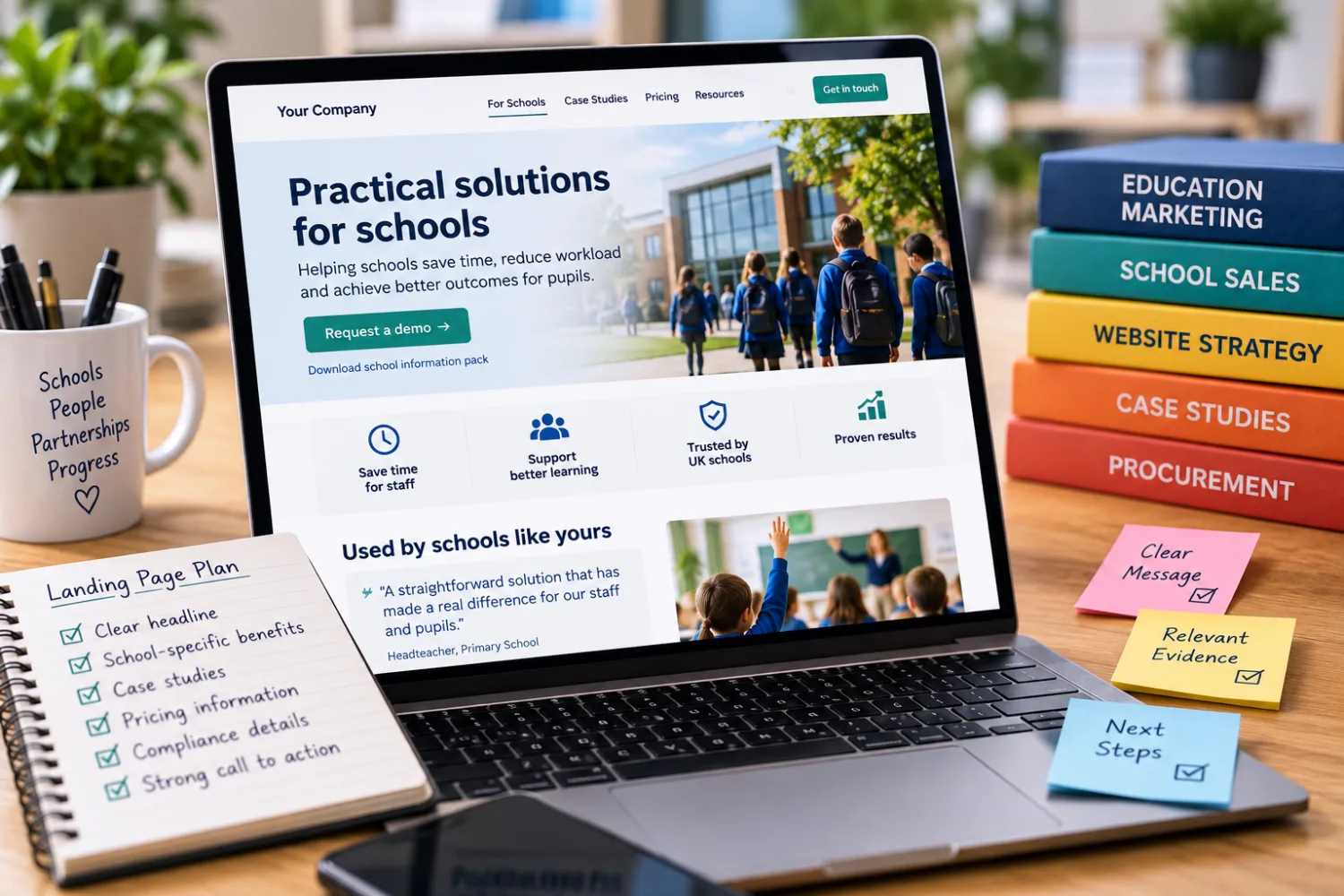
A strong school catering page on your website could include sections such as:
- “School meal services we provide”
- “How we meet school food standards”
- “Allergies and special diets”
- “Sample primary school menu”
- “Sample secondary school menu”
- “How we support meal uptake”
- “Switching from your current caterer”
- “Request a school catering proposal”
This can make your outreach much stronger. If a school receives your email and clicks through to a vague homepage, the opportunity may be lost. If they find a clear school catering page, they are more likely to trust you.
You may also find these useful: What Schools Ask Before Approving a New Supplier and Requirements for Businesses Working With Schools.
Make your proposal about outcomes, not just meals
A school catering proposal should not read like a restaurant menu.
Menus matter, but schools also want outcomes. They want pupils fed well, parents reassured, staff supported, queues managed, standards met and budgets protected.
When writing your proposal, focus on the benefits that matter to schools:
- better meal uptake;
- reduced food waste;
- clear allergen management;
- pupil-friendly healthy menus;
- smooth lunchtime operation;
- support for free school meals;
- good communication with parents;
- reliable staffing;
- transparent pricing;
- compliance with relevant standards;
- less admin for school staff.
For example, instead of saying:
“We offer a wide range of nutritious meals.”
Say:
“Our menus are designed to meet school food standards while keeping familiar, pupil-friendly choices on the menu. We review uptake and feedback each term so the service remains healthy, realistic and financially sustainable.”
That sentence shows a better understanding of the school’s challenge.
A good proposal should also explain implementation. Schools need to know what happens if they choose you.
Include:
- mobilisation timeline;
- staffing plan;
- kitchen review;
- menu setup;
- parent communication support;
- allergen data collection;
- launch day planning;
- first-term review process.
The easier you make the change feel, the more attractive your proposal becomes.
For more on proposal structure, read How to Write a Proposal That Wins School Contracts.
Use timing to reach schools before contracts are reviewed
Catering contracts are not usually won overnight.
A school may need to review current performance, understand notice periods, consult internally, compare options, seek quotes, use a framework or complete a procurement process. If you contact them only when they are already signing a new contract, you may be too late.
The best approach is to build visibility before the formal buying window.
Useful outreach windows may include:
- September to November: introduce your service after the school year has settled, especially if schools are already unhappy with current provision.
- January to March: start conversations about the next academic year and contract review periods.
- April to June: focus on September planning, mobilisation and supplier decisions.
- July and August: suitable for operational teams if a school is preparing a catering change, but less useful for cold outreach to teaching staff.
Your message should reflect the timing.
For example:
“We are contacting local schools now because many teams begin reviewing catering arrangements ahead of the next academic year. If you are considering a change of provider or would like to benchmark your current service, I’d be happy to send a short school catering overview.”
That is much stronger than:
“We provide catering services. Can we book a call?”
The first version gives the school a reason to read the email now.
Approach the right people in the right way
School catering decisions may involve several people.
Depending on the school, the decision may include:
- headteacher or principal;
- school business manager;
- operations manager;
- trust procurement lead;
- finance team;
- governors or trustees;
- site or facilities manager;
- office manager;
- pastoral or pupil support staff;
- parents or pupil voice groups in some cases.
For a single primary school, the school business manager or headteacher may be the best route. For a large secondary school, operations and finance may be more relevant. For a multi-academy trust, catering may be handled centrally.
Do not send the same email to everyone.
A message to a school business manager might focus on service quality, pricing, compliance and contract management.
A message to a headteacher might focus on pupil wellbeing, parent confidence and reducing staff workload.
A message to a MAT procurement lead might focus on consistency, reporting, mobilisation, value and multi-site capacity.
Good outreach is specific. It shows that you understand the recipient’s role.
For email structure, read How to Write a School Outreach Email That Gets a Reply.
Consider frameworks and procurement routes
Some schools and trusts use frameworks or formal procurement routes when buying catering services.
DfE’s Get help buying for schools service lists DfE-approved catering buying options. These include outsourced catering services and food and drink frameworks. Frameworks can help schools buy through a more structured and compliant route.
For catering companies, this means two things.
First, you need to understand how schools may be allowed or expected to buy. A school may like your company but still need to follow a specific process.
Second, if you are serious about larger school catering contracts, you may need to explore relevant frameworks, dynamic purchasing systems, local authority opportunities or trust procurement portals.
Questions to ask yourself:
- Are local schools buying catering through a framework?
- Are academy trusts using central procurement?
- Do you meet the requirements to apply for relevant frameworks?
- Can you provide the documentation schools need for procurement?
- Are you monitoring local tender opportunities?
- Can you compete on value, not just price?
Frameworks are not the only way into schools, especially for smaller or local contracts, but they can matter. If you want to win larger school meal contracts, procurement readiness is part of your sales strategy.
You should also be prepared for schools to request quotes, compare suppliers and assess value for money. A professional proposal, clear pricing and strong evidence can help you stand out.
Show how you will improve meal uptake
One of the biggest challenges in school catering is not simply producing healthy food. It is getting pupils to choose and eat it.
Schools care about meal uptake because it affects pupil nutrition, free school meal participation, kitchen viability, parent satisfaction and contract sustainability.
A strong catering company should be able to explain how it encourages pupils to use the service.
This might include:
- pupil feedback sessions;
- taste testing;
- menu names and presentation suited to pupils;
- balanced familiar meals and new options;
- special themed days;
- clear parent communication;
- quick service to reduce queues;
- secondary school grab-and-go options where appropriate;
- support for pupils with dietary or sensory needs;
- termly review meetings with the school.
This is where many caterers can differentiate themselves.
A school may already have a provider that technically meets requirements but struggles with uptake, queues, complaints, waste or pupil satisfaction. If you can show a realistic way to improve those things, your offer becomes more compelling.
Use specific examples where possible:
- “We introduced pupil tasting sessions before launching the new menu.”
- “We reduced lunchtime queues by changing service flow.”
- “We improved vegetarian and halal options after parent feedback.”
- “We added simple weekly menu communication for families.”
Schools do not just want a caterer. They want a partner who can make lunchtime work better.
Build trust before asking for the contract
Many catering companies approach schools only when they want a contract. That can work, but it is not always the best route.
School catering decisions involve risk. A poor catering change can lead to parent complaints, pupil dissatisfaction, staff stress and operational problems. Schools are more likely to consider a provider they have heard of, seen evidence from or already trust.
Ways to build trust include:
- creating a clear school catering page on your website;
- publishing useful guidance for schools about catering reviews;
- sharing sample menus and school-specific information;
- collecting testimonials from education settings;
- offering a short catering review or benchmarking conversation;
- attending local education events;
- joining relevant supplier directories;
- building relationships with local school business managers;
- sharing case studies about meal uptake or menu improvement;
- following up professionally rather than aggressively.
Being visible in the right places helps. If a school receives your email and then finds your business listed in an education supplier directory, with a clear description of what you offer, that can support trust.
This is one reason catering companies may benefit from joining AllSchools. A supplier profile gives you another place to explain your school catering services, link to your website, describe your offer and make it easier for schools to find you when they are researching providers.
You can view listing options here: AllSchools pricing.
A practical outreach email for school catering companies
Your first email should be short, relevant and easy to answer.
Here is a simple example you can adapt:
Subject: School meal catering for local primary schools
Hello,
I’m getting in touch from [Company Name]. We provide school meal catering for [primary schools / secondary schools / academies] in [area], including compliant menus, allergen management, special diet support and clear communication with school staff and families.
We are contacting local schools now because many teams begin reviewing catering arrangements ahead of the next academic year.
If you are considering a change of provider, or would simply like to compare options, I’d be happy to send over our school catering overview, sample menus and pricing approach.
If this is not relevant, just reply “no thanks” and I won’t contact you again about this.
Kind regards,
[Name]
This email works because it:
- explains who you are;
- states the school-specific service;
- mentions compliance and practical concerns;
- gives a reason for the timing;
- asks for a small next step;
- includes a simple opt-out.
Avoid sending long menus, heavy PDFs or multiple attachments in the first email. Link to a clear page or offer to send information if they are interested.
If you are unsure about email rules, read Can You Email Schools Legally in the UK? and School Email Lists in the UK: What Businesses Should Know.
Common mistakes catering companies should avoid
School catering is competitive. Avoiding obvious mistakes can help you stand out.
Common mistakes include:
- sending generic catering emails that do not mention schools;
- focusing only on food quality and ignoring compliance;
- not explaining allergen and special diet processes;
- failing to show how menus meet school food standards;
- contacting schools too late in the buying cycle;
- emailing the wrong person;
- not understanding current contract notice periods;
- providing unclear pricing;
- not having school-specific sample menus;
- ignoring pupil uptake and parent communication;
- overpromising on cost without understanding staffing and food inflation;
- sending large attachments in cold emails;
- failing to follow up professionally.
Another mistake is treating all schools the same. Primary, secondary, special and independent schools can have very different catering needs. Multi-academy trusts may have different requirements again.
A strong catering company shows that it understands these differences.
How to stand out when schools compare providers
When a school compares catering companies, it may consider price, but price is rarely the only factor.
You can stand out by making the school’s decision easier.
Provide:
- a clear summary of your school catering offer;
- sample menus for the relevant age group;
- evidence of compliance with school food standards;
- food hygiene and safety documentation;
- insurance and relevant accreditations;
- references or case studies;
- a mobilisation plan;
- a realistic pricing explanation;
- details of how you manage allergies and special diets;
- your plan for improving or maintaining meal uptake;
- how you communicate with parents and staff;
- how you review performance after launch.
The best school catering providers do not only say “we can do it”. They show the school what working with them would feel like.
If your proposal makes the change feel safe, organised and beneficial, you have a much better chance of being shortlisted.
FAQ: Winning school meal contracts
How do catering companies get school meal contracts?
Catering companies usually win school meal contracts by identifying suitable schools, understanding current contract arrangements, approaching the right decision-makers, providing a clear proposal, demonstrating compliance with school food standards and competing through the school’s required buying or procurement process.
Who decides school catering contracts?
It depends on the school. Decisions may involve the headteacher, school business manager, operations manager, governors, trustees, finance team, local authority or multi-academy trust central team. Larger contracts may involve formal procurement or a framework.
Do school meals have to meet food standards?
Yes. In England, food served in maintained schools and academies must meet school food standards. Catering companies should understand these standards and be able to show how their menus comply.
When is the best time to contact schools about catering?
January to June can be a strong period because schools may be reviewing contracts and planning for the next academic year. September to November can also work for introductions and early conversations. The right timing depends on contract end dates, notice periods and the school’s buying process.
Should catering companies contact individual schools or academy trusts?
Both can be useful, but it depends on the target market. Some schools choose catering providers individually, while multi-academy trusts may make decisions centrally or influence approved providers across multiple schools.
What should a school catering proposal include?
A school catering proposal should include sample menus, compliance information, pricing, allergen and special diet processes, staffing, food safety, mobilisation plans, service review processes, references and how the caterer will support meal uptake.
Can small local caterers win school contracts?
Yes, but they need to show that they can meet school requirements reliably. Local caterers may appeal to schools that want fresh food, responsive service and strong community links, but they still need compliance, capacity, documentation and a realistic operating model.
Do schools always choose the cheapest caterer?
No. Schools need value for money, but they also consider quality, reliability, compliance, pupil uptake, staffing, safety, communication and risk. A cheaper provider may not be the best choice if the service is weak.
How can catering companies improve meal uptake?
They can improve uptake through pupil-friendly menus, taste testing, good presentation, shorter queues, parent communication, special diet support, themed days, feedback sessions and regular menu reviews.
Should catering companies join a school supplier directory?
A school supplier directory can help catering companies become easier for schools to find, especially when combined with a strong website, clear school catering page, outreach emails and case studies. It can support trust and visibility during the school’s research process.
What should a first email to a school say?
A first email should briefly explain who you are, what school catering service you provide, why the timing is relevant, what practical problems you help solve and what small next step the school can take. It should also include a clear opt-out.
How can catering companies stand out from larger providers?
Smaller caterers can stand out through local knowledge, responsive communication, flexible menus, strong relationships, fresh food, careful implementation and a clear understanding of the school’s specific needs. They still need to prove reliability and compliance.