A Christmas school trip can be one of the highlights of the autumn term.
It might be a theatre performance, Christmas exhibition, historic property, museum workshop, winter nature visit, place of worship, local heritage event, concert, science experience or a trip linked to a curriculum topic being taught during November and December.
But Christmas visits come with a particular set of planning challenges.
Popular dates fill quickly. Coaches can be expensive. December daylight is limited. Roads are busier. Weather is less predictable. Venues may be crowded with school groups and members of the public. Staff absence can increase as winter illnesses circulate. And a trip scheduled for the final week of term can collide with concerts, assessments, Christmas lunches, rehearsals and dozens of other school commitments.
The result is that a visit that looks straightforward in September can become surprisingly complicated by December.
The best way to avoid that is to plan early and focus on the things that genuinely matter.
This checklist takes teachers through the process from deciding whether the visit is worth doing to checking the venue, transport, cost, SEND arrangements, safeguarding, winter conditions and the final details before departure.
Start by asking what pupils will actually gain from the visit
Christmas is not, by itself, an educational objective.
A visit can be enjoyable, memorable and seasonal while still having a clear purpose.
Before booking, ask:
- Why are we taking pupils out of school?
- What will they see, experience or understand that is difficult to reproduce in the classroom?
- How does the visit connect to current learning?
- Is the main purpose curriculum, cultural enrichment, personal development, community experience or a combination?
- Is this the best venue for that purpose?
A seasonal visit can still have strong curriculum value
For example, a Christmas visit might support:
- English: seeing a live production of a text, pantomime conventions, storytelling or performance;
- history: exploring Christmas in a particular historical period;
- RE: understanding Christian traditions, worship and the religious meaning of Christmas;
- music: experiencing a live concert or seasonal performance;
- art: studying decoration, design, architecture or visual culture;
- geography: investigating a local town centre, tourism, land use or seasonal economic activity;
- science: taking part in winter ecology, astronomy or seasonal science activities;
- personal development: experiencing theatre, museums, historic sites or cultural events that some pupils may not otherwise access.
It does not need to produce three worksheets and an assessment to justify leaving school.
But there should be a clearer reason than simply “we always do a Christmas trip”.
Check that the experience matches the age group
A Christmas activity advertised to schools may still be designed primarily for younger children.
Likewise, an atmospheric historic-property visit may involve long periods of standing, listening or reading that are unrealistic for very young pupils.
Before booking, ask exactly what pupils will do rather than relying on promotional language.
The AllSchools guide to questions every teacher should ask before booking a school trip venue provides a wider list of checks for any educational visit.
Book popular Christmas dates earlier than you think
December can be a compressed school-trip season.
Schools often want similar dates: late November through to the final week of term.
At the same time, theatres, historic attractions, Christmas markets, museums and seasonal events may also be serving families, tourists and private groups.
Check availability before announcing the trip
Before telling pupils or families:
- confirm the date;
- confirm the number of pupil places;
- confirm adult places;
- ask whether your booking is provisional or confirmed;
- check the deposit deadline;
- check when final numbers are required;
- understand the cancellation terms.
A verbal conversation with a venue is not necessarily the same as a confirmed group booking.
Have alternative dates ready
Instead of approaching a venue with only one possible date, identify two or three workable options.
This can make a major difference when popular school sessions are already filling.
Think carefully about the final few days of term
The last week before Christmas may look attractive because curriculum pressure appears lower.
It can also contain:
- Christmas performances;
- assemblies;
- carol services;
- staff events;
- Christmas lunches;
- class parties;
- reward events;
- early finishes;
- higher pupil and staff absence.
A late-November or early-December visit may sometimes be easier to staff and organise.
Check the total cost before committing the school
The ticket price is rarely the full cost of a Christmas educational visit.
Transport can cost as much as—or more than—the venue.
Build a realistic total
Include:
- pupil admission;
- adult admission;
- workshop charges;
- coach or minibus costs;
- parking;
- driver waiting charges;
- public transport;
- insurance where applicable;
- cover or staffing implications;
- food if included;
- any unavoidable booking fees.
Ask whether teachers and accompanying adults are free.
A venue charging £12 per pupil may appear cheaper than one charging £14 until you discover that the second venue includes accompanying adults, a workshop and a teacher resource pack.
Ask about deposits and final numbers
Christmas bookings may require payment well before the actual visit.
Clarify:
- how large the deposit is;
- whether it is refundable;
- when the balance is due;
- whether pupil numbers can change;
- whether absent pupils are refundable;
- what happens if the venue cancels.
Think about affordability before sending the parent letter
A visit becomes much harder to manage if the school announces it and only afterwards discovers that the likely level of voluntary contributions will not cover the cost.
Follow your school's charging and remissions policy and consider how pupils from families facing financial difficulty will be supported.
A memorable December experience should not become something that quietly separates children according to which families can easily afford it.
For more general cost-saving ideas, see School Trips on a Tight Budget: Worth-Visiting Options for Schools.
Check the venue properly before booking
A polished Christmas webpage does not tell you everything teachers need to know.
Ask what the visit actually looks like
Find out:
- how long the session lasts;
- whether the group stays together;
- whether pupils rotate through activities;
- which parts are indoors and outdoors;
- how much walking is involved;
- whether pupils will sit on the floor;
- whether there are dark, noisy or crowded areas;
- whether the public will be present at the same time;
- where pupils can eat;
- where toilets are;
- whether there is somewhere to store coats and bags.
Ask about school-group numbers
A venue can feel very different when several hundred pupils arrive on the same morning.
Ask whether:
- multiple schools will be attending;
- groups have separate arrival slots;
- lunch areas are allocated;
- activities are exclusive to your group;
- public visitors share the same spaces.
Check the provider's safety arrangements
Where an outside organisation is providing activities, schools should satisfy themselves that appropriate safety arrangements are in place.
Depending on the activity and your school's procedure, this may include reviewing:
- public liability insurance;
- risk assessments;
- emergency arrangements;
- safeguarding procedures;
- staff competence;
- first-aid arrangements;
- relevant licences or accreditation;
- responsibility for supervision.
Do not assume that because a venue advertises extensively to schools, all the checks have already been completed on your behalf.
The AllSchools guide What Schools Need From a School Trip Provider Before They Book explains what useful provider information should look like.
Plan around December weather and short daylight
Winter changes the practical risk profile of even a familiar visit.
A journey that works comfortably in June may feel very different in December.
Check daylight as well as opening times
The UK has short days during December, particularly further north.
Consider whether:
- pupils will be walking after dark;
- the coach collection point is well lit;
- the group will use rural paths;
- outdoor activities finish with enough daylight;
- delays could push part of the visit into darkness.
Do not plan using the ideal timetable alone.
Ask what happens if the coach is 30 minutes late.
Prepare for cold and wet weather
If pupils will spend time outdoors, families need clear information about suitable clothing.
Depending on the visit, that may mean:
- a waterproof coat;
- warm layers;
- appropriate footwear;
- hat and gloves;
- spare clothing for younger pupils where practical.
Schools also need a plan for the pupil who arrives without the requested coat.
Check the surface underfoot
Winter introduces:
- ice;
- mud;
- wet leaves;
- standing water;
- poor visibility;
- slippery paths and steps.
If the visit includes significant walking outside, ask the venue how routes are managed during poor weather.
Have a weather decision point
Decide in advance:
- who checks the forecast;
- when the final decision will be made;
- what conditions would cause the visit to change;
- what happens if the venue remains open but travel becomes unsafe.
The AllSchools guide to planning an autumn school trip around weather, daylight and backup plans covers these seasonal considerations in greater detail.
Sort transport early and check the timetable realistically
For many Christmas visits, transport is the part most likely to cause problems.
Get transport quotes before confirming affordability
Coach prices vary according to:
- distance;
- journey time;
- vehicle size;
- number of vehicles;
- driver hours;
- waiting time;
- date and local demand.
A seemingly inexpensive venue can become an expensive trip when transport is added.
Check exactly where the coach can stop
Christmas attractions in town centres can be particularly difficult.
The venue's postcode may lead to a pedestrianised area where coaches cannot actually stop.
Ask:
- Where is coach drop-off?
- How far is it from the entrance?
- Is the route accessible?
- Where does the coach collect?
- Will pupils have to cross busy roads?
- Is there space for the group to wait safely?
Add realistic buffers
December traffic can be unpredictable, especially near:
- shopping centres;
- Christmas markets;
- city centres;
- popular attractions;
- major evening events.
If a performance starts at 10:30, planning to arrive at 10:25 is not a plan.
Give yourself enough time for toilets, unloading, organising groups and unexpected traffic.
Plan the return as carefully as the outward journey
Ask:
- What time must we leave?
- When is the coach expected back?
- Does this affect normal home transport?
- Will parents need different collection information?
- What happens if the return is delayed?
Plan inclusion, SEND and medical needs before the final week
A Christmas trip should not become inaccessible because adjustments were considered after everything else had already been booked.
Look at the actual demands of the visit
For each pupil who may need additional support, consider:
- physical accessibility;
- walking distance;
- stairs and lifts;
- toilet access;
- sensory demands;
- noise;
- crowding;
- dark spaces;
- flashing lights;
- waiting and queuing;
- changes to normal routine;
- food requirements;
- medical needs;
- communication needs.
A theatre trip, for example, might involve a dark auditorium, loud music, flashing effects, very limited opportunities to leave and a long period of sitting.
A Christmas market may involve dense crowds, strong smells, loud music and unpredictable public interaction.
Those details matter more than whether the venue describes itself as “accessible”.
Contact the venue about specific adjustments
Ask direct questions.
For example:
- Is there step-free access throughout the school route?
- Is there a quiet space available?
- Can a pupil leave the performance temporarily?
- Is there an accessible toilet?
- Can a pupil enter before the main group to avoid a crowd?
- Can you provide visual information about the visit in advance?
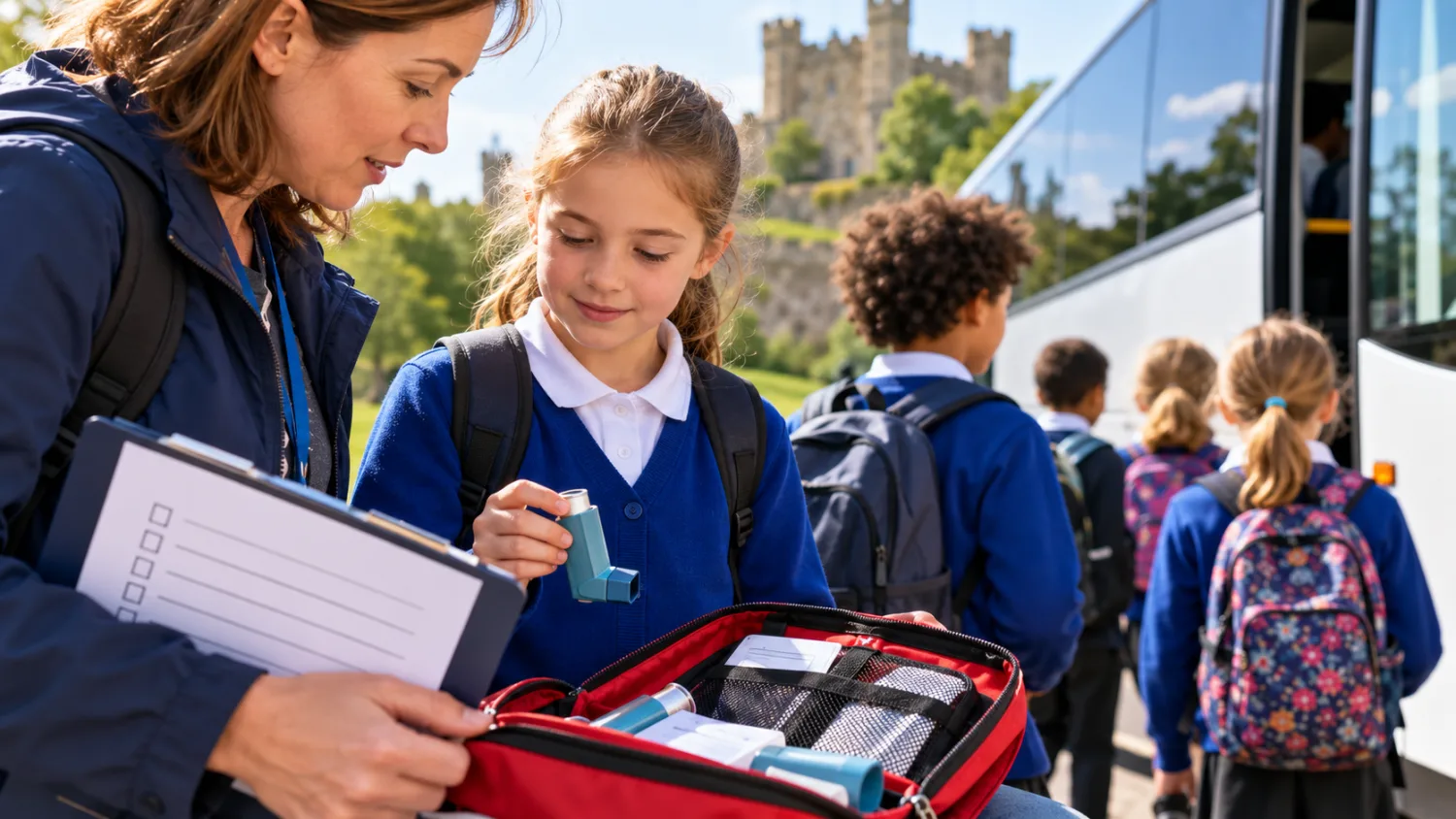
Carry required medication
Check arrangements for:
- inhalers;
- adrenaline auto-injectors;
- diabetes equipment;
- seizure medication;
- other prescribed medicines;
- individual healthcare plans.
Do not discover on the morning of departure that essential medication has expired or been left elsewhere in school.
For a fuller inclusion checklist, see How to Make a School Trip Work for Pupils With SEND.
Write a proportionate risk assessment for the actual December visit
A risk assessment should help staff manage the visit.
It should not simply prove that somebody completed a form.
Start with significant hazards
For a Christmas educational visit, these could include:
- road travel;
- busy public areas;
- pupils becoming separated;
- winter weather;
- ice or slippery surfaces;
- darkness;
- particular medical needs;
- large crowds;
- specific venue activities;
- food allergies;
- changes to normal school transport.
Not every visit will have all of these.
Only include hazards that are genuinely relevant.
Use existing venue information without copying it blindly
Venue risk assessments can be useful because they show how the provider manages its premises and activities.
They do not replace the school's responsibility for issues such as:
- your pupils;
- your staffing;
- your journey;
- your supervision;
- your medical arrangements;
- your emergency procedures.
Write practical control measures
Instead of:
“Risk: pupils lost. Control: close supervision.”
write something staff can act on:
“Pupils remain in named groups of ten with a designated adult. Headcounts take place after coach arrival, before leaving each activity zone, before lunch and before boarding the return coach.”
The second version tells adults what the plan actually is.
The AllSchools guide to writing a school trip risk assessment gives a more detailed approach to hazards, controls and supervision.
Plan staffing and supervision for the visit you are actually running
Do not begin with a magic adult-to-pupil ratio and assume everything is solved.
Appropriate supervision depends on:
- pupil age;
- maturity;
- SEND;
- medical needs;
- behaviour;
- the venue;
- crowding;
- transport;
- the activities being undertaken;
- staff experience.
Allocate adults to groups before departure
Every adult should know:
- which pupils they are supervising;
- where they need to be;
- the day's timetable;
- the meeting points;
- which pupils have important medical or additional needs;
- what happens in an emergency;
- who the visit leader is.
Do not assume venue staff replace school supervision
A workshop leader may teach an activity.
A theatre usher may show pupils to seats.
A museum educator may lead the tour.
That does not automatically mean school staff can stop supervising.
Clarify responsibilities with the provider in advance.
Have a contingency for adult absence
December is illness season.
Ask:
“What happens if one of our key adults is absent on the morning of the trip?”
If the visit only works when every named adult is present, identify a possible replacement in advance where practical.
Communicate with families early and clearly
Christmas is already expensive and busy for many families.
Give parents enough notice to understand what is happening and what they need to provide.
Your parent communication should answer the obvious questions
Include:
- the date;
- the destination;
- the educational purpose;
- departure and return times;
- cost or voluntary contribution arrangements;
- clothing requirements;
- lunch arrangements;
- whether pupils need to bring anything;
- what happens to normal transport or clubs;
- the school's consent arrangements where applicable.
Be specific about clothing
“Dress appropriately for the weather” leaves considerable room for interpretation.
If pupils will spend two hours outside, say:
- warm coat;
- comfortable closed shoes or boots;
- hat and gloves if cold;
- school uniform underneath if required.
Tell families about unusual features
Where relevant, mention:
- significant walking;
- outdoor activities;
- a later return;
- bringing a packed lunch;
- a performance containing loud sound or flashing effects;
- the possibility of buying souvenirs if the school permits this.
Surprises that are enjoyable for pupils are good.
Surprises that change the logistics for parents are less useful.
Have a backup plan before December arrives
Winter visits are more vulnerable to disruption.
Snow does not need to fall directly on the venue to cause problems. A coach company may be affected elsewhere. Staff may be unable to travel to school. Public transport may be disrupted. A venue may close part of its site because of high winds.
Ask the venue what happens if it cancels
Clarify:
- whether the booking moves to another date;
- whether the school receives a refund;
- what happens to deposits;
- how late a cancellation may be communicated.
Ask the same question about transport
If the school cancels because weather makes travel unsafe, what happens to the coach payment?
Terms vary, so understand them before committing significant money.
Have an educational fallback
If the visit cannot happen, pupils will still be in school.
You do not necessarily need an elaborate replacement day, but knowing what the class will do prevents a cancelled trip becoming several hours of improvised supervision.
Do not feel pressured to travel because money has been spent
A non-refundable booking can create emotional pressure to continue.
That should not override a genuine safety decision.
If conditions make the journey or activity unsafe, money already spent does not make the conditions safer.
Do a final check in the week before the visit
By December, several months may have passed since the booking was first discussed.
Do not assume that everything remains exactly as agreed.
Reconfirm with the venue
Check:
- date and arrival time;
- group size;
- adult numbers;
- programme;
- arrival entrance;
- coach drop-off;
- lunch arrangements;
- accessibility requirements;
- any recent changes.
Reconfirm transport
Check:
- collection time;
- school entrance;
- number of vehicles;
- destination;
- return time;
- contact arrangements.
Check pupil information
Look for changes since the trip was booked:
- new medical information;
- changed medication;
- new pupils;
- pupils who have left;
- new SEND information;
- significant behaviour or safeguarding considerations;
- updated emergency contacts.
Check the weather several times
Do not rely on a forecast viewed a week earlier.
Check again closer to departure and be prepared to adjust clothing advice or the day's plan where necessary.
Brief pupils before the day
Tell them:
- why they are going;
- what the day will look like;
- which group they are in;
- who their supervising adult is;
- what they need to bring;
- what behaviour is expected;
- what to do if they become separated;
- where meeting points are.
A clear briefing allows the actual visit to begin with learning rather than twenty minutes of repeated instructions.
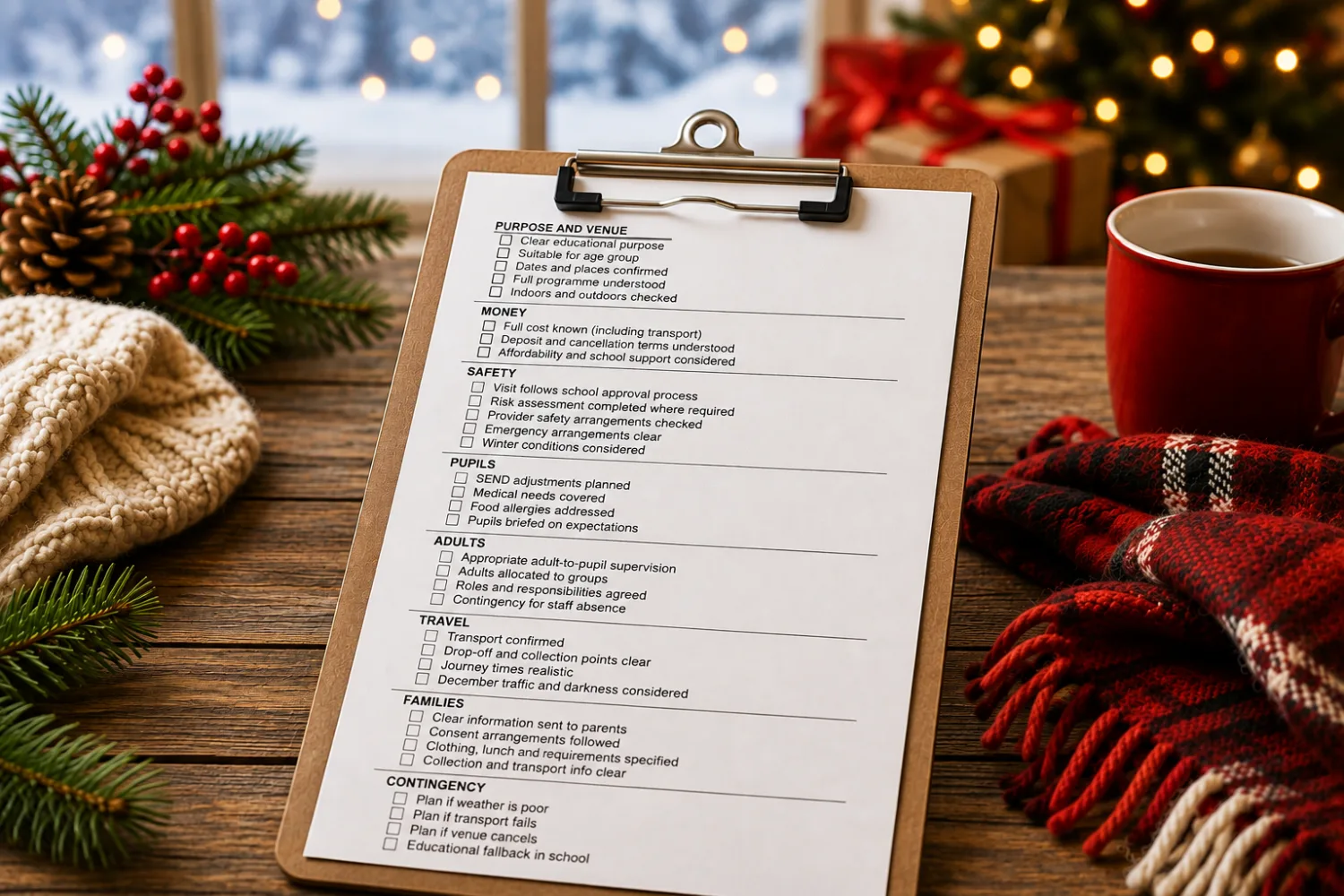
A quick Christmas educational visit checklist
Before considering the booking complete, check the following.
Purpose and venue
- Is there a clear educational or enrichment purpose?
- Is the activity suitable for the age group?
- Are dates and places confirmed?
- Do we understand the complete programme?
- Have we checked what happens indoors and outdoors?
Money
- Do we know the full cost?
- Is transport included in the calculation?
- Do we understand deposit and cancellation terms?
- Have we considered affordability and school support arrangements?
Safety
- Has the visit followed the school's approval process?
- Has a proportionate risk assessment been completed where required?
- Have provider safety arrangements been checked?
- Are emergency arrangements clear?
- Have winter conditions been considered?
Pupils
- Have SEND adjustments been planned?
- Are medical needs covered?
- Have food allergies been addressed?
- Do pupils know what to expect?
Adults
- Are there enough appropriate adults for this particular group and visit?
- Does every adult know their pupils?
- Have staff roles been agreed?
- Is there a contingency for staff absence?
Travel
- Is transport confirmed?
- Are drop-off and collection locations clear?
- Are journey times realistic?
- Has December traffic been considered?
- Will any part of the journey happen after dark?
Families
- Have parents received clear information?
- Have relevant consent arrangements been followed?
- Are clothing and lunch requirements specific?
- Are changed collection arrangements clear?
Contingency
- What happens if weather is poor?
- What happens if transport fails?
- What happens if the venue cancels?
- What will pupils do if the entire visit is cancelled?
For a broader start-to-finish planning checklist, see How to Plan a School Trip Without the Stress.
Frequently asked questions
When should schools book Christmas trips?
Popular theatres, historic attractions and seasonal school programmes can fill well in advance. Where possible, begin looking during the first half of the autumn term—or earlier for particularly popular venues—rather than waiting until December.
Does a Christmas trip need to link directly to the curriculum?
Not every educational visit needs a narrow curriculum outcome. Cultural enrichment, personal development and access to experiences pupils may not otherwise receive can also be valuable. However, the school should still be clear about why pupils are being taken out of normal lessons.
Does every Christmas trip need a separate risk assessment?
Not necessarily. Schools should follow their educational-visits policy. Routine visits may already be covered by existing procedures, while visits outside those arrangements or involving additional risks may need further assessment and planning.
Do parents need to give written consent?
Schools should follow their own consent procedures. In England, current Department for Education guidance says written consent is always required for nursery-age children but is not normally required for most curriculum visits involving older pupils. Written consent is generally associated with visits requiring a higher level of risk assessment or taking place outside normal school hours.
How many adults do we need for a Christmas school trip?
There is no single ratio suitable for every visit. Supervision should take account of pupil age and needs, the activity, venue, crowds, transport, medical requirements and the competence of accompanying adults, alongside your school's own policy.
Should we cancel if snow is forecast?
Not automatically. Consider the actual forecast, journey, venue, local conditions, school policy and advice from relevant providers. Conditions may be very different across different parts of the route.
What if a pupil arrives without a warm coat?
Schools should plan for foreseeable situations like this. The appropriate solution depends on the visit and conditions, but simply excluding a child from a curriculum visit because a family forgot an item should not be the automatic response.
Should we allow pupils to bring spending money?
This is a school decision. Consider whether shopping is genuinely part of the visit, how money will be kept safe and whether allowing spending creates unnecessary differences between pupils. Many educational visits work perfectly well without a gift-shop stop.
Should teachers visit the venue beforehand?
A pre-visit can be very useful for unfamiliar or complex venues, although it is not necessary for every trip. Detailed venue information, conversations with staff and previous school experience may provide sufficient information for straightforward visits.
What if the venue provides its own risk assessment?
Use it as useful evidence about how the provider manages its activities and premises. It does not cover every risk connected with your particular pupils, transport, supervision, medical needs and school arrangements.
What if several schools will be at the venue at once?
Plan for increased crowding. Use clearly identified groups, meeting points and regular checks. Ask the venue how school groups are separated and how arrivals, lunches and departures are managed.
What is the biggest difference between a Christmas trip and the same visit in summer?
Often it is the combination of shorter daylight, colder weather, potentially slippery conditions, seasonal traffic and crowded venues. Those factors should be built into the planning rather than treated as surprises on the day.
A Christmas educational visit should feel special to pupils.
It should not feel chaotic to staff.
The difference is usually preparation.
Choose the visit because it offers something worthwhile. Book before the best dates disappear. Work out the real cost. Check exactly what the provider will deliver. Plan for pupils who need adjustments. Think about darkness and winter weather. Confirm transport. Brief adults properly. Tell families exactly what they need to know.
And have a Plan B.
December will always contain a few things you cannot control.
A good visit plan does not try to predict every possible problem. It makes sure that when something changes, staff already know enough about the pupils, venue, journey and alternatives to make a sensible decision.
That leaves more time for the part pupils will actually remember: going somewhere different, experiencing something together and ending the autumn term with learning that happened beyond the classroom walls.