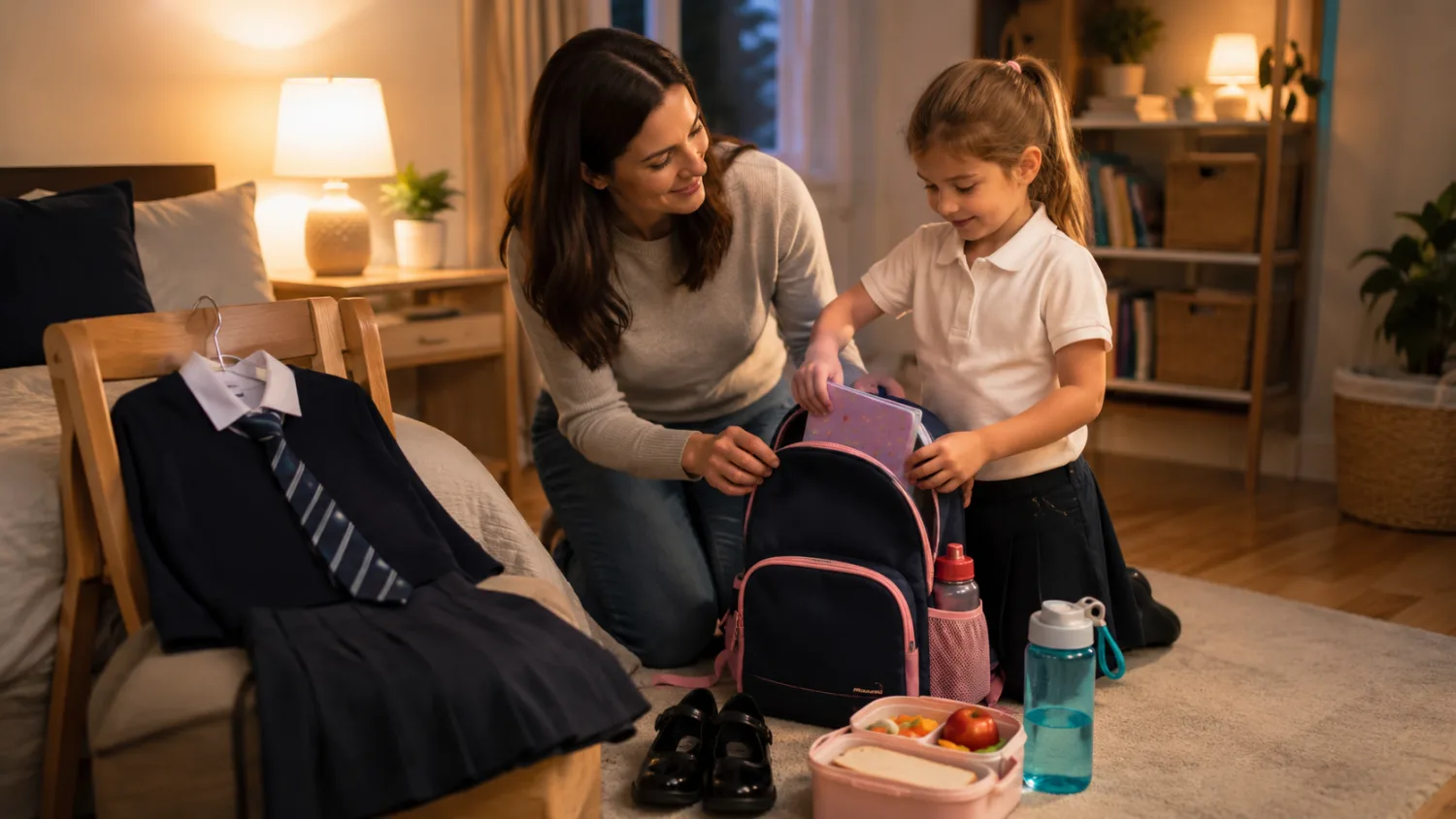
Starting Reception is a big change, even for a child who has been happily attending nursery for years.
The building may be bigger. The adults are different. There are new children, new routines, new expectations and much more to remember. Lunch might happen differently. Toilets are somewhere unfamiliar. Children have to work out where their coat goes, when they can get a drink, how to ask for help and what happens when the person who brought them to school leaves.
Then, after holding everything together for six hours, they come home and cry because their banana broke in half.
For many families, the first two weeks of Reception can therefore feel surprisingly unsettled.
A child who was excited about school may suddenly say they do not want to go. Another may skip into the classroom happily but become exhausted every afternoon. Some children barely talk about school at all. Others become clingier, angrier, hungrier or more emotional at home.
Much of this can be part of a normal adjustment.
Department for Education guidance published in 2026 describes starting Reception as a significant transition and emphasises that children develop at different rates. Building relationships with families, establishing familiar routines and identifying additional needs early are important parts of helping children settle successfully.
There is no single correct way for a four- or five-year-old to settle into school.
This guide explains some common patterns during the first two weeks of Reception, why children can behave very differently at school and home, and when it is worth asking the school for help.
Expect settling in to take longer than the first day
Adults sometimes talk about a child being “settled” because they walked into school without crying on day one.
In reality, settling in is a process.
A child is learning much more than where to hang their coat.
They are gradually discovering:
- which adults they can ask for help;
- what happens during the school day;
- where things belong;
- how lunch works;
- when their parent or carer returns;
- how to join other children's play;
- what classroom boundaries are;
- how to manage belongings;
- how to cope with a larger group;
- what happens when something goes wrong.
For some children, this becomes familiar quickly.
Others need several weeks.
Some appear completely comfortable at first and then have a wobble after the novelty wears off.
That does not automatically mean something has gone wrong.
Settling is rarely a straight line
You may see:
Day 1: excitement.
Day 3: exhaustion.
Day 5: “I love school.”
Monday of week two: tears at the gate.
Wednesday: happily running inside again.
This can be frustrating for parents because it makes progress difficult to judge.
Look at the overall pattern rather than one difficult morning.
Local authority guidance for families also notes that settling into school may take several weeks and that increased tiredness, clinginess and emotion can occur during this period.
Being extremely tired after school is very common
One of the biggest surprises for new Reception parents is often just how tired their child becomes.
A child may have attended nursery for similar hours without appearing nearly as exhausted.
School can still require a different kind of effort.
Reception requires constant mental work
Even when children spend plenty of time playing, they are continuously processing new information.
They are thinking about:
- new routines;
- new names;
- classroom expectations;
- where to sit;
- when to listen;
- when to stop an activity;
- how to negotiate with unfamiliar children;
- how to make themselves understood;
- how to manage without their usual adult nearby.
That is tiring.
Tiredness may look like bad behaviour
Some children become visibly sleepy.
Others become:
- irritable;
- tearful;
- silly;
- argumentative;
- very sensitive to small disappointments;
- less able to follow instructions;
- more physically active.
A child who manages themselves carefully throughout the school day may release a lot of emotion once they reach the safety of home.
Reduce expectations after school
The first few weeks may not be the ideal time to fill every afternoon with activities.
Your child may benefit more from:
- a snack and drink;
- quiet play;
- being outdoors;
- watching something familiar;
- a cuddle;
- an earlier bedtime;
- a quieter weekend.
Some children will still want clubs and playdates. Others will need considerably more downtime than usual.
Follow the child in front of you rather than somebody else's September routine.
For more on sleep and school routines, see the AllSchools guide to healthy sleep habits for school-aged children.
Separation can become harder after a few successful days
A child who happily separated on the first morning may suddenly cry several days later.
This can be confusing.
Parents sometimes think:
“But you were fine yesterday.”
The child may simply understand the situation better now.
On the first day, everything was new and exciting. By the second week, they know that walking through the door means several hours without you.
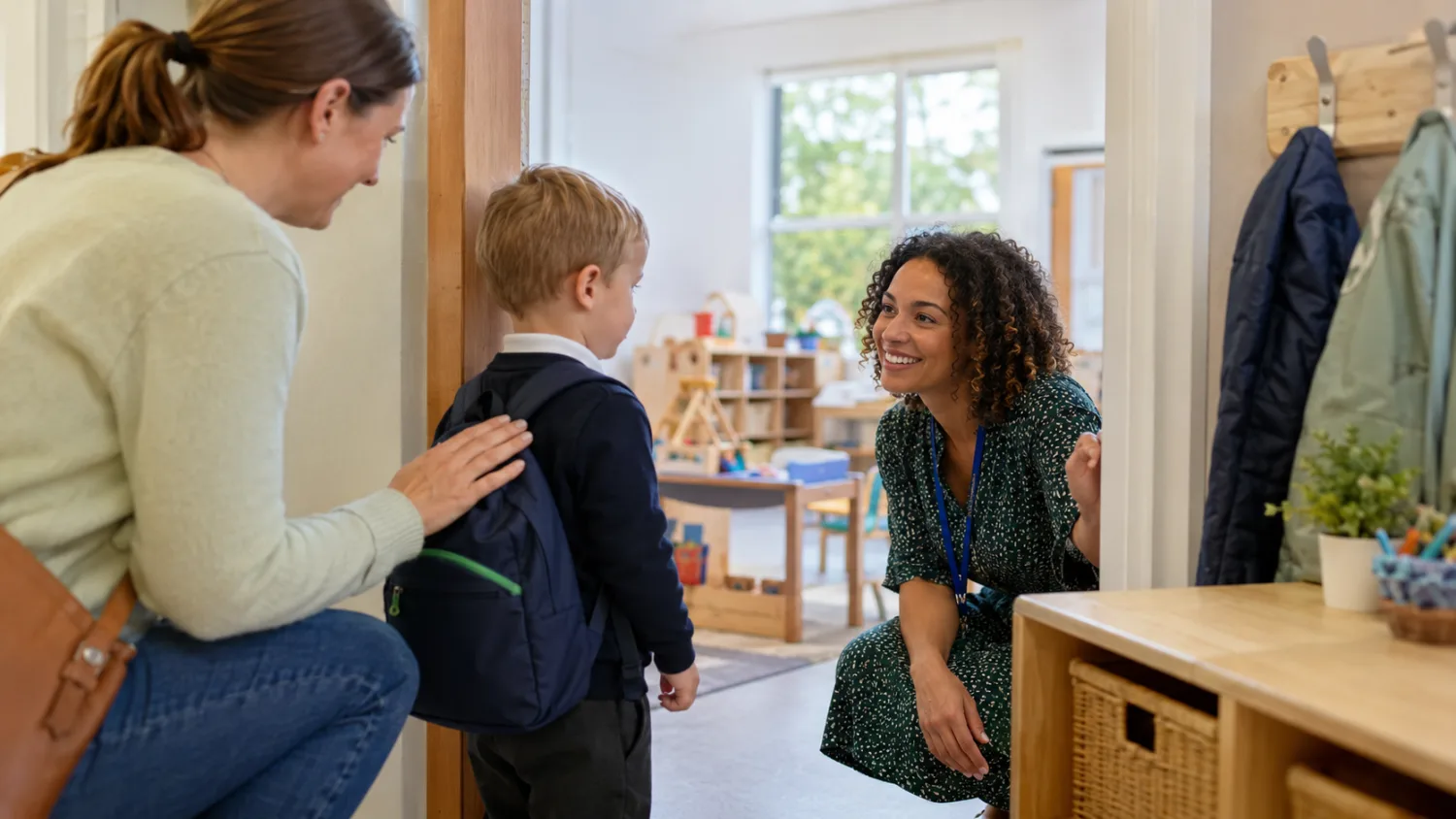
Keep goodbyes warm but predictable
A simple routine can help:
- arrive with enough time not to rush;
- say clearly that you are leaving;
- tell your child when you will return in language they understand;
- give the usual hug, kiss or goodbye;
- let the school adult take over.
Avoid disappearing secretly while your child is distracted.
It may prevent tears that morning, but it can make the child less certain about whether you might disappear again.
Try not to repeatedly return after saying goodbye
If a teacher is confidently supporting your child, repeated returns can restart the separation.
A calm message such as:
“I love you. You're safe. Your teacher will help you, and I'll be back after school.”
is usually clearer than a long negotiation.
Guidance on separation anxiety similarly recommends calm, loving goodbyes and reassuring children that their parent or carer will return.
Ask what happens after you leave
This is important.
A child may scream as you walk away and be happily building with blocks three minutes later.
Alternatively, they may remain distressed for a significant part of the morning.
Those are very different situations.
If drop-off is consistently difficult, ask the teacher:
“How long does it usually take them to settle once I've gone?”
The answer gives you much better information than the goodbye alone.
Do not expect a detailed account of the school day
You collect your child after six hours apart.
Naturally, you want to know everything.
You ask:
“What did you do today?”
And receive:
“Nothing.”
This is extremely common.
The question may simply be too big
A Reception child has experienced dozens of small events.
Retrieving and organising an entire school day into a useful summary is difficult.
Try narrower questions instead:
- Who did you sit near at lunch?
- Did you go outside today?
- What story did your teacher read?
- What made you laugh?
- Did anything feel tricky?
- What did you play with?
Do not conduct the interview immediately
Some children need ten or twenty minutes before they want to talk.
They may be hungry, thirsty and mentally tired.
Conversation often appears naturally later while:
- eating;
- playing;
- having a bath;
- walking;
- getting ready for bed.
Accept that you will not know everything
One of the transitions into school is also a transition for parents.
Your child now has a part of their day that you do not directly observe.
That can feel strange, particularly if nursery previously provided detailed updates.
Over time, you will learn what your child tends to share and what information the school provides.
Big emotions at home do not necessarily mean school is going badly
A child may be calm, cooperative and cheerful at school and then become extremely emotional at home.
Parents sometimes find this difficult to understand.
If school says everything is fine, why are evenings suddenly so hard?
Home is where some children release the effort
At school, they may have spent all day:
- listening;
- waiting;
- sharing;
- following routines;
- managing frustration;
- communicating with unfamiliar people;
- coping with noise and activity.
At home, they no longer need to hold everything together.
The result might be tears because the wrong cup was used or fury because their sock feels uncomfortable.
Respond to the need behind the behaviour
You can still maintain ordinary boundaries while recognising that exhaustion may be contributing.
Sometimes the most useful response is:
- food;
- water;
- less conversation;
- fewer demands;
- a predictable routine;
- an early night.
You do not need to analyse every emotional outburst as evidence of a problem at school.
Look for patterns that persist
If your child's emotional distress remains intense after they have had time to settle, or if it is steadily increasing rather than easing, speak with the teacher.
The NHS notes that some anxiety around starting a new school can be normal, but anxiety may need additional help when it begins to interfere significantly with everyday home, school or social life.
Friendships may look very uncertain at first
Parents naturally want to hear that their child has “made a best friend”.
Reception friendships are often much more fluid.
Your child may:
- play with one child on Monday;
- talk about somebody completely different on Tuesday;
- say nobody played with them on Wednesday;
- announce a new best friend on Thursday;
- forget that person's name by Friday.
This can all be part of learning how a new social group works.
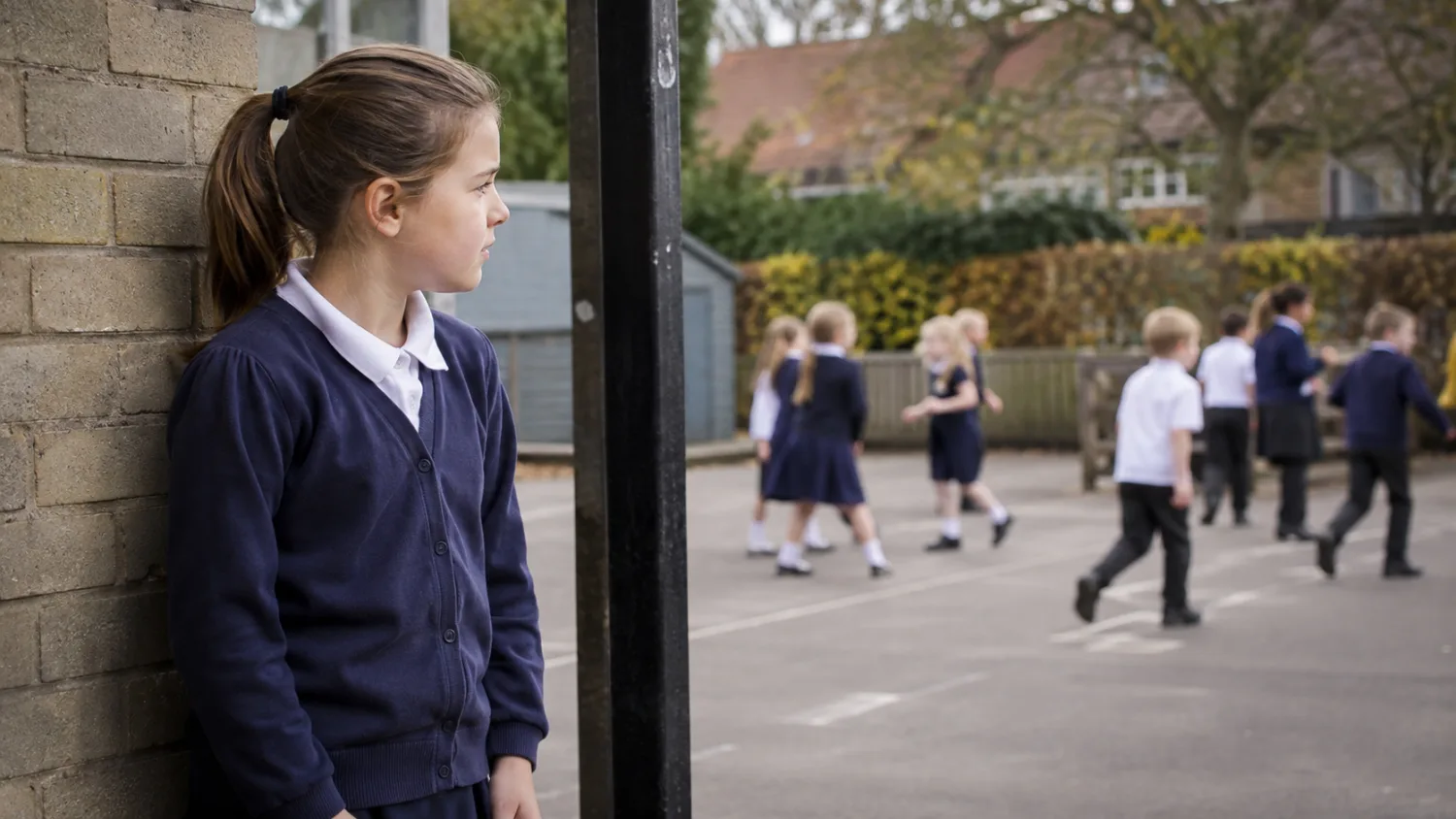
Do not panic over one lonely lunchtime
If your child says:
“Nobody played with me.”
take it seriously without immediately concluding that they are isolated or being bullied.
You might ask:
- What were you trying to play?
- Who was nearby?
- What happened next?
- Did you tell a grown-up?
If the same concern appears repeatedly, speak to the teacher.
Teachers often see social dynamics parents cannot
A child may genuinely feel lonely at one point in the day while also spending other periods happily playing with classmates.
Reception staff can help build a fuller picture.
A simple question such as:
“They've mentioned being alone at playtime a few times. Have you noticed how they're getting on socially?”
is entirely reasonable.
Toileting accidents and other small regressions can happen
Children who have been reliably independent may occasionally have an accident after starting school.
There are many possible reasons:
- they do not know where the toilet is;
- they feel unsure about asking;
- they wait too long because they are absorbed in an activity;
- the toilet environment feels unfamiliar;
- they are tired;
- they are anxious.
One isolated accident does not necessarily indicate a larger problem.
Keep your response matter-of-fact
Avoid shame.
You can simply say:
“Accidents happen. Tomorrow, remember you can tell your teacher when you need the toilet.”
Repeated accidents deserve a conversation
If accidents continue, ask school what staff have noticed.
Your child may need:
- reminders;
- reassurance about asking;
- easier access;
- support with clothing;
- a health issue investigated.
The DfE's current Reception transition guidance recognises toileting and managing personal needs as skills children may still be developing, while also emphasising that children progress at different rates.
Eating may change when school starts
A child who eats reliably at home may barely touch lunch at school during the first few days.
Others come out of school apparently ready for a second lunch.
Lunch at school is a very different environment
There may be:
- lots of noise;
- limited time;
- unfamiliar food;
- different plates and cutlery;
- many children eating together;
- new rules;
- pressure to choose quickly.
A cautious child may initially eat less simply because there is so much else happening.
Ask what was eaten, not whether lunch was “good”
If your child regularly comes home extremely hungry, find out what actually happens at lunchtime.
For packed lunches, look at what returns.
For school meals, ask the teacher or lunchtime staff if there is an ongoing concern.
The AllSchools guide School Lunches in September: Packed Lunch, School Meals or a Mix? covers school meals, packed lunches, allergies and sensory needs in more detail.
Expect appetite to increase after school
A substantial after-school snack can be useful.
Reception children may eat lunch quite early and then remain active for several more hours.
Hunger combined with tiredness is not an ideal recipe for a peaceful 4pm.
Some children become more clingy outside school
You may notice a child suddenly wanting:
- more cuddles;
- you to stay nearby;
- help with things they previously did independently;
- you at bedtime;
- more reassurance about where you are going.
This can seem contradictory.
They are developing greater independence at school while temporarily seeking more security at home.
You do not have to push independence everywhere at once
If your child is managing their bag, coat, lunch and relationships at school, it is not disastrous if they temporarily want a little more help at home.
Support can coexist with independence.
Keep routines predictable
It may help to keep:
- drop-off consistent;
- collection arrangements clear;
- mealtimes familiar;
- bedtime routines predictable;
- weekends relatively calm.
The more predictable home feels, the easier it can be for a child to manage all the newness elsewhere.
Do not compare your child's settling-in pattern with other children
At the school gate, it can appear that everybody else's child is doing brilliantly.
One parent says their child has already memorised everyone's name.
Another says theirs cannot wait to go back every morning.
Your child may still be crying at drop-off.
This does not automatically mean they are less ready for school.
Children show stress differently
One child cries.
Another becomes very quiet.
Another talks constantly.
Another behaves perfectly at school and falls apart at home.
Another appears completely unaffected.
The DfE's 2026 Reception transition guidance explicitly recognises that children's development and confidence vary and emphasises individualised transition support rather than expecting every child to arrive with identical skills.
Starting confidently does not predict the whole school year
Likewise, a difficult first fortnight does not predict how a child will feel in November.
The purpose of Reception is not to identify who is best at being a school pupil after ten days.
Children are learning how school works.
Give that process time.
Know when to speak to the teacher
You do not need to wait until there is a serious problem.
Reception teachers expect families to have questions during transition.
Current government guidance places strong relationships and information-sharing between schools, early years settings and families at the centre of successful Reception transitions.
Ask if you see a repeated pattern
It is worth checking in if your child repeatedly says:
- they have nobody to play with;
- they are frightened of a particular child;
- they do not know how to ask for the toilet;
- they cannot eat lunch;
- they do not understand what adults are telling them;
- they are frightened of a particular part of the school day;
- they feel unable to ask adults for help.
Share relevant changes at home
Tell school if something significant is happening that may affect your child.
For example:
- bereavement;
- family separation;
- a new sibling;
- moving house;
- sleep difficulties;
- new medical information;
- significant anxiety.
Staff do not necessarily need every private detail, but useful context can help them understand changes in behaviour.
Keep the first conversation simple
You do not need to arrive with a diagnosis of the problem.
You can say:
“We've noticed that she's becoming very distressed every evening and saying she's worried about lunchtime. Have you noticed anything at school?”
That opens a conversation between two people who see the child in different environments.
For advice on raising concerns constructively, see How to Talk to Your Child's Teacher When You're Worried.
Know when something may need more support than ordinary settling in
There is no precise day on which normal transition difficulty becomes a problem.
Severity, persistence and the impact on everyday life matter more than simply counting how many mornings a child has cried.
Speak to school sooner if distress is intense
Ask for support if your child:
- remains significantly distressed for long periods after you leave;
- is becoming increasingly frightened of school;
- regularly cannot eat, use the toilet or participate because of anxiety;
- is consistently isolated from other children;
- reports bullying, frightening behaviour or feeling unsafe;
- shows a significant change in behaviour that concerns you;
- is struggling with communication, sensory demands or routines in ways that substantially affect the day.
You do not need to wait several weeks when there is an obvious problem.
Look at whether anxiety is interfering with ordinary life
According to the NHS, children can commonly feel anxious when starting a new school. Additional help may be appropriate when anxiety begins significantly affecting everyday wellbeing, school, home or social life. Possible signs include persistent worry, sleep disturbance, irritability, clinginess, frequent crying and physical complaints such as tummy aches.
If anxiety is becoming significant, begin by speaking with the school and your GP or another appropriate health professional where necessary.
AllSchools also has a detailed guide to school anxiety and school avoidance.
Take physical symptoms seriously too
Starting school can coincide with ordinary childhood illnesses.
Do not assume that every tummy ache, headache or period of exhaustion is emotional simply because school has just started.
If your child appears physically unwell, has persistent symptoms or you are worried about their health, seek appropriate medical advice.
Frequently asked questions
Is it normal for my child to cry when starting Reception?
Yes. Some children cry at separation during the first days or weeks. What matters is the broader pattern, including whether they settle once you leave and whether the distress gradually becomes easier. If your child remains very distressed for long periods or things are getting worse, speak to the teacher.
Why did my child start crying in week two when week one was fine?
This can happen once the novelty wears off and the child understands that school is now a regular routine. Tiredness can also build during the first week. A temporary wobble does not necessarily indicate a problem.
Is extreme tiredness after Reception normal?
It is very common for children to be noticeably more tired during the first weeks. They are managing new routines, relationships, expectations and environments. Consider quieter afternoons, food, rest and consistent sleep. Persistent or unusual fatigue should be discussed with an appropriate health professional.
Why does my child behave well at school but melt down at home?
Some children use considerable effort to manage themselves in a new environment and release their emotions when they return somewhere safe and familiar. Hunger and tiredness can intensify this. If distress is extreme or persistent, ask school whether they are seeing anything similar.
Is it normal for a Reception child to say they have no friends?
Occasionally, yes. Early friendships can change rapidly, and one difficult playtime can feel very significant to a young child. If your child repeatedly reports loneliness or appears distressed about friendships, ask their teacher what they have observed.
What if my child will not tell me anything about school?
This is common. Avoid repeatedly asking broad questions such as “What did you do today?” Try specific, low-pressure questions later in the evening or allow information to emerge naturally through play and conversation.
Is it normal for toileting accidents to happen after starting school?
An occasional accident can happen while children adjust to unfamiliar toilets and routines. Respond calmly. Repeated accidents should be discussed with school and, where appropriate, a healthcare professional.
Should I keep after-school activities during the first two weeks?
There is no rule. Some children cope perfectly well with familiar activities, while others need considerably more downtime. If your child is exhausted or emotionally overwhelmed, temporarily reducing commitments may help.
How long does Reception normally take to settle into?
There is no fixed timeframe. Some children appear comfortable within days, while others need several weeks. Look for gradual familiarity and increasing confidence rather than expecting a particular settling-in date.
Should I stay longer at drop-off if my child cries?
Usually a short, predictable goodbye is easier than repeatedly leaving and returning, assuming school staff are ready to support your child. Ask the teacher what happens after you leave if you are unsure whether they are settling.
When should I contact the teacher?
You can contact the teacher whenever a repeated pattern concerns you. You do not need to wait for a crisis. Persistent separation distress, problems eating or toileting, friendship concerns, fear of school or significant behavioural changes are all reasonable reasons to check in.
When should I seek additional help for school anxiety?
Seek advice when anxiety is severe, persistent or significantly interfering with your child's everyday life. School should usually be part of the conversation, and your GP or another appropriate health professional can advise where health or mental wellbeing is a concern.
The first two weeks of Reception can look messy.
Children may be excited one morning and reluctant the next. They may eat very little at school and everything in the kitchen afterwards. They may cry at drop-off, insist they cannot remember anyone's name and then casually mention three new friends at bedtime.
Much of this reflects the scale of the transition they are making.
Your job is not to make your child settle according to a timetable.
Keep home reasonably predictable. Make space for rest. Listen without interrogating. Keep goodbyes clear and reassuring. Let small wobbles remain small where possible.
And use the school.
Reception staff see your child in the environment you cannot see. You know the child they come home to. When something does not seem right, putting those two perspectives together is often the most useful first step.
For a broader guide to preparing for and beginning the year, see Starting Reception in September.