The night before school starts has a strange ability to make ordinary household tasks feel much more important than they really are.
Is the uniform ready? Where is the PE kit? Does the water bottle still leak? What time should everyone go to bed? Should you remind your child about everything that will happen tomorrow—or will that make them more nervous?
For children starting Reception, secondary school or a completely new school, the evening can carry even more emotion. Excitement and anxiety can sit side by side. A child who seemed relaxed throughout the summer may suddenly have dozens of questions just as bedtime approaches.
The aim of the night before school is not to create a flawless first morning.
It is to remove a few avoidable problems, help everyone know what happens next and make the evening calm enough for sleep.
You do not need a colour-coded command centre, perfectly ironed uniform or elaborate first-day breakfast. Most families need something much simpler: clothes ready, bags packed, timings checked and enough space for a child to say, “Actually, I’m a bit worried about tomorrow.”
This practical checklist is designed for the night before the first day of a new school year, but it is equally useful when a child is starting a new school or returning after a long break.
Check the morning plan before you do anything else
One of the easiest ways to make the evening calmer is to remove uncertainty about the morning.
Before worrying about stationery or hairstyles, establish the basic logistics.
Confirm what time school actually starts
Do not assume that the first day follows the normal timetable.
Schools sometimes use different arrangements for:
- Reception pupils;
- Year 7;
- sixth-form students;
- new starters;
- different year groups returning on different days;
- induction or staggered starts.
Check the school's latest email, website or parent app rather than relying on something remembered from weeks ago.
Work backwards from the time you need to leave
Decide:
- what time everyone needs to get up;
- how long breakfast realistically takes;
- how long dressing takes;
- whether lunch still needs preparing;
- how long the journey takes;
- how much extra time you want for first-day traffic or uncertainty.
A morning plan should contain a little spare time without requiring everyone to wake at an unnecessarily early hour.
If the journey is unfamiliar, check the route, bus times, parking or walking arrangement the evening before.
Tell your child the plan in simple terms
A younger child may benefit from:
“We’ll get up, have breakfast, get dressed, brush your teeth and leave at eight o’clock. I’ll walk with you to the school gate.”
An older pupil may simply need confirmation of the train, bus or departure time.
Predictability can be particularly helpful for children who find transitions difficult.
Lay out the uniform and clothes now
Few things improve the first morning more reliably than knowing what everyone is wearing before they go to bed.
Check the complete outfit
Depending on the school, this might include:
- shirt or polo shirt;
- trousers, skirt, dress or shorts;
- jumper, cardigan or blazer;
- socks or tights;
- school shoes;
- tie;
- coat;
- hair accessories that meet school rules.
Do not stop at the obvious items. The missing black sock causes disproportionately more stress at 7:40am than it does at 7:40pm.
Let your child try unfamiliar items
If the uniform is new, check that:
- shoes are comfortable enough to walk in;
- buttons can be managed independently where appropriate;
- the tie can be put on;
- labels and seams are not causing significant irritation;
- the coat fits over the uniform;
- the child can manage fastenings after using the toilet.
For younger children, practical independence matters more than looking immaculate.
Do not make a small uniform problem feel like a catastrophe
If you discover the trousers are slightly too long or the correct jumper is still drying, solve what you reasonably can.
A first day does not need to be ruined because one detail is imperfect.
If there is a genuine difficulty meeting the school's uniform requirements, communicate with the school rather than sending a child in anxious about getting into trouble.
Families concerned about uniform requirements or costs can also read the AllSchools guide to school uniform costs in the UK.
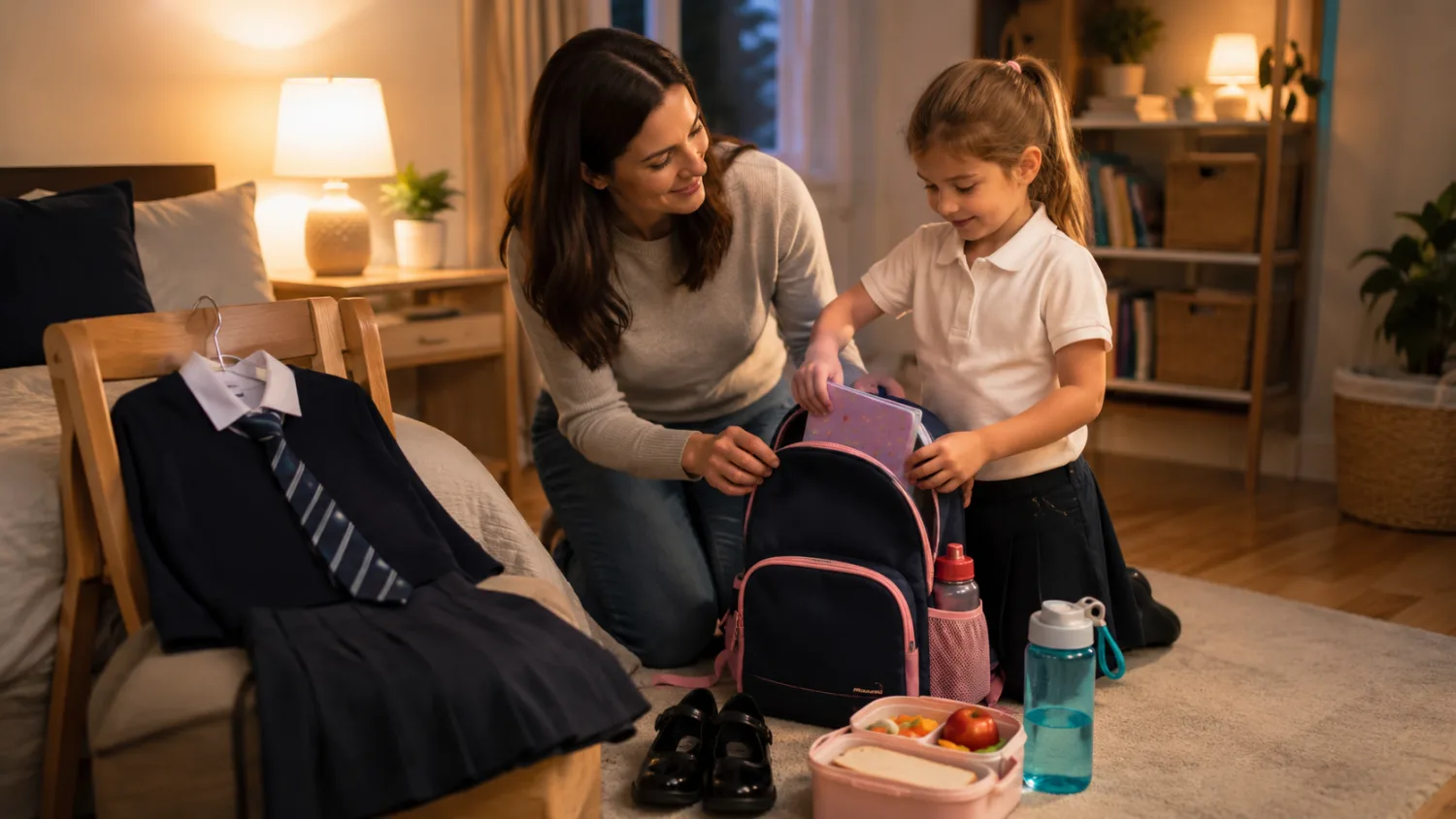
Pack the school bag together
Packing the bag with your child has two advantages.
It reduces the chance of forgetting something, and it helps the child know what they are carrying and where to find it.
Start with what the school has actually requested
A typical list might include:
- school planner;
- pencil case;
- water bottle;
- lunchbox;
- reading book;
- PE kit;
- calculator or maths equipment;
- school laptop or tablet;
- bus pass or travel card;
- locker key;
- medical items where agreed with school.
Do not buy or pack large quantities of equipment simply because social media says pupils “need” them.
Schools vary in what they provide and what pupils are expected to bring.
For children starting secondary school, the AllSchools guide What Does My Child Really Need for Secondary School? separates genuinely useful equipment from unnecessary extras.
Put important items in predictable places
A child is much more likely to use a bus pass, key or inhaler correctly when they know exactly where it is.
Choose:
- a particular bag pocket for keys;
- a secure place for travel cards;
- a section for the planner;
- a bottle pocket for water;
- the school-approved location for medication if pupils are permitted to carry it.
Consistency reduces the frantic searching that often happens later.
Make sure the child can carry the bag
Lift it.
If it feels excessively heavy before books have even been added, remove unnecessary items.
Secondary pupils in particular can end up carrying stationery, large bottles, sports kit and “just in case” items they rarely use.
Sort out lunch, snacks and water
Do not wait until the morning to discover that nobody knows whether your child is having school dinner or packed lunch.
Confirm the lunch arrangement
Check whether:
- a school meal has been ordered;
- your child needs money or a funded account;
- the school uses a card or biometric system;
- a packed lunch is required;
- snacks are permitted;
- the school provides drinking water;
- there are restrictions connected with allergies.
If your child is unsure about school meals, it does not have to become an all-or-nothing decision. Many families use a combination of the two where the school permits it.
See the AllSchools guide School Lunches in September: Packed Lunch, School Meals or a Mix? for practical advice on choosing an arrangement.
Prepare as much as safely possible
You may be able to:
- wash fruit;
- prepare suitable containers;
- fill or place the water bottle ready;
- prepare part of the packed lunch;
- put refrigerated items together so they are easy to collect in the morning.
Follow normal food-safety precautions and keep foods that require refrigeration chilled.
Do not turn first-day lunch into a nutrition project
Pack food your child is reasonably likely to eat.
The night before a new school year is rarely the ideal moment to introduce an adventurous new lunch because it looks healthier.
A familiar, reasonably balanced meal can be particularly reassuring for younger or anxious pupils.
Check medicines, allergies and important school information
Medical arrangements deserve more attention than stationery.
Check whether anything has changed over the summer
If your child has:
- asthma;
- allergies;
- epilepsy;
- diabetes;
- a significant medical condition;
- new medication;
- a recently changed dose;
make sure the school has the current information it requires.
Do not assume that telling last year's teacher means the new teacher automatically knows.
Check medication arrangements
Depending on school policy and the child's age, ask:
- Is the medication in date?
- Has the school received it?
- Is the correct label attached?
- Is the consent or healthcare documentation current?
- Does your child know who to speak to if they need help?
If medication must be handed directly to the office rather than sent in the child's bag, build this into the morning plan.
Update emergency contact details
Check that the school has current:
- telephone numbers;
- email addresses;
- home address;
- emergency contacts;
- collection arrangements where relevant.
This is particularly important after a house move, job change, new telephone number or change in family circumstances.
Talk about tomorrow—but do not conduct a long interrogation
Some children want to talk continuously about the first day. Others do not want to talk about it at all.
Both responses can be normal.
Ask one open, low-pressure question
You might ask:
“How are you feeling about tomorrow?”
or:
“Is there anything about tomorrow you're not sure about?”
Then listen.
Avoid immediately responding with a list of reasons the child should not worry.
If they say they are nervous about getting lost, friendship groups or finding a toilet, that concern may be entirely reasonable.
Answer the question they actually asked
A child asking:
“What if I don't know where maths is?”
may not need a general speech about how everyone feels nervous.
They may need:
“If you aren't sure, ask your form tutor or a member of staff. You'll also have your timetable with the room number on it.”
Practical answers can reduce anxiety better than broad reassurance.
Be honest when you do not know
Parents do not have to know exactly what will happen.
You can say:
“I'm not sure whether you go straight to the classroom or wait in the hall. We'll check the message from school, and if it isn't there, we'll ask when we arrive.”
This teaches the child that uncertainty can be managed without becoming a crisis.
Avoid repeatedly checking whether they are nervous
If a child appears content, allow them to be content.
Repeated questions such as “Are you sure you're not worried?” can unintentionally suggest that there is something they ought to fear.
For children starting Reception, the AllSchools guide to starting Reception in September covers separation, independence and first-day routines in more detail.
For children moving to secondary school, see what to do before starting secondary school.
Keep the evening ordinary enough for sleep
A special dinner or first-day photograph can be lovely family traditions.
But the evening does not need to become an event so exciting that nobody can fall asleep.
Return to the usual bedtime routine
A predictable sequence may include:
- finishing screens and games;
- washing or bathing;
- putting on pyjamas;
- brushing teeth;
- reading or another quiet activity;
- going to bed at a familiar time.
NHS guidance recommends calm, predictable bedtime routines and reducing screen use before bed for younger children.
AllSchools also has a fuller guide to healthy sleep habits for school-aged children. That article is included in the current resources sitemap.
Do not suddenly demand an unrealistically early bedtime
If your child's summer sleep pattern has drifted substantially later, trying to move bedtime by two hours on the final evening may simply create frustration.
A gradual adjustment in the days before school is easier, but if that opportunity has passed, aim for a calm evening and a sensible bedtime rather than turning sleep into a battle.
Prepare for “I can't sleep”
The night before school is a common time for minds to become busy.
If your child cannot settle:
- keep lights low;
- avoid returning to stimulating screens;
- offer quiet reassurance;
- keep the environment calm;
- remind them that resting quietly is still useful.
One imperfect night's sleep does not mean the first day will be a disaster.
Give anxious children a plan, not endless reassurance
When a child is worried, parents naturally want to say:
“Everything will be fine.”
Sometimes it will be. But a child may know that you cannot guarantee it.
A more useful approach is to help them know what to do if something feels difficult.
Create a simple “if this happens” plan
For example:
If I don't know where to go: ask a member of staff.
If I can't find my friend: go to the place I am supposed to be rather than searching around school.
If I feel ill: tell my teacher or another adult.
If I forget something: tell the teacher rather than hiding it.
If I get on the wrong bus: speak to the driver or a responsible adult immediately.
This converts a vague fear into a manageable action.
Identify safe adults
A child might be able to approach:
- their class teacher;
- form tutor;
- teaching assistant;
- head of year;
- pastoral member of staff;
- SEND staff;
- reception or office staff.
Children do not need to memorise the entire school staffing structure. They need to know that asking an adult for help is acceptable.
Take significant anxiety seriously
Some nerves before returning to school are normal.
More significant distress deserves attention, particularly when it is persistent or accompanied by:
- repeated inability to attend;
- panic;
- sleep problems lasting beyond the transition;
- frequent physical complaints;
- withdrawal;
- a specific fear of another pupil or adult;
- previous bullying or difficult school experiences.
If your child's anxiety is more than ordinary first-day nerves, contact the school rather than waiting for the situation to become harder.
The AllSchools guide to school anxiety and school avoidance explains what families can do when worry begins to interfere with attendance.
Give older children some responsibility for their own preparation
The older the child, the less useful it becomes for a parent to secretly prepare everything while the pupil goes to bed without knowing what is in their bag.
Secondary school in particular requires growing independence.
Let them pack while you provide a final check
A useful approach is:
“Pack what you think you need, then we'll check it together.”
This lets the child practise responsibility without turning one forgotten item into a first-day crisis.
Let them check the timetable
Older pupils should gradually learn to identify:
- which lessons they have;
- whether PE kit is needed;
- which books or equipment to bring;
- where lessons are;
- what time they need to leave home.
Parents can support the system without becoming the system.
Do not rescue every possible mistake in advance
Forgetting one ordinary piece of stationery is usually a manageable problem.
Small mistakes can help children develop routines of their own.
Distinguish between things where the consequence is genuinely significant—such as medication or safe transport—and things where the child can learn from a minor inconvenience.
Make the morning easier before everyone goes to bed
The final ten minutes of preparation can remove many of the problems that otherwise appear when everybody is tired and rushing.
Create one departure point
Put together, near the door if practical:
- school bag;
- shoes;
- coat;
- PE kit;
- anything that must be handed to the school office.
Keep refrigerated lunch items in the fridge, but make a visible reminder so they do not stay there until after the school run.
Set alarms
If an alarm clock, phone or smart speaker is being used, confirm:
- the volume;
- the correct time;
- that it is not still set to a summer-holiday schedule;
- that the device has enough battery.
One backup alarm on an important first morning is reasonable.
Check transport one final time
For an older child travelling independently:
- check the bus or train time;
- confirm the stop;
- make sure the travel card is ready;
- agree what happens if the service is cancelled;
- make sure the child knows how to contact you where appropriate.
For a younger child, simply confirm who is taking them and who is collecting them.
Decide breakfast now
The first morning does not need a spectacular breakfast.
Choose something familiar that your child normally eats.
If mornings are rushed, put bowls, cereal or other non-perishable items ready the evening before.
Know which jobs can wait until tomorrow
Part of creating a calm evening is stopping.
Not every school-related task needs to be completed before bedtime.
Do not reorganise the whole household
You do not need to:
- create a complete homework station;
- label every pencil;
- reorganise the bedroom;
- set the family's entire term-time schedule;
- buy every item another parent mentioned;
- complete paperwork that is not due yet.
Deal with what affects tomorrow.
Do not cram academic preparation into the final evening
If your child has not revised multiplication tables, handwriting or French vocabulary throughout the summer, the night before school is not the time for an emergency catch-up session.
The academic year will provide time for learning.
A calm evening and adequate sleep are likely to be more useful than last-minute worksheets.
Stop checking once the important things are done
At some point, the bag is packed enough.
The uniform is ready enough.
The morning is organised enough.
Continuing to repeatedly check everything can communicate anxiety to a child who was previously feeling reasonably relaxed.
Frequently asked questions
What should I prepare the night before school starts?
Prioritise the morning timings, uniform, school bag, lunch arrangements, transport and any essential medication or paperwork. Once those are ready, focus on a calm evening rather than finding more tasks to complete.
What time should my child go to bed before the first day?
There is no single bedtime for every child. Aim for a routine that provides sufficient sleep for your child's age and usual needs. A predictable wind-down routine is generally more useful than suddenly enforcing a dramatically earlier bedtime on the final night.
What if my child cannot sleep because they are nervous?
Keep the environment calm and avoid stimulating screens or arguments about sleep. Offer reassurance and remind them that one imperfect night does not ruin the first day. If sleep difficulty continues because of school anxiety, consider speaking with the school or an appropriate health professional.
Should I wake my child earlier than normal on the first day?
Allow enough time to get ready without rushing, but there is usually no need to add a very large buffer. Excessive waiting can sometimes give an anxious child more time to worry.
What if we discover part of the uniform is missing?
Use the closest acceptable alternative you have and contact the school where necessary. Avoid making the child feel that a small uniform problem will ruin their first day.
What if my child says they do not want to go to school?
Listen and ask what is worrying them. Ordinary first-day nerves can often be helped by making the morning predictable and identifying who they can ask for help. Persistent or severe anxiety, especially when it interferes with attendance, should be discussed with the school.
Should I pack my teenager's school bag for them?
It is usually better to let older children take responsibility while you help them check the essentials. This develops independence while still providing support during a transition.
Should we practise schoolwork the night before?
Usually not. There is little value in last-minute academic cramming before the first day. Reading for pleasure or another calm activity is fine, but the priority should be preparing practically and settling for sleep.
Should I prepare a special first-day breakfast?
You can if your family enjoys that tradition, but a familiar breakfast the child will actually eat is perfectly adequate. Avoid introducing unfamiliar food on a morning when the child may already feel nervous.
What if my child has forgotten everything about the school routine?
That is normal after a long break. Schools expect pupils to need reminders. Review the key points—arrival, collection, lunch and who to ask for help—rather than trying to rehearse the entire school day.
How can I keep myself calm if I am nervous about my child's first day?
Focus on the parts you can control: preparation, timings and being available to listen. Children may notice adult anxiety, so try not to repeatedly seek reassurance from them about whether they will be all right.
What is the most important thing to do the night before school?
Remove the obvious practical problems and then allow the evening to become ordinary. A child benefits more from feeling safe, prepared and listened to than from having every possible first-day detail perfected.
The night before school starts does not need to become a test of how organised your family is.
Pack the bag. Put the uniform out. Check the journey. Sort lunch and medication. Give your child an opportunity to talk if they want to.
Then stop preparing.
The first day may contain a forgotten pencil, an awkward goodbye, a wrong turn or a lunch that comes home untouched. None of those things means the start has failed.
The aim is not to make tomorrow perfectly predictable.
It is to help your child feel that whatever tomorrow brings, it can be managed.