
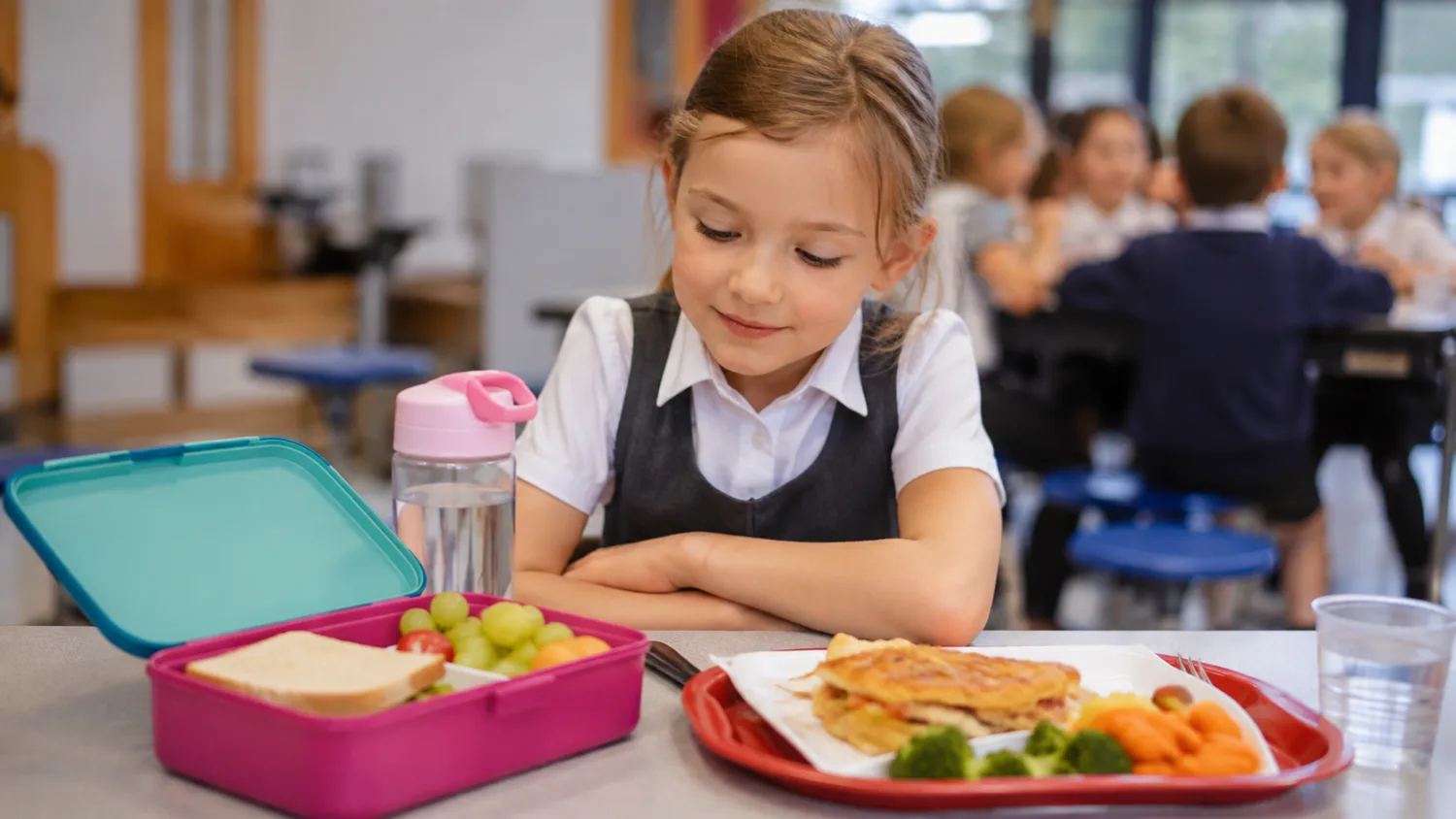
September brings a surprising number of small decisions.
New shoes, new routines, earlier mornings, homework systems, clubs, PE days—and somewhere among them is a question that can become much more complicated than expected:
What should my child have for lunch?
For some families, the answer is obvious. A child enjoys school dinners, the school menu works well and there is no reason to change. Another child strongly prefers familiar food from home and takes a packed lunch every day.
Many families sit somewhere in between.
A child may like pizza day but dislike most other school meals. A parent may prefer packed lunches but find preparing them every morning exhausting. A pupil starting a new school may want to copy what their friends are doing. Allergies, sensory needs, cost, religious requirements, school rules and the length of the lunch break can all affect what works in practice.
There is no single lunch arrangement that is best for every child.
The useful question is whether your child's lunch is nutritious enough, eaten reliably, manageable for the family and compatible with the way their school actually operates.
This guide looks at school meals, packed lunches and combining the two, with particular attention to the first weeks of the new school year.
Start with what your school actually offers
Before deciding between packed lunches and school meals, look at the arrangements at your child's school rather than relying on assumptions from another school or a previous year.
Schools differ considerably.
Some offer several hot choices each day. Others operate rotating menus with one main meal and alternatives. Secondary schools may use cafeteria-style systems where pupils choose individual items, while primary schools are more likely to have pre-planned menus.
Check:
- the current menu;
- meal prices;
- how meals are ordered;
- whether choices must be booked in advance;
- how payment works;
- whether pupils can alternate between packed lunches and school meals;
- how allergies and dietary requirements are managed;
- whether packed lunches have their own school policy;
- how long pupils have to eat;
- whether younger children receive help carrying trays, opening packaging or cutting food.
Do this even if your child attended the school last year. Caterers, prices, menus and ordering systems can change over the summer.
Look at a complete menu cycle
Do not judge the school lunch offer from one day's menu.
Many schools operate a menu across several weeks. A child who rejects Monday's option may happily eat several meals later in the cycle.
Look at the full menu together and ask your child which meals they would genuinely choose.
This can make a mixed arrangement particularly easy. For example, your child might take a packed lunch on two days and have school meals on three.
Ask practical questions before the first day
If your child is starting Reception, Year 7 or a new school, the lunch system itself may be unfamiliar.
Find out:
- where pupils go at lunchtime;
- whether they select meals in the morning;
- whether a card, fingerprint or online account is used;
- where lunchboxes are stored;
- whether water is available;
- who pupils should speak to if there is a problem.
A child can dislike “school dinners” when the real difficulty is standing in an unfamiliar queue, not knowing how payment works or feeling rushed in a noisy dining hall.
What are the advantages of school meals?
School meals can be an excellent option, particularly when the school offers food your child actually eats.
In England, food served in maintained schools and academies must meet statutory school food standards designed to provide a varied and balanced diet. The standards cover areas such as fruit and vegetables, starchy foods, protein and dairy, while restricting some foods high in fat, salt and sugar. Parents who want to understand the requirements can read the government's school meals and food standards guidance.
A hot meal can make the school day easier
For some children, having a substantial cooked lunch helps them manage a long day better than grazing on a collection of snack foods.
A typical school meal may include:
- a main dish;
- vegetables or salad;
- a carbohydrate such as rice, pasta or potatoes;
- fruit, yoghurt or another dessert;
- water or another permitted drink.
That does not automatically mean every school meal is nutritionally perfect or that every pupil eats every component. What is served and what reaches the child's stomach are different questions.
However, school meals can provide a useful structure.
There is less preparation for families
A school meal removes the evening or early-morning job of:
- planning lunch;
- checking the fridge;
- making sandwiches;
- finding clean containers;
- remembering an ice pack;
- discovering at 7:45am that somebody ate the last yoghurt.
That convenience is not trivial.
School routines need to be sustainable for parents as well as children. A theoretically perfect lunch system that causes daily stress may not be the best option for the household.
School meals can expose children to different foods
Some children will try food at school that they refuse at home, particularly when classmates are eating the same meal.
This is not guaranteed, and school lunchtime should not become a battle over eating. But regular exposure to a range of dishes can help some children gradually become more comfortable with unfamiliar foods.
There is no lunchbox to remember
For children moving between homes, travelling independently or already carrying several books and PE equipment, this can be surprisingly useful.
It also avoids the mystery of the lunchbox discovered in a school bag on Sunday evening containing Friday's uneaten banana.
What are the disadvantages of relying entirely on school meals?
School meals work well only if the child eats enough of them.
A nutritionally balanced plate that is mostly thrown away is less useful than a reasonably balanced packed lunch a child actually eats.
Choice can be limited
A child may dislike the day's main option or find unfamiliar sauces, mixed foods or textures difficult.
This can matter particularly for:
- younger children;
- pupils with sensory sensitivities;
- some autistic pupils;
- children with restricted eating;
- pupils managing allergies;
- children accustomed to particular cultural foods.
If your child regularly comes home extremely hungry, find out what they are actually eating rather than assuming the school portion is too small.
The dining environment can affect eating
School dining halls can be busy and noisy.
Some pupils spend significant time queuing, socialising or trying to find a seat. Younger pupils may eat slowly. Secondary pupils may prioritise getting outside to see friends.
A child can therefore technically have access to a full meal but consume relatively little.
If this becomes a pattern, speak to the school rather than framing the problem simply as the child “being fussy”.
Popular choices may run out
This depends on the school's catering system, but pupils eating later in the lunch period may occasionally find fewer choices available.
If your child repeatedly reports that their preferred meal is unavailable, ask the school how meals are allocated. Pre-ordering systems may reduce this problem.
The menu may not suit every dietary need equally well
Schools should have arrangements for allergies and may cater for vegetarian, religious and other dietary needs, but the range varies.
If your child has a medically diagnosed allergy, do not rely on informal assumptions about ingredients. Contact the school and complete whatever medical or allergy process it requires.
The Department for Education updated its school food standards resources in July 2026 to link to current statutory allergy-safety guidance for schools.
When does a packed lunch work better?
A packed lunch offers control and predictability.
You know what has been sent. Your child recognises the food. Portions can be adjusted to appetite, and dietary needs may be easier to manage.
For some children, that makes packed lunches clearly preferable.
Familiar food can reduce first-week stress
September already involves change.
A child starting school may be dealing with:
- a new classroom;
- new adults;
- different friends;
- unfamiliar toilets;
- new routines;
- a noisy dining hall;
- a longer school day.
Taking a familiar lunch can remove one uncertainty.
This does not mean your child must take packed lunches permanently. It may simply be the easiest option while other routines settle.
You can tailor portions to your child
Some children have large appetites. Others become overwhelmed by seeing too much food.
A packed lunch allows parents to adjust the quantity and format.
You may know that your child will eat half a sandwich, cucumber, cheese and fruit but will ignore a large filled roll. Another child may need substantially more food because of their age, activity level or appetite.
Packed lunches can suit particular dietary requirements
Families managing allergies, intolerances, religious diets or strong sensory preferences may find home-prepared food easier.
However, check the school's rules.
Some schools restrict nuts or particular foods because of severe allergies among pupils. A food that is safe for your own child may not be permitted in the shared school environment.
How to build a packed lunch without making it complicated
The internet can make packed lunches look like a competitive art form.
They do not need miniature sandwiches cut into stars, colour-coordinated fruit and vegetables or an inspirational note written in perfect handwriting every morning.
A sensible packed lunch can be simple.
Think in broad components
A practical starting point is to include:
- a main starchy item such as bread, wrap, pitta, pasta, rice, couscous or potatoes;
- a source of protein such as chicken, egg, cheese, beans, hummus, fish or another suitable option;
- fruit or vegetables your child is reasonably likely to eat;
- a dairy food or suitable alternative where appropriate;
- water unless the school provides it or has a different drinks policy.
It does not have to look different every day.
Children often appreciate predictable lunches, particularly during the first weeks of school.
Variety can happen across the week
Not every lunch needs to contain every possible food group in perfect proportions.
Think about the child's diet over several days.
For example, main items could rotate between:
- a sandwich;
- a wrap;
- leftover pasta served appropriately chilled;
- a pitta with filling;
- a rice or couscous salad;
- soup in an appropriate insulated container if the school permits it.
Repetition is also acceptable. If your child reliably eats the same reasonably balanced lunch and is reluctant to change, September may not be the month to force variety.
Be realistic about vegetables
Sending raw peppers every day because you wish your child ate peppers does not mean your child has eaten vegetables every day.
Start with foods that have a reasonable chance of being eaten.
You can continue offering variety at home where there is more time and less social pressure.
Keep treats in proportion rather than making them forbidden
A packed lunch does not have to be nutritionally flawless to be reasonable.
A small biscuit or similar food alongside a substantial lunch is very different from a lunch made mainly of crisps, sweets and sugary drinks.
Also check your school's packed-lunch policy. Individual schools may have restrictions that go beyond general nutritional advice.
Could mixing packed lunches and school meals be the easiest option?
For many families, yes.
There is no particular virtue in choosing one system and remaining loyal to it for the entire academic year.
If the school allows daily choice, a mixed approach can combine the advantages of both.
Choose school meals your child actually likes
Sit down with the menu together.
Your week might look like:
- Monday — school meal;
- Tuesday — packed lunch;
- Wednesday — school meal;
- Thursday — packed lunch;
- Friday — school meal.
Another child might take school meals every day except when a particular menu appears.
This reduces packed-lunch preparation without requiring the child to eat meals they repeatedly reject.
A mixed approach can help a nervous child try school dinners
If your child is unsure about the dining hall, agree to try one school meal each week.
They can learn:
- where to queue;
- how to order;
- where to sit;
- how payment works;
- which meals they like.
Once the process feels familiar, they may choose school meals more often.
Check whether the school requires advance booking
Not every school allows pupils to switch spontaneously.
Some primary schools need meal choices days or weeks in advance. Others allow pupils to select each morning.
Build your family routine around the actual school system.
A mixed approach can also help with family workload
If packed lunches are becoming tiring to prepare, choose one or two school-meal days.
You do not need to wait until the entire packed-lunch routine collapses.
Sustainable routines matter. The beginning of the academic year already asks families to establish many new habits.
Check whether your child is entitled to free school meals
September 2026 is particularly important because free school meal eligibility is changing significantly in England.
From the beginning of the 2026/27 academic year, children in households receiving Universal Credit qualify for benefits-related free school meals regardless of household earnings, provided the required claim is made and eligibility is verified.
This expands eligibility substantially compared with previous arrangements.
Do not assume the school will automatically know
Government guidance says that eligibility needs to be verified. Schools and local authorities have processes for checking this, and families may still need to provide or confirm information.
If you receive Universal Credit and have a school-aged child in England, check with the school or local authority rather than assuming you will automatically be enrolled.
The government's free school meals service can direct families to the appropriate local arrangements.
Reception, Year 1 and Year 2 are different
In England, pupils in Reception, Year 1 and Year 2 at state-funded schools continue to be entitled to a free school meal through Universal Infant Free School Meals regardless of family income.
However, families who also meet benefits-related criteria should still make sure the school knows. Benefits-related eligibility can affect additional school funding as well as the meal itself.
Rules differ across the UK
Free school meal schemes differ between England, Scotland, Wales and Northern Ireland, and provision can also vary by age.
If you are outside England, use the relevant national or local authority service rather than assuming the English criteria apply.
AllSchools also has a fuller guide to free school meals, eligibility and how to apply.
Think about allergies, SEND and sensory needs before September
Food is straightforward for many pupils. For others, lunch requires advance planning.
Tell the school about allergies properly
Do not rely on your child verbally telling staff about a serious allergy.
Make sure the school has:
- the required medical information;
- details of allergens;
- medication where prescribed;
- current emergency instructions;
- your contact details;
- information about any change since the previous year.
If your child is using school meals, ask how the catering team identifies pupils with allergies and how cross-contact risks are managed.
Sensory needs deserve practical planning
Some children find food texture, smell, temperature or appearance unusually difficult.
The dining hall itself can also create challenges because of:
- noise;
- crowding;
- food smells;
- unpredictable seating;
- queues;
- pressure to eat quickly.
A child who eats successfully at home may struggle significantly at school.
If your child has autism or other sensory needs, discuss lunchtime as part of their wider transition arrangements rather than waiting until they repeatedly miss lunch.
The AllSchools guide to neurodiversity in the classroom explains some of the wider environmental and sensory challenges pupils may experience at school.
Do not turn restricted eating into a lunchtime confrontation
If your child has very restricted eating, significant anxiety around food or another feeding difficulty, the priority is not to make the lunchbox look more conventionally healthy at any cost.
Work with appropriate health professionals and the school where necessary.
A child eating a limited but safe lunch may be preferable to a theoretically ideal lunch they cannot tolerate at all.
Ask what your child actually ate, not whether lunch was “good”
The first few weeks are useful for discovering whether your chosen system works in real life.
A child saying “lunch was fine” may mean almost anything.
Use specific questions
Instead of:
“Did you eat your lunch?”
try:
- What did you choose today?
- Which bit did you like?
- Was there anything you didn't eat?
- Did you have enough time?
- Who did you sit with?
- Was the dining hall noisy?
- Were you still hungry afterwards?
This helps distinguish a food problem from a lunchtime-environment problem.
Look at what comes home
If you send a packed lunch, the leftovers provide useful evidence.
If the apple returns untouched every day, repeatedly packing another apple does not improve the child's diet.
Ask why it is not being eaten.
Perhaps the child dislikes whole apples but eats sliced fruit. Perhaps there is not enough time. Perhaps opening the container is difficult. Perhaps they eat the preferred items first and then leave to play.
Watch for persistent hunger after school
Many school-age children are understandably hungry by the end of the day.
But if your child is ravenous every afternoon, tired, irritable and regularly reports eating very little at lunch, investigate.
They may need:
- a larger packed lunch;
- a different school meal choice;
- help accessing food;
- more time to eat;
- support with the dining environment.
For younger children, particularly those starting school for the first time, the wider AllSchools guide to starting Reception in September covers other routines families may want to establish alongside lunch.
Make September lunch routines easy enough to sustain
A school lunch system is successful only if it still works several weeks after the enthusiasm of the new term has disappeared.
Prepare packed-lunch basics in advance
You can reduce morning work by keeping a small collection of reliable options available.
For example:
- bread, wraps or pittas;
- easy fillings;
- fruit the child reliably eats;
- vegetables that require little preparation;
- yoghurt or suitable alternatives;
- reusable water bottles;
- containers the child can open independently.
Some components can be prepared the evening before, depending on food-safety requirements.
Teach younger children to open their lunch
Before September, practise:
- opening the lunchbox;
- unscrewing the bottle;
- opening containers;
- peeling fruit where necessary;
- opening permitted packaging;
- putting leftovers back safely.
This small preparation can make the lunchtime experience much easier.
Have a backup plan
Mornings go wrong.
You may oversleep, run out of bread or discover that the lunchbox is still in the dishwasher.
Know whether your child can obtain a school meal at short notice and how you would notify the school.
If not, identify one or two emergency packed lunches you can assemble quickly.
Let the system change
Your September decision is not a contract for the whole year.
A child who begins with packed lunches may move to school meals once they feel settled. A pupil who initially enjoys school meals may later prefer a mix.
Review the arrangement when something stops working instead of continuing purely because “that's what we chose at the start of term”.
Frequently asked questions
Are school meals healthier than packed lunches?
School meals in England must meet school food standards, which are designed to provide a healthy and balanced food offer. A well-planned packed lunch can also be nutritious. The more important practical question is what the individual child actually eats rather than which category of lunch appears healthier on paper.
Can my child have school dinners on some days and packed lunches on others?
Many schools allow this, but arrangements differ. Some require meals to be booked in advance or operate fixed patterns. Check with your child's school before relying on daily switching.
Are school meals free in Reception, Year 1 and Year 2?
In England, pupils in Reception, Year 1 and Year 2 at state-funded schools are entitled to Universal Infant Free School Meals. Families who also qualify for benefits-related free school meals should still make sure their eligibility is recorded.
What changes to free school meals in September 2026?
From the start of the 2026/27 academic year in England, children in households receiving Universal Credit are eligible for benefits-related free school meals regardless of household earnings, subject to the required claim and eligibility verification process.
What should I put in a healthy packed lunch?
A practical lunch might combine a starchy main food, a protein source, fruit or vegetables, a dairy item or appropriate alternative, and water. The exact foods should suit the child's age, appetite, dietary needs and school rules.
What if my child eats almost nothing at school?
Ask what is making eating difficult. The issue may be the food, but it may also involve noise, queues, limited time, anxiety, sensory needs or difficulty opening containers. Speak to the school if the problem continues.
What if my child only wants the same packed lunch every day?
Repetition is not automatically a problem if the overall diet is reasonably balanced. Variety can be introduced gradually across other meals rather than turning school lunch into a daily battle.
Can schools ban certain foods from packed lunches?
Schools can have packed-lunch policies and may restrict certain items, particularly where allergy safety is involved. Check your school's current policy rather than assuming that any food normally eaten at home can be brought in.
Should I send nuts if my child has no nut allergy?
Check the school's allergy policy first. Some schools restrict nuts or particular nut products because another pupil has a severe allergy.
Is a hot school lunch better in winter?
Some children enjoy a hot meal more during colder months, but it is not nutritionally necessary simply because the weather is cold. What matters is that the child receives sufficient suitable food and actually eats it.
Should I let my child choose between school meals and packed lunches?
Where practical, involving the child can help. Look at the school menu together and discuss which meals they are likely to eat. Parents still need to make decisions about cost, nutrition and practicality, but children are more likely to eat food they have had some role in choosing.
What is the best lunch option for starting a new school?
There is no universal best option. Familiar packed food can reduce uncertainty for some children, while others enjoy joining classmates for a school meal immediately. If the school permits it, a gradual mixed approach can work particularly well.
The best September lunch is not the one that looks most impressive in a photograph or follows a rigid idea of what parents “should” choose.
It is the lunch your child can access, has enough time to eat, receives adequate nutrition from and is reasonably happy to have.
Start with the school's actual arrangements. Ask your child what they are eating rather than what they theoretically receive. Check whether you are entitled to free school meals. Take medical and sensory needs seriously, and change the routine if it is not working.
School meals, packed lunches and a mixture of the two can all be perfectly sensible choices.
September is a good time to find out which one works for your child.