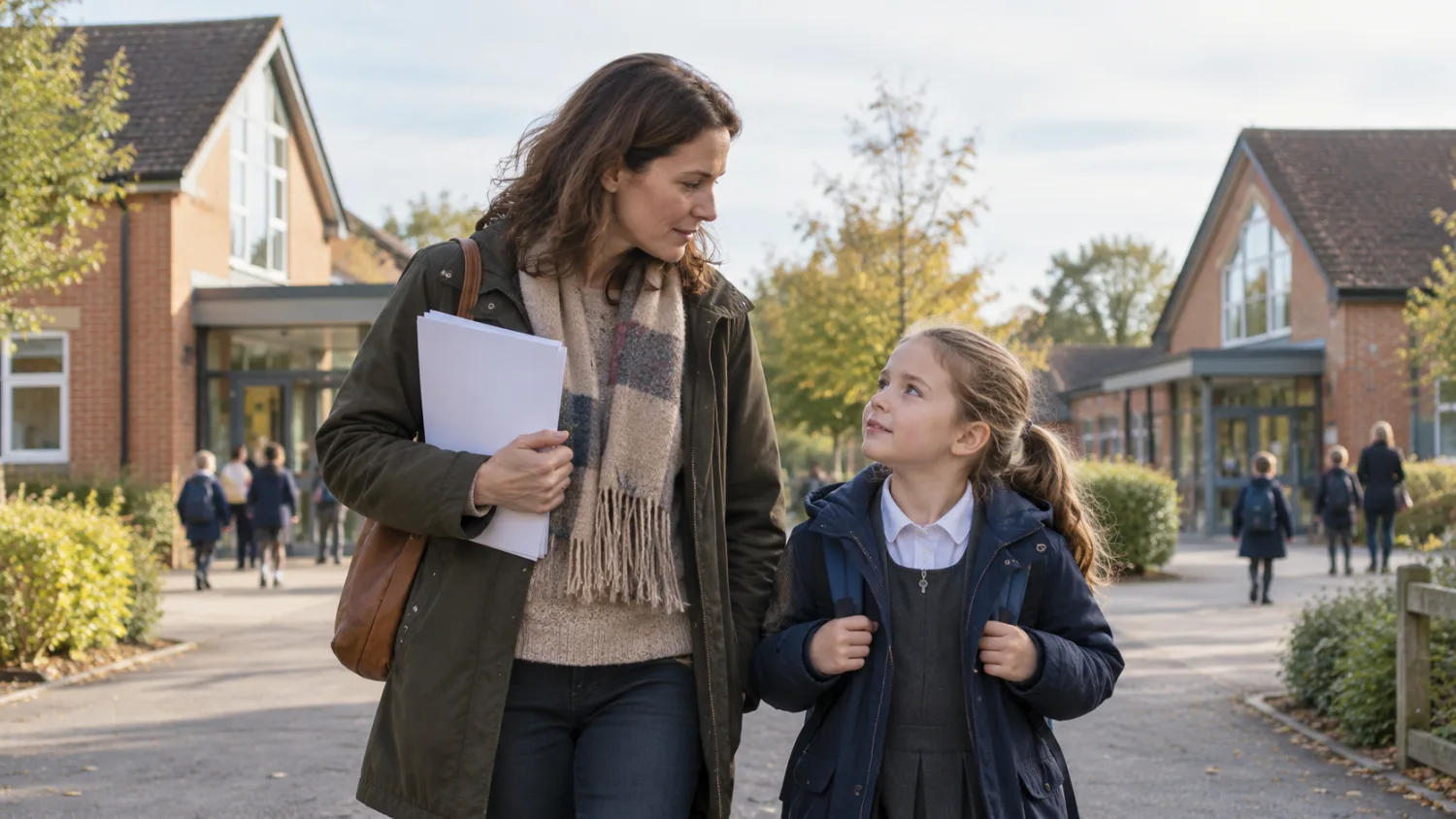

Most parents know the feeling: something does not seem quite right, but you are not sure how serious it is. Your child may be coming home upset, avoiding homework, saying they have no friends, falling behind, getting into trouble, refusing school, or simply seeming different. You want to speak to the teacher, but you do not want to overreact, damage the relationship, or make life harder for your child.
The good news is that teachers are used to parents raising concerns. In fact, most teachers would rather know early than find out months later that a child has been struggling in silence. A calm, clear conversation can make a big difference, especially when it happens before a worry turns into a crisis.
This guide is for UK parents who are worried about school and want to speak to their child’s teacher in a constructive way. It covers how to prepare, what to say, what to avoid, how to follow up, and what to do if the problem is not resolved.
First, remember: you are not “being difficult” by raising a concern
Many parents delay speaking to school because they worry they will be seen as pushy. Others feel embarrassed because they are not sure whether the issue is “bad enough”. Some had difficult school experiences themselves and find it uncomfortable to speak to teachers. These feelings are very common.
But raising a concern is part of normal home-school communication. Schools cannot always see what parents see at home. A child who seems settled in class may be melting down every evening. A pupil who appears quiet and compliant may be anxious, lonely or confused. A child who is getting into trouble may be struggling with work, friendship, sleep, attention, confidence or something happening outside school.
The aim is not to accuse the teacher or demand instant answers. The aim is to share what you have noticed, ask what school has noticed, and agree what happens next.
When should you contact the teacher?
You do not need to wait for parents’ evening if you are worried. Parents’ evening is useful for general progress, but it is often too short for a sensitive conversation. If something is affecting your child’s wellbeing, learning, behaviour or attendance, it is reasonable to contact school sooner.
It may be time to speak to the teacher if your child:
- regularly says they do not want to go to school;
- comes home tearful, angry, withdrawn or unusually tired;
- seems to be falling behind or losing confidence with work;
- is repeatedly getting into trouble;
- mentions friendship problems, bullying or feeling left out;
- has a sudden change in behaviour, sleep, appetite or mood;
- is anxious before tests, lessons, PE, breaktime or a particular day of the week;
- is avoiding homework or saying they “can’t do it” before trying;
- has new physical complaints such as headaches or stomach aches on school days;
- has additional needs and the support does not seem to be working.
If your concern is mainly about academic progress, you may also find this guide helpful: How to Know If Your Child Is Falling Behind at School. If the worry is about anxiety or school avoidance, read School Anxiety and School Avoidance: A Parent’s Guide alongside this article.
Speak to your child first, but do not turn them into the investigator
Before contacting school, gently ask your child what has been happening. Try to choose a calm moment rather than starting the conversation at the school gate, during homework stress, or when everyone is tired.
Children often give partial information. They may exaggerate one part, miss out another, or describe how something felt rather than exactly what happened. This does not mean they are lying. It means they are children, and school life can be complicated.
Instead of asking, “What did your teacher do?” or “Who is being horrible to you?”, try questions that leave room for detail:
- “Which part of the day feels hardest at the moment?”
- “When did you first notice this?”
- “Is it happening every day or only sometimes?”
- “What have you already tried?”
- “Is there an adult at school you feel comfortable talking to?”
- “What would make tomorrow feel a little easier?”
It is also important not to make promises you cannot keep. Saying “I won’t tell anyone” can become difficult if the concern involves bullying, safety, mental health or safeguarding. A better phrase is: “I will not rush in angrily, but if you need help, I may need to speak to school so the right adult knows.”
Write down the concern before you contact school
When emotions are high, it is easy for a conversation to become too broad. “My child is miserable” may be true, but the teacher will need examples before they can help. A few notes can make the first conversation much more productive.
Write down:
- what you have noticed at home;
- what your child has said, using their own words where possible;
- when it started;
- how often it is happening;
- whether there are patterns, such as certain days, lessons, children or times of day;
- anything that has changed recently at home or school;
- what you would like school to help you understand.
You do not need to arrive with a legal-style case file. The point is to be specific enough for the teacher to respond. “He says maths is hard and cries on Sunday nights” is more useful than “He hates school”. “She says she sits alone at lunch three times a week” is more useful than “Nobody likes her”.
Start with the right person
In most cases, start with your child’s class teacher in primary school, or form tutor, class teacher or head of year in secondary school. If the concern is about a particular subject, a subject teacher may be the right person. If it involves special educational needs, you may need the SENCO. If it involves bullying, behaviour, attendance, safeguarding or mental health, the school may involve pastoral staff or a designated safeguarding lead.
You do not normally need to go straight to the headteacher. Starting with the adult closest to the situation is usually quicker and more constructive. It also gives the school a fair chance to respond before the matter is escalated.
There are exceptions. If you believe your child is at immediate risk of harm, contact the school urgently and ask for the safeguarding lead or a senior member of staff. If a child is in immediate danger, call emergency services. For wider safeguarding concerns, the NSPCC has guidance for parents at nspcc.org.uk.
How to ask for the conversation
A short, calm message is usually best. Avoid sending a long emotional email late at night if you can. You can explain the issue properly in the meeting or phone call.
For example:
Hello, I’m a little worried about how Ava is feeling about school at the moment. She has been upset several evenings this week and has mentioned finding playtimes difficult. Could we arrange a short time to talk about what you have noticed and how we can support her?
Or:
Hello, I’m concerned that Daniel may be struggling with the current maths work. He is becoming very anxious about homework and says he does not understand what is happening in lessons. Could we arrange a time to discuss how he is getting on and what we can do next?
Or, for behaviour:
Hello, I’d like to talk about the recent behaviour incidents involving Sam. I want to understand what school is seeing, what might be triggering it, and how we can support a more positive pattern. Could we arrange a call or meeting?
This tone matters. It shows that you are concerned, but also that you want to work with the school rather than simply complain.
What to say in the meeting
Once you are speaking to the teacher, begin with the concern rather than the conclusion. This is one of the most useful shifts a parent can make.
Instead of saying, “You are not supporting my child,” try: “I’m worried that she does not feel confident asking for help.”
Instead of saying, “The school is ignoring bullying,” try: “He has described several incidents that sound like they may be bullying, and I want to understand what school has seen.”
Instead of saying, “The work is too hard,” try: “Homework is taking over an hour and ending in tears, so I’m wondering whether there is a gap in understanding.”
A good structure is:
- Share what you have noticed. Keep it factual and specific.
- Ask what the teacher has noticed. There may be information you do not have.
- Ask what support is already in place. Sometimes support is happening but has not been explained clearly.
- Agree the next step. This might be a seating change, check-in, extra explanation, friendship support, SEN review, behaviour plan or follow-up date.
- Agree how you will communicate. Decide whether updates will be by email, phone, planner, app or another system.
Questions that help teachers give useful answers
Teachers are often juggling a lot of information. Clear questions help them move from general reassurance to practical detail.
You might ask:
- “Have you noticed this in school?”
- “Is this typical for their age, or does it stand out?”
- “Are there particular lessons, times or situations where it happens more?”
- “How are they socially at break and lunch?”
- “Do they ask for help when they are stuck?”
- “What does their work show at the moment?”
- “What support has already been tried?”
- “What would you suggest we try for the next two weeks?”
- “When should we review whether it is working?”
- “Who should I contact if things get worse?”
If you are preparing for a wider school conversation, this article may also help: Questions to Ask Teachers at Parents’ Evening.
Try not to begin with blame, even if you are upset
This is not because schools are always right. They are not. Teachers can miss things. Communication can be poor. Behaviour systems can feel unfair. Support can be inconsistent. But if the first conversation begins with blame, people often become defensive before the facts are clear.
A better approach is firm but open: “I’m concerned, and I need help understanding what is happening.” This makes it easier for the teacher to listen properly and for you to get useful information.
That does not mean accepting vague reassurance. If you are told, “They’re fine in school,” but your child is distressed every evening, it is reasonable to say: “I’m glad they seem settled in class, but what we are seeing at home suggests something is still wrong. Can we look more closely at possible triggers?”
If you are worried about learning or progress
Academic worries can be difficult because children develop at different rates. A dip does not always mean a serious problem, but repeated confusion, falling confidence or avoidance should be taken seriously.
Ask the teacher what the current evidence shows. Are there gaps in reading, writing, maths, attention, memory, language, organisation or confidence? Is your child working below, at or above age-related expectations? Are they making progress from their own starting point? Do they understand in class but struggle independently? Is homework harder than classwork?
It may help to bring examples from home, such as a homework task that caused particular difficulty. But avoid turning the conversation into a demand for extra worksheets. The more useful question is: “What is the barrier?” A child who refuses writing may have weak spelling, poor handwriting stamina, anxiety about mistakes, difficulty planning ideas, or a lack of understanding. Each needs a different response.
For more detail, read What to Do If Your Child Is Struggling Academically Before Hiring a Tutor and A Parent’s Guide to School Reports and Grades.
If you are worried about behaviour
When a child keeps getting into trouble, parents often feel judged. It can be tempting either to defend the child completely or to come down hard at home without understanding what is happening. Neither approach usually solves the problem.
Behaviour is communication, but it is also habit, skill, context and consequence. The key is to understand the pattern. Ask what happens before the incident, what the behaviour looks like, what happens afterwards, and whether it is linked to certain lessons, transitions, friendships, unstructured times or adult instructions.
You might say:
I am not excusing the behaviour, but I do want to understand what is driving it. Are there patterns we can look at together?
If consequences are being used, ask what support is also being put in place. A child who lacks a skill will not develop it through punishment alone. They may need help with emotional regulation, friendship repair, organisation, language, attention, sensory needs or confidence.
You may find this related guide useful: What to Do If Your Child Keeps Getting in Trouble at School.
If you are worried about friendships or bullying
Friendship problems are not always bullying, but they still matter. Children can be deeply affected by exclusion, teasing, rumours, group changes and social media conflict. Schools may not see everything, especially at breaktime, lunchtime, on the way home or online.
If your child describes repeated, targeted behaviour that makes them feel afraid, humiliated or isolated, use the word “bullying” calmly and ask how the school will investigate and record it. The NSPCC advises parents to involve the school when bullying is a concern and to agree a key person the child can speak to if further incidents happen. You can also read NSPCC advice on dealing with bullying.
Helpful questions include:
- “Can you speak to the relevant staff who supervise break and lunch?”
- “How will incidents be recorded?”
- “Who can my child go to during the day?”
- “How will you check whether the behaviour has stopped?”
- “How can we avoid making my child feel more exposed?”
If online behaviour is part of the issue, you may also want to read How to Check Your Child Is Safe Online Without Spying.
If you are worried about anxiety, mood or mental health
Teachers are not therapists, but school is a major part of a child’s life, so they need to know when a child is struggling. A child may be holding things together during the day and falling apart at home. That does not mean the problem is imaginary. It may mean school is taking all their energy.
Tell the teacher what you are seeing at home: sleep changes, panic, tearfulness, irritability, withdrawal, loss of appetite, angry outbursts, refusal to attend, or physical symptoms before school. Ask whether school has noticed changes in friendship, participation, concentration, attendance, confidence or behaviour.
For mental health concerns, the NHS has advice for parents supporting children and young people at nhs.uk, and YoungMinds has a parent support section at youngminds.org.uk/parent.
If your child is at risk of harm, talks about not wanting to live, or you believe they are not safe, seek urgent help. Contact your GP, NHS 111, local crisis services, or emergency services if there is immediate danger.
If your child may have special educational needs
Sometimes a school worry is the first sign that a child may need additional support. This could involve speech and language, autism, ADHD, dyslexia, dyspraxia, sensory needs, emotional regulation, working memory, processing speed, anxiety or another area of need.
You do not need a diagnosis before asking school what support can be put in place. In England, children may receive SEN support in school, and some children with more complex needs may need an Education, Health and Care Plan. GOV.UK explains the basics of SEND support and EHC plans at gov.uk/children-with-special-educational-needs.
Ask the teacher:
- “Do you think there may be an underlying learning, attention, communication or sensory need?”
- “Has the SENCO been involved?”
- “What support is currently in place?”
- “How will we know whether it is working?”
- “Is my child on the SEN register?”
- “Should we arrange a meeting with the SENCO?”
For a clear explanation of the difference between school-level support and statutory plans, read SEN Support vs EHCP: What Is the Difference?.
During the conversation, listen for specifics
A reassuring teacher may say, “They’re doing fine.” That may be true, but it is not always enough. Politely ask for specifics. What does “fine” mean? Fine academically? Fine socially? Fine compared with the class? Fine in lessons but not at break? Fine in school but exhausted afterwards?
Likewise, if you hear, “They need to try harder,” ask what that looks like in practice. Does your child understand the work? Can they start independently? Can they sustain attention? Can they organise themselves? Do they know what a good piece of work looks like? Are they avoiding mistakes because they lack confidence?
Good conversations move from labels to evidence. “Lazy”, “dramatic”, “naughty”, “quiet” or “sensitive” are not plans. The question is always: what is happening, why might it be happening, and what are we going to try next?
Agree a small plan, not just a nice chat
A conversation may feel positive in the moment but fade away afterwards unless there is a clear next step. Before the meeting ends, agree what will happen next and when you will review it.
The plan does not need to be complicated. It might be:
- a check-in with the teacher each morning for two weeks;
- a change of seating;
- a named adult to speak to at breaktime;
- reduced or adapted homework while confidence rebuilds;
- a reading, spelling or maths assessment;
- a SENCO observation;
- a friendship group or lunchtime support;
- a behaviour target focused on one specific skill;
- a home-school communication book;
- a follow-up meeting after two or three weeks.
Try to make the plan realistic. A teacher may not be able to give daily long updates, but they may be able to send a Friday summary. A child may not be able to “stop worrying”, but they may be able to use a help card, meet a trusted adult, or have a plan for difficult transitions.
Send a short follow-up message
After the conversation, it is often useful to send a brief email thanking the teacher and summarising what was agreed. This is not about creating pressure. It prevents misunderstandings.
For example:
Thank you for speaking with me today. Just to confirm, we agreed that Mia will have a check-in after lunch for the next two weeks, you will keep an eye on playtime friendship issues, and we will review how things are going on Friday 14th. I appreciate your help.
If the issue is serious or ongoing, keeping a written record can be helpful. Note dates, incidents, meetings, agreed actions and follow-up. This is especially important for bullying, SEND, attendance, safeguarding, exclusions, repeated behaviour incidents or formal complaints.
What if the teacher disagrees with your view?
Sometimes the teacher’s view will be different from yours. This can be frustrating, but it can also be useful. Children behave differently in different settings. A child may be confident at school and anxious at home, or difficult in class and calm at home. Both pictures matter.
If you feel dismissed, stay focused on evidence. You might say:
I understand that you are not seeing the same level of distress in school. I am still concerned because this is happening regularly at home. Could we agree a way to monitor it for a short period?
Or:
I appreciate that this may look different in class, but the pattern at home is significant. Could we involve the SENCO or pastoral lead to get another view?
The goal is not to win an argument. The goal is to make sure the concern is taken seriously enough to be checked.
When to escalate the concern
Many worries can be resolved with the class teacher or tutor. But if the problem continues, if agreed actions do not happen, or if the issue is serious, it may be appropriate to escalate.
Escalation does not have to be aggressive. It simply means involving the next appropriate person. Depending on the issue, this could be the head of year, phase leader, SENCO, pastoral lead, deputy head, safeguarding lead or headteacher.
You might write:
Thank you for the support so far. Unfortunately, the problem is continuing and I am concerned that the current plan is not enough. Could we arrange a meeting with the SENCO/pastoral lead/head of year to review next steps?
If you reach the point where you are considering a formal complaint, read the school’s complaints policy first. Schools should have a complaints procedure, usually available on their website. GOV.UK also has guidance on how to complain about a school at gov.uk/complain-about-school. For a parent-friendly overview, see School Complaints: When to Raise a Concern and When to Make a Formal Complaint.
What to avoid when talking to school
When you are worried about your child, strong emotions are natural. Still, a few things tend to make school conversations harder.
Try to avoid:
- Sending very long emails before anyone has spoken. A short request for a meeting is usually more effective.
- Copying in many senior staff immediately. Start with the right person unless the concern is urgent or serious.
- Using social media to apply pressure. It may damage trust and rarely helps the child directly.
- Questioning another child directly. Let school handle pupil conversations.
- Promising your child a specific outcome. You can promise to help, but not that a teacher will move a child, punish someone, or change a decision.
- Letting the conversation become about personalities. Keep returning to the child’s needs, evidence and next steps.
Being calm does not mean being passive. Some of the most effective parent conversations are polite, persistent and very clear.
How to involve your child without putting pressure on them
After speaking to school, tell your child the basics in a way that feels reassuring rather than dramatic. For example:
I spoke to your teacher. We both want to help. Tomorrow, you can go to Mrs Patel if lunchtime feels difficult, and we are going to check how things are going at the end of the week.
Avoid giving your child every adult detail, especially if there has been disagreement. Children can feel responsible for adult conflict. They need to know that the adults are working together and that they have a simple next step.
For older children and teenagers, involve them more directly. Ask what they want school to understand and what kind of support would feel acceptable. Teenagers are more likely to engage with a plan if they have had some say in it.
When the school relationship already feels difficult
Some parents are not starting from a place of trust. Perhaps previous concerns were dismissed. Perhaps communication has been poor. Perhaps your child has been labelled. Perhaps you feel school only contacts you when something has gone wrong.
If the relationship is strained, structure helps. Keep communication factual. Ask for meetings with clear agendas. Summarise agreed actions in writing. Focus on one or two priorities at a time. If needed, ask whether another member of staff can attend so there is a shared record and a wider view.
You might say:
I know communication has been difficult recently, but I would like us to reset the conversation around what will help my child. Can we agree the main concern, the support plan and a review date?
That kind of sentence can shift the tone from conflict to problem-solving without pretending everything is fine.
A practical script for a difficult school conversation
If you are nervous, it can help to have a script. You do not need to read it word for word, but it can keep you steady.
Thank you for meeting with me. I wanted to talk because I am worried about [child’s name]. At home we have noticed [specific examples]. They have said [child’s words, if useful]. I understand you may be seeing a different picture in school, so I would like to know what you have noticed. I am hoping we can agree what might be causing this and what we can try next. Could we also agree when we will review it?
If the issue is not improving, you can adapt it:
Thank you for the support so far. I am still worried because [specific examples]. The current plan does not seem to be resolving the issue yet. Can we look again at what else might be needed and whether another member of staff should be involved?
What a good outcome looks like
A good outcome does not always mean the problem disappears overnight. It means the adults have a shared understanding, the child feels heard, and there is a clear plan.
You are looking for:
- a specific description of the concern;
- school’s view of what is happening;
- your child’s voice included appropriately;
- practical support, not just reassurance;
- a named person responsible for key actions;
- a review date;
- clear communication if things change.
Sometimes the first plan will not work. That does not mean the conversation failed. It means the plan needs adjusting. Supporting children is often a process of trying, reviewing and refining.
Final thoughts
Talking to your child’s teacher when you are worried can feel daunting, but it is one of the most important things you can do. You know your child in a way school never fully can. School sees your child in a setting you do not witness. When those two pictures are brought together calmly, children are much more likely to get the right support.
Start early. Be specific. Stay calm where you can. Ask what school has noticed. Agree a next step. Follow up. And if the concern continues, keep going through the right channels until your child’s needs are properly understood.
You are not making a fuss. You are doing your job as a parent: noticing, asking, listening and advocating.
Frequently Asked Questions
Should I email the teacher or ask for a meeting?
For a simple concern, an email may be enough. For anything emotional, repeated, complex or sensitive, ask for a phone call or meeting. Tone is easier to manage in conversation, and both sides can ask questions.
What should I put in the first message to the teacher?
Keep it short. Say what you are worried about, give one or two examples, and ask for a time to talk. You do not need to include every detail in the first message.
Can I speak to the teacher at the school gate?
You can mention briefly that you would like to talk, but the school gate is not the best place for a proper concern. Teachers may be supervising pupils, speaking to other parents, or preparing for lessons. Ask for a suitable time.
What if my child begs me not to tell the teacher?
Listen to their worries and reassure them that you will handle it calmly. Explain that adults sometimes need to work together to help. Where possible, involve your child in deciding what is shared and how, but do not promise secrecy if there are safety, bullying, wellbeing or safeguarding concerns.
What if the teacher says my child is fine at school?
Ask for more detail and explain what you are seeing at home. Some children mask difficulties during the school day and release their distress afterwards. You can ask school to monitor patterns for a short period.
How long should I wait before following up?
It depends on the concern. For low-level worries, a review after two or three weeks may be reasonable. For bullying, distress, school refusal, safeguarding or repeated behaviour incidents, follow up much sooner and agree a clear timescale with school.
When should I involve the SENCO?
Ask for SENCO involvement if your child may have additional needs, if ordinary classroom support is not enough, if progress or behaviour concerns persist, or if you need a clearer plan for learning, communication, sensory, attention or emotional needs.
What if I disagree with the school’s view?
Stay factual and ask for evidence. Share what you are seeing at home and ask how school can monitor the issue. If you still feel the concern is not being understood, ask for another member of staff to be involved.
When does a concern become a formal complaint?
A concern may become a complaint if the issue has not been resolved through normal communication, if agreed actions have not happened, or if the matter is serious. Read the school’s complaints policy and follow the stages carefully.
Can I bring someone with me to a school meeting?
Usually, you can ask to bring another parent, carer, family member or supporter, especially if the meeting is stressful or complex. Let the school know in advance. For formal meetings, check the school’s policy.
What if I think my child is being bullied?
Contact school promptly. Give dates, examples, names if known, screenshots if relevant, and explain the impact on your child. Ask how incidents will be recorded, who your child can go to, and when the school will update you.
What if my child refuses to go to school?
Contact school early and explain what is happening. School refusal can be linked to anxiety, bullying, unmet needs, friendship problems, learning difficulties or other worries. You may also find this guide useful: What to Do If Your Child Refuses to Go to School.