Starting secondary school can make an ordinary shopping list feel surprisingly complicated.
Suddenly there are blazers, ties, PE kits, calculators, planners, water bottles, school bags, trainers, football boots, stationery sets, lunch accounts, bus passes and perhaps a long list of things other parents insist your child will “definitely need”.
It is easy to spend far more than necessary before Year 7 has even begun.
But the truth is that most children need fewer things than parents initially expect. More importantly, some of the things that make the biggest difference to starting secondary school successfully cannot be bought at all.
A reliable bag matters. Comfortable shoes matter. Having the correct uniform matters. But so do knowing the journey to school, being able to ask an adult for help, remembering where your keys are, understanding how to check tomorrow’s timetable and knowing what to do when you inevitably forget something.
This guide explains what a child really needs for secondary school, what is worth buying before September, what can usually wait, and which practical skills are more valuable than another expensive stationery set.
Start with your own school's list, not someone else's
The most important rule when preparing for secondary school is simple: check what your child's school actually requires before buying anything.
Secondary schools vary considerably.
One school may require a blazer, tie and branded PE top. Another may have a much simpler uniform. One school may insist on a particular scientific calculator while another provides guidance after pupils start. Some schools use exercise books almost exclusively, while others expect pupils to carry folders. Mobile-phone policies also differ enormously.
You should normally be able to find information about:
- school uniform;
- PE kit;
- acceptable shoes;
- school bags;
- basic stationery;
- calculators;
- technology;
- school meals;
- mobile phones;
- transport;
- equipment for particular subjects.
Check the school website, transition booklet and any emails sent to new Year 7 families.
If the information is unclear, ask the school rather than guessing.
Be particularly careful with advice from online parent groups. A parent saying “every Year 7 needs an iPad” may be describing their child's particular school rather than secondary schools generally.
The same applies to stationery. There is little point buying an expensive geometry set, ten folders and several specialist notebooks in July if teachers will tell pupils exactly what they need in September.
If you are working through the broader transition rather than just shopping, our guide on what to do in the summer before starting secondary school covers travel, friendships, independence, routines and anxiety in more detail.
What secondary school uniform does your child really need?
Buy enough uniform to make the school week manageable, but do not assume you need five of everything.
The exact combination will depend on the school, but a typical secondary uniform might include:
- blazer or school jumper;
- school shirt or polo shirt;
- trousers, skirt or other approved lower garment;
- tie where required;
- school shoes;
- socks or tights;
- an appropriate coat;
- PE kit.
For items worn directly against the body, having enough to rotate through the week makes life easier. Shirts, blouses, socks and tights generally need washing more frequently than blazers or jumpers.
You may therefore want several shirts but only one or two more expensive outer garments.
Before buying branded items, check carefully which pieces genuinely have to carry the school logo.
In England, new rules applying from September 2026 limit the number of compulsory branded items schools can require. Schools should also make second-hand uniform available and explain how families can access it.
The government's school uniform guidance for parents provides current information on affordability, branded items and help with uniform costs.
If money is tight, do not be embarrassed about asking the school what support exists. Many schools have excellent second-hand schemes, uniform exchanges or hardship arrangements.
Our guide to school uniform costs in the UK also explains practical ways families can reduce the cost without buying unsuitable clothing.
Do not remove the labels too quickly
Children can grow significantly over the summer. Where possible, keep receipts and leave labels attached until reasonably close to the start of term.
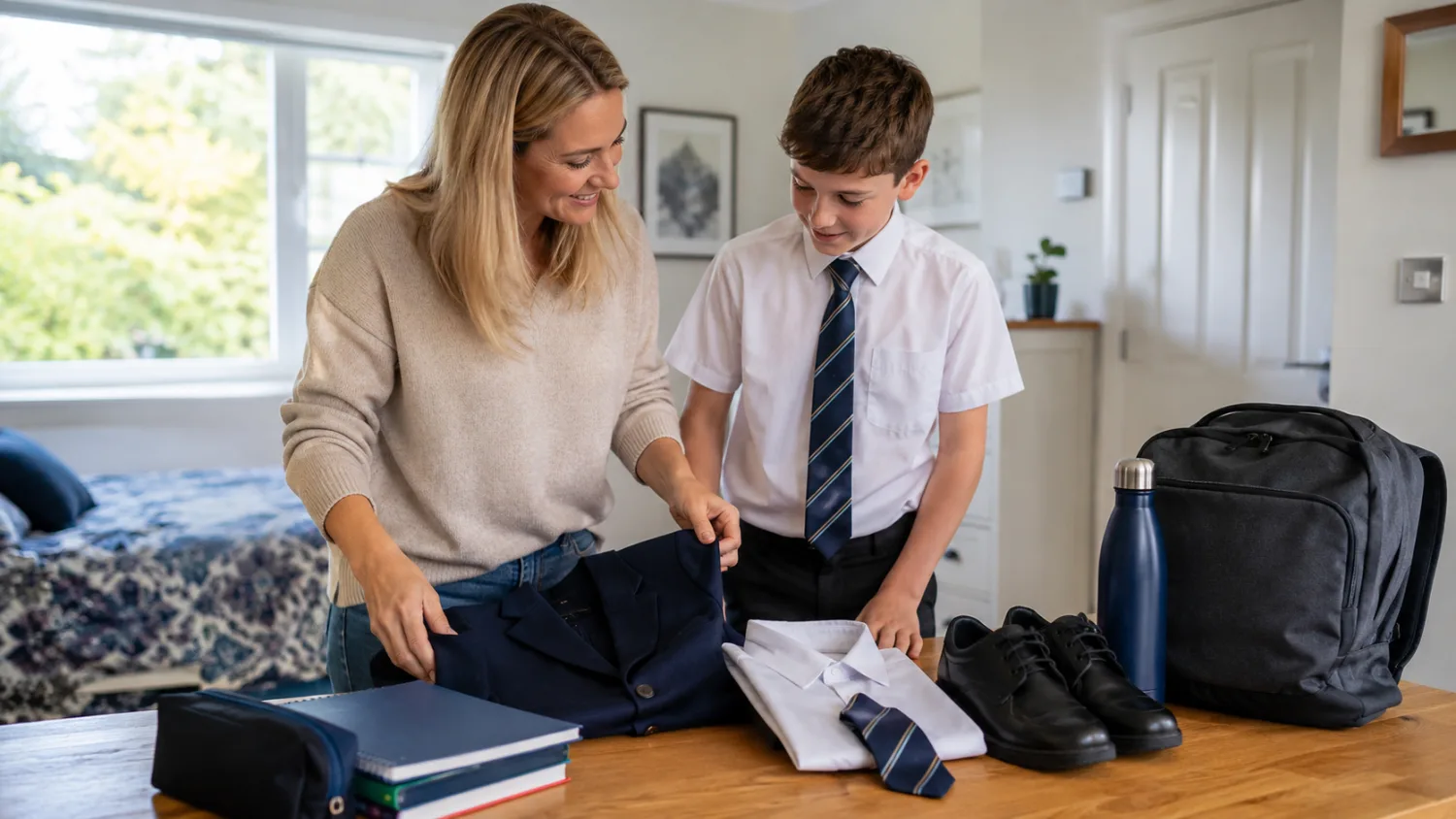
Have your child try the full uniform on together rather than checking individual items separately.
Can they comfortably sit down?
Can they fasten the shirt?
Can they manage the tie?
Does the blazer still fit when worn over a jumper?
Can they change into their PE kit without struggling with complicated fastenings?
Small practical difficulties become much more stressful when a child is trying to change quickly in a busy school environment.
Comfortable school shoes matter more than fashionable ones
Shoes deserve more attention than they sometimes receive.
A secondary pupil may walk considerably farther during the day than they did at primary school. They may walk to and from school, move between several buildings, climb stairs repeatedly and spend break and lunch outside.
Footwear therefore needs to satisfy two requirements:
it must follow the school rules, and your child must be able to wear it comfortably for an entire day.
Check the policy before buying. Schools may distinguish between shoes and trainers or restrict particular colours, logos, heels or styles.
Once you know what is permitted, prioritise:
- correct fit;
- reasonable durability;
- comfort when walking;
- weather resistance;
- fastenings your child can manage;
- enough room for normal growth without the shoe being dangerously loose.
Do not wait until the first morning to discover that new shoes rub.
Let your child wear them around the house and for a few short walks before term starts.
If your child has sensory difficulties, mobility issues or another condition affecting footwear, contact the school if the standard policy creates a problem. Do not simply assume they must tolerate painful or unsuitable shoes.
Choose a school bag for the school day, not the photograph
A secondary-school bag has a fairly demanding job.
On some days it may need to carry:
- books;
- a pencil case;
- a planner;
- a water bottle;
- lunch;
- PE kit;
- a reading book;
- perhaps a laptop or tablet;
- extra equipment for a particular lesson.
A small fashionable backpack may look perfect in August and become extremely irritating by the second week of term.
Look for a bag that is:
- large enough for ordinary school materials;
- comfortable when carrying weight;
- strong around the straps and zips;
- reasonably weather-resistant;
- easy for your child to open;
- divided into enough sections to prevent everything disappearing into one large compartment.
A side pocket for a water bottle can be surprisingly useful. A leaking bottle beside exercise books or electronics is one of those Year 7 experiences worth avoiding.
Try the bag on your child rather than judging it only by capacity.
They are the person who will be carrying it.
Also teach them that the solution to forgetting books is not to carry every book every day.
Secondary school is largely about learning to use a timetable.
One of the most useful habits you can establish is a short evening routine:
- Check tomorrow's timetable.
- Remove today's unnecessary books.
- Add what tomorrow requires.
- Check whether PE kit is needed.
- Check homework and special equipment.
- Put keys and travel pass somewhere predictable.
That routine is worth considerably more than an expensive backpack.
Keep the Year 7 stationery list simple
There is something about starting secondary school that makes stationery remarkably tempting.
Parents can easily find themselves buying highlighters in eight colours, giant pencil cases, elaborate organisers, folders for every subject and enough pens to supply an entire classroom.
Your child probably does not need all of it.
Unless their school says otherwise, a sensible basic pencil case might contain:
- two or three black or blue pens;
- two pencils;
- an eraser;
- a pencil sharpener;
- a 30cm ruler;
- a few coloured pencils;
- one or two highlighters;
- a glue stick if requested.
The most important stationery rule is not what you buy. It is that your child has working equipment when they need it.
A modest pencil case that gets checked regularly is far more useful than a huge one whose pens have all vanished by October.
Keep spare basics at home. Pens, pencils and glue sticks disappear with extraordinary efficiency in secondary schools.
What about a calculator?
Many secondary pupils will eventually need a scientific calculator, but check which model the school recommends before buying one.
This matters because teachers often demonstrate calculator functions in class, and it is much easier for pupils if their calculator works in the same way as the models being used around them.
There is little benefit in buying an advanced calculator simply because it looks more capable.
Do they need folders?
Perhaps, but wait for instructions.
Some subjects may require folders while others keep pupils' work in school. Buying twelve large lever-arch files before September can create unnecessary cost and clutter.
One folder at home for important school paperwork can, however, be very useful for parents.
PE kit needs more thought than many families expect
PE kit can be one of the more expensive parts of starting secondary school, so read the school's list carefully.
Your child may need some combination of:
- PE shirt;
- shorts, skort or sports trousers;
- socks;
- trainers;
- football or rugby boots;
- shin pads;
- a sweatshirt or sports layer;
- a separate PE bag.
Do not automatically buy every specialist item before the school confirms it is required.
Ask whether different equipment is needed at different times of year. Football boots, for example, may not be necessary immediately.
Label everything.
PE changing rooms are particularly effective at separating children from expensive clothing.
Your child's full name on the inside of the garment gives lost property at least some chance of returning it.
Also check whether your child can pack the kit themselves. A useful habit is for the child to put dirty PE kit somewhere obvious when they return home rather than discovering it at the bottom of the school bag the following Monday.
If sensory needs, physical disability or another SEND-related issue makes standard PE clothing difficult, discuss adaptations with the school before lessons begin.
Phones, laptops and other technology: do not assume more is better
A smartphone is not automatically an essential piece of secondary-school equipment.
For some families it is useful because a child travels independently and needs to make contact if transport changes. Other families may prefer a basic phone, particularly at the beginning of Year 7.
Check the school policy first.
Some schools allow pupils to carry smartphones but require them to remain switched off and out of sight. Others operate stricter restrictions.
Whatever device your child uses, teach them that having a phone available for the journey does not mean it should dominate the school day.
Before September, discuss:
- when the phone can be used;
- what happens if the school confiscates it under its policy;
- not photographing other pupils without permission;
- not recording teachers or lessons;
- group-chat behaviour;
- privacy settings;
- location sharing;
- what to do with upsetting or inappropriate messages;
- keeping passwords private.
Our guide on how to check your child is safe online without spying explains how parents can remain involved without secretly monitoring every conversation.
Group chats often become considerably more active after children start secondary school. Problems that begin online can quickly affect relationships in school, so establish sensible expectations before problems arise.
You may also find our guide to how digital distraction affects children's learning helpful when deciding how phones should fit around homework, sleep and family life.
Does my child need a laptop?
Do not buy one purely because your child is starting secondary school.
Find out how the school handles digital learning first. Some schools provide devices, some operate loan schemes, some use computer rooms and others expect pupils to access homework systems from home.
If home access is expected and buying equipment would cause financial difficulty, ask the school what support is available before spending money you cannot comfortably afford.
Lunch, water, travel and the small things that prevent big problems
Some of the most useful Year 7 essentials cost very little.
A reliable water bottle
Choose one that closes properly and that your child can recognise easily.
Test it before putting it beside books or electronics.
Lunch arrangements
Find out how your school handles meals.
Children may use:
- a payment card;
- a biometric system;
- an online account;
- cashless tills;
- packed lunches.
Your child should know approximately what they can buy and what to do if their account does not work.
If your family may qualify for free school meals, it is worth applying rather than assuming your child will not want to use them. Our guide to free school meals and how to apply explains the process and why registration can be important even where a child does not take a school meal every day.
Keys
If your child will arrive home before an adult, practise looking after a key before the first school day.
Choose a consistent place for it rather than allowing it to move randomly between coat pockets, pencil cases and bags.
Travel pass
If your child uses public or school transport, make sure they understand:
- which service to use;
- where to get on and off;
- where the pass is kept;
- what to do if they lose it;
- what to do if the bus does not arrive;
- how to contact you.
These practical details often cause children more anxiety than lessons themselves.
A watch
A simple watch can be unexpectedly useful, especially in schools where pupils cannot check phones during the day.
Children need to know when break ends, when they need to reach a club or how long they have before a bus leaves.
It does not need to be a smartwatch.
The things your child needs that you cannot put in a school bag
The longest shopping list in the world cannot fully prepare a child for secondary school.
Some of the most important Year 7 equipment is behavioural and emotional.
They need to know how to ask for help
Primary pupils often have one familiar teacher who notices when something is wrong. In secondary school, a child may see several teachers during a single day.
Practise simple phrases:
- “I'm not sure where this room is.”
- “Could you explain what I need to do?”
- “I've lost my timetable.”
- “I don't understand the homework.”
- “I'm feeling overwhelmed. Who can I speak to?”
A child does not need to solve every problem independently. Real independence includes knowing when to find someone who can help.
They need a system for remembering things
Memory should not be the entire organisational strategy.
Use:
- timetables;
- planners;
- phone reminders where appropriate;
- visual checklists;
- a fixed place for school equipment;
- an evening packing routine.
This is particularly important for children who struggle with attention, working memory or executive functioning.
Our guide to helping a child who struggles to focus contains practical strategies that can work at home and school.
They need permission to make mistakes
Your child will probably forget something eventually.
They may walk into the wrong classroom, lose a pen, misunderstand homework or realise halfway through the day that their PE kit is at home.
These are ordinary problems, not evidence that they are failing at secondary school.
A useful message before September is:
“We will help you get organised, but nobody expects you to get everything right immediately. When something goes wrong, work out who can help and what you can do next.”
They need somewhere safe to come back to
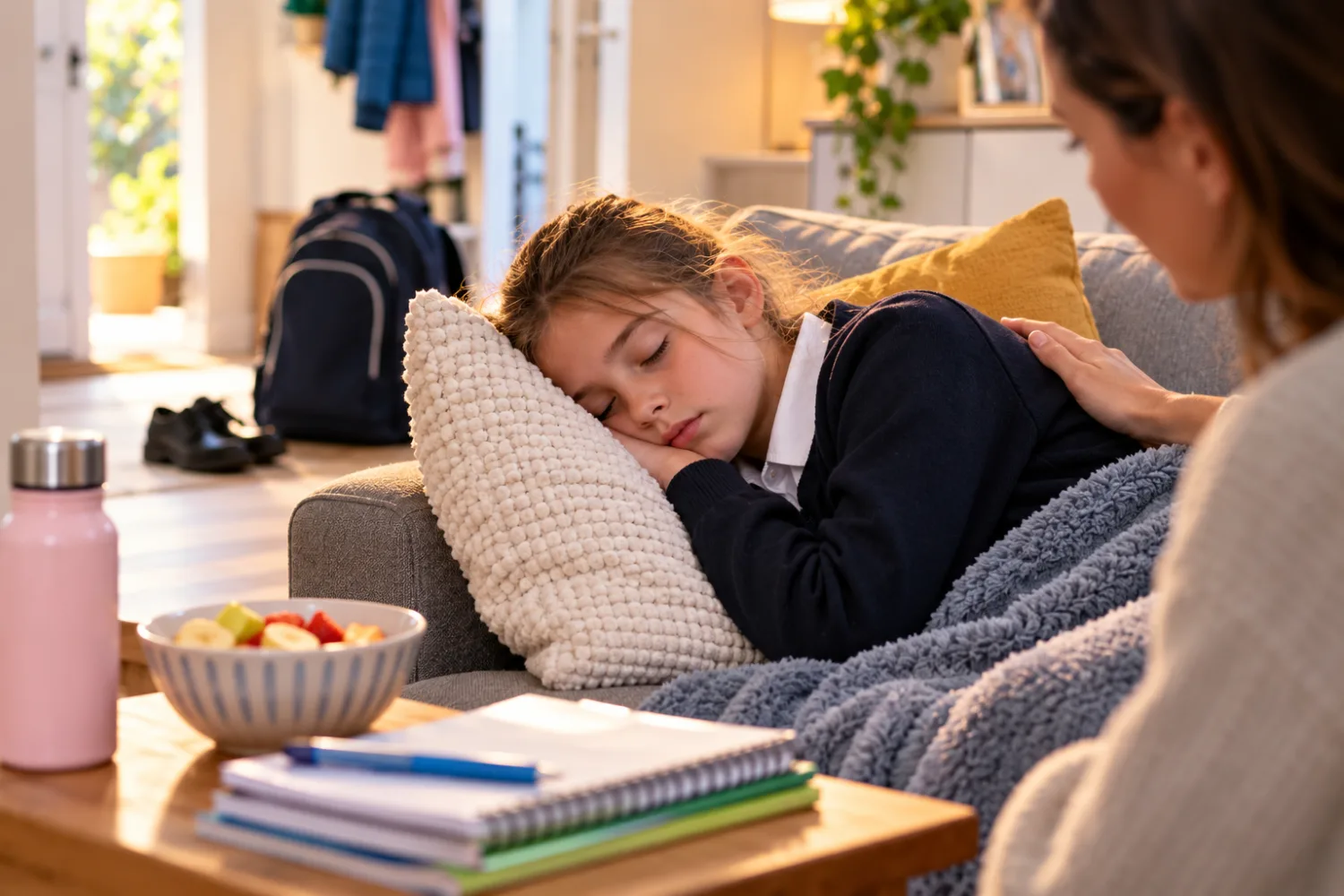
The first weeks of Year 7 can be exhausting.
Your child is learning hundreds of small things simultaneously: teacher names, classroom locations, rules, friendship dynamics, homework systems and new expectations.
They may arrive home unusually quiet, irritable or tired.
Try not to interpret every difficult afternoon as evidence that the school is wrong for them.
Give them food, some breathing space and an opportunity to talk later.
If the transition follows an especially difficult primary-school year, read our guide on helping your child after a difficult school year. Some children need more recovery and reassurance than others before they can embrace a fresh start.
Children with SEND may need a different kind of preparation
For a child with SEND, the most important preparation may not be another piece of equipment. It may be ensuring that the right adults understand what they need before the first day.
Depending on the child, useful preparation could include:
- a visual timetable;
- photographs of key areas of the school;
- additional transition visits;
- a named adult to approach;
- information about quiet spaces;
- adjustments to uniform;
- sensory equipment;
- assistive technology;
- help organising equipment;
- extra support with travel;
- clear arrangements around medication;
- a plan for becoming overwhelmed.
Do not assume all information has automatically transferred from primary to secondary school.
Confirm what the new school's SENCO knows and what support will be available from September.
If your child is receiving SEN Support or has an EHCP, our guide to SEN Support versus an EHCP explains the difference and what parents can expect from each arrangement.
Where your child has an EHCP, transition planning should consider what support will be required in the new setting rather than simply assuming that strategies used at primary school will transfer unchanged.
Most importantly, include your child in the preparation wherever possible. Ask what makes them feel safer, what they found difficult on transition visits and what they want teachers to understand about them.
What you can probably wait to buy
Parents often save money by resisting the urge to complete every possible purchase before the first day.
Unless the school specifically requests them, you can often wait before buying:
- large numbers of folders;
- subject-specific revision guides;
- expensive art equipment;
- specialist maths equipment;
- a printer;
- a new laptop;
- a tablet;
- a smartwatch;
- large stocks of exercise books;
- an elaborate desk setup;
- every piece of sports equipment your child might eventually use.
Let your child attend school first.
Teachers will explain what is required. Your child will also discover which systems actually work for them.
You may initially imagine they need twelve colour-coded folders only to discover that almost all their work stays in exercise books.
Similarly, avoid buying piles of academic material simply because secondary school feels more serious.
Your child does not need to spend the summer teaching themselves Year 7. Our guide on how much learning children should do during the summer holidays explains why light, targeted learning is usually more useful than trying to recreate school at home.
Start with the essentials. Add things when a genuine need appears.
Frequently asked questions
What stationery does a Year 7 child need?
Unless the school provides a specific list, start with a simple pencil case containing pens, pencils, an eraser, sharpener, ruler, a few coloured pencils and perhaps a highlighter. Check whether the school recommends a particular calculator or geometry set before buying one.
How many school shirts does my child need?
There is no fixed number, but families commonly find that several shirts or blouses make washing during the school week easier. You generally need fewer blazers, jumpers and other outer garments than items worn directly against the body.
Does my child need two blazers?
Usually not. One may be enough, particularly because blazers can be expensive. A spare can be convenient but should not be treated as essential unless your circumstances make it worthwhile.
Does a Year 7 pupil need a laptop?
Not automatically. Check how the school handles digital learning first. Schools may provide devices, operate loan schemes or expect homework to be completed through systems accessible on different devices. Speak to the school if access to technology is a financial difficulty.
Does my child need a smartphone for secondary school?
No. Some parents find a phone useful when children travel independently, but it does not necessarily need to be a smartphone. Check the school's mobile-phone policy and choose what works for your family.
What type of bag is best for secondary school?
A strong backpack with comfortable straps and enough room for books, lunch, a water bottle and occasional PE equipment is usually practical. Check whether the school has specific bag requirements.
Does my child need a separate PE bag?
Many pupils find one useful, although requirements vary. A separate bag prevents damp or muddy PE clothing mixing with books and makes it easier to remove the kit for washing.
Should everything be labelled?
Label expensive or frequently removed items wherever practical, particularly blazers, jumpers, coats and PE kit. Secondary-school lost-property collections can become very large, and clearly labelled items are much easier to return.
Should I buy all the uniform before the summer holidays?
Buying early can spread the cost, but remember that children can grow over the summer. Keep receipts and avoid removing labels too early. Check sizing again shortly before school starts.
What if I cannot afford all the uniform and equipment?
Contact the school rather than keeping the problem to yourself. Ask about second-hand uniform, hardship support, payment arrangements and which items genuinely need to be purchased immediately. Your local authority may also provide support depending on where you live and your circumstances.
What should my child keep in their bag every day?
The exact contents depend on the timetable, but basic stationery, the school planner where used, water, lunch arrangements, travel pass and any required medical items are common essentials. Books and PE equipment should normally be packed according to the day's timetable rather than carried constantly.
What is the one thing children most need before secondary school?
More than any particular possession, children need to know that they can ask for help.
They do not need to begin Year 7 already knowing how secondary school works. They need enough practical preparation to manage the basics and enough confidence to approach an adult when they do not know what to do.
Starting secondary school can make families feel as though they need to purchase an entirely new life before September.
They do not.
Buy the uniform the school actually requires. Choose comfortable shoes and a practical bag. Provide basic stationery. Sort out lunch and transport. Label the things that are likely to disappear.
Then spend at least as much time helping your child practise the things money cannot buy: checking a timetable, packing their bag, looking after keys, asking for directions, coping with a mistake and telling an adult when something is wrong.
The best-prepared Year 7 pupil is not necessarily the one with the most equipment.
It is the child who knows that they do not have to get everything right on the first day.