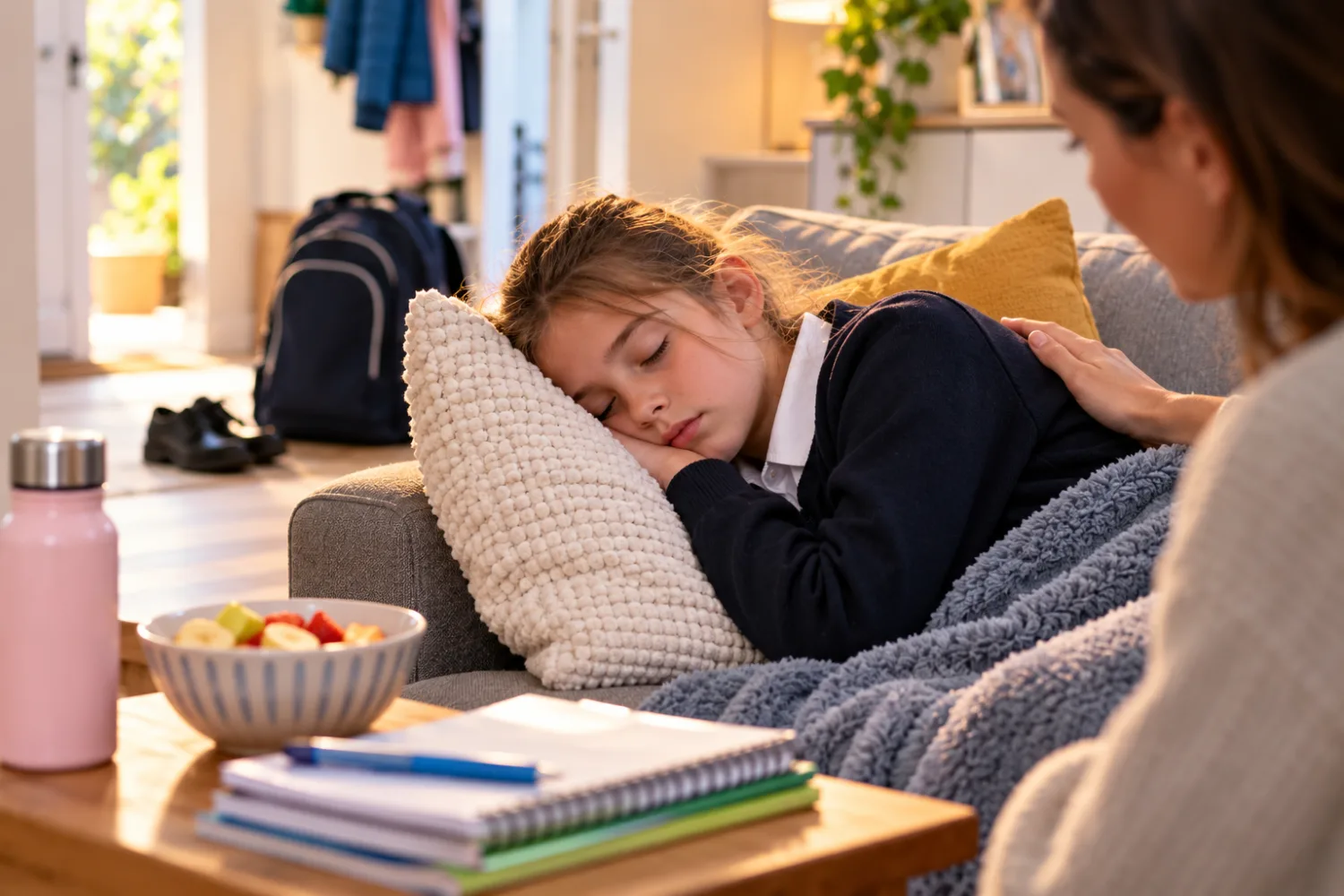
Some children seem to use every bit of energy they have at school.
They hold it together through lessons.
They remember instructions.
They manage friendships.
They cope with noise, transitions, queues, lunch, PE, homework reminders and the pressure of being around other people all day.
Then they get home.
And collapse.
Your child may:
- lie on the sofa and refuse to move;
- become unusually irritable;
- cry over something minor;
- say they are starving;
- fall asleep;
- refuse homework or activities;
- want to be completely alone.
For many children, some tiredness after school is normal.
A school day demands sustained attention, movement, social interaction and self-control.
But persistent or extreme exhaustion deserves a closer look, particularly if it is affecting family life, sleep, attendance or your child's ability to enjoy anything outside school.
NHS guidance notes that tiredness can have many causes, including insufficient sleep, stress, lifestyle factors, illness and some medical conditions. It recommends speaking to a GP when tiredness has continued for several weeks without a clear reason, affects everyday life or occurs alongside other concerning symptoms.
This guide looks at the common reasons children are exhausted after school, what families can change at home, when the school may be able to help and when tiredness is worth discussing with a health professional.
First ask what “exhausted” actually looks like
Children do not always say:
“I have reached the limit of my mental and physical capacity for today.”
Tiredness often appears as behaviour.
You might notice
- irritability;
- arguments;
- tearfulness;
- silence;
- difficulty making simple decisions;
- very strong hunger;
- headaches;
- falling asleep unusually early;
- being unable to begin homework.
Look for the pattern
Ask:
- Does this happen every school day?
- Is Monday easier than Friday?
- Is it worse after PE?
- Is it worse after certain lessons?
- Does your child recover after an hour?
- Are weekends completely different?
The pattern can tell you more than the word “tired”.
Give them a genuine transition out of school
One of the easiest mistakes is expecting a child to move immediately from school mode into home responsibilities.
They walk through the door and hear:
“Shoes away.”
“How was school?”
“Have you got homework?”
“Get changed.”
“We need to leave for football in twenty minutes.”
That may be too much at once.
Build in decompression time
For some children, 20 to 40 minutes of low-demand time after school can make the whole evening easier.
That might mean:
- a snack;
- quiet play;
- music;
- drawing;
- reading;
- sitting alone;
- watching something familiar.
Do not demand a school report immediately
Some children genuinely do not want to talk when they first arrive home.
Instead of:
“What did you do today?”
you can wait until later, perhaps during dinner or bedtime, when the child has more capacity to talk.
Check whether hunger is part of the crash
Children can arrive home tired partly because they have not eaten enough during the day.
Lunch may be smaller than you think
A child may:
- leave part of a school meal;
- run out of time;
- dislike part of lunch;
- be too distracted to eat;
- avoid the dining hall because it is noisy.
Offer something predictable after school
A useful snack might include a combination of:
- fruit;
- yoghurt;
- toast;
- cheese;
- oatcakes;
- a sandwich;
- another familiar food.
The exact food matters less than ensuring the child is not trying to get through the evening after eating very little since lunchtime.
Ask what they actually ate
Not:
“Did you have lunch?”
but:
“What did you manage to eat?”
Those can produce very different answers.
If school lunches are becoming a recurring issue, see School Lunches in September: Packed Lunch, School Meals or a Mix?.
Protect sleep before trying to fix everything else
A child cannot reliably compensate for too little sleep through motivation.
If tiredness is happening every day, look carefully at the whole evening and morning routine.
Ask practical questions
- What time does your child actually fall asleep?
- Do they wake during the night?
- Are screens delaying bedtime?
- Are they waking very early?
- Do they struggle to get up most mornings?
Consistency matters
NHS advice on tiredness recommends regular sleep times, a relaxing sleep environment and reducing screen use before bedtime.
Watch for poor-quality sleep
A child can spend a long time in bed and still not sleep well.
If you notice:
- very loud snoring;
- gasping;
- choking noises;
- frequent waking;
mention this to your GP. NHS guidance lists disrupted breathing during sleep among the possible reasons someone may feel unusually tired during the day.
For more general routines, see Healthy Sleep Habits for School-Aged Children.
Consider whether school itself is unusually demanding
Two children can experience the same school day very differently.
A day may be especially tiring if your child is constantly
- trying hard to concentrate;
- worrying about getting things wrong;
- monitoring social situations;
- trying not to stand out;
- coping with noise;
- remembering multiple instructions;
- working harder than peers to read or write.
Ask what part of school takes the most energy
You might ask:
“Which part of the school day feels hardest?”
or:
“When do you feel most tired at school?”
That may reveal:
- a particular subject;
- lunchtime;
- friendship stress;
- PE;
- crowded corridors;
- extended writing;
- constant worry about behaviour or mistakes.
Sensory overload can look like exhaustion
Some children expend a lot of energy coping with sensory input.
A normal school day can include:
- bells;
- hundreds of voices;
- chairs scraping;
- bright lighting;
- crowded corridors;
- smells from lunch;
- physical proximity.
A child may hold it together at school
Then become overwhelmed once they reach the safety of home.
This pattern is sometimes especially noticeable in autistic or otherwise neurodivergent children, although sensory overload is not exclusive to any diagnosis.
Reduce demands after school
Useful options may include:
- a quieter room;
- dim lighting;
- comfortable clothes;
- less conversation initially;
- a predictable routine.
If this seems relevant, the AllSchools guides Neurodiversity in the Classroom and Understanding Autism in Schools may provide useful context.
Do not schedule every afternoon
Clubs can be brilliant.
So can sport, music, tutoring and activities with friends.
But a child does not necessarily benefit from having every afternoon filled.
Look at the entire week
If the schedule is:
- Monday football;
- Tuesday tutoring;
- Wednesday swimming;
- Thursday music;
- Friday another club;
there may be almost no recovery time.
Consider one genuinely empty evening
For some children, knowing that nothing is expected after school one or two days each week makes a substantial difference.
Do not assume stopping a club means failure
An activity can be positive and still be badly timed.
If a child is struggling through the school week, reducing one commitment temporarily may be sensible.
Be realistic about homework when they first get home
A child who is exhausted at 4pm may not suddenly produce excellent homework because you insist they start immediately.
Experiment with timing
Some children work best:
- after a snack and short break;
- after dinner;
- earlier in the afternoon before becoming sleepy.
The best time is the one that consistently works for your child.
Do not let homework consume the evening
If your child is spending far longer than expected, find out why.
The problem may be:
- difficulty understanding the task;
- poor concentration;
- perfectionism;
- too much homework;
- genuine exhaustion.
See How Much Homework Is Reasonable at Different Ages? and Helping Your Child With Homework Without the Stress.
Look for signs of anxiety rather than tiredness alone
Stress is physically tiring.
A child who spends the day worrying can reach home exhausted even if they have not been especially physically active.
Possible clues include
- frequent tummy aches;
- headaches;
- tearfulness;
- irritability;
- difficulty sleeping;
- constant worrying;
- reluctance to go to school.
NHS guidance says childhood anxiety can show up as irritability, tearfulness, sleep problems, difficulty concentrating and physical complaints such as stomach aches. Anxiety can relate to schoolwork, teachers, bullying, loneliness or noisy school environments.
Do not immediately respond with reassurance alone
Instead of:
“There's nothing to worry about.”
try:
“What part feels hardest?”
Talk to school if there is a pattern
NHS advice suggests working with the school where anxiety is linked to school life and speaking to a teacher or SENCO where appropriate.
If worry about attending school is growing, see School Anxiety and School Avoidance: A Parent's Guide.
Ask the teacher what they see during the day
Your child may appear completely different at school.
You might hear
“They seem fine here.”
That does not automatically mean the exhaustion at home is imaginary.
It may mean the child is using a large amount of effort to manage successfully during school hours.
Ask specific questions
For example:
- Do they participate?
- Do they appear tired in afternoon lessons?
- Do they eat lunch?
- Are they struggling with friendships?
- Do they need frequent prompting?
- Are certain tasks much harder for them?
Compare patterns
If school and home share observations, a clearer picture may emerge.
The AllSchools guide How to Talk to Your Child's Teacher When You're Worried can help you structure the conversation.
Keep a simple two-week record if you cannot see the cause
You do not need a complicated health diary.
Just record enough to spot patterns.
Note
- bedtime;
- approximate sleep time;
- wake time;
- school-day tiredness;
- after-school activities;
- homework;
- food;
- any physical symptoms.
Look for repeated links
You might discover:
- late nights consistently lead to difficult afternoons;
- the child crashes only after PE days;
- tiredness is worst on days with a particular lesson;
- weekends do not improve it at all.
That information can also be useful if you later speak to school or your GP.
Know when tiredness deserves medical advice
Most after-school tiredness is not a sign of a serious medical condition.
But persistent unexplained fatigue should not simply be dismissed as school being tiring.
NHS advice says to see a GP if
- tiredness has lasted a few weeks and you do not know why;
- it is affecting daily life;
- it occurs alongside other symptoms such as unexplained weight loss or mood changes;
- there are signs of disturbed breathing during sleep.
Other symptoms are worth mentioning
For example:
- looking unusually pale;
- shortness of breath;
- unusual thirst;
- frequent urination;
- significant weight change;
- persistent pain;
- recurrent fever;
- significant concentration problems.
NHS guidance lists conditions such as iron-deficiency anaemia, diabetes, thyroid problems and sleep apnoea among possible medical causes of persistent tiredness. These cannot be diagnosed from tiredness alone, so avoid trying to identify the cause yourself.
Extreme fatigue is different from ordinary tiredness
ME/CFS, for example, can affect children and involves persistent disabling fatigue alongside symptoms such as unrefreshing sleep, concentration problems and worsening symptoms after physical or mental activity.
That does not mean an exhausted child has ME/CFS.
It means persistent, unusual fatigue deserves proper medical assessment rather than internet diagnosis.
A calmer after-school routine to try
If there are no obvious warning signs, try simplifying the first hour after school for a week.
On arrival
- water;
- food;
- minimal questions;
- comfortable clothes if wanted.
For the next 20 to 40 minutes
Allow low-demand recovery.
This could be:
- quiet screen time;
- reading;
- Lego;
- drawing;
- lying down;
- playing outside.
Then reassess
Ask:
“Do you feel ready to do anything now, or do you need a bit longer?”
Do necessary tasks later
Homework, clubs, chores and conversation may all go better once the initial crash has passed.
Frequently asked questions
Is it normal for children to be exhausted after school?
Some tiredness is normal because school requires sustained concentration, movement, social interaction and self-control. Persistent or extreme fatigue that affects daily life deserves further investigation.
Why is my child fine at school but falls apart at home?
Some children use considerable effort to manage themselves during the school day, then release that tension once they reach a familiar and safe environment. Look at sensory, emotional, social and learning demands as well as sleep.
Should I make my child do homework immediately after school?
Not necessarily. Many children benefit from food and a short decompression period first. Experiment with timing rather than assuming immediate homework is best.
How long should my child rest after school?
There is no fixed amount. Twenty to forty minutes works well for some families, while others need less or more. The aim is recovery, not creating another rigid rule.
Should I let my child sleep after school?
An occasional short nap after an unusually demanding day may be understandable, but frequent long naps can interfere with bedtime and may signal inadequate sleep or another issue. If your child regularly needs to sleep after school, investigate why.
Could hunger cause an after-school meltdown?
Yes. A child who has eaten little since lunchtime may be tired, irritable and unable to concentrate. Check what they actually eat during the school day.
Can anxiety make children exhausted?
Yes. Anxiety can require a great deal of mental effort and can also disturb sleep. NHS guidance notes that anxiety in children may cause irritability, concentration problems, sleep difficulty and physical symptoms.
Can sensory overload cause tiredness?
Yes. Noise, crowds, bright environments and constant social demands can be tiring, particularly for children who are sensitive to sensory input.
Should I cut down after-school clubs?
If your child has almost no recovery time and is consistently exhausted, temporarily reducing activities can be a sensible experiment. You can always add them back when things settle.
What if my teenager sleeps all weekend?
Occasional catch-up after a particularly busy week happens, but repeated extreme weekend sleeping can suggest insufficient weekday sleep or another issue. Look at bedtime, workload and any other symptoms.
When should I talk to school?
Talk to school if exhaustion seems linked to learning difficulty, friendships, anxiety, sensory demands, homework or something specific happening during the day.
When should I talk to a GP?
NHS guidance recommends seeing a GP when unexplained tiredness has lasted for several weeks, is not improving, affects everyday life or comes with other concerning symptoms.
Could iron deficiency cause tiredness?
It can be one possible cause. NHS guidance lists tiredness, pale skin, shortness of breath and noticeable heartbeats among features that can occur with iron-deficiency anaemia. Do not start supplements or assume this is the cause without medical advice.
After-school exhaustion is often a clue rather than a diagnosis.
Sometimes the answer is simple.
Your child needs more sleep.
More food.
Less rushing.
A quieter hour after school.
Fewer activities.
Sometimes the tiredness points towards something happening at school:
anxiety, friendships, sensory overload or work that is taking much more effort than anybody realises.
And sometimes persistent fatigue needs medical attention.
Start by observing rather than assuming.
Give your child genuine recovery time.
Protect sleep.
Check what they are eating.
Look at the weekly schedule.
Talk to school if patterns emerge.
And if the tiredness is prolonged, unexplained or affecting ordinary life, speak to your GP.
A child being exhausted every afternoon should not automatically be dismissed as:
“That's just school.”
School is tiring.
But home should still contain enough energy for a child to be themselves.