
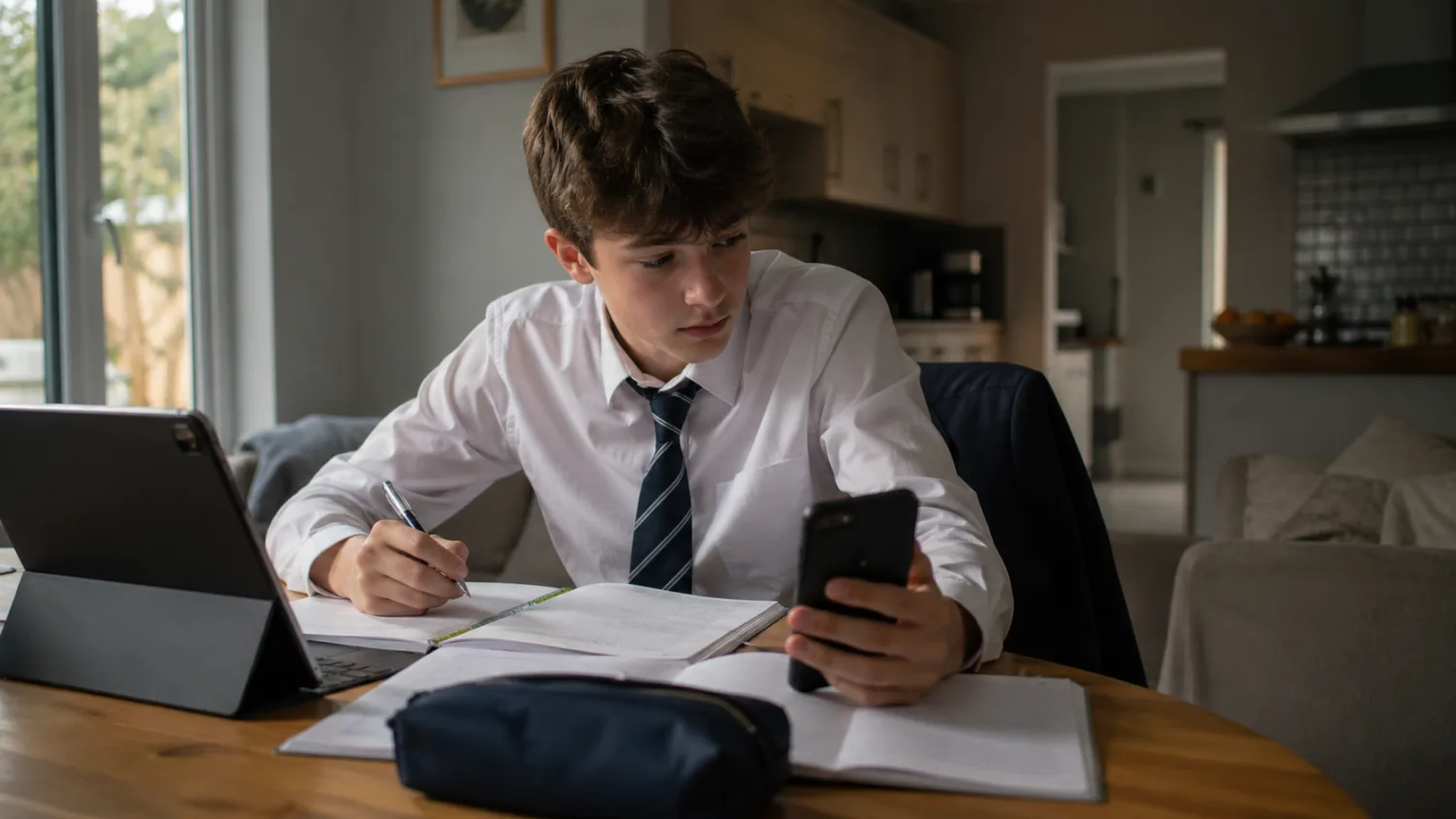
Digital distraction is now one of the most common worries parents and schools share. It is not just about children spending “too much time on screens”. It is about homework interrupted by notifications, lessons disrupted by phones, sleep pushed later by scrolling, friendships affected by group chats, and children finding it harder to sit with a difficult task without reaching for something more instantly rewarding.
For many families, the problem does not look dramatic at first. A child says they are doing homework, but the work takes two hours because messages keep appearing. A teenager insists they can revise while watching videos. A younger child becomes restless or irritable when a game is turned off. A pupil who used to read easily now finds books slow compared with short clips. A child is physically in class but mentally waiting to check what has happened online.
Digital technology is not the enemy. Children use screens to learn, create, communicate, research, revise and relax. Schools use technology for homework, feedback, accessibility and teaching. For some children with SEND, the right technology can be life-changing. The real issue is not whether screens are good or bad. The issue is whether digital habits are helping or harming attention, sleep, confidence, relationships and learning.
This guide explains how digital distraction affects children’s learning, what parents and schools should look for, how phones and apps are designed to capture attention, what can be done at home, and how to support children without turning every conversation into an argument about screens.
What do we mean by digital distraction?
Digital distraction happens when a device, app, game, message, video, notification or online habit repeatedly pulls a child’s attention away from what they are trying to do. That might be homework, reading, revision, sleep, a conversation, a lesson, a family meal or simply being calm enough to think.
It can be obvious, such as a child checking their phone every few minutes while revising. It can also be hidden, such as a child thinking about a group chat during class, worrying about a message they have not answered, or replaying a video in their mind when they should be listening.
Digital distraction can involve:
- smartphones
- tablets
- gaming consoles
- social media
- messaging apps and group chats
- video platforms
- short-form clips
- online games
- streaming services
- notifications from school apps or homework platforms
Some digital distraction happens during learning. Some happens before learning, by affecting sleep or mood. Some happens after learning, by reducing quiet time, reading time, play, movement or conversation — all of which help children process the world.
Why this matters for learning
Learning needs attention. Not perfect attention, and not silence all the time, but enough sustained attention for the brain to take in information, hold it in working memory, connect it to existing knowledge and practise it until it becomes more secure.
When a child is constantly interrupted, learning becomes shallow. They may complete the task, but not absorb much. They may read a paragraph, but not remember it. They may watch a revision video, but not practise retrieving the knowledge. They may spend a long time “studying” while doing very little real thinking.
This matters because many school tasks require exactly the skills digital distraction weakens: concentration, patience, memory, planning, problem-solving, reading stamina, writing stamina, self-control and the ability to stay with something difficult.
The Education Endowment Foundation’s guidance on metacognition and self-regulated learning is useful here. Children do better when they can plan, monitor and evaluate their own learning. Digital distraction makes that harder because it repeatedly pulls them away from the very process of noticing what they understand, what they do not understand, and what they should do next.
The problem is not only screen time
Parents often ask, “How many hours is too much?” It is an understandable question, but it is not the only one that matters. Two children could both spend two hours on a screen and have very different experiences. One might be video-calling grandparents, researching a school project and using a maths app. Another might be scrolling short videos late at night, arguing in group chats and switching constantly between homework and notifications.
Time matters, especially when screens crowd out sleep, movement, reading, family time or face-to-face friendships. But quality, timing and context matter too.
Better questions include:
- Is screen use affecting sleep?
- Is it interrupting homework or revision?
- Is it making your child more anxious, angry or withdrawn?
- Is your child able to stop without a major argument?
- Is screen use replacing reading, outdoor play, hobbies or social time?
- Is your child using screens to avoid difficult feelings or difficult work?
- Is school noticing problems with focus, behaviour or learning?
A healthy digital life is not just about fewer minutes. It is about children being able to choose, stop, switch attention, sleep well, learn deeply and live offline too.
How phones and apps capture children’s attention
Digital distraction is not just a failure of willpower. Many apps and platforms are designed to be hard to put down. Notifications create urgency. Infinite scroll removes natural stopping points. Short videos offer constant novelty. Games use rewards, streaks, levels and social pressure. Group chats make children feel they must respond quickly or risk being left out.
Adults struggle with this too. So when a child finds it hard to ignore a device, it is worth remembering that they are trying to resist systems built to attract and hold attention. Children and teenagers are still developing the self-regulation skills adults often find difficult.
Ofcom’s Children and Parents: Media Use and Attitudes Report 2025 gives a useful picture of how embedded digital media is in children’s lives across the UK. It is a helpful external source for parents and schools because it shows that this is not a problem affecting only a small number of families. It is part of the environment children are growing up in.
Attention: why switching costs more than children think
Many children believe they can multitask. They may say they can revise while messaging, listen to music while watching a video, or complete homework while checking social media. Some background noise may not be a problem for every child, and some pupils do work better with quiet music. But constant switching is different.
Every time a child switches from homework to a message and back again, their brain has to reorient. What was I doing? What did the question ask? Where was I in the sentence? What was the method? That switching takes energy. It also makes it harder to think deeply.
This is especially important for tasks such as:
- reading longer texts
- writing extended answers
- solving multi-step maths problems
- learning spellings or times tables
- revising for exams
- planning essays
- memorising key facts
- learning a new concept for the first time
A child may still finish the homework, but the learning is often weaker. They may have spent time with the work without giving it the uninterrupted attention it needed.
Working memory and digital distraction
Working memory is the ability to hold information in mind while using it. It is essential for learning. A child uses working memory when they follow instructions, solve a maths problem, write a sentence, remember what they have just read, or connect a teacher’s explanation to a task.
Digital distraction competes for working memory. A message notification is not just a sound. It creates a thought: who is it, what do they want, what if I do not reply, what if something has happened? Even if the child does not open the phone, part of their attention may now be elsewhere.
Children who already struggle with attention, working memory, ADHD, anxiety, dyslexia, autism or processing speed may be especially affected. They may have less spare capacity to handle interruptions while learning.
If this sounds familiar, you may find our guides on what to do when your child struggles to focus, working memory strategies and improving focus in the classroom helpful.
Reading stamina in the age of short content
One of the quietest effects of digital distraction is reduced reading stamina. Reading asks children to stay with a line of thought. It asks them to imagine, infer, remember, predict and build meaning over time. Longer reading also requires patience because the reward is slower than the reward from a short video or fast-moving game.
Some children who can technically read begin to avoid reading because it feels slow. They skim. They lose their place. They say books are boring. They can decode words but struggle to sit with a chapter, article or exam text. This matters because reading stamina affects almost every subject, not just English.
Parents do not need to respond by banning all screens and forcing classic novels every night. A better starting point is to rebuild daily moments of sustained attention. That might mean ten minutes of shared reading, an audiobook with the printed book, reading a football report, cooking instructions, graphic novels, magazines, or non-fiction linked to a child’s interests.
The aim is to help children rediscover that not every valuable thing is instant.
Homework: why it takes so long when screens are nearby
Many parents say the same thing: “The homework should take 30 minutes, but it takes two hours.” Sometimes the work is too hard. Sometimes the child is tired. Sometimes they do not understand the task. But very often, the problem is fragmented attention.
A child opens the laptop to complete homework. A message appears. They check it. Then they return to the task. Then they change music. Then they search for something school-related and end up on a video. Then they remember a group chat. Then they type one sentence. Then they check the time. Then they feel overwhelmed because the work is still not done.
From the parent’s point of view, it looks like laziness. From the child’s point of view, they may genuinely feel they have been working for ages. Both can be true. They have spent time near the work, but not enough uninterrupted time in the work.
If homework is a major source of conflict, our guide on helping your child with homework without the stress may help you reset the routine.
Digital distraction and sleep
Sleep is one of the biggest links between digital habits and learning. Children who do not sleep well are more likely to struggle with attention, memory, mood, behaviour and motivation. Even a very bright child will find learning harder when tired.
Screens can affect sleep in several ways. Bright light and stimulating content can make it harder to wind down. Games, videos and social media can push bedtime later. Group chats can create emotional drama just when the child should be relaxing. A phone in the bedroom can tempt a child to check messages during the night or first thing in the morning.
Oxford Health CAMHS has practical advice on screens and sleep, including reducing screen exposure before bedtime. The NHS also has wider information on children and young people’s mental health, which can be useful if screen use is connected with anxiety, low mood or emotional difficulties.
If sleep is already difficult in your home, see our guide on healthy sleep habits for school-aged children.
Digital distraction, anxiety and emotional overload
Digital distraction is not only a learning issue. It can also be an emotional issue. Children may be distracted because they are worried about what is happening online. They may fear being left out of a group chat. They may compare themselves with others. They may be upset by something they have seen. They may be waiting for likes, replies or reactions. They may be trying to keep up with multiple social worlds at once.
For some children, the phone becomes a source of both comfort and stress. It soothes boredom but creates pressure. It connects them to friends but also exposes them to conflict. It helps them relax but makes it harder to stop.
Parents sometimes focus on the device and miss the emotional need underneath. A child who is constantly online may be lonely, anxious, bored, avoiding schoolwork, struggling socially, or using screens to escape difficult feelings. That does not mean boundaries are unnecessary. It means boundaries work better when paired with understanding.
If your child is becoming anxious about school or using screens to avoid school-related stress, our guide on school anxiety and emotionally based school avoidance may be useful.
Phones in school: why many schools are tightening rules
Schools are increasingly concerned about phones because distraction does not stop at the classroom door. Phones can affect lessons, breaktimes, bullying, safeguarding, filming, social pressure and behaviour. Even if a phone is not being used, the possibility of checking it can pull attention away from learning.
The Department for Education has published guidance on mobile phones in schools, saying schools should be mobile phone-free environments by default. The House of Commons Library briefing on mobile phones in schools in England also gives useful background on the policy discussion.
For parents, this can be difficult. Some want their child to have a phone for travel or safety. Some children have medical, caring or SEND-related reasons for needing access to technology. Others simply feel anxious without it. But from a learning point of view, many schools are trying to create a clear boundary: school time should not be phone time unless there is a specific, agreed reason.
If your child’s school has a strict phone policy, it may help to frame it not as punishment but as protection of attention, safety and social calm.
Digital distraction and classroom behaviour
Digital distraction can also affect behaviour. A child may be tired because they were online late. They may be irritable after gaming before school. They may be distracted by a conflict in a group chat. They may break rules by checking a phone. They may film or be filmed. They may struggle to move from a fast-paced digital world into the slower pace of classroom learning.
Some behaviour that looks like defiance may be difficulty transitioning from stimulation to focus. This does not excuse poor behaviour, but it helps adults respond more intelligently.
If your child is repeatedly getting into trouble at school, it may be worth asking whether screen use, sleep, online conflict or phone rules are part of the pattern. Our guide on what to do if your child keeps getting in trouble at school explains how to look for the causes behind repeated behaviour incidents.
When digital distraction hides learning difficulties
Sometimes adults blame screens when the deeper problem is that the child is struggling with the work. A child who finds reading hard may escape into videos. A child who cannot start writing may keep checking their phone. A child who is behind in maths may use gaming as a place where they feel competent. A teenager who feels overwhelmed by revision may scroll because they do not know where to begin.
In these cases, reducing screens may help, but it will not fully solve the problem unless the learning difficulty is addressed too.
Ask:
- Is the child distracted because the device is tempting?
- Is the child distracted because the work is too hard?
- Is the child distracted because they do not know how to start?
- Is the child distracted because they are anxious about failing?
- Is the child distracted because they are tired or emotionally overloaded?
If you are worried your child may be falling behind, read our guide on how to know if your child is falling behind at school. If you think additional needs may be involved, our guides on SEN Support and EHCPs, ADHD, autism and dyslexia may help you explore the wider picture.
Signs digital distraction may be affecting learning
Digital distraction becomes a concern when it repeatedly affects learning, mood, sleep, relationships or family life. Parents may notice one or two signs at first, then realise they have become the normal pattern.
Possible signs include:
- homework takes much longer than expected
- your child says they are revising but remembers little afterwards
- they check devices repeatedly during study time
- they become angry or anxious when asked to stop
- they struggle to read for more than a few minutes
- they are tired in the morning after late-night screen use
- teachers mention focus, incomplete work or low effort
- they rush schoolwork to get back online
- they avoid difficult tasks by switching to screens
- friendship drama online affects school mood or behaviour
- they seem unable to tolerate boredom
- they lose interest in hobbies they previously enjoyed
None of these signs means your child is “addicted” or that technology is ruining them. But they do mean it is time to look at habits, boundaries and support.
What parents should avoid
It is tempting to respond to digital distraction with sudden, sweeping rules: no phone, no games, no social media, no screens at all. Sometimes a reset is needed, especially if sleep, safety or schoolwork is being badly affected. But dramatic bans can also create secrecy, conflict and power struggles if they are not part of a wider plan.
Try to avoid:
- making every conversation about screens
- using screen removal as the only consequence for everything
- arguing about devices at bedtime
- allowing phones in bedrooms overnight and then blaming the child for checking them
- assuming all screen use is equally harmful
- ignoring your own screen habits while criticising your child’s
- using screens as the main reward, comfort and babysitter, then expecting children to self-regulate easily
Children need adults to create an environment where good choices are easier. A child who is expected to sleep beside a buzzing phone is being asked to show more self-control than many adults manage.
A better home approach: reduce friction, increase structure
The best digital boundaries are usually clear, boring and consistent. They do not require a new argument every day. They are part of family life, like brushing teeth or getting school uniform ready.
Start with the biggest learning levers: sleep, homework focus and phone-free routines.
For many families, the most powerful changes are:
- no phones or tablets in bedrooms overnight
- a charging station outside bedrooms
- homework done with the phone away from the table
- notifications off during study time
- short focused work blocks with planned breaks
- screen-free time before bed
- clear rules for gaming on school nights
- family meals without devices
These changes are not glamorous, but they work because they reduce the number of decisions a child has to make. Instead of relying on willpower every five minutes, the environment supports attention.
How to talk to your child about digital distraction
Children are more likely to listen if the conversation is not framed as “screens are bad and you are irresponsible”. Many children know they are distracted. They may even hate the feeling of being unable to stop. But shame rarely builds self-control.
Try starting with curiosity:
- “Which apps are hardest to stop using?”
- “When does your phone help you, and when does it get in the way?”
- “Do group chats make homework harder?”
- “Do you feel more relaxed or more stressed after scrolling?”
- “What would make revision easier to start?”
- “Would it help if the phone was out of the room for the first 20 minutes?”
With younger children, keep it concrete. You might say: “Your brain needs quiet time to learn this. The tablet can wait until after reading.” With teenagers, focus more on goals: sleep, exams, sport, mood, friendships, independence and trust.
Teach children attention as a skill
Attention is not just something children either have or do not have. It is a skill that can be strengthened. Children need to learn how to begin, stay with a task, notice distraction, recover focus and finish.
You can help by teaching simple routines:
- Set the task: “What exactly are you doing for the next 20 minutes?”
- Remove the obvious distractions: phone away, tabs closed, TV off.
- Use a timer: short focus blocks often feel less overwhelming.
- Write a distraction note: if they remember something, jot it down instead of leaving the task.
- Take a planned break: movement, drink, snack, stretch — not always a scroll.
- Review: “What helped you focus? What interrupted you?”
This builds self-regulation rather than relying only on parental control. The long-term goal is not just a child who follows rules at home. It is a young person who can manage attention when adults are not watching.
Homework and revision: a practical digital setup
For homework and revision, the setup matters. A child working on a laptop with a phone beside them, multiple tabs open and a group chat active is starting at a disadvantage.
A better setup might look like this:
- phone in another room or on a parent-controlled charging point
- only the necessary homework tabs open
- notifications turned off
- a written list of tasks before starting
- 20 to 30-minute focus blocks for older children
- shorter blocks for younger children
- breaks that involve movement, not automatic scrolling
- a clear finish point
For secondary pupils, our guide on study skills every secondary pupil should know explains why effective revision is more than sitting near notes. You may also find last-minute revision strategies that actually work useful during exam season.
What about educational technology?
It would be too simple to say screens harm learning. Many digital tools support learning very well. Online quizzes can help retrieval practice. Speech-to-text can support pupils with writing difficulties. Audiobooks can open up texts. Assistive technology can help children with SEND access the curriculum. Homework platforms can help schools communicate tasks. Educational videos can explain difficult concepts.
The question is whether the technology is serving the learning or replacing it with passive activity.
Useful educational technology usually has a clear purpose. It helps the child practise, create, retrieve, organise, access or understand. Less useful screen use often feels busy but shallow. The child watches, clicks, scrolls or copies without doing much thinking.
Parents can ask:
- What is this tool helping my child learn?
- Is my child actively thinking or passively watching?
- Can they explain what they learned afterwards?
- Is the tool accessible and age-appropriate?
- Does it reduce barriers or create new distractions?
For schools and suppliers, this distinction matters. The strongest EdTech is not simply more digital content. It is technology that improves learning, accessibility, feedback, practice or communication without adding unnecessary distraction. Our guide on how EdTech companies can reach UK schools explores how providers can communicate value to schools more clearly.
Digital distraction and SEND
Children with SEND may be affected by digital distraction in different ways. Some may be more vulnerable to distraction because of attention, sensory, language or executive function difficulties. Others may rely on technology to communicate, regulate, access learning or reduce barriers.
For a child with ADHD, digital platforms can be especially compelling because they offer novelty, speed and reward. For an autistic child, screens may offer predictability, control and relief from social demands. For a dyslexic child, technology may support reading and writing. For an anxious child, screens may become avoidance. For a child with speech and language needs, visual tools may be essential.
This is why one-size-fits-all rules do not always work. The principle should be: reduce harmful distraction while protecting helpful access.
If your child has additional needs, discuss digital boundaries with school and, where relevant, the SENCO. The question is not “screens or no screens?” but “which digital tools help this child learn, and which digital habits make learning harder?”
What schools can do
Schools cannot control every child’s home screen use, but they can create clearer learning environments and teach digital self-regulation. Phone policies help, but they are only one part of the picture.
Helpful school approaches include:
- clear, consistently applied mobile phone rules
- teaching pupils why attention matters
- using technology purposefully, not as a default
- designing homework that avoids unnecessary online distraction
- supporting pupils with revision planning and self-regulation
- addressing online conflict as part of pastoral care
- teaching online safety and digital wellbeing through PSHE
- communicating with parents about expectations
- making reasonable adjustments for pupils who need technology for SEND or medical reasons
Schools should also be careful not to create avoidable digital overload. If homework instructions, revision resources, messages, behaviour points and deadlines are spread across multiple platforms, some pupils will struggle to manage them. Digital organisation is now part of learning, and children may need explicit help with it.
What parents can ask schools
If you are worried digital distraction is affecting your child’s learning, it is reasonable to raise it with school. This is especially important if teachers are mentioning focus, incomplete work, tiredness, behaviour or falling behind.
You might ask:
- Is my child focused in lessons?
- Does school think phone use or online conflict is affecting them?
- Are they completing work in class?
- Are homework tasks clear and easy to find?
- Do they seem tired or distracted?
- Are there concerns about friendships, group chats or online behaviour?
- Could attention, anxiety, SEND or learning gaps be involved?
- What digital tools does school expect pupils to use?
- How can we support better study habits at home?
If you are already preparing for a school meeting, our guides on how to prepare for parents’ evening and questions to ask teachers at parents’ evening may help you organise the conversation.
How to set screen boundaries without constant arguments
Screen boundaries work best when they are predictable, explained and applied calmly. If rules change depending on parental mood, children are more likely to argue. If rules are discussed only during conflict, everyone becomes defensive.
Choose a calm moment and explain the reason. For example:
“We are not doing this because screens are evil. We are doing it because sleep and learning are getting harder, and we need a better routine.”
Then agree the basics:
- where devices charge overnight
- when homework happens
- whether phones are allowed during homework
- what happens on school nights
- what happens at weekends
- which apps or games are hardest to stop
- what the consequence is if rules are broken
- when the plan will be reviewed
For older children, involve them in the plan where possible. You do not have to hand over control, but you can ask what would make it realistic. Teenagers are more likely to cooperate with boundaries that feel connected to their own goals: better sleep, less stress, exams, sport, friendships, independence or trust.
What if your child refuses to follow screen rules?
If your child strongly resists screen limits, do not assume the answer is simply stricter punishment. Strong resistance can mean many things: habit, anxiety, social pressure, fear of missing out, boredom, lack of offline alternatives, low mood, gaming dependency, or a family pattern where boundaries have been unclear for a long time.
Start with the non-negotiables: sleep, safety, school attendance, homework and respectful behaviour. You may need to begin with one change, such as devices out of bedrooms overnight, rather than trying to change everything at once.
If screen use is causing severe conflict, aggression, school refusal, major sleep disruption, withdrawal from normal life or serious mental health concerns, seek professional advice through your GP, school pastoral team or local support services.
Build offline life, not just screen limits
Children find it easier to reduce screen use when offline life has something to offer. If the only instruction is “get off your phone”, the child is left with boredom, loneliness or stress. Screens often fill a gap. The long-term answer is not just removing the screen, but filling the gap in healthier ways.
Helpful alternatives include:
- sport or movement
- clubs and after-school activities
- reading that matches the child’s interests
- creative hobbies
- cooking or practical tasks
- family walks
- board games or card games
- face-to-face time with friends
- quiet time without constant stimulation
Our guide on how clubs and after-school activities boost learning explains why wider interests can support children’s confidence, social skills and motivation.
A family reset plan
If digital distraction has become a serious issue, a short reset can help. This does not need to be dramatic. Think of it as a two-week experiment rather than a permanent punishment.
A sensible reset might include:
- Move devices out of bedrooms overnight. This is often the most important first step.
- Create phone-free homework blocks. Start with 20 minutes if attention is poor.
- Turn off non-essential notifications. Especially during study time.
- Set a screen cut-off before bed. Replace it with a calmer routine.
- Agree gaming or social media windows. Avoid unlimited use on school nights.
- Add offline activities. Do not leave a vacuum.
- Review after two weeks. Ask what improved and what was still hard.
The goal is not perfection. It is to see whether sleep, mood, homework, reading, focus or family conflict improves when the digital environment is calmer.
For teenagers: link screens to independence
Teenagers often dislike rules that feel childish. But digital self-control is part of growing independence. A teenager who can manage phone use, sleep, revision and online relationships is building skills they will need for college, work and adult life.
Instead of saying only, “You are on your phone too much,” try connecting the issue to maturity:
“We want you to have more independence, but independence includes being able to sleep, revise and manage your phone without it taking over.”
For exam years, be especially practical. Agree revision blocks, app limits, phone-free study, and realistic breaks. Do not expect a teenager to revise for three hours with a phone buzzing beside them and then blame them for struggling.
For younger children: start before habits are fixed
It is much easier to build healthy digital habits early than to reverse unhealthy habits later. Younger children do not need constant access to personal devices. They benefit from clear routines, shared screen use, outdoor play, sleep, conversation and reading.
For younger children, keep rules simple:
- screens after key routines, not before
- no screens at meals
- no screens before school if they cause arguments or delays
- no screens in bedrooms overnight
- adult-approved content
- clear stopping points
If your child is starting school or still building early routines, our guide to starting Reception in September may also be useful, because sleep, independence and calm routines matter long before homework becomes formal.
What a healthy digital balance looks like
A healthy digital balance does not mean your child never uses screens. It means screens are not in charge of the day. Your child can sleep, learn, talk, move, read, play, think and cope with boredom. They can use technology without being pulled constantly away from everything else.
Signs of a healthier balance include:
- your child sleeps well most nights
- homework has a clear start and finish
- devices are not present during every family moment
- your child can stop without extreme distress most of the time
- screen use does not regularly replace schoolwork
- your child has offline interests
- teachers are not repeatedly raising focus concerns
- your child can talk about online experiences openly
This is not about creating a perfect household. It is about making attention, sleep and learning easier to protect.
Final thoughts
Digital distraction is one of the defining learning challenges of modern childhood. It affects attention, sleep, memory, reading, homework, revision, behaviour and emotional wellbeing. But it is not solved by panic, shame or pretending technology can be removed from children’s lives completely.
Children need adults to help them build digital self-control. They need clear boundaries, calm routines, good sleep, phone-free learning time, purposeful use of technology, and offline experiences that still feel meaningful. They also need adults to notice when distraction is hiding something deeper, such as anxiety, learning gaps, SEND, friendship problems or low confidence.
The best approach is balanced and practical: protect attention, protect sleep, reduce unnecessary interruptions, use technology where it genuinely helps, and teach children how to manage their digital world rather than be managed by it.
If your child is struggling with focus, homework, schoolwork or behaviour, these AllSchools guides may help you explore the next step:
- When Your Child Struggles to Focus
- Improving Focus in the Classroom
- Helping Your Child With Homework Without the Stress
- How to Know If Your Child Is Falling Behind at School
- Study Skills Every Secondary Pupil Should Know
- Healthy Sleep Habits for School-Aged Children
- What to Do If Your Child Keeps Getting in Trouble at School
- School Anxiety and Emotionally Based School Avoidance
Frequently asked questions
Does screen time make children worse at learning?
Screen time itself is not always harmful. It depends on what the child is doing, when they are doing it, and what screen use is replacing. Educational tools, assistive technology and creative digital activities can support learning. The concern is when screens interrupt attention, reduce sleep, replace reading or practice, increase anxiety, or make homework and revision shallow.
How does digital distraction affect homework?
Digital distraction makes homework take longer and often reduces the quality of learning. A child may spend an hour near their homework but keep switching to messages, videos or other tabs. Each switch makes it harder to remember the task, follow the argument, solve the problem or write clearly.
Should my child have their phone beside them while revising?
For most children, no. Even if they do not pick it up, the phone can still create a mental pull. Revision usually works better when the phone is in another room, notifications are off, and the child works in short focused blocks with planned breaks.
Is music okay during homework?
It depends on the child and the task. Quiet background music may help some children settle, especially for repetitive tasks. But lyrics, videos, switching playlists or using music as a reason to keep the phone nearby can become distracting. Reading, writing and difficult problem-solving usually need more quiet than children expect.
Are educational apps good or bad?
Educational apps can be helpful when they support a clear learning goal, such as practice, retrieval, accessibility or explanation. They are less useful when they become passive watching, guessing, clicking or distraction. Ask whether your child can explain what they learned after using the app.
Should phones be banned in schools?
Many schools restrict or ban phone use during the school day to protect learning, behaviour and safeguarding. Government guidance says schools should be mobile phone-free environments by default. Some children may need exceptions for medical, SEND or caring reasons, but these should usually be agreed clearly with school.
How can I stop screen arguments at home?
Set rules at a calm time, not in the middle of an argument. Focus on a few clear routines: devices out of bedrooms overnight, phone-free homework, screen-free meals and a bedtime cut-off. Explain the reason and apply the rule consistently. Children argue more when rules are unclear or change every day.
What is the best first step if screens are affecting learning?
Start with sleep and homework. Move devices out of bedrooms overnight and create phone-free homework blocks. These two changes often make the biggest difference because they protect rest and focused attention.
Could digital distraction be a sign my child is struggling at school?
Yes. Some children escape into screens because schoolwork feels too hard, confusing or embarrassing. If your child constantly avoids homework or revision with screens, ask whether they understand the work, whether they are falling behind, or whether anxiety or SEND may be involved.
What if my child needs technology for SEND?
Then the goal should not be removing technology completely. The goal is to protect helpful access while reducing unnecessary distraction. Speak to the school SENCO about which tools support learning and what boundaries help your child stay focused.
Is gaming always bad for learning?
No. Gaming can be social, strategic and enjoyable. The problem is when gaming affects sleep, homework, mood, behaviour or family life, or when a child cannot stop without major distress. Clear time boundaries and no gaming close to bedtime can help.
When should I seek help?
Seek help if screen use is causing severe family conflict, major sleep problems, school refusal, falling grades, social withdrawal, aggression, anxiety, low mood or loss of interest in offline life. Start with school, your GP, the SENCO or local family support services depending on the concern.