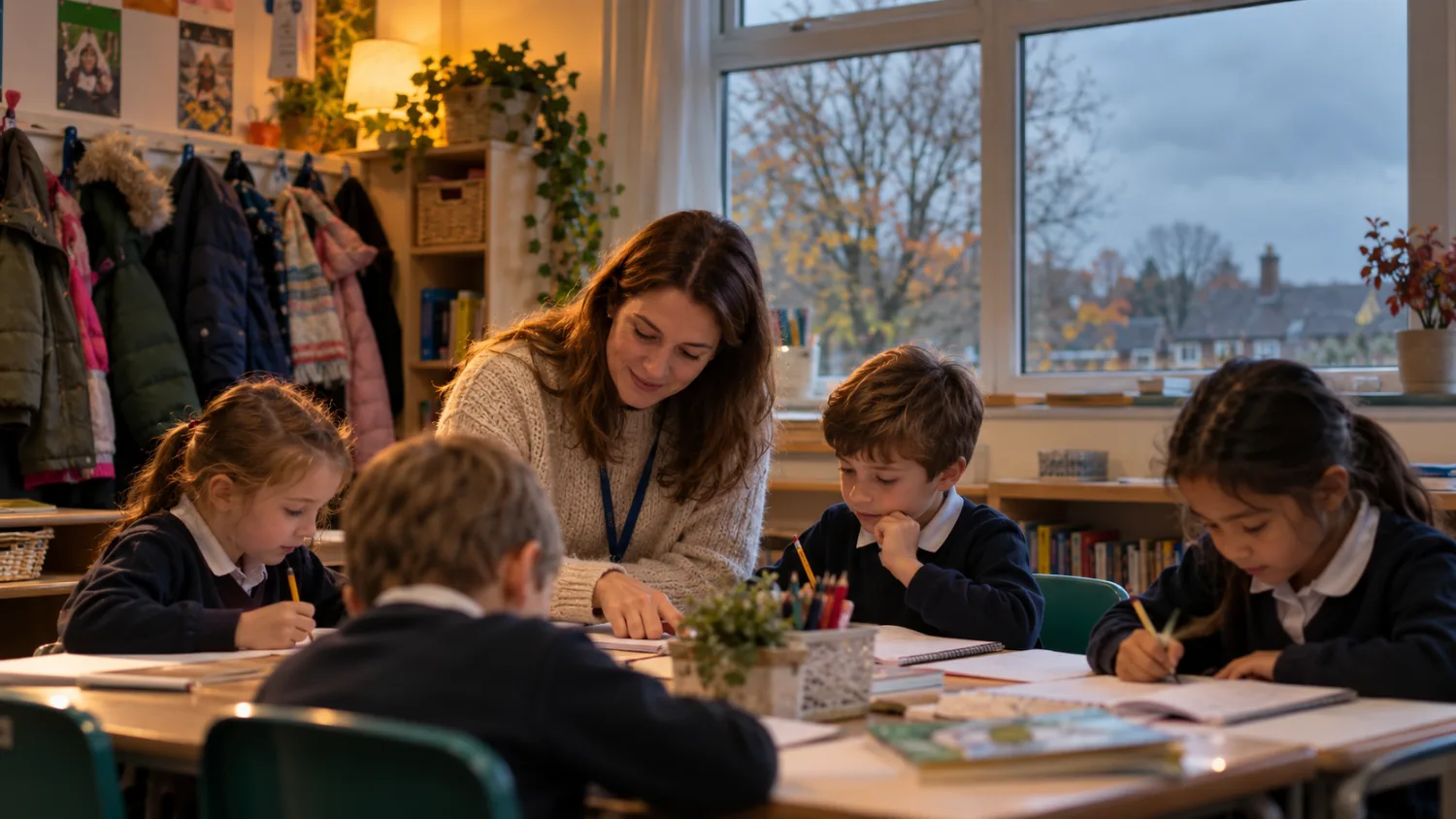

September makes some pupils very easy to notice.
They arrive late. They argue. They refuse work. They cry. They receive behaviour points. They repeatedly ask to leave the room.
Other pupils struggle much more quietly.
They arrive on time, sit where they are asked and rarely cause disruption. Their book is open. They nod when the teacher checks whether everything is clear. They may even produce enough work to avoid concern.
But underneath that apparently successful start, they may be confused, anxious, exhausted, socially isolated, overwhelmed by new routines or trying very hard to hide that they cannot manage the work.
This is particularly important in September.
A new school year changes classes, teachers, timetables, peer groups, expectations and routines all at once. For pupils starting Reception, Year 7, sixth form or a new school, the change can be even larger.
The challenge for teachers is not to diagnose every quiet pupil with a problem.
Quietness is not itself a warning sign.
The aim is to notice changes, patterns and small signals that suggest a pupil may need a conversation, an adjustment or somebody to look a little more closely.
Current safeguarding guidance in England reinforces that staff should maintain professional curiosity, notice changes in children's behaviour and wellbeing, and act on concerns rather than waiting for a child to make a direct disclosure. Keeping Children Safe in Education 2026 came into force on 1 September 2026 and all school staff are now expected to read Part One in full. ([gov.uk](https://www.gov.uk/government/publications/keeping-children-safe-in-education--2?utm_source=chatgpt.com))
This guide looks at the pupils who may appear to be coping in September, the signs worth noticing and what teachers can do without turning every wobble into a major intervention.
Start by looking for change, not a particular personality type
A quiet pupil is not necessarily a struggling pupil.
Some children are naturally reserved. Some prefer listening to speaking. Some need more time before contributing in a new group.
The more useful question is:
“Is anything noticeably different from what we would expect for this pupil?”
Change may be more important than the behaviour itself
For example:
- a normally confident pupil stops volunteering answers;
- a reliable pupil begins forgetting equipment;
- a sociable pupil starts spending breaktimes alone;
- a strong reader begins avoiding reading aloud;
- a pupil who normally completes work begins leaving pages blank;
- a previously punctual pupil starts arriving late;
- a pupil becomes unusually tired or withdrawn.
None of these automatically proves there is a serious problem.
But change deserves curiosity.
Use information from previous staff carefully
Transition information can help you identify what has changed.
You may know that a pupil:
- previously contributed confidently;
- had an established friendship group;
- normally worked independently;
- needed a particular classroom adjustment;
- had attendance concerns;
- received pastoral support.
Use that information as context rather than a permanent label.
The AllSchools guide What Every Teacher Should Know About Their New Class explains how to use previous information without allowing it to predetermine how you see a pupil.
Notice pupils who appear compliant but do not know what to do
One of the easiest pupils to miss is the child who has learned how to look busy.
The book is open.
The pen is moving.
There is no disruption.
But very little actual learning is happening.
Look beyond whether the pupil is “on task”
Ask:
- Have they started the correct task?
- Are they producing meaningful work?
- Are they copying from the board without understanding?
- Are they waiting for a neighbour before doing anything?
- Do they repeatedly erase and restart?
- Are they completing only the easiest part?
Compliance and understanding are not the same thing.
Check understanding individually
Instead of:
“Everyone understand?”
try:
“Tell me what you're going to do first.”
or:
“Show me where you would start.”
That reveals more without making the pupil feel publicly exposed.
Watch for repeated copying
A pupil who repeatedly waits for another child before writing may be:
- uncertain;
- lacking confidence;
- struggling with literacy;
- unable to process the instruction;
- afraid of being wrong.
Do not immediately assume laziness or cheating.
Find out what is making independent work difficult.
Watch for perfectionism that looks like conscientiousness
Some struggling pupils produce beautifully presented work.
The problem is that it takes them four times longer than everybody else.
Notice excessive checking
A pupil may:
- repeatedly rub out correct answers;
- ask whether every sentence is acceptable;
- refuse to move on until handwriting looks perfect;
- restart work after a small mistake;
- become distressed by minor errors.
From a distance, this can look like care and effort.
It may also indicate anxiety, low confidence or a fear of failure.
Listen to the language around mistakes
Phrases such as:
“I can't get anything wrong.”
“Everyone else knows this.”
“Mine is terrible.”
can tell you more than the finished page.
Normalise correction
Teachers can help by modelling mistakes and revisions as ordinary parts of learning.
A pupil who believes that every answer must be perfect before it reaches the page may need explicit permission to attempt, review and improve.
Look for pupils who disappear socially
Teachers naturally notice conflict.
They may notice social isolation less quickly because nothing dramatic happens.
Watch transitions and unstructured moments
Notice who:
- leaves lessons alone;
- waits behind unnecessarily;
- regularly has no partner;
- is always the last pupil selected for group work;
- stands at the edge of friendship groups;
- spends breaktime near adults;
- appears uncertain about where to go at lunchtime.
One isolated moment does not prove loneliness.
A repeated pattern may be worth checking.
Look at what happens during paired work
A pupil may technically have a partner but:
- rarely speak;
- be ignored;
- allow the other pupil to make every decision;
- be repeatedly left without a partner when pupils choose;
- look noticeably uncomfortable.
Social difficulties are often easiest to see when pupils have to organise themselves.
Avoid forcing friendships
If a pupil appears isolated, do not simply assign a “nice child” to look after them permanently.
Instead, create varied, low-pressure opportunities to interact with different peers.
The AllSchools parent guide My Child Says They Have No One to Play With at School explores loneliness, exclusion and bullying from the family perspective.
Pay attention to attendance changes and patterns
Attendance can provide an early signal that something is becoming difficult.
The Department for Education emphasises that attendance supports learning, wellbeing and safeguarding, and that changes in attendance can be important information about what is happening for a pupil. ([gov.uk](https://www.gov.uk/government/publications/improving-the-attendance-of-children-with-a-social-worker/attendance-why-it-matters-key-data-and-guidance?utm_source=chatgpt.com))
Notice more than full-day absence
A pupil may begin:
- arriving late;
- missing particular lessons;
- visiting medical or pastoral staff frequently;
- being absent on particular days;
- asking to go home;
- struggling after weekends.
Patterns sometimes reveal more than the overall percentage.
Do not assume absence is simply motivation
Attendance difficulties can be connected with:
- anxiety;
- friendship problems;
- bullying;
- SEND;
- health;
- family circumstances;
- transport;
- fear of a particular lesson or situation.
DfE guidance specifically recognises that social, emotional and mental-health difficulties can affect attendance and encourages schools to work with pupils and families to understand barriers rather than treating every absence as the same problem. ([gov.uk](https://www.gov.uk/government/publications/mental-health-issues-affecting-a-pupils-attendance-guidance-for-schools?utm_source=chatgpt.com))
Share patterns
A subject teacher may only notice:
“He has missed my lesson three times.”
A pastoral lead may discover:
“He is missing the same point in the timetable every week.”
Small observations become more useful when they are connected.
Notice pupils who suddenly become very tired
September is tiring.
New routines, earlier mornings and a full timetable after the summer break can leave many pupils visibly exhausted.
Some tiredness is normal.
Persistent or unusual exhaustion deserves more attention.
Watch for pupils who repeatedly
- put their head on the desk;
- struggle to stay awake;
- appear unusually pale or lethargic;
- lose concentration rapidly;
- become increasingly irritable through the day;
- arrive without having eaten;
- say they are regularly awake late at night.
Avoid diagnosing the cause
Tiredness could relate to:
- sleep;
- illness;
- medication;
- anxiety;
- caring responsibilities;
- family circumstances;
- travel;
- normal adjustment to the school routine.
Teachers do not need to decide which one applies before raising a concern.
If something feels unusual or persistent, share the observation through the appropriate school route.
Look for pupils who never ask for help
Teachers often worry about pupils who constantly seek reassurance.
The opposite pattern can also hide difficulty.
Some pupils would rather fail quietly than reveal confusion
They may:
- leave questions blank;
- copy;
- guess;
- wait until answers are reviewed;
- pretend they have finished;
- avoid eye contact when the teacher circulates.
They may never put their hand up.
Create help-seeking routines that do not depend on confidence
For example:
- circulate routinely rather than waiting for raised hands;
- use mini whiteboards;
- check first steps;
- use whole-class response systems;
- provide predictable points where pupils can ask questions.
This allows you to identify misunderstanding without requiring pupils to publicly announce it.
Notice the pupil who always says “I'm fine”
If the work suggests otherwise, investigate gently.
You might say:
“I can see you've started, but it looks like this part is tricky. Talk me through what you're thinking.”
That is easier to answer than:
“Do you need help?”
which can be dismissed with a quick no.
Look for masking, particularly around SEND and sensory needs
Some pupils expend a great deal of effort appearing to cope.
They may follow classroom expectations successfully while becoming increasingly overwhelmed.
Watch for effort rather than only behaviour
A pupil might:
- copy what peers do because they are unsure of the routine;
- remain completely still while feeling overwhelmed;
- avoid asking questions because they fear standing out;
- manage lessons but become distressed at transitions;
- cope throughout school and struggle significantly at home.
Teachers will not always see the full picture.
Take family information seriously
A parent may say:
“School says she's fine, but every evening she has a huge meltdown.”
That does not necessarily mean either account is wrong.
The pupil may genuinely be managing at school through considerable effort.
Ask what demands could be contributing.
Consider the environment
Potential difficulties can include:
- noise;
- bright lighting;
- crowded corridors;
- unpredictable transitions;
- seating position;
- complex verbal instructions;
- lunch halls;
- changing rooms.
The AllSchools guides to neurodiversity in the classroom and creating a sensory-friendly classroom offer practical ways to consider these environmental demands.
Notice changes in presentation, organisation and basic needs
A pupil's book may tell you something.
So might their coat, lunch, equipment or repeated requests for basic items.
None of these should be interpreted in isolation.
Look for patterns such as
- regularly having no lunch or money;
- wearing clothing that is consistently inappropriate for conditions;
- repeatedly arriving without essential equipment;
- appearing unusually hungry;
- a marked deterioration in hygiene or appearance;
- frequently losing belongings;
- being unable to organise for lessons despite trying.
There are many possible explanations.
Financial difficulty, executive-function difficulties, family stress, neglect, a house move or simply the chaos of a new school year can all look superficially similar.
Do not investigate safeguarding concerns yourself
If an observation contributes to a safeguarding concern, follow your school's safeguarding procedure.
Keeping Children Safe in Education 2026 requires staff to act on welfare concerns and share information through the school's established processes. Staff should not wait for a child to make a perfect disclosure before passing on a concern. ([gov.uk](https://www.gov.uk/government/publications/keeping-children-safe-in-education--2?utm_source=chatgpt.com))
The AllSchools first-week safeguarding reminder covers disclosures, attendance, child-on-child abuse and reporting concerns in more detail.
Watch how pupils respond when work becomes difficult
The first easy task may not reveal much.
Difficulty often becomes visible when the pupil encounters something they cannot immediately do.
A struggling pupil may
- stop writing;
- become unusually quiet;
- start chatting;
- ask to go to the toilet;
- copy somebody else;
- make jokes;
- become perfectionistic;
- say the task is boring;
- rush through it carelessly.
These behaviours can look very different while serving a similar purpose: escaping a task that feels threatening.
Ask what happens immediately before the behaviour
If a pupil reliably disengages when independent writing begins, that is useful information.
If they cope with direct modelling but struggle once several instructions must be held in mind, that is useful information.
If they participate orally but produce very little written work, that is useful information.
The pattern helps identify what to investigate next.
Use early assessment diagnostically
The first weeks should help teachers work out what pupils know without immediately labelling them by a score.
See Beginning-of-Year Baseline Assessment Without Exhausting Pupils and First-Day Activities That Reveal What Pupils Know Without Feeling Like a Test for practical ways to gather this information.
Use a simple September check-in before escalating concern
Not every sign requires a referral.
Often the best first step is a short conversation.
Choose a private, ordinary moment
You might say:
“You've seemed a little quieter than usual this week. How are things going?”
Or:
“I noticed you've found it difficult to get started in the last couple of lessons. Is there anything making the work tricky?”
This is better than:
“What's wrong with you?”
Do not force a disclosure
The pupil may say:
“Nothing.”
That does not mean your observation was worthless.
You have signalled that you noticed and that conversation is possible.
You can continue observing and share the concern appropriately if the pattern persists.
Ask practical questions
Sometimes:
“Is anything making lessons harder at the moment?”
is easier to answer than:
“How is your mental health?”
A pupil may tell you that:
- they cannot see the board;
- they are lost with the timetable;
- they have no one to sit with at lunch;
- they did not understand last year's topic;
- they are worried about getting changed for PE.
A seemingly large concern may sometimes have a very practical starting point.
Join the dots with colleagues and families
A pupil may show a small sign in six different places.
No individual teacher sees enough to be concerned.
Together, the pattern may be obvious.
Share specific observations
Instead of:
“I'm worried about Ella.”
say:
“Ella has completed very little independent work in three lessons, has been sitting alone at break and asked to go home twice this week.”
Specific information is easier for pastoral, SEND or safeguarding staff to use.
Check whether colleagues see the same thing
Ask:
- Is this happening in other subjects?
- Has attendance changed?
- Has the family contacted school?
- Does the SENCO know of an existing need?
- Has anything changed socially?
Use parent communication constructively
Families may see things school does not.
A useful conversation might begin:
“We've noticed that Max seems very tired and quieter than usual in lessons. Is that something you're seeing at home as well?”
This invites information rather than presenting a conclusion.
Current DfE attendance communication guidance similarly emphasises constructive, supportive communication with families and understanding barriers rather than relying on punitive or purely administrative messaging. ([gov.uk](https://www.gov.uk/government/publications/communicating-with-parents-about-school-attendance?utm_source=chatgpt.com))
Know when quiet struggle becomes a safeguarding or wellbeing concern
Teachers do not need to diagnose a pupil before passing on a concern.
The threshold is not:
“I know exactly what is happening.”
It is often:
“Something has changed and I am concerned about this pupil's welfare.”
Follow safeguarding procedures immediately where appropriate
Examples could include:
- a disclosure;
- signs of abuse or neglect;
- a pupil appearing frightened of a particular person;
- unexplained injuries;
- significant changes in behaviour or presentation alongside other concerns;
- sexual harassment or child-on-child abuse;
- concerns about exploitation;
- serious self-harm or suicide concerns.
Follow your school's policy and contact the DSL or appropriate safeguarding lead.
Do not promise confidentiality
If a pupil begins sharing something concerning, listen calmly.
Do not promise:
“I won't tell anybody.”
Explain that you may need to share information with people whose job is to help keep them safe.
Record rather than rely on memory
Use the school's reporting system.
A small September observation may become important when combined with later information.
Current KCSIE guidance stresses appropriate information-sharing and recordkeeping as part of safeguarding practice. ([gov.uk](https://www.gov.uk/government/publications/keeping-children-safe-in-education--2/part-one-overview-for-all-staff?utm_source=chatgpt.com))
Frequently asked questions
Is being quiet a sign that a pupil is struggling?
Not by itself. Many pupils are naturally quiet. Look for changes, repeated patterns, difficulty accessing learning, social isolation or other indicators rather than treating personality as a problem.
What are the easiest signs to miss in September?
Commonly missed signs include copying rather than understanding, never asking for help, social isolation, perfectionism, repeated lateness, unusual tiredness and pupils who appear compliant while completing very little meaningful work.
Should I speak to a pupil if I am only slightly concerned?
A short, low-pressure check-in is often appropriate. You do not need to wait until the concern becomes serious to ask how things are going.
What if the pupil says everything is fine?
Accept the answer without forcing a disclosure, but continue to observe. If the pattern persists or involves safeguarding or wellbeing concerns, share it through the appropriate school process.
Should I contact parents?
Often this can be useful, particularly for learning, attendance or wellbeing concerns. Follow school procedures, and do not contact families independently about a safeguarding issue where doing so could compromise the school's safeguarding response.
How can I tell the difference between tiredness and a bigger problem?
Look at persistence, severity and associated changes. September tiredness is common, but a pupil who is repeatedly falling asleep, missing school or showing significant behavioural or physical changes deserves closer attention.
What if a pupil only struggles in my subject?
That is still useful information. The issue may relate to prior knowledge, literacy, confidence, a classroom routine, peer dynamics or a specific aspect of the subject. Compare observations with colleagues before assuming the problem is general.
Should every concern go to the SENCO?
No. Ordinary teaching difficulties can often be explored through classroom adjustments first. Persistent patterns suggesting an additional need should be discussed through your school's SEND processes.
What if the pupil is achieving well academically?
High attainment does not rule out anxiety, social difficulty, SEND, safeguarding concerns or significant pressure. Look at the whole pupil rather than assuming strong grades mean everything is fine.
Can attendance problems be a sign that a pupil is struggling?
Yes. Changes in attendance, lateness or absence patterns can sometimes reflect barriers involving anxiety, bullying, health, SEND or family circumstances. They should be understood in context.
How long should I observe before raising a concern?
There is no fixed period. A mild classroom pattern may justify observation over several lessons. A safeguarding concern should be reported immediately according to school procedure.
What is the most important thing teachers can do in September?
Notice pupils accurately. Learn their normal patterns, create opportunities for them to ask for help and share concerns when something does not feel right.
September is full of visible adjustment.
New uniforms. New classrooms. New seating plans. New routines.
The pupils who attract attention are often the ones whose difficulty becomes disruptive.
But the pupil who never interrupts a lesson can still be struggling.
Look at the child who spends ten minutes making one sentence perfect.
Notice the pupil who always says they understand but waits for somebody else before beginning.
Notice the pupil who has quietly stopped sitting with friends.
Notice the pupil whose attendance changes.
Notice the pupil who manages everything without ever asking for help.
Then be curious rather than certain.
Ask a small question. Check with a colleague. Look at the pattern. Speak to home where appropriate. Make a reasonable adjustment. Record a safeguarding concern when necessary.
Teachers do not need to solve every problem themselves.
But they are often the first person in a school who notices that something has changed.
For some pupils, that small act of noticing is what allows support to begin.