
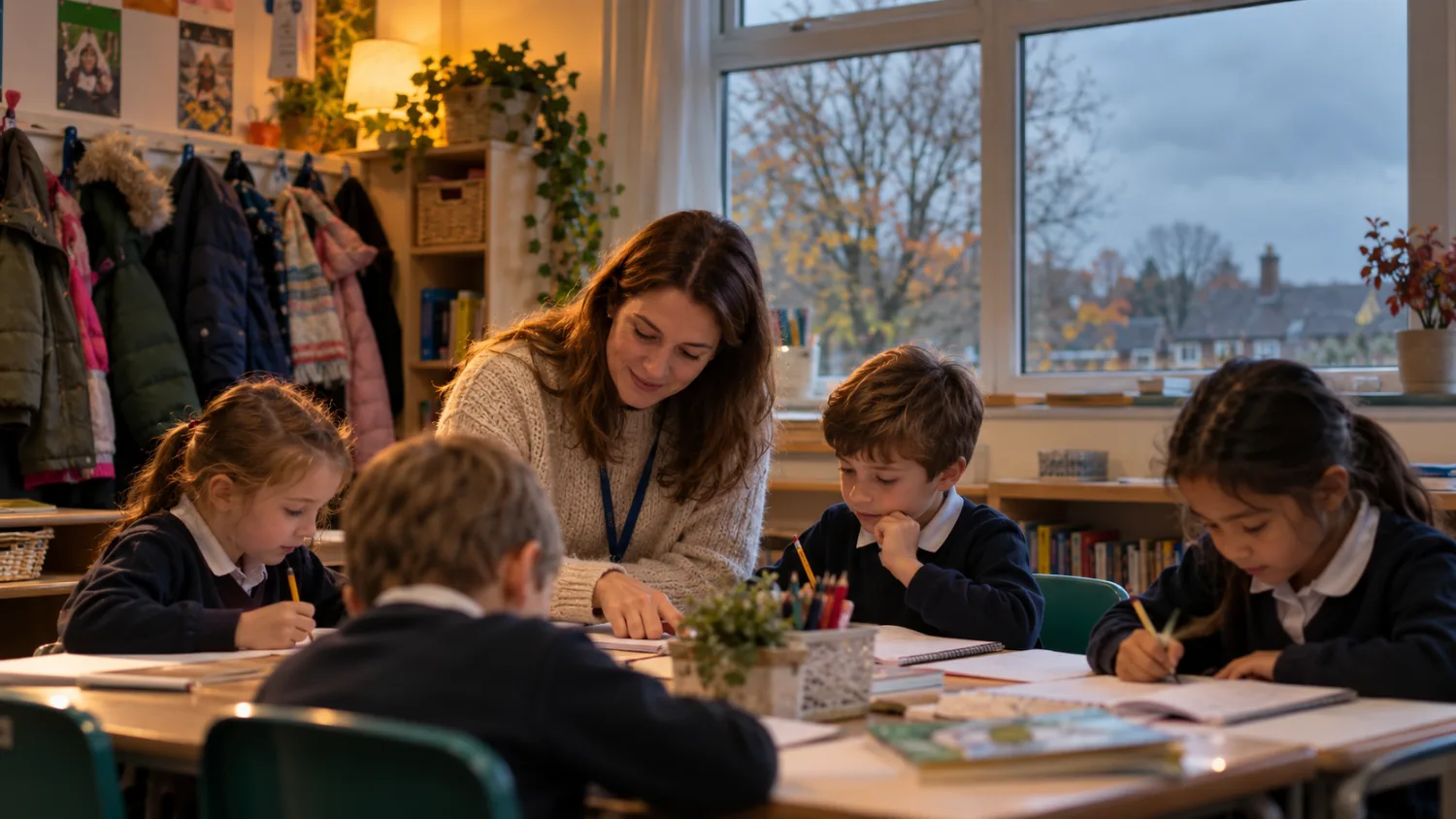
Late October can change the feel of a school day surprisingly quickly.
Mornings become darker.
Afternoons shorten.
Pupils arrive in heavier coats.
Breaktimes may be colder or wetter.
Some children seem more tired.
Others become more restless.
And when the clocks go back, the change can feel sudden even though daylight has been reducing for weeks.
In the UK, the clocks go back one hour on Sunday 25 October 2026, when British Summer Time ends and the country returns to Greenwich Mean Time.
For schools, this is not a reason to expect a dramatic seasonal decline in every pupil.
But it is a useful moment to think ahead.
Reduced daylight, disrupted sleep routines, darker journeys and colder weather can all affect how pupils arrive at school and how they function during the day.
The best response is usually not a special “winter programme”.
It is a handful of sensible adjustments:
- protect routines;
- notice sleep-related tiredness;
- use daylight well;
- keep pupils moving;
- look out for children whose mood or attendance is changing;
- make darker travel safer.
This guide explains what teachers and school leaders can do before the clocks change rather than waiting until November problems are already established.
Start by expecting some routine disruption
The clock change itself is only one hour.
But children and teenagers do not experience school purely by what the clock says.
Sleep timing, morning light, evening routines and family schedules all matter.
Some pupils may arrive temporarily more tired
You may notice:
- slower starts in the morning;
- more irritability;
- reduced concentration;
- more complaints of tiredness.
NHS-linked guidance on children's sleep notes that insufficient sleep can affect mood, concentration and behaviour, while consistent sleep routines and exposure to daylight can support healthier sleep.
Do not overinterpret one difficult week
A pupil who is unusually tired on the first Monday after the clocks change may simply be adjusting.
But if tiredness:
- continues;
- worsens;
- affects attendance;
- comes with significant mood change;
it deserves closer attention.
Keep morning routines especially predictable
Darker mornings can make the beginning of the school day feel slower.
That is not the moment to make arrival unnecessarily complicated.
Protect familiar entry routines
For example:
- the same equipment expectations;
- a clear starter task;
- resources already available;
- minimal waiting around.
Use a calm but active start
A useful morning starter should help pupils transition into learning.
It might include:
- retrieval;
- short reading;
- a familiar maths routine;
- a simple independent task.
Avoid letting tiredness become an excuse for lowering expectations
The message can be:
“I know mornings feel darker now. Our routine stays the same because it helps us get started.”
If classroom routines have already started to drift, see How to Reset Expectations After a Difficult First Month.
Use natural daylight wherever you can
Light is one of the strongest environmental signals affecting sleep and wakefulness.
NHS-linked advice for children and teenagers recommends exposure to natural daylight and notes that morning light can help the body wake and regulate sleep patterns.
Simple school adjustments include
- opening blinds rather than teaching in unnecessarily dim rooms;
- using outdoor breaktimes where weather allows;
- taking learning outside occasionally;
- avoiding keeping pupils indoors all day unless necessary.
Do not confuse darker weather with a need for permanently darker classrooms
Some classrooms become surprisingly gloomy during autumn because:
- blinds stay closed;
- displays block windows;
- projectors are used continuously.
If the projection is finished, open the room back up.
Balance this with sensory needs
Bright glare can also be difficult for some pupils.
The aim is not maximum brightness.
It is a comfortable, functional environment.
See How to Create a Sensory-Friendly Classroom on a Budget.
Keep pupils physically active during the school day
Cold and wet weather can gradually reduce movement.
Outdoor break gets shortened.
PE becomes less appealing.
Pupils spend more time sitting indoors.
But movement can support alertness and wellbeing
Where appropriate, protect:
- PE;
- outdoor breaktimes;
- movement between lessons;
- active learning opportunities.
Even short movement can help
This does not mean turning every lesson into exercise.
But if pupils have been sitting for a long period, a brief transition or movement task may improve readiness for the next activity.
The AllSchools guide The Role of Exercise in Supporting Pupils’ Mental Health looks at this more broadly.
Watch for changes in concentration rather than assuming laziness
Autumn tiredness can sometimes look like poor effort.
A tired pupil may
- forget instructions;
- take longer to start;
- make careless mistakes;
- become more irritable;
- appear disengaged.
That does not mean every concentration problem is caused by sleep
But if several signs appear together, ask:
“Is this pupil tired, overloaded or actually avoiding the work?”
Adjust support before lowering challenge
You might:
- shorten instructions;
- check understanding;
- break tasks into clearer steps;
- reduce unnecessary distractions.
For wider classroom strategies, see Improving Focus in the Classroom: Evidence-Based Approaches.
Pay particular attention to teenagers
Secondary pupils can be especially vulnerable to sleep difficulties.
Puberty shifts sleep timing later, while school still requires early waking.
NHS-linked guidance notes that teenagers often naturally want to fall asleep later and may struggle to wake early, while insufficient sleep can affect mood, concentration, learning and mental health.
Autumn can amplify an existing problem
If a pupil is already:
- sleeping too little;
- using phones late at night;
- struggling to wake;
darker mornings may make school arrival feel even harder.
Schools can reinforce sensible messages
For example:
- regular sleep and wake times;
- less late-night screen use;
- morning light;
- avoiding excessive caffeine late in the day.
This does not need to become a lecture.
A short tutor-time reminder before half-term can be enough.
Notice pupils whose mood changes as daylight reduces
Most pupils will not develop seasonal affective disorder.
But reduced daylight can affect mood and sleep in some people.
The NHS says seasonal affective disorder is thought to be linked to reduced winter daylight and changes that affect mood and circadian rhythms.
School staff are not diagnosing seasonal conditions
But they can notice changes.
Look for pupils who become
- consistently withdrawn;
- unusually low;
- much more tired;
- less interested in activities;
- more absent.
Use the usual pastoral and safeguarding routes
If there is a significant or sustained change in wellbeing, follow your school's normal processes.
The important thing is not to dismiss a noticeable change as:
“Everyone gets miserable in winter.”
Look again at pupils who were already quietly struggling
Some pupils attracted attention in September because they were visibly unsettled.
Others managed quietly.
By late October, their coping strategies may be wearing thin.
Review pupils who
- rarely ask for help;
- are completing less work;
- look increasingly tired;
- have started missing days;
- seem socially withdrawn.
Seasonal change may not be the cause
But it can reveal a difficulty that was already present.
The AllSchools guide How to Spot Pupils Who Are Quietly Struggling in September remains useful beyond September because the same warning signs can emerge later.
Review attendance before winter patterns become established
Autumn and winter can bring more illness.
They can also expose pupils who are beginning to develop repeated absence patterns.
Look for
- Monday absence;
- repeated late arrival;
- frequent morning illness;
- patterns linked to anxiety.
Do not wait for the percentage to become alarming
Early conversations are easier than trying to reverse a deeply established pattern later.
If you are reviewing this strategically, see A Practical Autumn Attendance Review for School Leaders.
Prepare pupils for darker journeys to and from school
When the clocks go back, many pupils who previously travelled home in daylight may begin doing part of the journey in darkness.
That is worth addressing before the change.
Remind pupils about visibility
Depending on age and travel method, useful reminders may include:
- using well-lit routes;
- crossing roads at safer points;
- being visible to drivers and cyclists;
- using lights when cycling.
Local authorities routinely renew “be bright, be seen” messaging as autumn days shorten.
Review after-school arrangements
Particularly for:
- clubs;
- sports fixtures;
- revision sessions;
- detentions.
Ask whether pupils leaving later than normal have safe travel arrangements.
Think about pupils with SEND before routines change
Some pupils respond strongly to environmental change.
The shift into:
- darker mornings;
- winter uniform;
- indoor breaktimes;
- different lighting;
may be more significant for them than adults expect.
Predictability can help
Explain changes in advance where appropriate.
For example:
“After half-term it will be darker when you arrive, but our morning routine will stay exactly the same.”
Watch sensory changes too
Wet coats, crowded indoor spaces and fewer outdoor breaks can increase:
- noise;
- physical proximity;
- sensory discomfort.
Small environmental adjustments may prevent larger difficulties.
See Neurodiversity in the Classroom.
Use half-term as the reset point
In many schools, the clock change falls alongside or immediately before October half-term.
That creates a useful natural break.
Before pupils leave
You can remind them about:
- sleep routines;
- morning punctuality;
- darker journeys;
- return-to-school routines.
After half-term
Re-establish expectations quickly.
Do not spend two weeks allowing routines to drift because:
“Everyone is tired after the break.”
Keep the restart simple
Use:
- familiar starters;
- clear transitions;
- consistent behaviour expectations.
If teachers are using half-term for planning, see How to Plan a Productive October Half-Term Without Working All Week.
A simple pre-clock-change checklist for schools
Classrooms
- Is natural daylight being used effectively?
- Are morning routines clear?
- Are indoor spaces becoming unnecessarily crowded?
Pupils
- Who is noticeably more tired?
- Whose concentration has changed?
- Is anybody becoming more withdrawn?
Attendance
- Are lateness or absence patterns emerging?
- Are morning difficulties becoming more frequent?
Travel
- Will pupils now arrive or leave in darkness?
- Do cycling and walking reminders need refreshing?
- Are after-school arrangements still safe?
SEND
- Will environmental changes affect particular pupils?
- Can changes be explained or adjusted in advance?
After half-term
- Which routines need immediate re-establishment?
- Which pupils need an early check-in?
Frequently asked questions
When do the clocks go back in 2026?
In the UK, the clocks go back one hour on Sunday 25 October 2026. British Summer Time ends and the UK returns to Greenwich Mean Time.
Can the clock change make pupils tired?
It can temporarily affect sleep timing and routines for some pupils. The wider shift into darker mornings and shorter days may also make existing sleep problems more noticeable.
Should schools change lesson times after the clocks change?
Normally no. Consistent school routines are usually more useful. The focus should be on recognising tiredness, using daylight effectively and protecting good routines.
Can darker days affect concentration?
Indirectly, yes. Sleep quality and insufficient sleep can affect concentration, mood and behaviour.
Should teachers let tired pupils do less work?
Not automatically. Maintain appropriate expectations while providing clearer instructions, checking understanding and making reasonable adjustments where needed.
Does natural daylight really matter?
Yes. NHS-linked guidance recommends daylight exposure as part of healthy sleep and wake routines for children and teenagers.
What should schools do about pupils travelling home in darkness?
Refresh road-safety and visibility messages, consider how after-school activities affect departure times and ensure younger pupils' collection arrangements remain suitable.
Can shorter days affect mood?
Reduced daylight is linked with seasonal changes in mood for some people. Persistent or significant mood changes should be handled through normal pastoral and health-support routes rather than assumed to be ordinary winter tiredness.
Are teenagers more affected by sleep changes?
Teenagers are already more likely to have later sleep patterns because of developmental changes, so early school mornings can be difficult even before winter.
Should schools send information to parents before the clock change?
A short reminder can be useful, particularly around sleep routines, punctuality and darker journeys. It does not need to become a major campaign.
What if a pupil remains exhausted for weeks?
Do not assume the clocks are responsible. Discuss the pattern with the pupil and family where appropriate and use normal pastoral, SEND or health-support routes if the problem continues.
Should the return after October half-term be treated like another September?
No. Pupils already know the school and routines. A short, confident reminder of expectations is usually more effective than starting everything again.
The clocks going back are not a school crisis.
Most pupils will adjust without any difficulty.
But late October marks a wider seasonal shift that schools can prepare for.
More darkness.
Colder mornings.
Less outdoor time.
Potentially more tired pupils.
And more journeys taking place after daylight has gone.
Good preparation is simple.
Protect routines.
Use daylight.
Keep pupils moving.
Notice changes in sleep, mood and attendance.
Prepare for darker travel.
And pay extra attention to pupils for whom seasonal and environmental changes are harder to manage.
The aim is not to make winter feel like a problem.
It is to make the transition into it uneventful enough that pupils can keep concentrating on school.