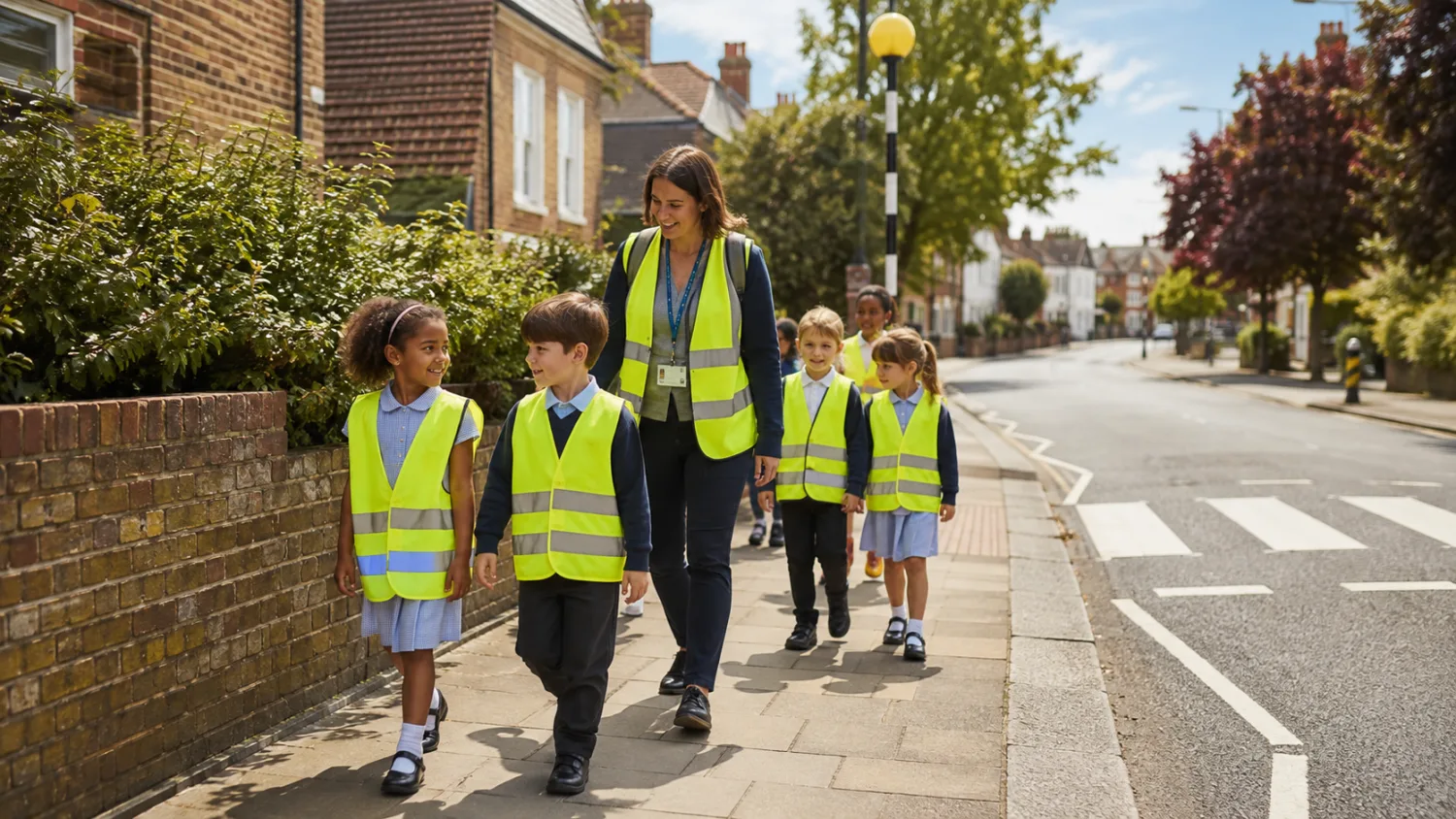
A local walking trip can be one of the simplest forms of educational visit.
There is no coach to book, no long journey, no expensive venue and often no complicated itinerary. A class might walk to the library, a church, a park, a museum, a local business, a place of worship, a war memorial, a nature area or simply around the neighbourhood as part of geography or history work.
Because the destination is familiar and nearby, it can also be easy to underestimate the planning.
The main risks are usually ordinary ones: roads, crossings, weather, uneven pavements, members of the public, pupils becoming separated, medical needs and changes to the route. None of these automatically makes a local walk high risk. But they still need to be thought through.
Current Department for Education guidance in England distinguishes between routine visits involving everyday levels of risk and visits that need additional risk assessment and planning. Routine local visits can often be managed through a school's existing policies and procedures, with proportionate additional planning rather than unnecessary paperwork. The Health and Safety Executive makes the same point: schools should focus on managing real risks, not creating bureaucracy for its own sake.
This guide explains how to plan a local walking school trip safely, from choosing the route and deciding staffing to road crossings, SEND, emergencies, weather and what to do if something changes on the day.
Start by deciding whether the walk is a routine local visit
Before completing forms, establish how the visit fits within your school's educational visits policy.
A short walk to a familiar local library is very different from a route involving woodland, open water, difficult terrain or significant road hazards.
The DfE describes routine visits as those involving no more than everyday levels of risk. These can often be treated as a lesson in a different classroom and require only limited extra planning beyond the educational purpose. Visits outside existing school procedures, or those involving greater distance, unusual activities, specialist locations or additional hazards, may need a fuller risk assessment and approval process.
Check your own school's procedure first
Your school or trust may have:
- a local-visit policy;
- a pre-approved local area;
- generic risk assessments for routine walks;
- an educational visits coordinator;
- an online approval system;
- specific expectations about parental information or consent;
- minimum staffing arrangements for particular groups.
Do not create a new process if the school already has an approved one.
Likewise, do not assume that because another school treats a particular walk as routine, your school automatically does the same.
Ask what is actually different from a normal school day
A proportionate planning process should focus on the things that change because pupils are leaving the site.
For example:
- they will be close to traffic;
- they will interact with members of the public;
- toilets may be less accessible;
- medical help may not be immediately available;
- the class may need to cross several roads;
- weather may affect the route;
- pupils may become separated more easily.
Those are the issues worth planning around.
For a broader overview of visit planning, see the AllSchools complete guide to school trips and educational visits.
Walk the route yourself before taking pupils
A map can tell you the distance. It cannot tell you whether a hedge blocks the view at a crossing, whether roadworks have narrowed the pavement or whether the footpath becomes crowded at school-closing time.
A route check is one of the most useful pieces of preparation for a local walking visit.
Walk it at roughly the same time of day
Traffic conditions can change dramatically.
A quiet road at 10am may be difficult at 3pm. A pavement outside another school may become crowded during arrival or collection time. Delivery vehicles may block part of the route at certain times.
Where possible, inspect the route at or close to the time the group will use it.
Look specifically at crossings
Do not simply ask whether there is a pedestrian crossing.
Consider:
- visibility in both directions;
- traffic speed and volume;
- whether vehicles regularly park near the crossing point;
- how many pupils can wait safely;
- whether the whole group can cross in one signal phase;
- whether a central island is large enough;
- whether younger pupils can see over parked cars;
- whether the route requires crossing entrances or side roads.
A slightly longer route with controlled crossings may be safer and easier to manage than the shortest route.
Notice temporary hazards
Check for:
- roadworks;
- scaffolding;
- closed pavements;
- temporary traffic lights;
- construction-site entrances;
- fallen trees or flooding;
- events affecting the area;
- changes to public access.
A route that worked perfectly last term may not be suitable today.
Identify safe stopping points
Know where the group can stop without blocking a pavement or standing close to traffic.
This is useful if you need to:
- count pupils;
- give instructions;
- wait for another part of the group;
- deal with a minor medical issue;
- change the plan.
Plan group organisation before you reach the pavement
Walking with pupils becomes much easier when everyone knows how the group will move before leaving school.
Decide the walking formation
The safest arrangement depends on:
- age;
- pavement width;
- traffic;
- pupil needs;
- group size.
Younger pupils may walk in pairs, while older pupils may be able to move more independently within clearly defined boundaries.
Explain:
- whether pupils walk in pairs or another formation;
- who their partner is;
- whether partners may change;
- how much space should be left between groups;
- what happens when the pavement narrows;
- where pupils stop before a crossing;
- who gives permission to cross.
Place adults deliberately
Do not simply tell adults to “spread out”.
A typical arrangement might include:
- an experienced adult leading;
- an adult at the rear;
- additional adults positioned around pupils requiring closer supervision;
- staff placed strategically at complicated crossings.
The precise arrangement should reflect the route and pupils.
Use regular headcounts
Count pupils:
- before leaving school;
- after significant crossings where appropriate;
- on arrival;
- before leaving the destination;
- on return to school.
For larger groups, splitting pupils into smaller named groups with a designated adult can make checking much quicker than repeatedly counting the entire class from scratch.
Make sure every adult knows the plan
Adults should know:
- the route;
- the destination;
- their position in the group;
- which pupils need additional attention;
- the road-crossing procedure;
- what to do if someone becomes separated;
- who carries emergency information;
- who leads if the visit leader becomes unavailable.
A briefing immediately before leaving can prevent misunderstandings that only become visible halfway down the road.
Make road crossings the most deliberate part of the walk
For many local walking trips, traffic is the most significant hazard.
This does not mean pupils should never walk beside roads. It means crossing procedures need to be predictable and closely supervised.
Use the safest practical crossing
Where available and appropriate, this may be:
- a pedestrian crossing;
- a signal-controlled junction;
- a school crossing patrol point;
- a pedestrian island;
- a location with good visibility and low traffic speed.
The shortest crossing is not always the best one.
Stop the whole group before crossing
Avoid a situation in which the front of the group begins crossing while pupils at the rear are still walking towards the kerb.
Establish a clear stopping routine.
For example:
“Everybody stops behind the line. We cross only when the adult at the front gives the instruction.”
Younger pupils may need this routine practised before the trip.
Think about whether the group should cross together or in smaller sections
A large group may not fit safely within one crossing phase.
Depending on the location, it may be safer to divide into smaller adult-led groups.
Whatever arrangement is used, staff should know it before reaching the crossing.
Watch side roads and driveways
Not every traffic risk involves crossing a major road.
Vehicles may emerge from:
- driveways;
- car parks;
- petrol stations;
- delivery areas;
- side streets;
- construction entrances.
Pupils may treat a continuous pavement as automatically safe, so adults need to remain alert at vehicle access points.
Choose staffing based on the pupils and route, not a magic ratio
One of the most common questions about school trips is: How many adults do we need?
There is no universal adult-to-pupil ratio that automatically makes every walking trip safe.
Staffing should reflect the circumstances.
Consider the group
Relevant factors include:
- pupil age;
- maturity;
- behaviour;
- SEND;
- mobility;
- medical needs;
- communication needs;
- familiarity with walking together;
- whether any pupil may abscond or become overwhelmed.
Consider the environment
A route almost entirely through a pedestrianised park presents different supervision demands from a town-centre route involving several busy junctions.
Look at:
- traffic;
- crowding;
- crossings;
- terrain;
- distance;
- visibility;
- public transport interfaces;
- open water or other significant hazards.
Consider staff competence as well as numbers
Four adults who have not been briefed may be less useful than three who understand exactly what they are doing.
At least one person should be clearly responsible for leading the visit, with others knowing their roles.
DfE guidance says those managing visits should have suitable competence, understand the risks and be familiar with the activity.
Do not count adults who cannot realistically supervise
An adult whose attention must remain almost entirely on one pupil may not be available to supervise the wider group.
Likewise, a staff member who needs to manage equipment or another task may have reduced supervision capacity.
Factor this into the plan.
Plan properly for SEND, medical and additional needs
A local walk should be genuinely accessible where reasonably possible.
The fact that a destination is close does not mean every pupil can reach it in the same way.
Think about the route from the pupil's perspective
Consider:
- mobility;
- kerbs and uneven surfaces;
- distance and fatigue;
- toilet access;
- sensory overload;
- busy crossings;
- communication needs;
- anxiety;
- unfamiliar environments;
- the ability to follow group instructions.
A pupil who manages well in the classroom may find a noisy road or crowded shopping area much harder.
Use familiar support strategies
Helpful adjustments might include:
- a visual route;
- pre-teaching the sequence of the visit;
- a familiar adult;
- additional processing time;
- ear defenders where appropriate;
- a planned position within the group;
- an alternative accessible route;
- additional breaks;
- a clear plan for distress or dysregulation.
The AllSchools guide on making school trips work for pupils with SEND covers this in more detail.
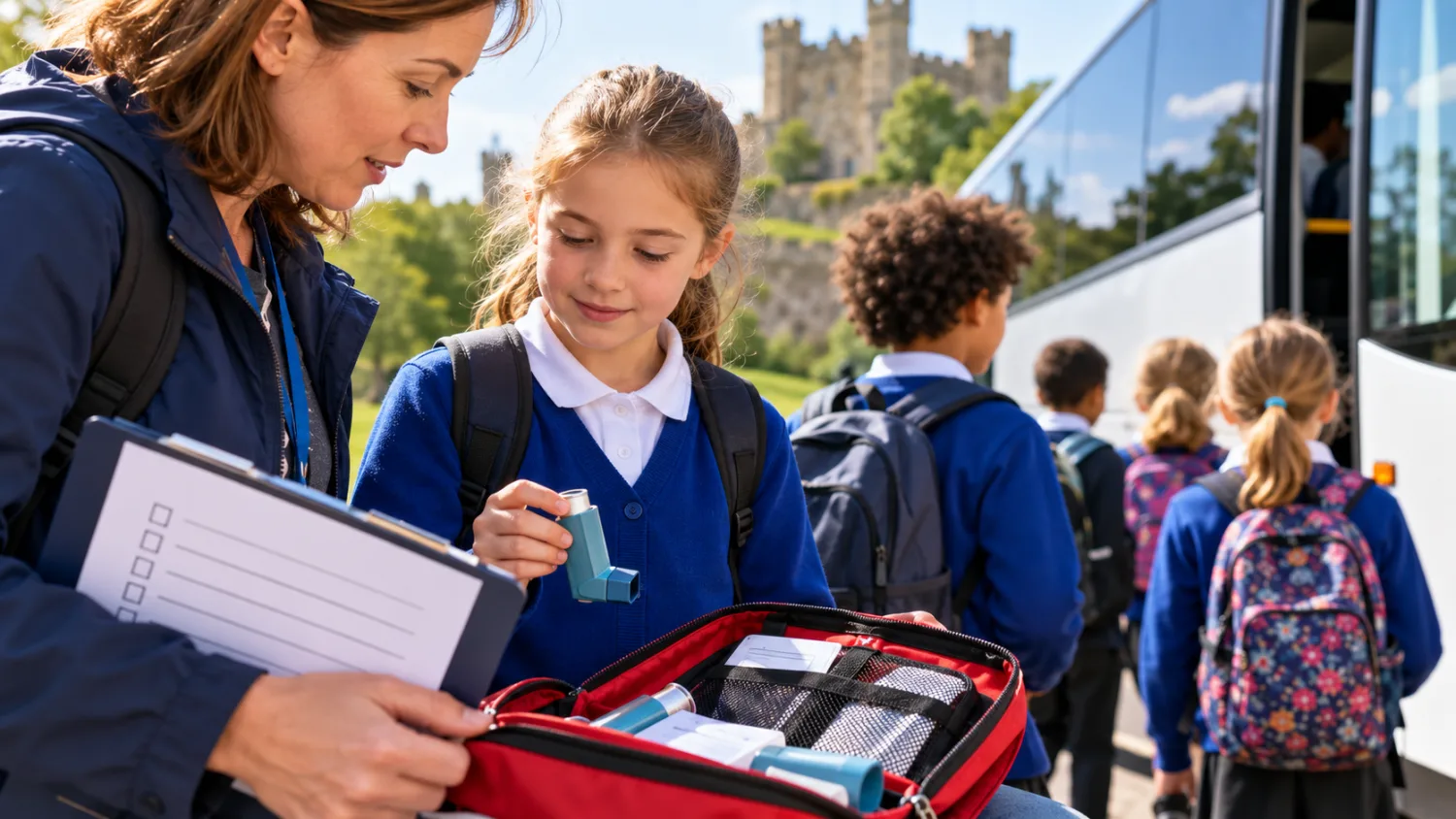
Carry essential medical information and medication
Follow school procedures for:
- inhalers;
- adrenaline auto-injectors;
- diabetes equipment;
- seizure medication;
- other prescribed medicines;
- individual healthcare plans;
- emergency contacts.
Do not assume a local trip is too short for medication to matter.
A medical emergency can occur five minutes from school just as easily as fifty miles away.
Check weather, clothing and physical conditions on the day
Walking trips are particularly affected by weather.
A route assessed on a dry day may feel quite different in heavy rain, strong wind, ice or extreme heat.
Check the forecast close to departure
Consider:
- heavy rain;
- thunderstorms;
- high winds;
- snow or ice;
- extreme heat;
- poor visibility.
The decision does not have to be simply “go” or “cancel”.
You may be able to:
- change the route;
- shorten the visit;
- move the timing;
- use a different destination;
- postpone until conditions improve.
Tell families what pupils need
Depending on the visit, this might include:
- a waterproof coat;
- comfortable footwear;
- a sun hat;
- water;
- appropriate layers.
However, schools should have a plan for pupils who arrive without the requested item. A child should not automatically be excluded from a curriculum visit because their family forgot a waterproof coat.
Consider ground conditions
Rain can turn:
- grass;
- paths;
- slopes;
- wooden bridges;
- leaves;
into slip hazards.
If conditions have changed substantially since the route check, reassess whether the planned path remains suitable.
Plan for members of the public and unexpected events
Unlike the school site, a public route cannot be controlled completely.
You may encounter dogs, cyclists, construction workers, protests, aggressive behaviour, emergency incidents or simply a crowded pavement.
Give pupils clear boundaries
Depending on age, remind pupils:
- not to leave the group;
- not to enter shops or other premises;
- not to accept items from members of the public;
- not to interact with unfamiliar animals without permission;
- to tell an adult if somebody approaches them in a way that makes them uncomfortable.
Keep this proportionate. The purpose is not to make pupils fearful of being outside school.
Know when to change the route
If you encounter:
- a serious police incident;
- unsafe roadworks;
- a blocked pavement;
- an aggressive person;
- a large unexpected crowd;
- another significant hazard;
do not continue simply because the written plan says to use that route.
Dynamic risk management means responding sensibly to the conditions actually in front of you.
Current DfE school-security guidance also encourages schools to consider external incidents that could affect pupils and to have suitable emergency arrangements.
Do not improvise an unplanned higher-risk activity
A local walk may pass a stream, climbing structure, woodland area or another tempting opportunity.
Do not add an activity that introduces risks not considered in the visit plan simply because pupils ask.
DfE guidance specifically warns against adding higher-risk activities during a visit without appropriate planning.
Have a simple emergency plan that staff can actually use
Most local walks end without incident.
Planning for emergencies is still essential.
The DfE says schools should have an emergency response plan for incidents away from school and that visit leaders should be familiar with it.
Carry a reliable way to contact school
The visit leader should have access to:
- the school telephone number;
- an appropriate mobile phone;
- emergency contact information;
- essential pupil medical information;
- the number of pupils and adults present.
Follow school policy regarding personal and school mobile phones.
Know what you would do if a pupil went missing
Before leaving, adults should understand:
- who keeps the remaining group together;
- who alerts the school;
- whether and how the immediate area is checked;
- when police or emergency services are contacted;
- how parents are informed;
- who coordinates the response.
Do not allow several adults to independently leave the main group searching without a coordinated plan.
Plan for illness or injury
Ask:
- Who is first-aid trained if required by school arrangements?
- Who carries the first-aid kit?
- Can the pupil return to school safely?
- Where could the group wait safely?
- Could an adult escort one pupil back without leaving the main group understaffed?
- When would an ambulance be required?
Know the full destination details
If emergency services are needed, “the park near school” is not precise enough.
Adults should know the name, address or other clear location information for the destination and significant points along the route.
Communicate clearly with pupils and families
Good communication makes the visit easier to manage.
Brief pupils shortly before leaving
Keep instructions concise.
Cover:
- the purpose of the visit;
- who their supervising adult is;
- the walking arrangement;
- the road-crossing procedure;
- what to do if they become separated;
- behaviour expected at the destination;
- any hazards particularly relevant to that route.
Long safety lectures containing every conceivable risk are less likely to be remembered than a few clear instructions.
Tell parents or carers what they need to know
For routine curriculum visits involving pupils over nursery age, written consent is not normally required under DfE guidance, although schools should inform families and follow their own consent arrangements. Written consent is more commonly required for higher-risk trips or those outside normal school hours. Nursery-age children require written consent.
A parent message for a routine local walk may simply need to state:
- where pupils are going;
- why;
- when;
- what clothing or equipment is needed;
- any relevant lunch arrangements;
- whether normal school times are affected.
Use the school's own policy rather than assuming the national minimum is the whole procedure.
Check new medical or contact information
A local visit may reveal that the emergency contact or medical information held by school is outdated.
Particularly at the beginning of the academic year, make sure important changes have been recorded.
Keep the risk assessment proportionate and useful
A local walk does not become safer because the risk assessment is ten pages long.
HSE and DfE guidance both stress proportionate risk management focused on real hazards and practical controls.
Focus on significant hazards
For a routine local walk, these might include:
- road crossings;
- pupils becoming separated;
- particular medical needs;
- open water if relevant;
- dangerous sections of pavement;
- significant weather conditions;
- specific pupil behaviour or mobility needs;
- unusual hazards at the destination.
You do not need to list every ordinary possibility such as a pupil dropping a pencil.
Write controls that tell staff what to do
Instead of:
Hazard: Traffic. Risk: Injury. Control: Staff vigilance.
write something operational:
“Group stops completely at the junction with High Street. Visit leader checks traffic and controls crossing. Pupils cross in two groups, each supervised by an adult. Rear adult confirms second group has cleared the road before the walk continues.”
The second version can actually guide practice.
For more detail, the AllSchools guide on how to write a school trip risk assessment explains how to keep documentation focused on genuine hazards and controls.
Use existing generic assessments properly
If your school already has a generic assessment for local walks, do not automatically rewrite it.
Instead ask whether anything about this visit differs from the assumptions in that assessment:
- a different route;
- a pupil with significant new needs;
- roadworks;
- a different destination;
- unusual weather;
- a particularly large group.
Add or amend what is necessary.
Review the walk afterwards and improve the next one
Routine local visits become easier and safer when schools learn from experience.
Notice where the plan did not match reality
After returning, ask:
- Did the crossing procedure work?
- Was the route too crowded?
- Were staffing positions effective?
- Did any pupil need unexpected support?
- Was the journey time realistic?
- Were there problems at the destination?
- Did weather affect the plan?
- Was communication with families sufficient?
Record incidents and near misses
DfE guidance recommends keeping records of incidents, accidents and near misses so schools can evaluate whether planning worked and improve future visits.
A near miss might include:
- a pupil stepping towards the road before being stopped;
- a crossing taking much longer than expected;
- a member of the public creating a concern;
- a medical item being difficult to access;
- a route becoming unexpectedly blocked.
These are useful opportunities to improve the next visit rather than evidence that local walking trips should stop.
Update the route information
If the same walk will happen regularly, record useful practical information for colleagues.
For example:
- the best crossing;
- a safer alternative route;
- where the group can stop;
- how long the walk realistically takes;
- which part becomes crowded;
- which entrance at the destination works best.
This turns experience into useful institutional knowledge.
If the local walk is part of a wider programme of visits, the AllSchools guide to planning a school trip without the stress offers a broader step-by-step approach.
Frequently asked questions
Does a short local walk count as a school trip?
Yes, it is an off-site educational visit, although many routine local walks can be managed through a school's existing policies and procedures with proportionate planning rather than a full bespoke process.
Does every local walk need a new risk assessment?
Not necessarily. Schools may have generic or standing assessments for routine local visits. Staff should check whether the particular route, pupils, activity or current conditions introduce anything that is not already covered.
Do parents need to give written consent for a local walk?
In England, written consent is generally not required for most routine curriculum visits involving children above nursery age, although parents should normally be informed and schools must follow their own consent policy. Written consent is always required for nursery-age children and is usually required for higher-risk activities or visits outside normal school hours.
Is there a legal adult-to-pupil ratio for local walking trips?
There is no single universal ratio suitable for every visit. Schools should determine supervision based on the age and needs of pupils, the route, traffic, activity, staff competence and other relevant risks, while following any requirements in their own school, trust or local authority policy.
Should staff walk the route beforehand?
For an unfamiliar route, or when circumstances may have changed, a pre-visit check is very useful. Regularly used routes may not require a full reconnaissance every time, but staff should remain aware of temporary hazards such as roadworks, closures and weather.
What is the biggest risk on a local walking trip?
It depends on the route, but road traffic is often one of the most significant hazards. Crossings, side roads, driveways and group organisation therefore deserve deliberate planning.
Should pupils wear high-visibility vests?
Some schools use them, particularly with younger children, but they are not a substitute for appropriate supervision, safe route selection and controlled crossings. Follow your school's policy and assess whether they add practical value for the particular visit.
What should staff carry on a local walk?
This depends on the visit and school procedure, but commonly includes access to emergency contact arrangements, an appropriate phone, necessary medication, essential medical information and a suitable first-aid kit.
Can a child with SEND be excluded because the walk is difficult to manage?
Schools should consider reasonable adjustments and plan for inclusion rather than assuming exclusion is necessary. This may involve extra supervision, an adapted route, equipment, sensory support or another appropriate arrangement. Individual circumstances should be discussed with relevant staff and the family where necessary.
What if roadworks appear on the day of the trip?
Reassess the route. Use a safe alternative, delay the visit or cancel if necessary. Staff should not continue along a route that has become unsafe simply because it was the route originally approved.
What if a pupil becomes separated from the group?
Follow the school's emergency procedure. Keep the remaining group supervised, alert the school promptly and coordinate any search or emergency response. Staff should know this procedure before leaving the site.
Can we change the activity while we are out?
Minor changes may be possible where they remain within the scope of the planned visit and existing controls. Do not add an activity that introduces significant new risks without appropriate assessment and approval.
How much paperwork should a routine local trip involve?
Only what is necessary under the school's policy to manage the visit safely. Both DfE and HSE guidance support proportionate planning and warn against unnecessary bureaucracy for everyday-risk educational visits.
A local walking trip does not need to become complicated simply because pupils leave the gate.
The strongest plan is usually straightforward: know your pupils, know the route, choose safe crossings, organise adults clearly, take essential medical information, check conditions and make sure everybody understands what happens if the plan changes.
The aim of risk management is not to remove pupils from ordinary life. It is to make valuable experiences possible while managing the risks that genuinely matter.
A short walk around the local community can provide geography, history, science, citizenship and cultural learning that cannot be recreated quite as effectively inside the classroom.
With sensible preparation, it can also be one of the simplest educational visits a school runs.