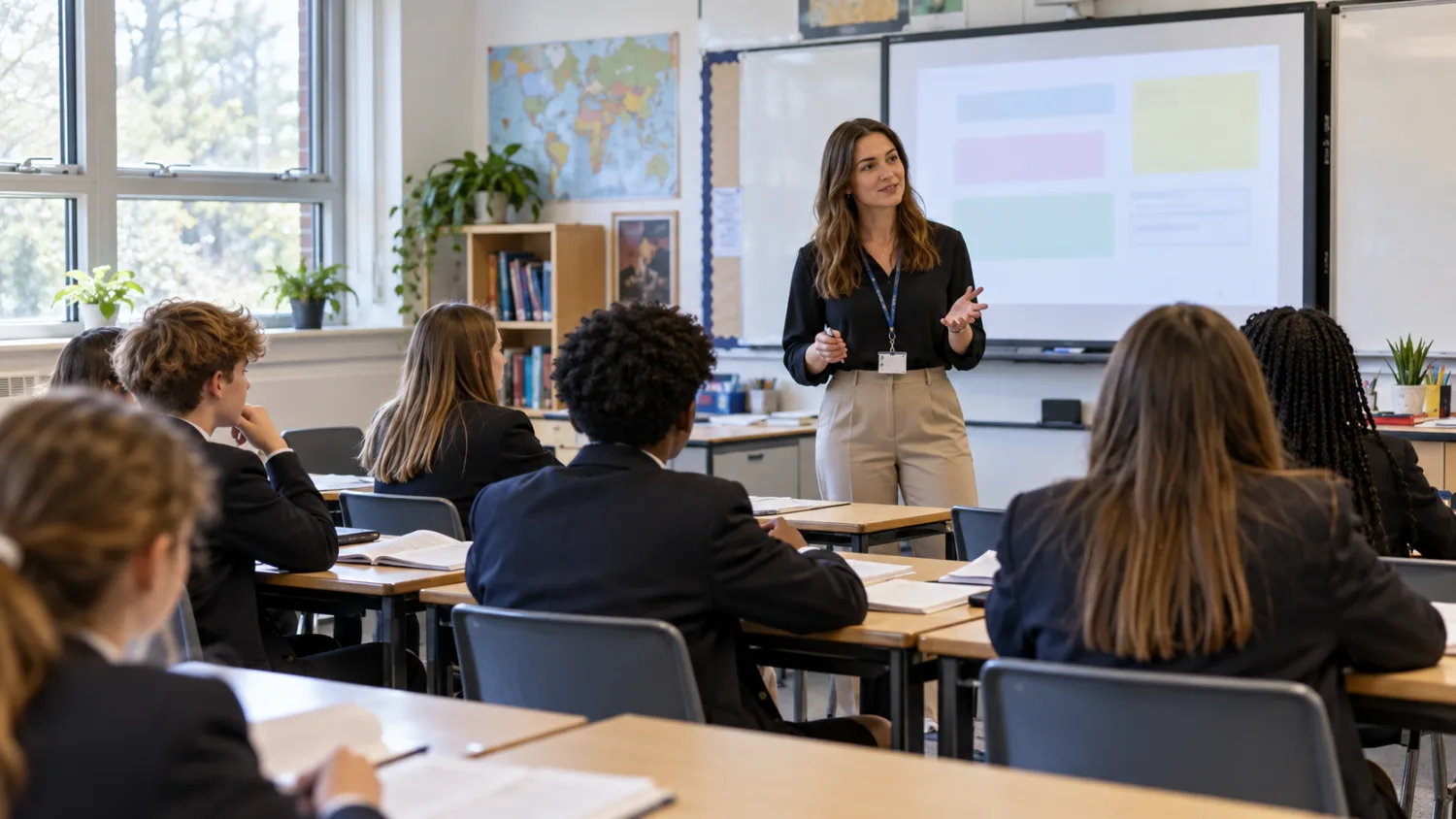
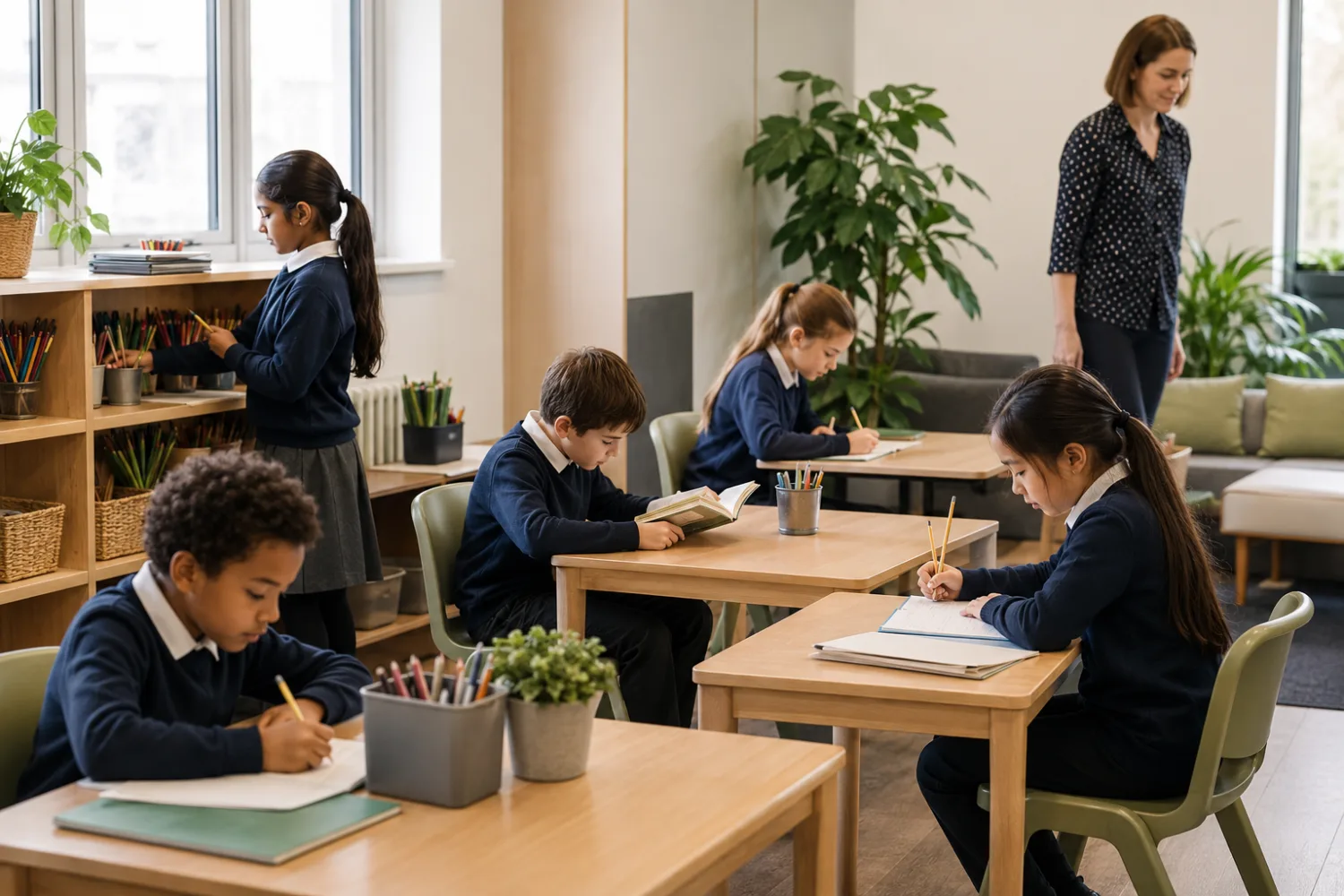
A well-organised classroom cannot guarantee calm behaviour or strong learning, but it can make both much easier. When pupils know where to go, what to do and how to find what they need, fewer small problems interrupt the lesson. Teachers spend less time repeating routine instructions, and pupils have more opportunities to work independently.
This does not require an immaculate room, expensive furniture or perfectly coordinated displays. Some excellent classrooms are small, shared or furnished with whatever the school already owns. What matters is whether the environment helps pupils understand expectations, move safely, access learning and take increasing responsibility for themselves.
The most effective classroom setups are usually practical rather than decorative. Resources have predictable homes. Important information is easy to find. Movement has been considered in advance. Displays support learning instead of competing for attention. The room feels purposeful, but it can also change as the teacher learns more about the class.
Classroom setup should therefore begin with a question: What do pupils need to be able to do here? The answer is more useful than starting with colours, borders or display themes.
Begin with the experience you want pupils to have
Before moving tables or printing labels, imagine an ordinary lesson from a pupil’s point of view.
They enter the room, find their place, organise their equipment, understand the first task, listen to an explanation, collect a resource, work independently, ask for help, move into a pair or group, tidy away and leave. Each stage can either feel obvious or require a new instruction.
A supportive classroom reduces unnecessary uncertainty. Pupils should not need to ask where books belong every day or wait for an adult to hand them every pencil. They should be able to see what they need, understand the routine and begin.
This is especially important at the start of the year. Teachers are still learning about pupils’ strengths, needs and working habits, while pupils are learning the teacher’s expectations. Our guide to what every teacher should know about a new class can help staff identify the pupil information that may affect seating, access, communication and support.
Think about the emotional experience too. A calm classroom is not necessarily silent, and an independent classroom is not one in which pupils are left to struggle. Calm means that activity feels purposeful and manageable. Independence means that pupils are taught how to do more for themselves while still receiving help when it is needed.
The physical room should support these aims rather than work against them.
Plan movement before deciding where everything belongs
Many classroom disruptions begin as movement problems. Pupils crowd around one tray, squeeze behind chairs, cross the room repeatedly or discover that the bin, books and equipment are all in the same congested corner.
Walk through the main routes pupils will use. Consider how they enter and leave, reach their seats, collect resources, submit work, access water or tissues and move during group activities. If possible, leave clear paths rather than filling every available space with furniture.
Pay particular attention to pinch points. A classroom may look spacious when empty but feel very different when 30 pupils stand up at once. Bags, coats and chair legs can quickly narrow a route. Pupils using mobility aids or those who find close physical contact difficult may be particularly affected.
Frequently used resources should be accessible without pupils crossing the teaching area or interrupting another group. Items that require permission or supervision can be stored separately. The aim is not for pupils to wander freely whenever they choose, but for permitted movement to be safe and predictable.
Teachers also need to move easily. Can you reach pupils who need support without climbing around bags and furniture? Can you see the parts of the room where pupils work? Is there somewhere to speak quietly to a pupil without making the conversation a public event?
Try the setup during real lessons and be willing to change it. A layout that appears logical during preparation may create a queue, distraction or blind spot once the class arrives.
Choose seating for learning, not appearance
There is no universally correct seating arrangement. Rows, pairs, grouped tables, horseshoes and flexible layouts can all work, depending on the pupils, subject, room and type of learning.
Rows may support forward attention and independent work but make some forms of collaboration less convenient. Grouped tables make shared activity easier but can increase distraction or leave pupils twisting to see the board. A horseshoe can support discussion but may use space inefficiently in a large class.
Instead of choosing the layout that looks most attractive, consider the teaching pupils will experience most often. Where will their attention usually need to be? How often will they work independently, in pairs or in groups? Can the arrangement change without using ten minutes of the lesson?
Individual seating decisions should also be thoughtful. A pupil’s place may need to reflect:
- their ability to see or hear the teacher and board;
- mobility and safe access;
- sensory needs;
- attention and distraction;
- peer relationships;
- access to adult support;
- and the level of independence the pupil is developing.
Avoid treating the front of the room as the automatic location for every pupil with an additional need. Some pupils benefit from being close to the teacher, while others find a central position overwhelming. A pupil who requires occasional support may prefer a seat that allows an adult to approach discreetly.
Seating plans should be provisional. Observe how pupils respond, speak to them where appropriate and make adjustments based on evidence. Do not preserve an ineffective arrangement merely because names have already been printed.
Reduce visual noise without making the room empty
Classroom displays can celebrate pupils’ work, explain important ideas and make a room feel cared for. They can also become so dense that pupils struggle to find the information they actually need.
More display does not necessarily mean more learning. When every surface is covered with bright colours, patterned borders, dangling objects and small pieces of text, important material may disappear into the background.
Try to give displays a clear purpose. Some may celebrate finished work or build a sense of community. Others may support current learning through vocabulary, worked examples, diagrams or reference material. Pupils should know which displays they are expected to use.
Keep essential information easy to locate. If the visual timetable, safety instructions or key learning prompts are important, they should not be surrounded by unrelated decoration. Use readable fonts, strong contrast and enough space between elements.
Displays do not all need to be completed before pupils arrive. A partially empty board can become a working display that develops alongside a unit. This often makes it more meaningful because pupils see when and why each element is added.
Some pupils are particularly sensitive to busy visual environments, but reducing unnecessary distraction benefits many others too. Our guide to creating a sensory-friendly classroom on a budget includes practical ways to review visual, auditory and physical aspects of the room without buying large amounts of specialist equipment.
Give resources obvious and consistent homes
Independence becomes possible when pupils can find resources, use them correctly and return them without needing individual instructions.
Store frequently used items in stable, clearly understood locations. Labels can help, but they should suit the age and needs of the class. Younger pupils and some pupils with additional needs may benefit from a simple picture alongside a word. Older pupils are unlikely to need every object labelled, but they still benefit from logical organisation.
Place related resources together. If pupils need a ruler, pencil and particular book for the same routine, consider whether collecting them from three different areas is necessary. At the same time, avoid placing everything in one crowded station that becomes difficult to manage.
Books and folders should be distinguishable quickly. Colour can be helpful when it communicates a consistent category, but too many colour systems become confusing. A class should not need to remember that blue refers to mathematics in one place, Year 4 in another and incomplete work somewhere else.
Decide how pupils will manage missing or damaged equipment. A small, predictable borrowing routine is calmer than a public debate every time someone lacks a pencil. It can preserve lesson time without suggesting that looking after equipment does not matter.
Resource organisation also affects staff workload. A complex system requiring the teacher to sort every book and refill every tray is unlikely to last. Give pupils age-appropriate responsibilities and teach the standard expected when resources are returned.
Make routines visible, then teach pupils how to use them
A visual prompt is not a substitute for teaching a routine. Putting instructions on the wall does not mean pupils will automatically notice, understand or follow them.
Choose a small number of routines that will make the greatest difference. These often include entering the room, starting work, gaining attention, asking for help, collecting equipment, moving between activities and ending the lesson.
Explain each routine clearly, model it and let pupils practise. Be specific about what successful behaviour looks like. “Get ready quickly” is less useful than showing pupils where bags go, which equipment should be on the desk and what they should begin.
Prompts can then reduce the need for repeated verbal instructions. A simple sequence on the board might remind pupils to collect a book, write the date and begin the first question. In a primary classroom, a visual timetable may make the day more predictable. In a secondary room, a consistent location for the starter task can allow pupils to begin across different classes without waiting.
Predictability is particularly helpful when routines change. If an assembly, visitor or altered timetable affects the normal day, explain this in advance where possible. A calm classroom is not one in which nothing unexpected happens; it is one in which changes are communicated and managed.
The Education Endowment Foundation’s guidance on improving behaviour in schools emphasises teaching learning behaviours, using classroom-management strategies and creating consistency. The physical setup supports these practices, but it cannot replace clear teaching and positive relationships.
Design help systems that build independence
In some classrooms, independence is interpreted as working without speaking to an adult. In others, pupils become so accustomed to immediate help that they stop attempting problems for themselves. A better system teaches pupils how to recognise what they can try, when to persist and when to ask for support.
Make available supports easy to understand. Depending on the subject and age group, pupils might be able to:
- reread the instruction;
- look at a worked example;
- use a vocabulary or reference display;
- check an agreed resource;
- ask a partner a focused question;
- or signal discreetly that adult help is needed.
This should not become a rigid rule that prevents a struggling pupil from receiving help. “Try three before me” can be useful in some contexts, but it can also delay support when the task or instruction is genuinely inaccessible.
Teach pupils what productive struggle feels like. A task may require thought and perseverance without being impossible. If a pupil has no entry point, repeatedly telling them to be independent is unlikely to help.
Scaffolds should make thinking possible rather than complete the thinking for the pupil. They may include a model, checklist, sentence opening, diagram or partially completed example. As understanding grows, the support should be reduced.
The EEF’s evidence on metacognition and self-regulation highlights the value of explicitly teaching pupils how to plan, monitor and evaluate their learning within normal curriculum content. An independent classroom therefore does not simply provide resources; it teaches pupils how and when to use them.
Create a classroom that includes pupils with different needs
A setup that works for most pupils may still create significant barriers for an individual. Teachers should review existing support information and work with pupils, families, the SENCO and other professionals where appropriate.
Consider how the room affects pupils who have visual or hearing impairments, physical disabilities, attention difficulties, sensory differences, speech and language needs or anxiety. Small environmental details may have a large impact.
For example, a pupil may need an unobstructed view of the teacher’s face, reduced glare on the board, a chair with more physical space around it or access to a quieter working position. Another may need visual instructions retained while the task is completed rather than erased immediately.
Reasonable adjustments should respond to the pupil’s actual disadvantage rather than being applied as a generic package. The Department for Education’s explanation of reasonable adjustments for disabled pupils describes their role in minimising disadvantages experienced in school.
Inclusion is not achieved by creating a separate desk in a corner for every pupil who struggles. Sometimes a lower-distraction position or quiet space is helpful, but it should not automatically isolate the child from teaching and peers.
The EEF’s guidance on special educational needs in mainstream schools begins with creating a positive and supportive environment for all pupils. Strong universal classroom practice provides a foundation, while individual pupils may still require carefully selected adjustments and additional support.
Plan for sound, light, temperature and sensory load
Teachers cannot control every aspect of a school building, but it is worth noticing the sensory conditions pupils experience throughout the day.
Listen to the room when it is occupied. Chair legs, equipment trays, fans, corridor noise and several simultaneous conversations may create far more sound than expected. Some noise is part of active learning, but unnecessary noise can make listening and concentration difficult.
Small changes may help: repairing rattling furniture, adding pads to chair legs where suitable, closing a door during independent work or avoiding several noisy routines at the same time. A class also needs to understand what different working volumes mean. “Quiet” should not depend on every pupil guessing the teacher’s current tolerance.
Review lighting and glare. Pupils should be able to see the board and their work without sitting directly in intense sunlight. Flickering or harsh lighting can be particularly difficult for some pupils. Blinds, seating changes or using only the necessary lights may improve the environment, subject to safety and visibility.
Temperature and ventilation affect attention too. Schools may have limited control over older buildings, but teachers can avoid placing a pupil next to a strong heat source or in a persistent draught where alternatives exist.
A calm corner or quieter workstation can be valuable when it has a clear purpose and does not become a place of punishment. It should not be assumed that every pupil will find the same sensory tools helpful. Items such as fidgets, ear defenders or movement cushions need thoughtful introduction, individual consideration and review.
Keep teacher storage and administration under control
A classroom should work for the adult as well as the pupils. If the teacher cannot find assessment notes, spare resources or frequently used documents, the resulting pauses and frustration affect the whole room.
Keep only what is regularly needed close at hand. Archive or remove outdated paperwork, duplicate resources and items kept “just in case” when they make useful materials harder to locate. Follow school policies for storing confidential information securely rather than leaving pupil records visible or accessible.
Create straightforward systems for work that needs marking, unfinished tasks, absent pupils and resources for later lessons. These do not need to be elaborate. A small number of dependable trays or folders is usually more effective than a detailed system nobody can maintain.
Think carefully before introducing an organisation system that depends on substantial daily preparation. If each lesson requires resources to be placed into individual decorative packs, ask whether the educational benefit justifies the time.
The room should also support smooth lesson preparation. Materials for the next class can be ready without obstructing current pupils. Essential teaching equipment should be easy to reach, while private belongings and potentially unsafe items remain secure.
Good organisation is not about making the classroom look unused. It is about reducing avoidable decisions, searches and interruptions so that attention can remain on pupils and learning.
Review the room once real pupils are using it
No classroom should be considered finished on the first day of term. The class will reveal problems that were invisible during preparation.
For the first two weeks, notice where queues form, which instructions pupils repeatedly miss and which resources generate the most questions. Observe whether some pupils are distracted by a display, unable to see a model or reluctant to access equipment because of where it is stored.
Ask pupils focused questions. “Do you like the classroom?” may produce little useful information. Better questions include:
- Can you see the board clearly from your seat?
- Do you know where to find the resources you are allowed to use?
- Which part of entering or leaving the room feels confusing?
- Is there anywhere you find it especially difficult to concentrate?
- What helps you begin work without waiting?
Pupil feedback should inform professional judgement rather than turn the setup into a popularity vote. Children may request arrangements that feel enjoyable but do not support learning. Even so, they can identify obstacles an adult has overlooked.
Use evidence from early teaching as well. The process of beginning-of-year baseline assessment can reveal more than academic starting points. It may show who can follow multi-step instructions, who relies heavily on adult reassurance and which pupils need a different way to access information.
Make changes deliberately and explain them. If equipment is moved because the old location caused congestion, tell pupils why and reteach the routine. Constant unexplained rearrangement can undermine the predictability you are trying to build.
A practical final check before pupils arrive
Stand at the doorway and look at the classroom as a pupil entering for the first time. Is it obvious where they should go and what they should do? Can they reach their place safely? Is the first instruction easy to locate?
Sit in several pupil seats. Check the view of the board, visualiser and important displays. Notice glare, obstacles and whether pupils need to turn awkwardly during explanations.
Then imagine the busiest moments of the day. What happens when everyone collects a book, packs away or leaves? Where will unfinished work go? How does a pupil ask for help without calling across the room? What does a child do if they arrive without equipment?
Finally, remove anything that does not serve a clear purpose. A calmer room often comes from taking something away rather than adding another label, poster or storage container.
Classroom setup is only one part of preparing for the year. Teachers can use the practical September checklist for teachers to connect the physical environment with routines, relationships, safeguarding, assessment and communication.
Frequently asked questions
What is the best classroom seating arrangement?
There is no single best arrangement. The layout should reflect the room, pupils, subject and balance of whole-class instruction, independent work and collaboration. The most important considerations are visibility, safe movement, access to support and the ability to maintain attention. Review the arrangement once pupils begin using it.
Should classroom walls be left completely bare?
No. Displays can celebrate work, build belonging and support current learning. The aim is not to remove everything, but to reduce unnecessary visual competition. Important information should be easy to find, readable and clearly separated from decoration.
How can a small classroom feel calmer?
Prioritise clear movement routes and remove furniture or resources that are rarely used. Store items vertically where safe, keep frequently used materials accessible and avoid creating several collection points in one corner. Consistent routines can make a small room feel more manageable even when additional space is unavailable.
Should pupils be allowed to choose their own seats?
Choice can sometimes support responsibility, but it should not prevent other pupils from learning or accessing the room. Teachers may offer limited choices, trial arrangements or allow flexibility for particular activities. The final decision should account for learning, relationships, additional needs and safe movement.
Does every classroom need a calm corner?
Not necessarily. A quieter space can help some pupils regulate or concentrate, but it needs a clear purpose, appropriate supervision and agreed expectations. It should not become an informal exclusion area or a generic solution for every difficulty. Some classrooms may support regulation through flexible seating or access to another agreed space instead.
How often should the classroom layout be changed?
Change it when there is evidence that the current arrangement is creating a problem or when a different type of learning genuinely requires it. Frequent changes can be unsettling and consume lesson time. Minor adjustments are often more effective than repeatedly redesigning the whole room.
How can classroom setup encourage independence?
Give resources predictable homes, make routine instructions easy to locate and teach pupils what they can try before asking for help. Provide useful scaffolds and gradually reduce them as pupils become more secure. Independence grows through clear teaching and practice, not simply through expecting pupils to manage alone.
A calm and independent classroom is built through hundreds of small, thoughtful decisions. The best setup does not draw attention to itself. It allows pupils to enter, understand, participate and learn with fewer unnecessary barriers.
Start with the room you have, focus on the routines that matter most and adjust the environment as you come to know the pupils who use it. A classroom does not need to be perfect on the first day. It needs to be clear, welcoming and ready to improve.