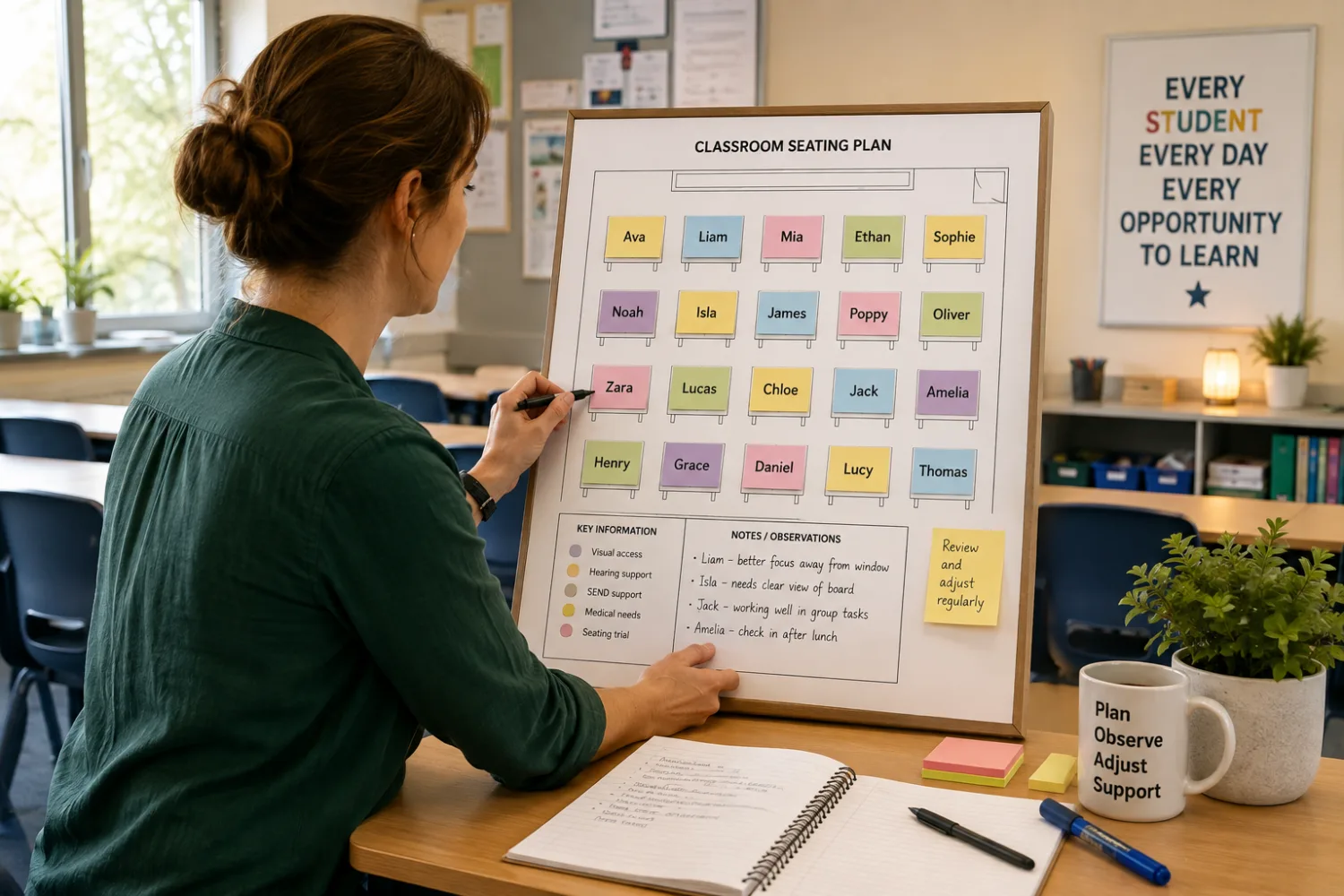
A seating plan can be useful before you know a class well.
It helps you learn names, makes it easier to place pupils with particular access needs and gives the room some structure from the first lesson.
The problem begins when the first seating plan quietly becomes permanent.
A pupil is placed at the front because somebody said they are easily distracted. Two pupils are separated because they argued last year. A child sits beside a teaching assistant because that is where they have always sat. A confident pupil becomes the permanent “helper” next to someone who struggles.
By October, the seating plan may look organised while no longer reflecting what you have actually learned about the class.
The strongest seating plans are not attempts to predict every pupil perfectly before the year begins. They are working hypotheses.
You begin with the best information available, observe what happens and change the plan when there is a clear reason.
This guide explains how to create a seating plan that supports learning, behaviour, inclusion and classroom relationships without turning pupils into fixed categories.
Start with the needs that are not optional
Before thinking about friendship groups or classroom behaviour, identify the pupils whose seating position is affected by safety, access or an essential adjustment.
These needs should shape the first version of the plan.
Check visual and hearing access
Some pupils may need:
- a clear view of the board;
- to sit close enough to hear the teacher clearly;
- to see the teacher’s face for lip reading or communication;
- to avoid glare from windows or lighting;
- to use specialist hearing or visual equipment;
- a particular position recommended in an individual plan.
Do not assume that “front row” is automatically the best place. A pupil with a hearing need may require a particular angle, while a pupil using assistive technology may need appropriate space or access to a power source.
Consider physical access
A pupil may require:
- wheelchair access;
- additional space around the chair;
- a route that avoids narrow passages;
- easy access to the door;
- specialist furniture;
- space for mobility equipment;
- reduced movement through crowded areas.
Check that the layout works when every pupil is actually in the room, bags are under tables and adults are moving between desks.
A route that looks wide enough in an empty classroom may become difficult once the lesson begins.
Respect safeguarding arrangements
There may be circumstances in which particular pupils should not sit together or where a pupil requires a position that supports an agreed safeguarding plan.
These arrangements should come through appropriate school procedures, not staff-room rumour.
Teachers do not necessarily need the full background. They do need enough information to apply the arrangement correctly.
The AllSchools guide to what every teacher should know about their new class explains how to use essential pupil information without allowing previous records to become permanent labels.
Use previous information carefully
Transition information can save teachers from repeating avoidable mistakes.
It can tell you that a pupil struggles to hear from one side, that two pupils significantly dysregulate one another or that a particular seating arrangement previously helped a child work more independently.
But previous information should inform the plan rather than dictate it forever.
Ask why a seating arrangement existed
If you receive last year’s seating plan, do not simply copy it.
Ask:
- Why was this pupil seated here?
- Was the arrangement still working by the end of the year?
- Was it based on an access need or convenience?
- Was the issue temporary?
- Has anything changed?
A pupil may have sat at the front because they were anxious at the beginning of Year 7, not because they still require that position.
Two pupils may have been separated after a short-term conflict that no longer exists.
Be cautious with reputation-based advice
Comments such as:
- “Keep him away from everyone”;
- “She needs to be right at the front”;
- “Those two are trouble together”;
- “Put him next to a sensible child”;
may contain useful experience, but they need unpacking.
Ask what actually happened.
Did the pupil talk continuously? Become distracted? Leave their seat? Feel anxious? Copy a particular peer? Stop working when the task became difficult?
The more specific the information, the more useful your seating decision can be.
Do not inherit another teacher’s frustration
A seating plan should not become a map of who previous staff found difficult.
Pupils deserve an opportunity to establish a different relationship with a new teacher.
That does not mean ignoring genuine risks or well-established patterns. It means separating practical information from emotional judgement.
Think about the purpose of your classroom layout
Before placing individual pupils, look at the room itself.
A seating plan works within a physical layout, and the layout should reflect what pupils need to do most often.
Ask how pupils normally learn in the room
Do lessons usually involve:
- whole-class explanation;
- independent written work;
- paired discussion;
- group practical work;
- regular movement;
- access to specialist equipment;
- teacher modelling at the board?
A layout that is excellent for group discussion may make sustained independent work harder. Rows can improve visibility and movement in some rooms but make collaborative tasks less natural.
There is no universally correct classroom arrangement.
Protect sight lines
Sit in several pupil positions and check:
- Can the board be seen?
- Are displays or equipment blocking the view?
- Can pupils see demonstrations?
- Can the teacher see pupils clearly?
- Are there hidden areas where low-level disruption is difficult to notice?
This is particularly important in irregular rooms and science, technology or art spaces where benches and equipment affect visibility.
Make movement possible
The teacher should be able to reach pupils without repeatedly squeezing behind chairs.
Pupils should be able to:
- enter and leave safely;
- access resources;
- move to practical areas;
- leave in an emergency;
- receive support without disrupting several classmates.
A tightly packed classroom can make an otherwise sensible seating plan difficult to manage.
Do not use “good pupil next to difficult pupil” as your main strategy
One of the oldest seating-plan habits is to place a pupil who struggles beside a calm, conscientious classmate.
Sometimes this works.
Sometimes it simply gives one child an unofficial support role they did not choose.
Ask what responsibility you are placing on the peer
A pupil should not repeatedly be expected to:
- keep another child on task;
- provide missing equipment;
- explain every instruction;
- calm behaviour;
- complete paired work for both pupils;
- act as a substitute teaching assistant.
Peer support can be valuable when it is mutual and appropriate.
It becomes unfair when one pupil’s learning is consistently used as a behaviour-management resource for somebody else.
Consider whether the pairing supports both pupils
Ask:
- Can both pupils concentrate?
- Do both contribute?
- Is one pupil doing most of the thinking?
- Does the pairing create dependence?
- Would both pupils benefit from working with different classmates?
A seating plan should support the whole class, not solve one pupil’s difficulty by transferring responsibility to another.
Rotate responsibility where appropriate
If pupils regularly support one another during practical or collaborative tasks, avoid allowing the same children to become permanent helpers.
Different pairings can expose pupils to different explanations, approaches and working styles.
Use seating to support attention without treating attention as a moral quality
Some pupils are more easily distracted than others.
Seating can help, but “put them at the front” is not always enough.
Identify the actual source of distraction
A pupil may be distracted by:
- friends;
- corridor movement;
- a window;
- equipment;
- noise;
- frequent teacher movement;
- the need to turn around to see the board;
- other pupils moving past them.
The best position depends on the distraction.
A pupil distracted by everything happening behind them may prefer the back or side of the room rather than the front.
Think about attention as an interaction between pupil and environment
Seating is only one factor.
A pupil may still struggle if:
- instructions are too long;
- the work is inaccessible;
- transitions are unclear;
- they do not know how to begin;
- the task is insufficiently challenging;
- the classroom is excessively noisy.
Do not expect a seating change to solve a teaching or task-design problem.
The AllSchools guide to improving focus in the classroom explores the wider factors that affect pupil attention.
Avoid making the front row a punishment area
If pupils believe that sitting near the teacher means they are in trouble, moving a child closer can become socially embarrassing.
Use the whole room flexibly enough that different pupils occupy different positions over time.
Build SEND adjustments into the plan without isolating pupils
Seating can make a significant difference to pupils with SEND, but well-intentioned arrangements can also create unnecessary separation.
Keep pupils connected to whole-class teaching
A pupil receiving adult support should still be able to:
- see the teacher;
- hear explanations;
- participate in questions;
- work with peers;
- join ordinary classroom routines.
A child should not automatically sit at a separate table because they have SEND.
Think carefully about teaching-assistant positioning
Placing a teaching assistant permanently beside one pupil can sometimes:
- reduce direct interaction with the teacher;
- make peers less likely to interact;
- create dependence;
- cause adults to intervene too quickly;
- make support highly visible.
There will be situations where close adult support is necessary, but it should be purposeful rather than automatic.
The Education Endowment Foundation's guidance on the deployment of teaching assistants emphasises supplementing rather than replacing teacher interaction and promoting pupil independence.
Consider sensory needs
A pupil may benefit from avoiding:
- a humming projector;
- bright direct light;
- a noisy corridor;
- a busy doorway;
- strong smells from practical areas;
- constant movement behind them.
Speak with the pupil, SENCO and relevant support staff where appropriate.
The AllSchools guide to creating a sensory-friendly classroom on a budget includes practical environmental adjustments that can complement seating changes.
Use the first two weeks to gather evidence
The first seating plan should not be designed to survive the year.
Its job is to create a workable starting point while you learn.
Watch what happens during explanation
Notice:
- who struggles to see;
- who turns repeatedly;
- who begins side conversations;
- who appears lost;
- who is hidden from your view;
- who needs frequent clarification.
Watch independent work
Ask:
- Who starts promptly?
- Who copies rather than thinks independently?
- Who becomes distracted by a neighbour?
- Who supports others constructively?
- Who needs more teacher access?
- Who avoids requesting help?
Watch discussion
A pairing that looks ideal during silent work may not function well during discussion.
Notice:
- who dominates;
- who is ignored;
- who becomes silly immediately;
- who explains ideas well;
- who agrees without thinking;
- who becomes more confident with a particular peer.
Look across several lessons
Do not move a pupil because they whispered once.
Look for patterns.
A pupil may be unusually unsettled on the first day because they are anxious. Two friends may initially talk excessively and then settle as routines become established.
The AllSchools first two weeks back at school checklist provides a wider framework for using the opening fortnight as a period of observation and adjustment.
Change seats for a reason, not out of frustration
Seating changes are useful when they solve a recognisable problem.
They are less useful when they become an emotional response to a difficult lesson.
Define the problem first
Instead of:
“These two are driving me mad.”
try:
“These pupils begin talking during every independent task and complete substantially less work when seated together.”
The second statement makes the reason for changing seats clear.
Make the smallest useful change
You may not need to redraw the entire room.
Try:
- moving one pupil;
- swapping a pair;
- changing the orientation of a table;
- moving a pupil away from a distraction;
- creating easier teacher access;
- adjusting one support arrangement.
Small changes make it easier to judge whether the intervention helped.
Explain changes neutrally
A seat move does not need a public speech.
You might say:
“I'm changing a few places because I've learned more about how everyone works. Your new seat is here.”
This frames seating as an ordinary part of classroom organisation rather than humiliation.
Do not threaten seating changes you do not mean
Repeatedly saying “I'll move you” without acting can weaken the classroom routine.
If the problem requires correction, address the behaviour directly. Move the pupil when the move itself serves a useful purpose.
Let pupils have a voice without handing over the plan
Pupils often know something useful about where they work best.
That does not mean they should simply choose where they sit.
Ask specific questions
Rather than:
“Where do you want to sit?”
ask:
- Can you see the board clearly?
- Can you hear well from here?
- Is there anything in this area that makes concentration difficult?
- Do you have enough space for your equipment?
- Does this seat work with your agreed support?
These questions produce information rather than a list of friendship preferences.
Listen particularly where access is involved
A pupil may notice a problem adults have missed.
They might explain that:
- sunlight reflects off the board;
- a hearing aid picks up noise from a fan;
- the route to the door is too crowded;
- sitting beside the wall makes them feel trapped;
- a particular area creates sensory overload.
Take this information seriously and investigate.
Do not promise every requested move
Pupils may understandably prefer to sit with friends.
Explain that seating decisions consider everyone’s learning and access, not just preference.
Being willing to listen does not mean giving pupils complete control.
Review social dynamics, not just behaviour
A classroom can be quiet while some pupils are socially uncomfortable or isolated.
Seating plans affect relationships as well as compliance.
Notice isolation
Ask whether any pupil:
- rarely has a partner;
- is ignored during discussion;
- is always positioned on the edge of a group;
- has been separated from all familiar peers;
- appears uncomfortable with the pupils around them.
This does not mean every child needs to sit with their best friend. It means social inclusion deserves consideration.
Watch for quiet peer pressure
Not all unhelpful pairings produce obvious disruption.
One pupil may:
- copy another's answers;
- wait for the other pupil to begin;
- agree with everything they say;
- allow the other pupil to dominate practical tasks;
- avoid contributing because they feel less confident.
Changing the pairing may reveal abilities that were previously hidden.
Do not use seating to engineer friendships
Teachers can create opportunities for pupils to work with different classmates, but friendship cannot be forced through furniture.
If there is a wider friendship or bullying concern, address it through appropriate pastoral and safeguarding processes rather than simply seating pupils beside one another.
Keep a record of why important changes were made
Most seating changes do not need extensive documentation.
But where arrangements relate to SEND, safeguarding, medical needs or a persistent learning issue, it can be useful to record the reason.
Use short, practical notes
For example:
“Moved away from doorway because corridor movement repeatedly interrupted independent work. Concentration improved in the following three lessons.”
Or:
“Seat changed following SENCO advice to give clearer visual access to teacher and board.”
This is more useful than simply recording:
“Moved seats.”
Share relevant information with colleagues
In secondary schools, a pupil may have a different seating experience in every lesson.
If you discover something important—particularly an access issue—make sure it reaches colleagues through the appropriate system.
A pupil should not need to repeatedly explain that they cannot see the board from a particular position.
Review whether the change worked
A seating change is an intervention.
Ask:
- Did attention improve?
- Did work completion improve?
- Did the pupil become more independent?
- Did the new pairing work?
- Did the change create a different problem?
If it did not help, change again.
Frequently asked questions
Should teachers use seating plans from the first lesson?
They can be very useful, particularly for learning names, meeting access needs and creating an orderly start. The first plan should be treated as provisional and reviewed once the teacher has observed the class.
How often should a seating plan change?
There is no ideal timetable. Change it when you have evidence that a different arrangement is likely to improve access, learning, behaviour or classroom relationships. Constant unnecessary changes can be disruptive, while never changing anything can preserve arrangements that no longer work.
Should friends be allowed to sit together?
Sometimes. Friendship is not automatically a reason to separate pupils. If friends work productively together, there may be no problem. Change the arrangement when the pairing consistently interferes with learning or creates another issue.
Should disruptive pupils always sit at the front?
No. The best position depends on what contributes to the behaviour. A pupil may be distracted by peers, movement, noise or difficulty accessing the work. Front-row seating is one possible adjustment, not a universal solution.
Should pupils with SEND sit next to the teaching assistant?
Not automatically. Some pupils require close adult support, but permanent proximity can sometimes reduce independence and interaction with the teacher or peers. Support should reflect the pupil's actual needs and agreed provision.
Is it fair to move a pupil because another pupil distracts them?
It can be, but consider the effect on both pupils and explain changes neutrally. Seating decisions should aim to improve learning rather than assign blame publicly.
Should high-attaining pupils be seated next to pupils who struggle?
Not as a default strategy. Mixed pairings can be valuable, but higher-attaining pupils should not become unpaid teaching assistants. Both pupils should benefit from the arrangement.
Can pupils ask to move seats?
Yes, and teachers should listen to the reason. A request may reveal a genuine visibility, sensory, social or safeguarding issue. The teacher still decides whether and how to change the plan.
What should teachers do if the whole class wants to choose their seats?
Explain that seating is part of classroom organisation and is based on learning, access and safety. There may be occasions when free choice is appropriate, but it does not need to be the normal arrangement.
Should seating plans be based on attainment groups?
Fixed attainment-based seating can reinforce assumptions and may not reflect the different strengths pupils show across tasks. If grouping is used for a particular learning purpose, keep it flexible and review it regularly.
What if a seating change makes things worse?
Change it again. Seating plans should be responsive. Record what you learned and use that information to make the next decision rather than treating the first change as something that must succeed.
What is the most important principle when making a seating plan?
Start with safety and access, then observe how pupils actually learn. Treat the plan as something you can improve as your knowledge of the class becomes more accurate.
A seating plan is not a map of who pupils are.
It is a practical tool for organising a classroom.
The best plans begin with good information, protect essential needs and remain open to change. Teachers should expect to discover that some assumptions were correct, some were incomplete and some were simply wrong.
That is not evidence of poor planning.
It is what happens when a teacher stops trying to predict a class from a spreadsheet and starts learning from the pupils actually sitting in front of them.