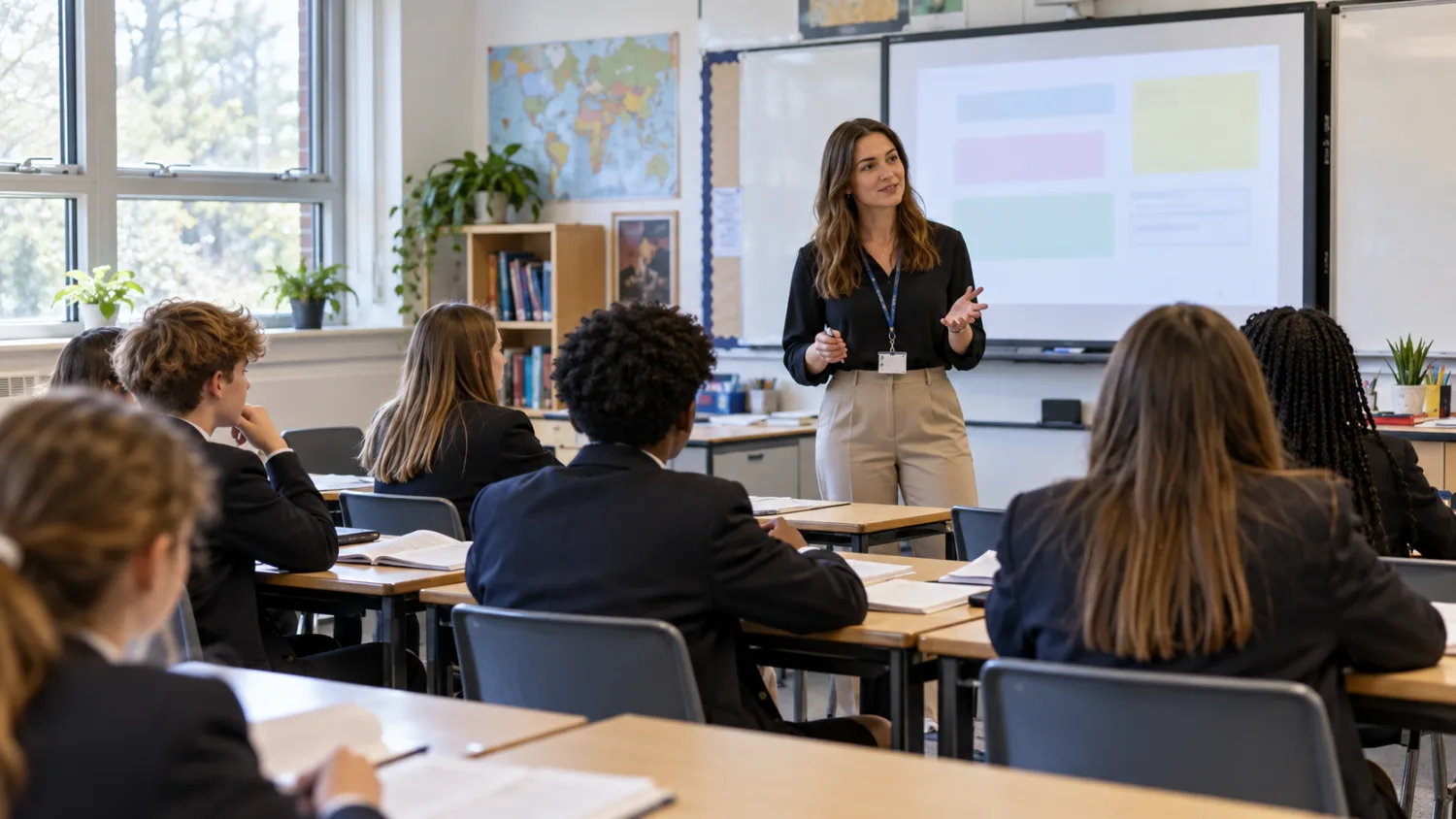
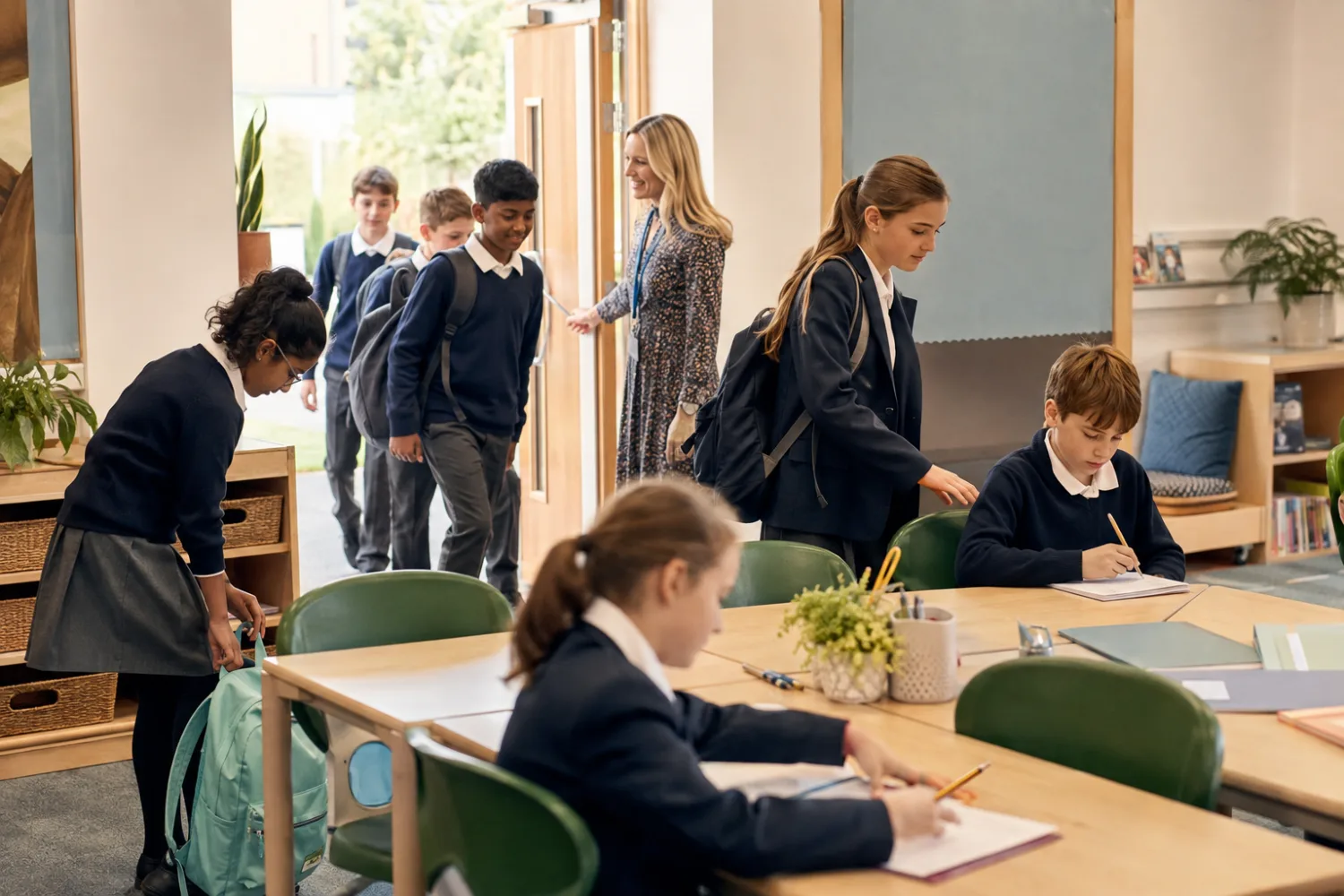
The first week with a new class often feels as though there is too much to fit in. Teachers want to learn names, introduce the subject, establish relationships, assess starting points and begin meaningful curriculum work. Classroom routines can seem like one more item competing for limited time.
In reality, routines are what make much of that other work possible.
When pupils know how to enter, begin, listen, collect resources, ask for help and finish a lesson, fewer minutes are lost to repeated instructions. The classroom becomes more predictable, which can reduce anxiety as well as low-level disruption. Teachers can concentrate on teaching, and pupils can direct more attention towards learning.
Effective routines do not appear because expectations have been displayed or explained once. They need to be taught, modelled, practised and revisited. The first week is not about creating a perfectly silent or rigid classroom. It is about making the ordinary parts of learning clear enough that pupils can manage them successfully.
Start with the routines that protect the most learning
It is tempting to create a procedure for every possible classroom event. This can leave teachers trying to remember a detailed system while pupils receive so many instructions that none of them becomes secure.
Begin with the moments that happen every day and have the greatest effect on learning. In most classrooms, these include:
- entering the room;
- getting ready and beginning work;
- gaining and giving attention;
- responding to questions and participating;
- moving between activities;
- collecting and returning resources;
- asking for help;
- and ending the lesson or school day.
A primary teacher may also need routines for the carpet, lining up, choosing books, accessing the toilet and changing between continuous provision or group activities. A secondary teacher may prioritise corridor entry, equipment, late arrival, practical work and dismissal.
Choose routines because they solve predictable problems, not because another teacher uses them. If pupils rarely collect equipment independently, an elaborate resource routine may not deserve first-week attention. If every lesson begins with books and a short task, the entry routine is likely to repay the time spent teaching it.
Keep each routine as simple as possible. The more steps it contains, the harder it will be for pupils to remember and staff to maintain. If the routine cannot be explained clearly in a few sentences, consider whether some steps can be removed.
Explain the purpose, then show exactly what to do
Pupils are more likely to understand a routine when they know why it exists. The explanation does not need to become a long speech.
You might say:
“We begin with the task on the board so everyone can settle, remember what we learned before and be ready to discuss it together.”
This is more meaningful than simply saying, “You must start immediately.” It connects the routine to learning rather than presenting it as a test of obedience.
After explaining the purpose, make the expected actions concrete. Phrases such as “enter sensibly”, “be ready to learn” or “tidy up properly” can mean different things to different pupils.
Show what the routine looks like:
- Enter calmly and go directly to your assigned place.
- Put your bag where it does not block the walkway.
- Place the required equipment on the desk.
- Read the task displayed in the usual location.
- Begin without waiting for another instruction.
Age matters, but older pupils also benefit from precise teaching. A Year 9 class may not need a theatrical demonstration of placing a pen on the desk, but they do need to know how your lesson begins and how it fits the school’s wider expectations.
The Department for Education’s support materials for early career teachers emphasise that a predictable and secure environment benefits all pupils, particularly those with special educational needs. The materials also stress teaching and maintaining clear expectations for participation, concentration and working volume.
Practise routines when the class is calm
A routine is difficult to teach for the first time during the moment when it is already going wrong.
If pupils have never practised moving from tables to the carpet, waiting until the transition becomes noisy and congested makes the learning harder. If a class does not know your attention signal, repeating it more loudly during an active group task is unlikely to create instant understanding.
Introduce and rehearse routines in relatively calm conditions. Explain the steps, model them and let pupils try. Give brief feedback, then repeat if necessary.
This can feel artificial, particularly with older pupils, but it does not need to be childish. A secondary teacher might say:
“In practical lessons, everyone will sometimes need to stop quickly to hear a safety instruction. When I use this signal, finish the immediate safe action, put equipment down and face this way. Let’s check that everyone understands what that will look like.”
Practising is not lost curriculum time. A transition that takes four minutes every lesson can consume hours across the year. Teaching it well at the beginning protects future learning.
Keep repetition proportionate. Once pupils can complete a routine successfully, use it in real lessons rather than continuing to practise for its own sake. Rehearse again if standards slip or circumstances change.
A strong first lesson with a new class should therefore contain worthwhile subject learning as well as a small number of deliberately taught routines. Pupils need to experience the classroom as a place where routines support learning, not replace it.
Make the entry routine calm and achievable
The beginning of a lesson sets the conditions for what follows. An unclear entry can leave pupils waiting, talking over instructions or discovering that they do not have the correct equipment only after teaching has begun.
Decide what happens before pupils arrive. Will you greet them at the door? Where should they wait? Are seats assigned? Is the first task visible? What should pupils do if they are late or do not have equipment?
Greeting pupils can help teachers notice mood, build relationships and communicate that the classroom is ready. It also provides an opportunity to give a quiet reminder before a problem enters the room.
The Education Endowment Foundation’s guidance on improving behaviour in schools identifies simple approaches such as greeting pupils positively and developing consistent classroom-management practices as part of a wider strategy.
The first task should be accessible enough for pupils to begin without individual explanation, but purposeful enough to deserve their attention. It might retrieve previous knowledge, introduce an interesting question, ask pupils to notice patterns or prepare material needed later in the lesson.
Avoid making the starter so complicated that pupils need help before they can participate. The entry routine should reduce dependence on the teacher at the busiest moment.
Plan for ordinary problems. A pupil who lacks a pen should know how to borrow one without starting a public negotiation. A late pupil should be able to enter and orient themselves without the teacher restarting the lesson, unless a private check-in is needed.
In primary settings, the beginning of the day may include registers, belongings, messages and emotional transitions from home. A clear arrival activity can help pupils settle while the teacher addresses individual needs.
Teach pupils how attention works in your classroom
Teachers need a reliable way to bring the class together after discussion, practical work or independent activity. Without one, instructions begin while some pupils are still talking, moving or handling equipment.
Choose an attention signal that fits the age group, room and school policy. It might be a short verbal phrase, a countdown, a hand signal or another familiar cue. Avoid using several competing signals.
Teach what pupils should do when they notice it. “Be quiet” may not be sufficient. Do they finish a sentence, stop immediately, put equipment down, face the teacher or remain in position?
In practical subjects, safety may require a specific response. Pupils using tools, heat or substances may need to make an item safe before turning their attention away. The procedure should be taught with the activity, not assumed.
Give enough time for the agreed response before speaking. If the teacher always begins while several pupils are still finishing conversations, the class learns that the signal is optional and the first part of every instruction can be missed.
At the same time, avoid turning every slight delay into a confrontation. Identify pupils who have not responded, use the school’s behaviour approach and reteach the routine where necessary. The goal is dependable attention, not an escalating performance between teacher and class.
Teachers should also signal when pupils are free to resume. Otherwise, some will restart while others continue listening, creating another unclear transition.
Plan transitions instead of treating them as gaps between learning
Transitions are often where calm classrooms become unsettled. Pupils finish at different times, resources move, seats change and attention briefly loses a clear focus.
Before giving a transition instruction, decide what pupils need to know:
- what they are stopping;
- what they are doing next;
- which resources they need;
- whether they should move;
- how much time they have;
- and what they should do once ready.
Give the whole instruction before releasing the class. If pupils begin moving after hearing only “put your books away”, they may not hear where to go or what to collect next.
Reduce unnecessary movement. If every pupil must visit the same tray, the routine creates its own congestion. Resources might be distributed by table, collected by designated pupils or placed where several groups can access them safely.
For younger pupils, a brief countdown or visual sequence may help. Older pupils may need only concise instructions and a clearly established time expectation.
Teach transitions in the actual layout pupils will use. A routine that sounds straightforward may fail because chairs block the route or two groups need the same space. Our guide to setting up a classroom for calm, independence and learning explains how furniture, movement routes and resource storage can make routines easier to follow.
When a transition repeatedly goes wrong, investigate its design before assuming pupils simply need a stronger warning. Too many steps, unclear destinations or poor resource placement may be creating the problem.
Create predictable ways to participate and ask for help
Classroom routines should support learning, not only movement and silence. Pupils need to understand how they contribute, ask questions and seek assistance.
Explain how discussion works in different parts of the lesson. Sometimes pupils may raise a hand. Sometimes you may invite responses without hands. At other points, they may discuss with a partner before anyone answers publicly.
If participation methods change without explanation, confident pupils may dominate while others remain unsure whether they are allowed to speak.
Teach routines for partner talk. Pupils need to know who begins, how long they have, whether both people should contribute and what they may be asked to share afterwards. Simply saying “discuss” can produce rich conversation in one pair and silence or unrelated talk in another.
Help-seeking also needs clarity. Some pupils call the teacher immediately; others remain stuck because they fear drawing attention to themselves.
A workable routine might encourage pupils to:
- reread the instruction;
- check the example or agreed classroom resource;
- identify the exact point of difficulty;
- and then use the class signal for help.
This should not become a barrier that forces pupils to struggle unnecessarily. A child who cannot read the instruction, has misunderstood the task or is becoming distressed may need support sooner.
The long-term aim is to teach pupils how to recognise what they know, what they can try and when assistance is necessary. The EEF’s evidence on metacognition and self-regulation highlights explicit teaching, teacher modelling and opportunities for pupils to plan, monitor and evaluate their learning.
Build inclusion into the routine from the beginning
A routine may appear simple to most pupils while creating a substantial barrier for another.
A child with a hearing impairment may not notice a spoken attention signal. A pupil with mobility needs may require more time or a clear route during transitions. An autistic pupil may need advance warning before the activity changes. A pupil with speech and language needs may struggle to process a sequence delivered only verbally.
Review available pupil information before finalising classroom procedures. Consider whether the routine depends on hearing, vision, speed, reading, memory, physical movement or tolerance of a crowded space.
Useful adjustments may include:
- a visual cue alongside a spoken signal;
- instructions given in shorter stages;
- a written or pictorial sequence retained while pupils work;
- additional processing or movement time;
- an agreed position in a line or transition;
- a discreet method of requesting help;
- or preparation before an unexpected change.
An adjustment does not mean abandoning the shared expectation. It means enabling the pupil to participate as fully as possible.
A predictable classroom benefits many pupils, but predictability should not become inflexibility. There will be days when a fire drill, assembly, visitor or individual need changes the normal pattern. Explain changes clearly and return to the familiar routine afterwards.
The government’s behaviour-culture resources identify relationships, pupil support, transition and staff development alongside school systems and social norms. Routines work best when they sit inside that wider culture rather than being treated as a stand-alone compliance technique.
Respond consistently when pupils do not follow the routine
During the first week, pupils may not follow a routine for several reasons. They may have forgotten, misunderstood, failed to notice the cue, copied someone else or chosen not to comply.
The response should reflect what actually happened.
If the class is uncertain, clarify and practise again. If one pupil missed an instruction, provide a brief prompt. If a pupil deliberately ignores a well-understood expectation, respond through the school’s behaviour policy.
A calm correction is usually more useful than a long public lecture:
“The routine is to place the book in the tray and return directly to your seat. Please do that now.”
Be specific about the behaviour that needs to change. “Make a better choice” or “show more respect” may express disapproval without telling the pupil what successful action looks like.
Notice pupils following routines correctly, particularly while they are new. Recognition can be simple and precise:
“Everyone has the correct equipment out and has started without waiting. That gives us more time for the practical work.”
This connects the behaviour to its benefit. Praise should remain credible; pupils do not need excessive celebration every time they complete an ordinary expectation.
Consistency matters more than intensity. If a routine is enforced strictly on Monday but ignored by Wednesday, pupils learn that the real expectation depends on the teacher’s mood or energy.
Teachers should follow the school’s agreed rewards, sanctions and escalation procedures. Classroom routines should complement the whole-school approach, not create a competing behaviour system.
Use the first week as a gradual rollout
Not every routine needs to be taught on the first day. Introduce them when pupils are about to use them.
A manageable first-week sequence could look like this:
Day one: teach entry, the first task, attention and dismissal. These routines frame the lesson and will be used immediately.
Day two: revisit the first routines and introduce how pupils participate, ask for help and manage basic equipment.
Day three: teach a more complex transition, such as moving into group work, practical activity or carpet time.
Day four: strengthen independent-work routines, including what pupils do when they finish or become stuck.
Day five: review what is becoming secure, correct inconsistencies and identify one routine that needs further teaching the following week.
This is not a rigid timetable. A primary class may use nearly every procedure on the first day, while a secondary teacher may see each class only once or twice during the week.
The important principle is to introduce routines through real classroom use. Do not spend a full lesson describing procedures pupils will not need for another month.
Continue meaningful curriculum teaching throughout the week. Routines become credible when pupils experience how they allow interesting, demanding work to happen smoothly.
The wider first two weeks back at school checklist can help teachers balance routines with safeguarding, relationships, assessment, communication and curriculum planning.
Review routines using evidence from the class
A classroom routine is a working system, not a tradition that must be preserved regardless of its effect.
At the end of the first week, consider where time is still being lost. Which instructions are repeatedly misunderstood? Where do queues form? Which pupils depend on adult prompting? Are staff applying the routine in the same way?
Do not judge success only by quietness. A routine may look calm while preventing participation or creating unnecessary dependence. Ask whether it helps pupils begin quickly, access resources, think, communicate and become more independent.
A short review might ask:
- Can pupils explain the routine?
- Can most pupils complete it without repeated reminders?
- Does it work for pupils with additional needs?
- Is the physical environment helping or hindering?
- Does the routine save more time than it consumes?
- Does it align with whole-school policy?
- What should be simplified, adjusted or retaught?
Ask colleagues for insight where appropriate. A class may follow the same transition successfully elsewhere because resources are organised differently or the instruction contains fewer steps.
Pupil feedback can also be helpful when questions are specific. Instead of asking whether they like the routine, ask whether they know what to do when they finish work or which part of collecting equipment is confusing.
Make changes deliberately and explain them. Constantly replacing procedures can reduce predictability. However, keeping a routine that clearly does not work creates frustration for everyone.
Early classroom observations and low-pressure baseline assessment may also reveal who struggles with multi-step instructions, independent starts or transitions. That information should shape support without turning the routine itself into another test.
Frequently asked questions
How many classroom routines should I teach in the first week?
Focus first on the small number used most often: entry, attention, transitions, help, equipment and lesson endings. Introduce additional routines when they become relevant. It is better for pupils to understand six useful procedures than hear 20 that they cannot remember.
Should pupils help decide the classroom routines?
Pupil input can identify obstacles and build understanding, but teachers remain responsible for safe, workable routines that align with school policy. Pupils might help refine how resources are organised or how group roles work, while expectations around safety, conduct and safeguarding should not become negotiable.
What if a routine takes too long to practise?
Keep the explanation brief, model the essential steps and practise in the real context. If the routine itself takes a long time, it may contain too many stages. Simplify it before spending more lesson time rehearsing an inefficient process.
Should secondary teachers rehearse routines with older pupils?
Yes, but in an age-appropriate way. Older pupils still need to know how a particular classroom operates. Explain the purpose, demonstrate anything that could be misunderstood and use the routine immediately. Rehearsal does not need to feel childish or theatrical.
What should I do if the class follows routines for one teacher but not another?
Check whether expectations, language and follow-through are consistent. Observe how the successful routine is introduced and supported rather than assuming the difference is simply personality. School leaders should help staff develop a shared approach while allowing appropriate subject and classroom variation.
How can routines support pupils with SEND?
Predictable routines can reduce uncertainty and memory demands, but some pupils need adjustments to access them. Use visual cues, shorter instructions, additional processing time, clear movement routes or discreet help signals where appropriate. Work from individual needs rather than applying the same adjustment to every pupil.
What if a routine stops working after the first few weeks?
Identify whether pupils have forgotten it, staff have applied it inconsistently or the procedure no longer fits the activity. Reteach the routine as calmly and explicitly as you did at the beginning. If its design is the problem, simplify or replace it and explain the change.
Can classroom routines become too strict?
Yes. A routine becomes unhelpful when it demands compliance without educational or safety value, prevents reasonable adjustments or consumes more attention than the problem it solves. Strong routines should create greater access to learning, not control every harmless movement or individual difference.
The first week does not need to produce flawless routines. It should give pupils a clear, fair and achievable understanding of how the classroom works.
Teach a few important routines well. Connect them to learning, practise them in context and respond consistently when pupils need a reminder. As the procedures become familiar, they should fade into the background—leaving more time and attention for relationships, curiosity and worthwhile work.