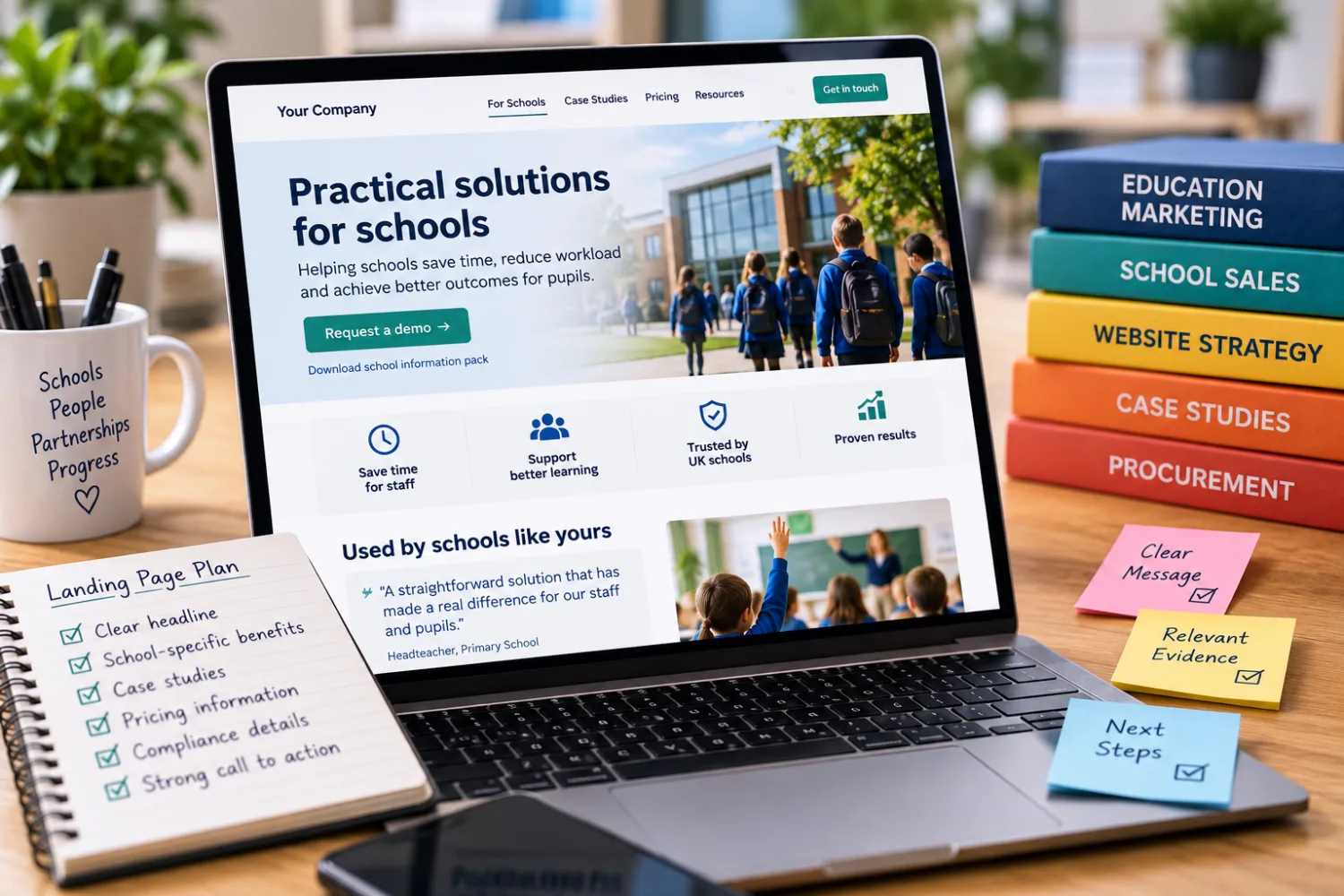

A school supplier sales pack should help an interested member of staff explain your offer to everyone else involved in the decision.
That is a different job from an ordinary marketing brochure.
A brochure is usually designed to attract attention. A school sales pack must also survive being forwarded to a school business manager, headteacher, IT lead, designated safeguarding lead, finance team or multi-academy trust colleague who has never spoken to the supplier.
Those readers may want answers to very different questions.
A teacher may ask whether the product will work in practice. A senior leader may want to understand its strategic value. A business manager will need the full price and contractual commitment. An IT manager may review compatibility and security. A safeguarding lead may need to understand who will interact with pupils and how concerns are handled.
If the sales pack contains only polished claims and product images, the original contact is left to assemble the internal case themselves.
A useful pack should make it easier to answer:
- What problem does this solve?
- Who is it intended for?
- What exactly are we buying?
- What will it cost in full?
- What evidence supports the offer?
- What work will the school need to complete?
- What risks or compliance questions need reviewing?
- What happens if we decide to proceed?
The goal is not to send every policy, certificate and contract in the first email. That creates a different problem: an enormous collection of files with no clear route through them.
The strongest approach is layered. Begin with a concise core sales pack that explains the commercial and practical case. Then provide clearly organised supporting documents when the school reaches technical review, due diligence, procurement or contracting.
This guide explains what to include, what to leave out and how to create a school supplier sales pack that helps a genuine opportunity move towards an informed decision.
Understand what the school sales pack needs to achieve
A sales pack should not attempt to complete the whole sale by itself.
Its main purpose is to make the offer easy to understand, discuss and assess.
It should help the original contact:
- explain the problem internally;
- show why the supplier may be relevant;
- identify the intended users or beneficiaries;
- give colleagues a realistic view of the cost;
- describe what implementation would involve;
- direct specialist questions to the correct supporting documents;
- propose a clear next step.
The pack may be used at several stages.
After initial outreach
A concise overview helps the recipient decide whether the offer is relevant enough to investigate.
After a discovery meeting
A more tailored version can reflect the school’s actual situation, priorities and questions.
Before an internal discussion
The contact may use the pack to brief the headteacher, business manager, department or trust team.
During evaluation
Decision-makers may compare the pack with material from other suppliers.
Before a formal proposal
The pack can establish the broad case before a detailed scope and quotation are prepared.
These uses require clarity rather than volume.
A 45-page presentation may appear comprehensive, but it is unlikely to be read closely by a busy headteacher or school business manager. A pack containing eight unrelated attachments may be technically complete but difficult to navigate.
A practical core pack will often consist of:
- a short introductory email;
- a two-to-six-page school overview;
- a one-page summary;
- relevant case studies;
- initial pricing or package information;
- a link to supporting procurement and assurance documents.
Complex opportunities may require more detail, but each item should have a clear purpose.
The pack should also reflect the way the offer is positioned. As explained in How to Position Your Product or Service for UK Schools, the supplier should begin with a recognised school problem rather than expecting readers to interpret a list of features.
The sales pack turns that position into an internal case the school can evaluate.
Begin with a clear one-page summary
The one-page summary is often the most valuable part of the pack.
It gives the school a document that can be read quickly, forwarded internally or placed at the beginning of a longer proposal.
A strong one-page summary should contain the following elements.
A specific title
Avoid a title such as:
“Company Overview”
Use something connected to the offer:
“Managed IT Support for Primary Schools and Multi-Academy Trusts”
or:
“A Practical Attendance Review and Improvement Programme for Secondary Schools”
The problem
Describe the recognised situation in two or three sentences.
For example:
“School business teams often manage contractor records, compliance checks and outstanding premises actions across several spreadsheets and email threads. This makes it difficult to see which actions remain open and to prepare a consistent record for internal review.”
The offer
Explain what the supplier provides in plain language.
“We provide a cloud-based premises compliance system, initial data setup, staff training and ongoing support for schools and academy trusts.”
The intended customer
State which schools, phases, roles or settings are the best fit.
For example:
- primary schools with limited internal IT support;
- secondary science departments replacing laboratory equipment;
- MATs seeking consistent safeguarding training across academies;
- special schools requiring adapted sensory equipment;
- schools within a defined regional service area.
The principal benefit
Explain the practical change the offer is designed to support.
Keep the claim proportionate:
“Give trust leaders a central view of training completion while allowing each academy to manage its own staff records.”
This is clearer and more defensible than:
“Transform safeguarding outcomes across your trust.”
What is included
Summarise the main scope, such as:
- initial assessment;
- equipment or licences;
- setup;
- training;
- delivery or installation;
- support;
- reporting;
- review meetings.
Price or pricing model
Provide a fixed price, starting price, typical range or clearly explained calculation.
Evidence
Include one or two relevant proof points, such as:
- a concise school case-study result;
- the number and type of schools served;
- a relevant accreditation;
- the experience of the delivery team;
- a short quotation from a comparable customer.
Implementation
State the typical timescale and the main requirement from the school.
The next step
End with one proportionate action:
- book a 30-minute discovery meeting;
- request a formal quotation;
- arrange a site visit;
- include the school’s IT lead in a technical review;
- discuss a defined pilot;
- confirm whether the supplier covers the school’s area.
Do not shrink an entire 20-page brochure onto one page using tiny text. The document should remain readable when opened on a laptop, printed or viewed on a phone.
Explain the school problem before describing your company
Many sales packs open with several slides about the supplier:
- when it was founded;
- its mission and values;
- the history of its logo;
- the founder’s career;
- the size of the market;
- general statements about innovation.
Some of that information may be useful later. It should not delay the explanation of why the school should care.
Begin with the school’s situation.
A useful problem section should demonstrate that the supplier understands:
- who experiences the problem;
- how it affects normal school work;
- why existing approaches may be inadequate;
- what happens if the problem remains unresolved;
- which part of the problem the supplier can realistically address.
For example, a school website provider might write:
“School websites often become difficult to maintain because responsibility is spread between senior leaders, office staff and external developers. Important information can become outdated, routine changes require technical support and parents struggle to find commonly requested documents.”
A catering equipment supplier might write:
“Replacing individual items without reviewing workflow can leave school kitchens with mismatched equipment, inefficient layouts and installation problems. Schools need a plan that accounts for service capacity, utilities, available space, maintenance and the timing of holiday work.”
A tutoring provider might write:
“Schools need tutoring provision that complements classroom teaching, fits existing assessment and safeguarding processes, and gives staff useful information about pupil engagement and progress.”
This is more credible than inventing urgency.
Avoid claims such as:
- “Every school is facing this crisis.”
- “Schools that do not act now will fall behind.”
- “Your current system is costing thousands every month.”
- “This is the only solution schools need.”
unless you have unusually strong evidence and the statement genuinely applies.
The problem section should also distinguish between symptoms and causes.
For example, slow administrative reporting may be caused by:
- several disconnected systems;
- unclear ownership;
- manual data entry;
- inconsistent staff processes;
- poorly configured existing software.
Your product may address one or two of these issues, but not all of them.
State the boundaries clearly. A school is more likely to trust a supplier that understands the limits of its offer than one claiming to solve a complex institutional problem single-handedly.
Describe the offer, scope and package clearly
After explaining the problem, show the school exactly what it can buy.
The pack should answer:
- What is the product or service?
- What is included as standard?
- What is optional?
- What is excluded?
- Who will deliver it?
- Where and how will it be delivered?
- How long will it last?
- What does the school need to provide?
This is especially important for services described as bespoke.
“Bespoke” should mean the service can be adapted to the school, not that the buyer receives no idea of the likely scope until after several meetings.
A clear service package might say:
Included: an initial leadership interview, review of current documents, one onsite audit day, a written report, a two-hour staff workshop and a follow-up meeting six weeks later.
Not included: legal advice, rewriting all school policies, additional site visits or ongoing retained consultancy. These can be quoted separately where required.
Product suppliers should include:
- product names or ranges;
- quantities;
- key specifications;
- age or phase suitability;
- compatibility requirements;
- delivery arrangements;
- installation;
- warranties;
- maintenance or replacement options.
Software suppliers should explain:
- which modules are included;
- how users are licensed;
- account and access arrangements;
- integrations;
- setup;
- data migration;
- training;
- support;
- contract term;
- data export at the end of the agreement.
Training providers should explain:
- the intended participants;
- learning objectives;
- delivery format;
- session length;
- maximum group size;
- materials;
- follow-up resources;
- certification or attendance records;
- what the training does not qualify participants to do.
If packages are offered, keep them comparable.
| Package | Best suited to | Main scope |
|---|---|---|
| Essential | A single school beginning with the core service | Core product, setup and standard support |
| Complete | A school needing implementation and staff training | Core product, setup, training and review |
| Trust | Several academies requiring central oversight | Multi-school rollout, central reporting and academy support |
Do not create meaningless tiers where important functions are hidden inside the most expensive option merely to make the entry price appear lower.
The recommended package should be the one most likely to work properly for the school—not simply the one with the highest margin.
Include transparent pricing and commercial terms
A sales pack should not force the school to arrange another meeting simply to understand the likely cost.
Where a fixed price is possible, show it.
Where the price depends on the school’s circumstances, provide:
- a starting price;
- a typical range;
- example packages;
- the factors that affect the final quotation;
- a clear process for obtaining an exact figure.
The pricing section should identify:
- whether VAT is included or excluded;
- whether the price is one-off or recurring;
- the initial contract term;
- setup charges;
- delivery and installation;
- training;
- support;
- travel and expenses;
- optional additions;
- renewal pricing;
- payment schedule;
- minimum order or commitment.
For example:
“The first-year price is £4,800 plus VAT. This includes setup, data import, two online training sessions and standard support. Renewal is £3,600 plus VAT annually. Additional onsite training is £650 plus travel per day.”
This is easier to approve than:
“Packages from only £300 per month.”
The second statement does not reveal the contract length, total commitment or additional costs.
If the school needs an itemised quotation, explain that the sales-pack price is indicative and identify when the formal quotation will be produced.
Do not mix quotations and proposals in a way that makes the commercial offer unclear. The proposal can explain the case. The quotation should state the exact scope, amount and terms being offered.
Schools and academy trusts may need to compare offers, follow internal procurement rules or use an approved buying route. Current Department for Education guidance tells schools to check their own procurement rules and choose an appropriate route according to the purchase and its expected value.
Your pack should therefore avoid unsupported statements such as:
- “No procurement is required.”
- “Schools can appoint us directly regardless of value.”
- “Only one quotation is needed.”
- “Being on this framework means every school can buy from us automatically.”
Where you are on a framework, include:
- the framework name;
- the provider or contracting authority;
- the relevant lot;
- the reference number;
- the framework expiry date;
- the routes available to the school, such as direct award or further competition where applicable;
- a link to official framework information.
DfE-approved buying options cover a range of school purchasing categories, but each framework has its own scope and buying procedure.
Make clear whether your business accepts:
- purchase orders;
- payment by invoice;
- staged project payments;
- central MAT billing;
- academy-level invoicing;
- online card payments for smaller orders.
The guide to making your business easier for schools to buy from explains why clear quotations, purchase-order support and accurate invoicing can be as important as the sales presentation itself.
Show evidence that matches the claims you make
The evidence section should help the school answer two questions:
- Has this supplier delivered something similar before?
- Is there a credible reason to believe the offer will work here?
Use evidence relevant to the proposed purchase.
Case studies
A strong case study should explain:
- the school or trust context;
- the original problem;
- the scope delivered;
- the implementation process;
- the school’s contribution;
- the result;
- the period over which the result was observed;
- any important limitations.
For example:
“The supplier replaced classroom furniture across 12 rooms during the summer holiday. The project included room measurement, layout planning, delivery, assembly and removal of old furniture. All rooms were handed back three working days before staff returned.”
This demonstrates a relevant operational result.
Testimonials
Use testimonials that identify the context and the part of the service being praised.
“The project plan was clear, and each academy knew when its data and staff training were required.” — Trust IT Director, nine-academy MAT
Obtain permission before naming a school, trust or member of staff.
Customer experience
Useful information may include:
- the number of schools served;
- the phases or settings covered;
- the regions served;
- the number of trust-wide projects completed;
- renewal or retention information;
- service-response performance.
Be precise about what the figures represent.
“Used by 500 schools” could mean 500 active annual customers, 500 free accounts or 500 schools that once placed an order. Define the measure where it materially affects the claim.
Impact data
Distinguish between:
- usage;
- customer satisfaction;
- staff confidence;
- administrative efficiency;
- service delivery;
- pupil outcomes;
- independent evaluation.
A high login rate demonstrates use. It does not automatically demonstrate improved attainment.
A positive staff survey may demonstrate perceived usefulness. It does not prove a reduction in workload unless workload was measured appropriately.
Explain the evidence honestly. Schools are more likely to trust a realistic result than a sweeping claim built on weak data.
Qualifications, accreditations and professional memberships
Include only those relevant to the offer.
State:
- the organisation;
- the qualification, standard or membership;
- which person or entity holds it;
- whether it is current;
- how it can be verified.
Do not allow a page of logos to substitute for an explanation of competence.
Explain implementation and the school’s responsibilities
The school needs to know what happens after it says yes.
A supplier may regard implementation as a delivery issue. The school sees it as part of the buying decision because it determines whether the product can be introduced successfully.
Your pack should explain:
- the expected implementation period;
- the main stages;
- the supplier’s responsibilities;
- the school’s responsibilities;
- which staff roles need to participate;
- the expected staff time;
- training;
- data, technical or site requirements;
- the proposed launch date;
- how delays are handled;
- what support is available after launch.
A simple implementation table can make the process much clearer:
| Stage | Supplier | School or trust |
|---|---|---|
| Planning | Provide project plan and confirm requirements | Nominate a lead and approve the timetable |
| Preparation | Configure the product or plan delivery | Provide agreed data, measurements or access |
| Training | Deliver sessions and resources | Arrange staff attendance and protected time |
| Launch | Provide launch support | Communicate the change and begin agreed use |
| Review | Report issues and agreed measures | Provide feedback and confirm next actions |
Be specific about timing.
Instead of:
“Fast and seamless onboarding.”
write:
“A typical single-school implementation takes four to six weeks from receipt of the purchase order and required data. The school needs to nominate one project lead and arrange two 60-minute staff-training sessions.”
For physical products or site services, explain:
- lead times;
- delivery access;
- room preparation;
- installation;
- term-time restrictions;
- holiday work;
- waste removal;
- inspection and handover;
- warranties and defects.
For pupil-facing provision, explain:
- referral or booking arrangements;
- staff supervision;
- consent where relevant;
- attendance and record keeping;
- safeguarding reporting;
- communications with school staff;
- outcome or service reporting.
For MATs, distinguish between central and academy-level work.
A trust-wide rollout may require:
- a central project sponsor;
- academy implementation contacts;
- shared configuration decisions;
- school-level training;
- phased launches;
- central and local reporting;
- a process for academies joining later.
Do not make the school discover its workload after signature. Accurate implementation detail may occasionally make a sale slower, but it is more likely to produce a workable contract and a successful renewal.
Provide assurance without overwhelming the main pack
Schools may need to review insurance, safeguarding, data protection, health and safety, financial standing, cybersecurity and other supplier information.
That does not mean every certificate should be placed in the main sales presentation.
Use a layered structure.
In the core sales pack
Include a concise assurance summary covering only what is relevant.
For example:
- the supplier carries appropriate public and employers’ liability insurance;
- pupil-facing staff are recruited and checked according to the roles they perform;
- a safeguarding policy and reporting procedure are available;
- data-processing and security documentation are available for review;
- site work is supported by relevant risk assessments and method statements;
- full documents can be provided during due diligence.
In the supporting assurance pack
Depending on the offer, provide:
- legal company details;
- insurance certificates;
- safeguarding policy;
- safer-recruitment and checking arrangements;
- health and safety policy;
- risk assessments;
- method statements;
- privacy notice;
- data-processing agreement;
- subprocessor information;
- cybersecurity documentation;
- business-continuity plan;
- accessibility information;
- complaints and escalation process;
- subcontractor information;
- standard terms and conditions.
Current statutory safeguarding guidance sets out duties schools and colleges must follow to safeguard and promote the welfare of children. Suppliers should therefore provide information that helps the school assess the specific activity rather than relying on vague claims that the business is “safeguarding approved”.
For pupil-facing providers, the pack should explain:
- who will attend the school;
- what roles they perform;
- how staff are recruited;
- which checks are completed where eligible and appropriate;
- how staff are supervised;
- how concerns are reported;
- how the provider works with the school’s designated safeguarding lead;
- whether subcontractors are involved.
Avoid statements such as:
- “All staff are DBS approved.”
- “Our DBS certificate proves all safeguarding requirements are met.”
- “Schools do not need to conduct their own checks.”
A DBS check is one part of a wider safeguarding and suitability process. The relevant arrangements depend on the role and activity.
For digital suppliers, include a short data and security summary, with detailed documents available separately.
The summary might cover:
- the categories of data processed;
- the purpose of processing;
- hosting locations;
- subprocessors;
- authentication;
- encryption;
- retention;
- data return or deletion;
- incident handling;
- product accessibility;
- the contact for technical review.
Privacy information should be clear and accessible rather than buried inside dense legal wording. The Information Commissioner’s Office supports layered privacy information, where key points are presented first and fuller detail is available where required.
Keep all documents current. Use clear filenames, version numbers, review dates and expiry dates.
A useful assurance index might list:
| Document | Version or expiry | Owner |
|---|---|---|
| Public liability certificate | Expires 31 March 2027 | Operations |
| Safeguarding policy | Reviewed January 2026 | Safeguarding lead |
| Data-processing agreement | Version 3.2 | Data protection |
| Standard school terms | Version 5 | Commercial team |
This makes the supplier easier for both its own sales team and the school to assess.
Make the pack relevant to different decision-makers
A single core story should run through the pack, but different readers need different detail.
Teachers and end users
They need to understand:
- how the product works in everyday practice;
- which pupils or tasks it supports;
- how much preparation is required;
- what training is provided;
- whether the offer is accessible and practical;
- what changes for them after implementation.
Subject, curriculum and specialist leaders
They need:
- fit with their area of responsibility;
- evidence;
- implementation detail;
- staff or pupil coverage;
- ways to assess progress;
- relevance to existing provision.
Senior leaders
They need:
- strategic relevance;
- whole-school benefit;
- implementation capacity;
- major risks;
- evidence of value;
- a concise decision request.
School business managers and finance teams
They need:
- complete pricing;
- contract duration;
- renewal terms;
- payment and purchase-order arrangements;
- insurance;
- procurement route;
- implementation costs;
- whole-life value.
IT and data teams
They need:
- technical requirements;
- integrations;
- account management;
- data flows;
- security;
- support;
- accessibility;
- exit and data-export arrangements.
Safeguarding leads
They need:
- the nature of contact with pupils;
- recruitment and checking arrangements;
- supervision;
- reporting procedures;
- information sharing;
- staff responsibilities;
- the relationship with school policy.
Trust central teams
They may additionally need:
- trust-wide pricing;
- central reporting;
- academy-level control;
- rollout capacity;
- standardisation options;
- how local variations are handled;
- contract structure;
- support for academies joining later.
This does not require seven completely separate brochures.
Create one core pack, then add short role-specific appendices or linked pages.
For example:
- Core school overview
- Finance and procurement summary
- Technical and security overview
- Safeguarding and delivery summary
- MAT implementation overview
This keeps the central message consistent while preventing every reader from searching through irrelevant detail.
Your supplier website should support this structure. The guide to what schools expect to see on a supplier website explains how product, pricing, evidence, assurance and implementation information can remain available after the pack has been forwarded.
Package and send the information professionally
Good content can still become difficult to use when the files are poorly organised.
A school should not receive an email containing:
- nine attachments with unexplained names;
- several versions of the same quotation;
- expired certificates;
- links requiring account creation;
- documents too large to download;
- a presentation that only works in specialist software;
- files containing another customer’s name or data.
Use a consistent folder and naming structure.
For example:
01-School-Overview.pdf02-One-Page-Summary.pdf03-Pricing-and-Packages.pdf04-Implementation-Plan.pdf05-Case-Study-Primary-MAT.pdf06-Assurance-Document-Index.pdf
Keep the initial email concise.
It might say:
Thank you for discussing your current attendance-reporting process with us. I have attached a short overview reflecting the points raised, together with indicative pricing and a relevant secondary-school case study.
The proposed package includes setup, two training sessions and standard support. The typical implementation period is four to six weeks.
The next useful step would be a 30-minute meeting with your attendance lead and business manager to confirm scope and budget before we prepare a formal quotation.
The email explains why the recipient is receiving each document and what should happen next.
Use accessible formats.
PDF is practical for fixed documents, but important information should also exist on the website where possible. Ensure:
- text can be selected and searched;
- headings are structured;
- links are descriptive;
- contrast is sufficient;
- images have meaningful alternatives where needed;
- the document works on mobile devices;
- the file size is reasonable.
Do not send editable Word or spreadsheet files unless the school has a reason to modify or complete them.
Where a secure document portal is used, make sure the buyer can access it without unnecessary friction. Avoid links that expire before colleagues have had time to review them.
Version control is essential.
Every quotation and tailored proposal should contain:
- the school or trust name;
- the date;
- a version or quotation number;
- the expiry date;
- the supplier contact;
- a clear indication when it replaces an earlier version.
Before sending, check:
- the customer name;
- the price;
- the VAT treatment;
- the package;
- the implementation dates;
- the legal company name;
- the links;
- the filenames;
- the references to other schools;
- the next step.
Nothing undermines confidence faster than receiving a proposal addressed to another school.
Common mistakes to avoid in a school supplier sales pack
Making the pack entirely about the supplier
The company’s experience should support the case, but the document should begin with the school’s need and proposed solution.
Including every service the company offers
Focus on the offer relevant to the school. A complete catalogue can be linked separately.
Using vague outcome language
Explain the practical change rather than relying on words such as transform, empower, innovate and revolutionise.
Hiding the price
Where an exact price is not possible, give a realistic range and explain what changes it.
Showing an unrealistically low starting price
The headline price should correspond to a genuine package that can work for an identifiable customer.
Leaving implementation until after the sale
Schools need to know the staff time, data, site access and training required before approving the purchase.
Sending every compliance document immediately
Provide a concise assurance summary first and organise detailed documents for the appropriate review stage.
Making unsupported approval claims
Do not say the supplier is “DfE approved”, “GDPR certified” or “DBS approved” without explaining the precise status and evidence.
Using irrelevant case studies
A trust-wide buyer needs evidence of scale. A small primary school may need evidence that the service is manageable for a limited team.
Overloading the pack with design
Large decorative photographs, complex layouts and tiny text can make the document harder to use. Design should support comprehension.
Providing no decision route
The pack should end with a clear next step, not “contact us for more information”.
Using different prices across documents
The website, sales pack, proposal and quotation should be aligned or clearly explain why the figures differ.
Ignoring the school’s legal identity
Confirm whether the customer is an individual school, local authority, standalone academy trust or MAT before preparing contractual documents.
Failing to update the pack
Review prices, personnel, product information, customer figures, policy links and certificates regularly.
Sending the same pack to every buyer
Maintain a reliable core version, but tailor the problem, examples, package and next step to the school’s actual situation.
Frequently asked questions
What is a school supplier sales pack?
It is a set of concise documents and links that helps a school understand, assess and share a supplier’s offer. It normally includes a school overview, one-page summary, scope, pricing, evidence, implementation information and access to relevant assurance documents.
How long should a school sales pack be?
The core overview will often be between two and six pages, supported by a one-page summary. Complex products may require additional appendices, but specialist detail should be separated so the main pack remains readable.
Should the sales pack include prices?
Yes, where possible. Include a fixed price, starting price, typical range or clearly explained pricing model. State VAT, setup, delivery, training, support, contract length and renewal costs.
Should every compliance document be attached?
No. Include a concise assurance summary and make detailed documents available during due diligence. Sending a large collection of policies and certificates during initial outreach can make the pack harder to use.
What is the difference between a brochure and a sales pack?
A brochure primarily markets the product. A sales pack also helps the school evaluate scope, price, evidence, implementation, risk and the internal approval required to buy it.
What is the difference between a sales pack and a proposal?
The sales pack is a reusable overview of the supplier and offer. A proposal should be tailored to a particular school or trust, reflecting its identified problem, recommended scope, timetable and price.
What is the difference between a proposal and a quotation?
A proposal explains the need, recommended solution and rationale. A quotation states the specific products or services, quantities, price, VAT, validity, payment terms and other commercial details being offered.
Should the pack be tailored for every school?
The core product, evidence and assurance information can remain standard. The opening problem, proposed package, examples, pricing and next step should be tailored where the opportunity is sufficiently important.
Should suppliers include customer logos?
Only with appropriate permission. A logo demonstrates that some relationship existed but does not explain the scope or result. Relevant case studies and contextualised testimonials usually provide stronger evidence.
Should the pack include a company history?
Include a short, relevant explanation of the company and its education experience. Avoid placing a long history before the school problem and offer.
What should an EdTech sales pack include?
It should include the user problem, product scope, pricing, implementation, training, support, integrations, data handling, cybersecurity, accessibility, contract terms and exit or data-export arrangements.
What should a pupil-facing provider include?
Explain the activity, intended pupils, delivery staff, school responsibilities, supervision, safeguarding procedures, relevant checks, reporting, data handling, pricing and how the provision fits alongside school staff.
Should a supplier mention DBS checks in the sales pack?
Where relevant, explain the checking arrangements accurately and in relation to the roles being performed. Do not imply that one DBS certificate replaces wider safeguarding, recruitment and supervision responsibilities.
Should framework information be included?
Yes, when it gives schools a genuine buying route. State the exact framework, lot, reference, expiry date and how the school can use it. Avoid general claims of being approved for all school purchasing.
What file format should be used?
A well-structured, accessible PDF is useful for the main pack, supported by web pages and downloadable specialist documents. The file should be readable on mobile devices, searchable and reasonably small.
What is the most important part of the pack?
The one-page summary is often the most useful because it helps the original contact explain the offer internally. It should cover the problem, solution, audience, scope, price, evidence, implementation and next step.
How often should the sales pack be updated?
Review it whenever prices, products, personnel, service areas, implementation processes, contract terms or assurance documents change. Customer numbers, case studies and time-sensitive claims should also be checked regularly.
How should the pack end?
End with one clear and proportionate action, such as requesting a quotation, arranging a site visit, booking a demonstration or involving the relevant finance, technical or safeguarding colleague.