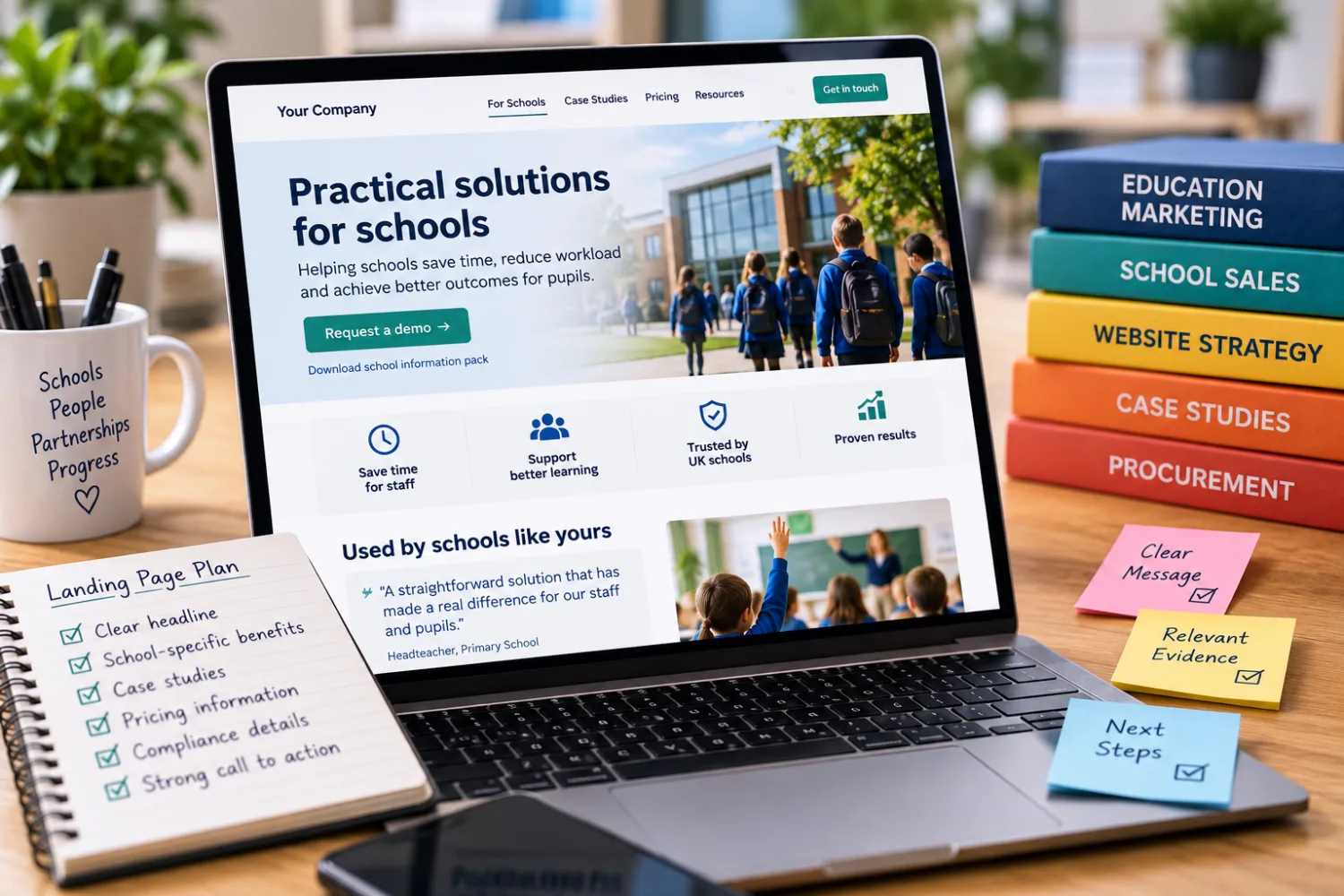

A product can be genuinely useful to schools and still be difficult to sell.
The problem is often not the quality of the product. It is the way the offer is positioned.
Many businesses approach schools using the same language they use for ordinary commercial customers. They describe their features, explain how innovative they are and list everything their company can provide. Schools are then expected to work out which problem the offer solves, who should use it, how it fits existing priorities and whether it is worth spending limited time and money on.
That is too much work to place on the buyer.
Schools do not usually buy a product because its supplier has the most impressive terminology. They buy because the offer addresses a recognised need, can be introduced without creating unreasonable disruption and represents a defensible use of school resources.
A school-specific position should therefore make several things clear:
- which school problem the offer addresses;
- who experiences that problem;
- which pupils, staff or operational teams benefit;
- what changes after the product or service is introduced;
- what the school must contribute for it to work;
- why the likely benefit justifies the cost and effort;
- why the supplier can be trusted to deliver in a school environment.
Positioning is not about disguising an ordinary product with education terminology. It is about understanding where the offer genuinely fits within a school and expressing that fit in language that different decision-makers can evaluate.
This guide explains how suppliers can position products and services for UK schools without relying on vague promises, artificial urgency or exaggerated claims about pupil outcomes.
Position the problem before positioning the product
The most common positioning mistake is beginning with the product.
A supplier says:
“We provide an innovative cloud-based platform with advanced automation, integrated dashboards and AI-powered reporting.”
The statement may be accurate, but it leaves the school with several unanswered questions:
- Which school team is this for?
- What problem does it solve?
- Why is that problem important now?
- How would staff use it?
- Would it replace an existing system?
- What work would implementation create?
- What evidence supports the claimed benefit?
A stronger position begins with the situation the school already recognises:
“We help school attendance teams identify patterns of absence earlier and reduce the time spent combining information from separate spreadsheets and systems.”
The second version does not explain every feature. It creates relevance. The intended user, operational problem and practical benefit are immediately easier to understand.
This does not mean every supplier must make its message extremely narrow. It means the supplier needs a clear primary problem around which the offer can be understood.
A cleaning company might position itself around reliable standards, safeguarding-aware staff and reduced management time rather than merely listing cleaning tasks.
A furniture supplier might focus on helping schools plan durable, adaptable learning spaces within a defined budget rather than claiming to sell “inspiring educational environments”.
A training provider might position a programme around a specific staff-development need and the practical changes participants should be able to make after the training.
A school website company might focus on reducing administrative workload, improving parent access to essential information and keeping statutory content easier to maintain.
The question to ask is not:
“What does our product do?”
It is:
“What recognised school problem becomes easier to manage because our product exists?”
That distinction matters because schools rarely begin by deciding that they need a particular supplier category. They begin with a problem, responsibility or planned improvement.
A SENCO does not necessarily wake up wanting to purchase “external consultancy”. They may need additional assessment capacity, specialist advice for a complex pupil case or practical support for staff.
A school business manager may not be looking for “facilities optimisation”. They may need more reliable contractor response times, clearer compliance records or lower management burden.
A trust IT director may not be searching for “digital transformation”. They may need consistent systems across academies, fewer support issues and better control over cybersecurity risks.
Positioning should connect the supplier’s category to the school’s actual situation.
Understand who the offer is really for
A product may be used by one group, selected by another and approved by someone else.
This makes education positioning more complicated than writing one headline for “schools”.
Consider a reading platform:
- pupils may be the end users;
- teachers may use it during lessons;
- the English or literacy lead may evaluate its educational fit;
- a deputy headteacher may consider the whole-school impact;
- the school business manager may assess affordability;
- IT may review technical requirements;
- the headteacher may approve the commitment.
Each participant asks a different version of the same question.
The teacher asks:
“Will this work with my pupils without creating more preparation?”
The subject leader asks:
“Will this improve consistency or address an identified weakness?”
The senior leader asks:
“Is this aligned with our priorities, and can we implement it successfully?”
The business manager asks:
“What will it cost in full, and is it better value than the alternatives?”
The IT team asks:
“Will it work safely with our systems, accounts and data?”
A supplier cannot position effectively without knowing which of these questions matters first.
The AllSchools guide to who buys products and services in UK schools explains how users, internal champions, budget holders, gatekeepers and final approvers can all influence one purchase.
The practical positioning task is to choose a primary audience without ignoring the others.
Your homepage or school landing page might lead with the problem owner. Supporting material can then answer the concerns of finance, IT, safeguarding and senior leadership.
For example:
Primary position: “Help SENCOs coordinate external provision and pupil support without relying on disconnected records.”
Supporting messages might include:
- role-based access and secure data handling for IT and data teams;
- transparent annual pricing for business managers;
- implementation and staff-training details for senior leaders;
- reporting that supports reviews and accountability.
Trying to place every benefit into one sentence usually produces vague language. A stronger structure gives the main audience a clear reason to continue reading, then gives each additional decision-maker the information relevant to them.
Translate features into school outcomes without overclaiming
Schools need to understand what a product changes, not merely what it contains.
A feature is something the supplier provides. An outcome is the practical effect that feature may help produce.
| Feature-led wording | More useful school-focused wording |
|---|---|
| Automated reporting dashboard | Bring attendance trends into one view so leaders can review concerns without manually combining reports |
| Unlimited user accounts | Give relevant staff access without restricting use to one department or charging for every new colleague |
| Dedicated account manager | Give the school one named contact for implementation, questions and service reviews |
| Modular furniture range | Allow rooms to be rearranged for different group sizes without replacing the full furniture set |
| Online CPD library | Let staff revisit training and access materials after the live session |
| Real-time notifications | Help relevant staff respond sooner when defined events or thresholds occur |
The outcome should remain close enough to the feature that the claim can be defended.
A dashboard may help staff notice information sooner. It does not automatically “transform pupil outcomes”. A training course may improve staff knowledge and confidence. It does not guarantee that behaviour incidents will fall by a particular percentage in every school.
This is where many education suppliers lose credibility. They jump from a product feature to a major educational claim without explaining the steps between them.
For example:
“Our software raises attainment.”
That is an extremely broad claim. A more credible explanation might be:
“The platform helps teachers identify gaps in pupil responses, group pupils for follow-up work and monitor whether those gaps are reducing over time.”
The second version describes a plausible mechanism. It allows the school to judge how the product might contribute to improvement.
Suppliers should separate different levels of benefit:
Immediate operational benefit
What becomes quicker, clearer, safer or easier for staff?
Behavioural or practice change
What can staff, pupils or leaders do differently because the product is available?
Longer-term organisational or educational outcome
What wider result might follow when the product is used well over time?
A credible supplier explains all three without pretending to control factors outside its influence.
For example, a pupil wellbeing provider might say:
- staff receive a clear referral and communication process;
- identified pupils gain access to structured support;
- the school receives agreed reporting on engagement and themes;
- the provision may contribute to the school’s wider pastoral strategy.
That is more trustworthy than promising to “solve the mental health crisis in schools”.
Evidence should also match the scale of the claim. Customer comments can support claims about service quality. Usage data can support claims about adoption. Properly designed evaluation may support stronger impact claims. One enthusiastic testimonial does not prove that a product raises attainment across all contexts.
Connect the offer to priorities schools already recognise
Schools are approached with a constant stream of products described as valuable, innovative or essential.
A supplier improves its position when it connects the offer to a recognised school responsibility or practical priority.
Common areas include:
- pupil learning and curriculum delivery;
- SEND and inclusion;
- safeguarding;
- attendance;
- behaviour and pastoral support;
- staff workload;
- recruitment and retention;
- financial sustainability;
- estates safety and maintenance;
- cybersecurity and data protection;
- parent communication;
- operational resilience;
- staff development;
- preparation for inspections or statutory responsibilities.
The connection must be genuine.
Suppliers sometimes attach their product to whichever education topic is receiving attention, even when the relationship is weak. A general business service suddenly becomes an “attendance solution”, “SEND solution” or “wellbeing solution” because those themes appear commercially attractive.
School leaders can usually recognise this quickly.
Do not claim alignment merely by inserting policy language into marketing copy. Explain the practical relationship.
For example, a parent-communication platform could support attendance work if it helps schools send timely, accessible messages and maintain clearer contact records. It should not claim that using the platform alone will resolve persistent absence.
A furniture supplier may support inclusion by providing adaptable, accessible options and practical planning advice. It should not imply that a new room layout by itself creates an inclusive school.
A staff training provider may support safeguarding practice by helping staff understand procedures and respond consistently. It should still make clear that the school retains responsibility for its policies, leadership and statutory duties.
Current statutory guidance requires schools and colleges to safeguard and promote the welfare of children. Suppliers working directly with pupils or influencing safeguarding processes should therefore demonstrate that they understand the school environment and their own responsibilities rather than treating safeguarding as a generic badge. The relevant national guidance should always be checked in its current version.
Positioning around an existing priority works best when the supplier can show:
- which aspect of the priority it addresses;
- which staff members are involved;
- what the supplier provides;
- what remains the school’s responsibility;
- how progress or service quality can be assessed;
- where the offer does not apply.
Clear boundaries improve credibility. Suppliers do not need to claim that they solve the whole problem. They need to explain the part they solve particularly well.
Show value for money, not merely a low price
Schools manage public resources and must be able to justify purchasing decisions. That does not mean the cheapest supplier always wins.
Value for money is broader than initial price. It can include quality, suitability, reliability, implementation, support, whole-life cost, risk and the outcomes achieved with the resources used.
Department for Education guidance encourages schools and academy trusts to consider effective procurement, relevant buying routes and wider value rather than treating procurement as a simple search for the lowest headline price. DfE-approved buying options may also give schools access to pre-checked suppliers and pre-agreed terms.
Suppliers should therefore explain value in a form the school can compare.
Weak positioning says:
“Our service is excellent value.”
Stronger positioning explains why:
- the price includes implementation and staff training;
- support is provided by named specialists;
- there are no additional per-user fees;
- the equipment has a longer expected service life;
- the service replaces several disconnected subscriptions;
- reporting reduces a defined administrative task;
- maintenance and replacement arrangements are included;
- the supplier can serve several academies under consistent terms;
- the product can be expanded without a complete replacement.
Where possible, show the full cost over the likely contract period.
A cheaper product may become more expensive when the school adds setup, training, support, replacement parts, user licences or cancellation costs. A higher initial price may be easier to justify when it includes a more complete service and reduces operational risk.
Suppliers should make clear:
- whether VAT is included;
- whether setup is charged separately;
- whether training is included;
- what level of support is provided;
- how many users, pupils or sites are covered;
- when prices may change;
- whether the contract renews automatically;
- what happens if the school needs to leave;
- which costs are optional and which are necessary.
This matters because a school cannot evaluate value when the real price remains unclear.
The supplier should also avoid presenting every benefit as a direct cash saving. Time saved does not automatically become money removed from the school budget. A teacher spending less time compiling reports may gain valuable capacity, but the school is unlikely to reduce that teacher’s salary as a result.
Describe the benefit accurately:
“Reduce the staff time required to prepare the termly report.”
That is more defensible than:
“Save the school £20,000 a year.”
unless the supplier has a credible method for calculating that financial saving.
Reduce the perceived risk of choosing a new supplier
Schools do not only consider the possible benefit of a purchase. They consider what could go wrong.
A product may fail to be adopted. A contractor may miss deadlines. A software provider may create data concerns. An external service may not fit school safeguarding procedures. Staff may require more training than expected. A small supplier may struggle to support several schools at once.
Positioning should therefore answer the school’s risk questions, not merely repeat the positive outcome.
Common perceived risks include:
- the product will create more work than it removes;
- staff will not use it consistently;
- implementation will disrupt teaching or operations;
- the supplier lacks school experience;
- support will disappear after the contract is signed;
- the service will not work with existing systems;
- sensitive data will be handled poorly;
- the provider will not understand safeguarding expectations;
- the school will become trapped in a long contract;
- the supplier cannot deliver at the required scale;
- the claimed results will not materialise.
A strong position reduces these risks with specific evidence.
For example:
- a clear onboarding plan;
- a named implementation contact;
- a realistic staff-training requirement;
- references from comparable schools;
- a service-level agreement;
- accessible technical and data documentation;
- current insurance and safeguarding information;
- a defined escalation process;
- transparent contract and cancellation terms;
- a pilot with agreed success criteria;
- evidence of delivery capacity.
Do not hide the effort required from the school.
If implementation needs two staff workshops, a data export and a senior project lead, say so before the school buys. Concealing that information may make the initial offer appear easier, but it increases the risk of poor implementation and non-renewal.
A supplier becomes easier to trust when it explains:
- what it will do;
- what the school needs to do;
- how long implementation takes;
- what commonly causes delay;
- how problems will be handled;
- what a realistic first year looks like.
The previous guide, How Long Does It Take to Sell to a School?, explains why technical reviews, procurement, due diligence and implementation planning can all extend the decision process. Positioning that anticipates these stages makes the offer easier to progress internally.
Adapt the position to different school types and market segments
“UK schools” are not one uniform customer.
A small rural primary school, a large urban secondary school, a specialist school and a multi-academy trust may all interpret the same offer differently.
The core product may remain unchanged, but the relevant problem, buying structure and implementation context can vary.
Primary schools
Primary schools often have smaller leadership and administrative teams. One person may hold several responsibilities, and staff capacity can be limited.
Positioning may need to emphasise:
- ease of implementation;
- low administrative burden;
- suitability across several year groups;
- clear pricing for a smaller school;
- practical support where specialist staff are limited;
- how the product fits existing classroom routines.
Secondary schools
Secondary schools usually have more specialised departments and operational teams. A product may need support from subject leaders, senior leaders, finance, IT and other specialists.
Positioning may need to address:
- department-level and whole-school use;
- larger user numbers;
- role-based access;
- integration with existing systems;
- consistency across departments;
- training at scale;
- reporting for different leadership levels.
Special schools and specialist settings
Suppliers should not make generic claims about SEND suitability. Explain which needs, settings or adaptations the product has been designed to support and where specialist assessment is still required.
Positioning may need to cover accessibility, staffing, sensory needs, communication, physical access, individualisation and the experience of the supplier’s team.
Maintained schools
The individual school may control the relevant budget, but local-authority arrangements and the school’s own financial procedures can affect the purchase.
Standalone academies
School-level leaders may control much of the decision, although the academy trust’s governance and financial controls still apply.
Multi-academy trusts
A MAT may be interested in standardisation, central oversight, combined reporting, consistent service and scalable implementation.
A trust-level position should not merely multiply a single-school price by the number of academies. It should explain how the offer works across different settings and what central teams gain from a trust-wide approach.
The guide to maintained schools, academies and MATs explains how organisational structure affects authority, budgets and contracts.
Local and regional suppliers
A smaller service area can be an advantage when the offer depends on quick response, local knowledge, site visits or relationships with nearby organisations.
Positioning might emphasise:
- realistic response times;
- knowledge of the local area;
- lower travel or delivery complexity;
- existing relationships with nearby schools;
- the ability to provide in-person support.
Do not present a limited service area apologetically when local delivery is part of the value.
Create a school-specific value proposition
A useful value proposition should explain who the offer is for, which problem it addresses, what practical change it supports and why the supplier is credible.
A simple structure is:
We help [specific school role or setting] address [recognised problem] by providing [product or service], so they can [practical outcome] without [major burden or risk].
For example:
“We help primary school business managers keep statutory premises checks and contractor records organised in one place, so they can prepare for reviews without maintaining several separate spreadsheets.”
Or:
“We help multi-academy trusts provide consistent safeguarding training across their academies while retaining school-level completion records and central reporting.”
Or:
“We help secondary science departments replace and expand laboratory equipment through phased plans that account for curriculum needs, room constraints and available budgets.”
A value proposition is not necessarily the final headline used everywhere. It is an internal discipline that forces the supplier to make decisions.
It should answer:
- Who is the primary audience?
- What is the core problem?
- What does the supplier actually provide?
- What practical result matters?
- What major concern or burden is reduced?
If the supplier cannot answer these questions in plain language, the position is probably too broad.
Compare:
“We empower educational organisations through innovative, end-to-end transformational solutions.”
with:
“We help school office teams move routine parent payments and consent forms online, reducing paper handling and making outstanding responses easier to track.”
The first could describe almost any company. The second creates an image of a real user, task and outcome.
Suppliers with several products may need more than one value proposition. A company selling both classroom devices and managed IT support should not force both offers into one vague message. Each has a different problem owner, decision process and evidence requirement.
The company can retain one overarching position while creating specific pages and materials for each use case.
Express the position consistently across your marketing and sales process
Positioning is not only a sentence at the top of a website.
It should shape every part of the supplier’s presentation.
The website
A school-specific page should explain:
- who the offer is designed for;
- which problem it addresses;
- how it works in a school;
- the practical benefits;
- the implementation process;
- relevant evidence;
- pricing or a realistic pricing indication;
- compliance and assurance information;
- the next step.
Do not make school visitors translate a page written for general corporate customers.
Directory listings
A supplier-directory description should not begin with the company’s history unless that history creates relevant confidence.
Lead with the school problem, intended customer and geographic coverage. Explain what the business provides, which school types it supports and what makes the offer practical.
For example:
“We provide playground inspection, maintenance and repair services for primary schools and academy trusts across the Midlands, with planned inspections, itemised reports and repair quotations from one team.”
This is more useful than:
“Established in 1998, we are a leading provider of comprehensive outdoor solutions.”
Outreach emails
The outreach message should reflect the recipient’s responsibility. An estates director should not receive the same introduction as a classroom teacher.
The AllSchools guide to writing a school outreach email that gets a reply explains how to keep the message relevant, concise and easy to respond to.
Sales meetings
Do not spend the whole meeting reciting the website. Use the positioning to guide discovery questions.
Ask how the school currently handles the problem, what is not working, who is affected and what a workable improvement would look like.
The position may need refinement when real school conversations reveal that the supplier misunderstood the priority.
Proposals
The proposal should begin with the school’s situation, not a generic company introduction.
Summarise:
- the need discussed;
- the proposed scope;
- the intended outcome;
- the school’s responsibilities;
- implementation;
- evidence and assurance;
- the full price;
- the next decision.
Case studies
Case studies should reinforce the chosen position. If the company claims to reduce implementation burden, the case study should explain how implementation worked. If it claims to support trust-wide consistency, show what changed across the participating academies.
A collection of unrelated testimonials may show that customers are pleased, but it does not necessarily prove the central value proposition.
Consistency matters because school buying decisions often involve several people. The teacher may see the website, the business manager may receive the proposal and the headteacher may read a one-page summary. If each document describes the offer differently, confidence falls.
Common positioning mistakes school suppliers should avoid
Trying to serve every school
“Suitable for every school” usually signals that the supplier has not defined its strongest use case.
A product may technically be available to every school, but the position should identify where it creates the clearest value.
Leading with company history
Experience matters, but the school first needs to know why the offer is relevant. Company history should support the position rather than replace it.
Using empty education language
Phrases such as “transforming education”, “empowering learners” and “revolutionising outcomes” are common because they sound positive. Without a practical explanation, they communicate very little.
Claiming to save time without identifying whose time
State which task becomes shorter and for which member of staff. “Save teachers hours” is weaker than “generate the weekly intervention summary without manually copying pupil results into a separate spreadsheet”.
Claiming to save money without a credible calculation
Explain the assumptions, current cost and source of the proposed saving. Do not convert every minute of staff time into an imaginary cash saving.
Confusing innovation with value
A school does not necessarily benefit because the technology is new. Explain why the innovation improves reliability, access, workload, teaching or another recognised need.
Hiding the implementation burden
A product is not “easy to implement” simply because the supplier can activate an account quickly. Consider training, data, configuration, communications, staff adoption and ongoing management.
Using compliance as the whole position
Insurance, safeguarding, data protection and quality standards may be essential, but they do not automatically create demand. Compliance helps a supplier become approvable. The product must still solve a worthwhile problem.
Positioning only around price
Being the cheapest creates a fragile position. A competitor can always reduce its price. Explain the combination of cost, quality, support, reliability and risk that creates value.
Copying a competitor’s message
When every supplier promises the same outcome in the same language, schools cannot see a meaningful difference. Study competitors, but build the position from customer needs and the supplier’s actual strengths.
Changing the message for every new enquiry
Flexibility is useful, but repeatedly reinventing the company around whichever school replies creates confusion. Maintain a clear core position and adapt the emphasis to the buyer and context.
How to test whether your school positioning is working
Positioning should be tested through real school responses, not judged only by the supplier’s internal team.
Begin by asking whether a person unfamiliar with the company can answer five questions after reading the main page:
- Who is this for?
- What problem does it solve?
- What does the supplier provide?
- What practical result should the school expect?
- Why should the school trust this supplier?
If the answers are unclear, simplify the position.
Next, examine the enquiries being generated.
Strong positioning should gradually produce:
- more enquiries from the intended school types;
- fewer conversations with clearly unsuitable prospects;
- better-informed first meetings;
- more relevant questions from buyers;
- greater consistency between marketing and sales discussions;
- fewer objections caused by misunderstood scope;
- stronger referrals from existing school customers.
Ask new school leads:
- What made the offer appear relevant?
- Which problem were they hoping to address?
- Which part of the website or listing was most useful?
- Was anything unclear before the meeting?
- Which alternatives are they considering?
Ask lost opportunities:
- Was the problem not important enough?
- Did another supplier appear more suitable?
- Was the price difficult to justify?
- Did implementation appear too demanding?
- Was evidence missing?
- Did the school need a different buying route?
Not every unsuccessful sale indicates bad positioning. Budget, timing and existing contracts matter. Look for patterns across several opportunities.
Suppliers can also test different positions by segment.
For example, a company may discover that its reporting feature attracts interest but its strongest value is actually the implementation support provided by experienced former school staff. Another may learn that schools do not care about the technical architecture promoted on its homepage but respond strongly to the ability to combine several existing processes.
The position should evolve as the supplier learns, but changes should be evidence-led.
Do not rewrite the entire message after one unusual conversation. Identify recurring needs and the situations in which the supplier consistently creates the most value.
Frequently asked questions
What does positioning mean for a school supplier?
Positioning is the way a supplier defines who its offer is for, which school problem it addresses, what practical result it supports and why it is a credible choice. It shapes how the product is described across websites, outreach, meetings, proposals and case studies.
Should a supplier position its offer for all UK schools?
Usually not. A product may be available nationally, but the message should identify the school types, roles and situations in which it is most valuable. A more specific position generally makes relevance easier to understand.
Should school marketing focus on features or benefits?
Both are needed, but features should be connected to practical school benefits. Explain what the product contains, what that allows staff or pupils to do differently and what wider outcome it may support.
How can suppliers avoid overclaiming pupil outcomes?
Describe the mechanism through which the offer may contribute to improvement, distinguish operational benefits from longer-term outcomes and match claims to the available evidence. Avoid implying that one product controls complex results such as attainment, attendance or wellbeing.
What do schools mean by value for money?
Value for money can include price, quality, suitability, reliability, implementation, support, whole-life cost, risk and outcomes. It does not always mean selecting the cheapest option. Suppliers should explain the complete cost and the practical value delivered.
Should suppliers publish their prices?
Where possible, suppliers should provide clear prices or a realistic indication. Complex services may require a tailored quotation, but schools still need enough information to decide whether further discussion is worthwhile. State what the price includes and which factors change it.
Should the same message be used for teachers and school business managers?
The core position should remain consistent, but the emphasis should change. Teachers need to understand classroom or pupil relevance. Business managers need full cost, implementation, risk, contract and value information.
How should a supplier position itself to a MAT?
Explain why the offer works across several academies, how central oversight and school-level delivery are balanced, how implementation scales and what trust-wide value is created. Do not merely offer a bulk discount on a single-school product.
Is being education-specific an advantage?
It can be, particularly when the supplier’s school experience improves implementation, safeguarding awareness, technical fit or communication. However, saying “we specialise in education” is not enough. Explain how that experience changes the service schools receive.
Can a general business product be repositioned for schools?
Yes, when it genuinely addresses a school need and can meet relevant operational, contractual, technical and safeguarding requirements. Replacing corporate terminology with school terminology is not sufficient; the product and delivery model may also need adaptation.
What makes a strong school value proposition?
It identifies a specific audience, recognised problem, practical solution, useful outcome and important reduction in burden or risk. It should be understandable without specialist marketing language.
How often should positioning be reviewed?
Review it when the product changes, the supplier enters a new segment, school feedback reveals recurring confusion or sales data shows that the wrong prospects are responding. Minor wording can be tested regularly, while major repositioning should be based on meaningful evidence.
Can safeguarding be used as a selling point?
Suppliers can demonstrate strong safeguarding awareness and safe delivery arrangements, but safeguarding should not be treated as a superficial marketing claim. Providers should explain their relevant policies, checks, procedures, supervision and boundaries accurately.
Why do schools ignore apparently good products?
The offer may not address a current priority, may be reaching the wrong person or may create too much uncertainty around cost, implementation and evidence. Good product quality is important, but schools also need a clear and approvable reason to buy.
What should a supplier do after defining its position?
Apply it consistently to the school landing page, directory listing, outreach emails, one-page summary, sales conversations, proposals and case studies. Then test whether schools understand the offer and whether the intended buyers are responding.