
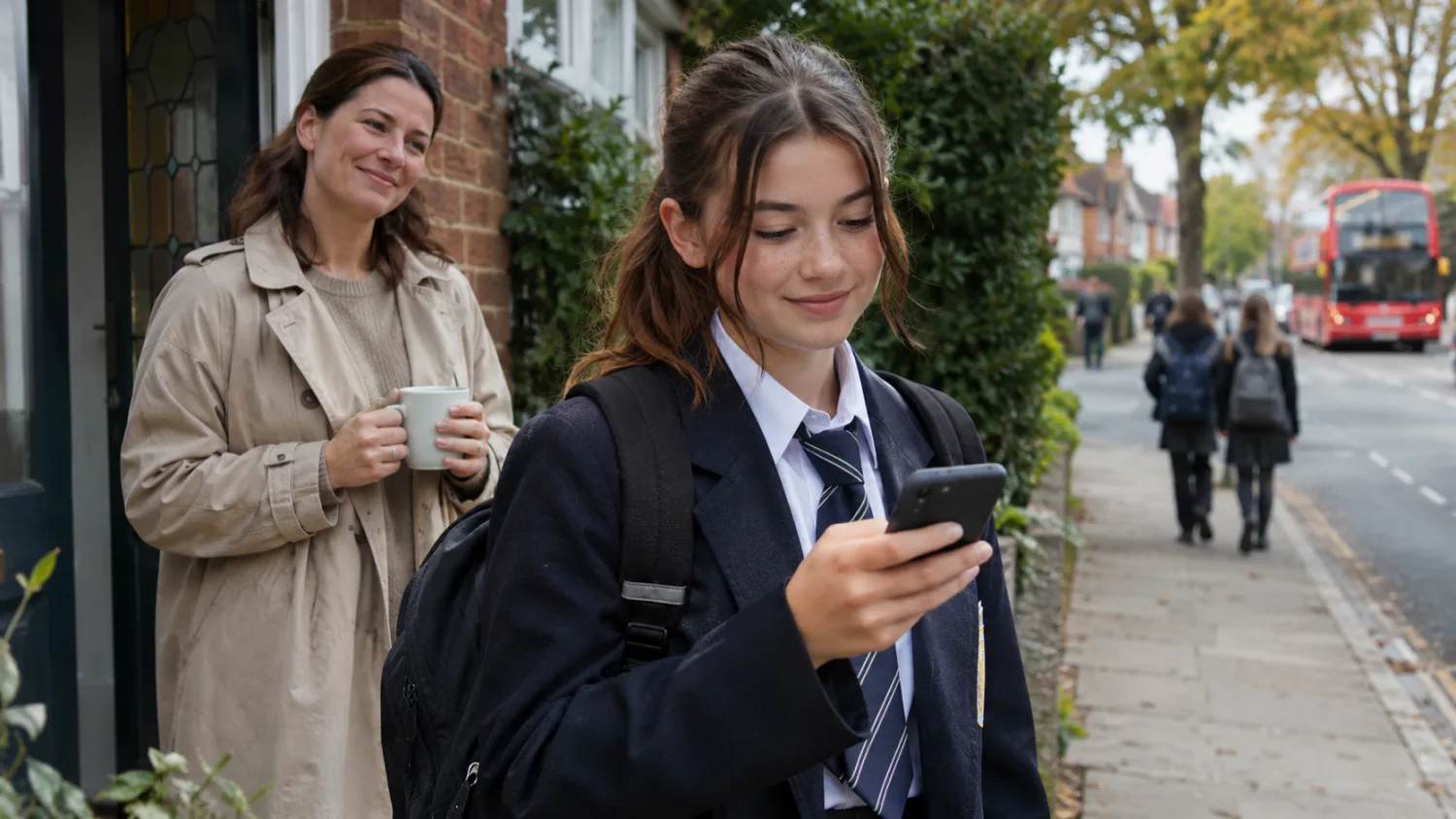
For many families, the first serious conversation about getting a child a phone begins with the journey to school.
Primary school may have meant walking together, driving or being collected at the gate.
Secondary school can look very different.
Your child may start walking alone.
They might take a bus.
They may travel with friends, change trains or arrive home before you do.
Suddenly, having a way to contact them feels much more important.
The obvious answer seems to be a smartphone.
But those are actually two separate decisions:
Does my child need a way to contact us while travelling?
and:
Does that mean they need a fully connected smartphone?
For some children, the answer to both will be yes.
For others, a basic phone, restricted smartphone or watch may provide the safety benefit parents want without immediately opening the door to unrestricted social media, gaming and constant notifications.
There is no universal age at which a child suddenly becomes “ready” for a smartphone.
The better decision depends on the journey, the child's maturity, your family's arrangements and what the phone will actually be used for.
Start with the journey rather than the child's age
A twelve-year-old who walks eight minutes along familiar residential streets has a very different journey from an eleven-year-old taking two buses across town.
Before deciding what device your child needs, think through the actual route.
Can they contact you if the bus is cancelled?
Do they sometimes have to change plans?
Will they arrive home to an empty house?
Does the route involve public transport, isolated sections or long waits?
If the journey is simple and predictable, the need for constant connectivity may be fairly small.
If travel is complicated, the practical case for some form of mobile phone becomes stronger.
This is particularly relevant around the move to secondary school. Ofcom's 2026 research found that smartphone ownership rises sharply around this transition: 56% of 10-year-olds owned a smartphone, increasing to 83% of 11-year-olds. Ofcom describes starting secondary school as a major tipping point for children's first smartphones. Ofcom's 2026 children's media research provides the wider context.
That does not mean children need a smartphone because their classmates have one.
It simply explains why this decision often arrives at exactly the same time as greater travel independence.
A phone can solve some genuine journey problems
There are good practical reasons for giving a child a phone.
A bus does not arrive.
The after-school club finishes early.
Your child misses the normal train.
They feel unsafe and want to call you.
You are unexpectedly delayed collecting them.
In those situations, a phone can be extremely useful.
It can also reduce the temptation for parents to prevent children from travelling independently simply because they are worried about not being able to make contact.
A sensible phone arrangement can therefore support independence rather than undermine it.
The NSPCC notes that phones can be useful for children travelling to school, while advising parents to consider limited-feature devices or parental controls when they want the communication benefit without unrestricted access. NSPCC guidance on children, phones and online safety discusses these options.
But safety does not automatically require a smartphone
This distinction is worth making carefully.
If your main reason for buying the device is:
“I want them to be able to call me if something goes wrong,”
then a basic phone may already solve the problem.
A simple device can provide:
- calls;
- text messages;
- emergency contact.
without necessarily giving access to TikTok, Snapchat, YouTube, games and a full web browser.
Another option is a smartphone that is technically capable of much more but initially configured with only the functions your child actually needs.
This allows families to add features gradually rather than going from no phone to unrestricted smartphone access overnight.
The NSPCC specifically suggests limited-feature phones as one option for parents who want their child to be contactable while travelling but are uncomfortable with broader smartphone risks.
For some families this is the most useful middle ground.
Check the school's phone policy before you buy anything
This has become particularly important in England.
Department for Education guidance on mobile phones became statutory in June 2026, with schools expected to follow it from September 2026.
The guidance says schools should normally be mobile-phone-free throughout the school day, including lessons, movement between lessons, breaktimes and lunchtime.
That does not mean pupils are necessarily forbidden from bringing a phone to school.
The government's own guidance recognises that children may need phones for travelling to and from school. It gives the example of schools using lockers so that pupils can still have a device available for the journey while not having access to it during the school day.
Different schools can therefore use different practical arrangements.
One school may require phones to remain switched off in bags.
Another may collect them.
Another may require lockers or secure pouches.
Before buying a phone specifically for secondary school, read the school's current policy.
There is little benefit in choosing a device based around features your child will not be permitted to access for seven hours each day.
For more background on school rules, see Dealing With Mobile Phones in the Classroom.
Location tracking can reassure parents, but it can also become too much
Location sharing is one of the strongest arguments parents make for smartphones.
Being able to check that your child has reached school or is on the normal route home can be reassuring.
Used sensibly, it can be useful.
But there is a difference between:
“Let me know if your bus is delayed.”
and:
“I am watching your location every minute of the journey.”
A child cannot develop much independence if every small deviation immediately generates a message from home.
One reasonable family arrangement might be to use location sharing as backup rather than continuous surveillance.
You may agree that your child contacts you if plans change and that you check their location only if they are unusually late or cannot be reached.
As children become older, involve them in that discussion.
The goal is not simply to know where they are.
It is to help them learn how to manage a journey safely themselves.
The phone itself can create risks during the journey
A smartphone may make a journey safer in one way while making it less safe in another.
A child staring at a screen may be less aware of traffic, crossings, cyclists or people around them.
Headphones can make the problem worse if they block environmental sound.
There is also the simple risk of theft or loss, particularly if an expensive phone is openly carried at a bus stop or railway station.
So one of the most useful rules is:
the phone should support the journey, not occupy the journey.
Children should learn to stop walking before looking at a map or sending a message.
Phones should stay away while crossing roads.
If headphones are used, volume should still allow awareness of the surroundings.
And there is rarely any reason for a child to walk home watching videos.
Those habits matter more than whether the phone itself is an expensive model or a basic handset.
A smartphone also brings the internet into every unsupervised moment
The journey-to-school argument can make it easy to think of a smartphone simply as an emergency communication device.
It is not.
It is also an internet-connected entertainment and social device that may travel everywhere with the child.
Ofcom's latest research shows how significant that shift can become. Children aged 8 to 14 spend close to three hours online per day on smartphones, tablets, laptops and computers, with usage increasing as children become older. Smartphone ownership also rises steeply around secondary-school age.
This does not mean smartphones inevitably harm children.
It does mean that buying one “for the journey” often creates decisions that have nothing to do with transport.
Can they install social-media apps?
Can they use the phone in their bedroom?
What happens at bedtime?
Can they join class group chats?
Who can contact them?
How are purchases controlled?
If you are ready for the journey but not ready for all of those questions, restrict the device initially.
For more on balancing independence with supervision, see How to Check Your Child Is Safe Online Without Spying.
Group chats may become more important than the phone call you bought it for
Many parents buy a phone because they imagine their child calling to say:
“The bus is late.”
The child may quickly become much more interested in the Year 7 WhatsApp group.
That is not necessarily a problem.
Group chats can help pupils arrange meeting points, discuss homework and maintain friendships.
They can also become noisy, distracting and difficult.
Messages may continue late into the evening.
Arguments that begin at school can continue all night.
Children can feel pressured to respond immediately.
Embarrassing photographs can travel quickly.
A child who was given a phone mainly for safety may therefore need considerably more guidance about messaging than about phone calls.
Talk about this before the first problem occurs.
Make it clear that leaving, muting or showing you a troubling conversation is not a failure.
And avoid creating a situation where your child believes asking for help will automatically result in the phone being permanently confiscated.
If the only consequence of telling you about an online problem is losing the device, children have a strong incentive not to tell you next time.
Readiness matters more than keeping up with classmates
One of the hardest pressures comes from:
“Everyone else has one.”
At secondary-school transition, that may increasingly be true. Ofcom's 2026 figures show how quickly ownership rises between ages 10 and 11.
But popularity does not determine readiness.
A child may be ready if they can reliably look after possessions, follow agreed rules, tell you when something online worries them and accept that the phone may sometimes be restricted.
A child who repeatedly loses their coat, forgets their school bag and cannot stop using a shared tablet when asked may need a more limited first device.
There is nothing wrong with treating smartphone access as something that grows with responsibility.
You might begin with calls, texts and maps.
Later, allow selected messaging.
Social-media apps can come later again if you decide they are appropriate.
This makes the phone a developing responsibility rather than a one-time decision that is impossible to revisit.
Agree the family rules before handing over the phone
Rules work better when they exist before the first argument.
They do not need to form a two-page contract.
A few clear expectations are usually enough.
For example:
- the phone stays away while crossing roads;
- school rules are followed without argument;
- parents are told if travel plans change;
- new apps need discussion first;
- the phone does not stay in the bedroom overnight.
Your rules will depend on your child and family.
The important thing is that the phone arrives with expectations attached.
Do not wait until midnight scrolling, inappropriate messages or school confiscation have already become problems.
The NSPCC recommends setting boundaries, discussing safe use and having regular conversations rather than relying entirely on technical controls.
Technical controls can help.
They cannot replace judgement.
Teach the journey before relying on the phone
A phone should be backup.
It should not be the child's entire travel plan.
Before independent travel begins, practise the route together.
Your child should know where to get off without relying entirely on GPS.
They should know what to do if they miss the bus.
They should have at least one important phone number available somewhere other than only inside a locked device.
They should know where they can go for help.
And they should understand what to do if the phone is lost, flat or has no signal.
A child who cannot get home without Google Maps is less independent than they appear.
The phone should make an already-understood journey more resilient.
It should not replace basic travel confidence.
If your child is preparing for the move to secondary school more generally, see What to Do in the Summer Before Starting Secondary School.
So, should your child have a smartphone?
If your child is beginning to travel independently, having some way to contact home is often sensible.
Whether that needs to be a smartphone is a separate question.
A smartphone makes good sense where maps, changing public transport, family location sharing or messaging are genuinely useful and the child is ready for the wider responsibility.
A basic phone may make more sense where the main requirement is simply:
“Call me if something goes wrong.”
A restricted smartphone may offer the best compromise for many families.
There is also no requirement to make the final decision forever.
You can start small.
See how your child handles it.
Then loosen restrictions as their judgement and independence develop.
Frequently asked questions
What age should a child get their first smartphone?
There is no official recommended age that suits every child. Consider why they need the phone, their maturity, their journey and whether they can follow agreed boundaries.
Does my child need a smartphone for secondary school?
Not necessarily. Many families find a phone useful because pupils travel more independently, but communication can also be provided through a basic phone or restricted device.
Can children take phones into school in England?
School policies differ in how phones are stored, but current statutory DfE guidance says schools should prohibit access to and use of mobile phones throughout the school day by default. The guidance recognises that pupils may still have a phone available for travelling to and from school.
Can a school confiscate my child's phone?
Schools can enforce their behaviour and mobile-phone policies and may use confiscation as part of those arrangements. Parents should check the particular school's published rules.
Is a basic phone enough for the journey to school?
For many children, yes. If the main purpose is calls and emergency contact, a feature phone may provide everything required.
What are the advantages of a smartphone?
Useful functions can include calling, messaging, maps, live transport information and location sharing. The disadvantage is that the same device also provides continuous access to apps, games, social media and the wider internet.
Should I track my child's location?
Location sharing can be useful, particularly when independent travel is new. Try to use it as a safety tool rather than a substitute for gradually trusting your child to manage the journey themselves.
Should my child use headphones while walking to school?
They should remain able to hear traffic and stay aware of their surroundings. Looking at the screen or using headphones should never interfere with safe road crossing.
What if everyone else in the class has a smartphone?
That may create social pressure, but it does not decide what is appropriate for your child. You can also explain that having a phone and having unrestricted access to every app are different things.
Can I give my child a smartphone without social media?
Yes. Smartphones can be configured with parental controls and limited apps. Some families introduce functions gradually rather than enabling everything immediately.
Should the phone stay in the bedroom overnight?
Many families choose to charge phones outside children's bedrooms. This can reduce late-night messaging and scrolling. Ofcom's research shows that a noticeable proportion of children's use of major apps occurs during late-night hours.
What if my child loses the phone?
Make sure they know what to do without it. They should know the route, have an alternative way to contact you where possible and understand where to seek help.
Is a smartwatch a good alternative?
It can be for some families, particularly where calls and location features are the main priorities. Check the school's policy first because current DfE guidance can also cover other smart communication devices, not just phones.
What is the best first phone for a child?
The best device is not necessarily the cheapest or most sophisticated. It is the one that provides the functions your child genuinely needs while giving them a level of responsibility they are ready to manage.
A child travelling independently does not necessarily need the entire internet in their pocket.
They may simply need a reliable way to say:
“The bus didn't arrive. I'm going to be twenty minutes late.”
For some families, a smartphone will be the most practical way to provide that.
For others, a simpler device will do the job better.
Start with the journey.
Think about what your child actually needs.
Check the school's rules.
Set expectations before the phone is handed over.
And remember that learning to travel independently is itself a skill.
The phone should support that independence—not become the thing your child cannot function without.