
Learning pupils’ names sounds like one of the simplest parts of starting a new class.
Then thirty children arrive at once.
Some have similar names. Some prefer a shortened version. Some names are unfamiliar to you. A few pupils change seats. You teach several classes in a day. By the end of the first lesson, you confidently remember five names, vaguely remember another ten and realise you have been calling one pupil by somebody else’s name for twenty minutes.
This is normal.
But learning names quickly is worth the effort.
A pupil hearing their own name used accurately can feel noticed in a way that “you at the back” never achieves. Knowing names also makes classroom management easier, improves questioning, helps you notice patterns and makes interactions with pupils more personal without requiring elaborate relationship-building activities.
For secondary teachers, the challenge can be much greater. You may be learning 150 or 200 new names across several classes rather than thirty. You may only see some groups two or three times a week. In that situation, hoping names will eventually stick is not much of a strategy.
The aim is not simply to memorise a register as fast as possible.
It is to connect names with actual pupils and then use those names in ways that support learning, belonging and clear classroom routines.
Start with the register before pupils arrive
You do not have to begin from zero when the class walks through the door.
If you have access to the class list beforehand, spend a few minutes becoming familiar with it.
Look at the names before the first lesson
You might notice:
- two pupils with the same first name;
- similar surnames;
- names you are unsure how to pronounce;
- preferred names recorded by school;
- pupils you already know from another context.
This gives your brain a framework before you attach faces to the names.
You do not need to memorise the entire register before meeting the class. Even recognising ten or fifteen names when you first hear them can make the learning process easier.
Check whether the register reflects the name the pupil actually uses
School information systems do not always tell the whole story.
A pupil might:
- use their middle name;
- prefer a shortened first name;
- use a different form of their name from the one shown on the register;
- have a pronunciation you would not know from reading it;
- have an agreed preferred name recorded elsewhere in the school system.
Where your school's systems contain an established preferred name, use that information. Otherwise, ask the pupil.
Do not guess pronunciation when you are unsure
You can simply say:
“Can you tell me how you pronounce your name?”
Then repeat it back.
If necessary, ask again later.
You might quietly make a phonetic note on your register or seating plan if that helps.
A pupil would usually rather correct you while you are genuinely trying to learn than hear their name mispronounced for the rest of the term.
Do not automatically shorten names
If the register says Alexander, do not assume the pupil uses Alex.
If a name is unfamiliar to you, do not invent an easier version for your own convenience.
Ask what the pupil prefers to be called and use that consistently.
Use a seating plan as a memory tool
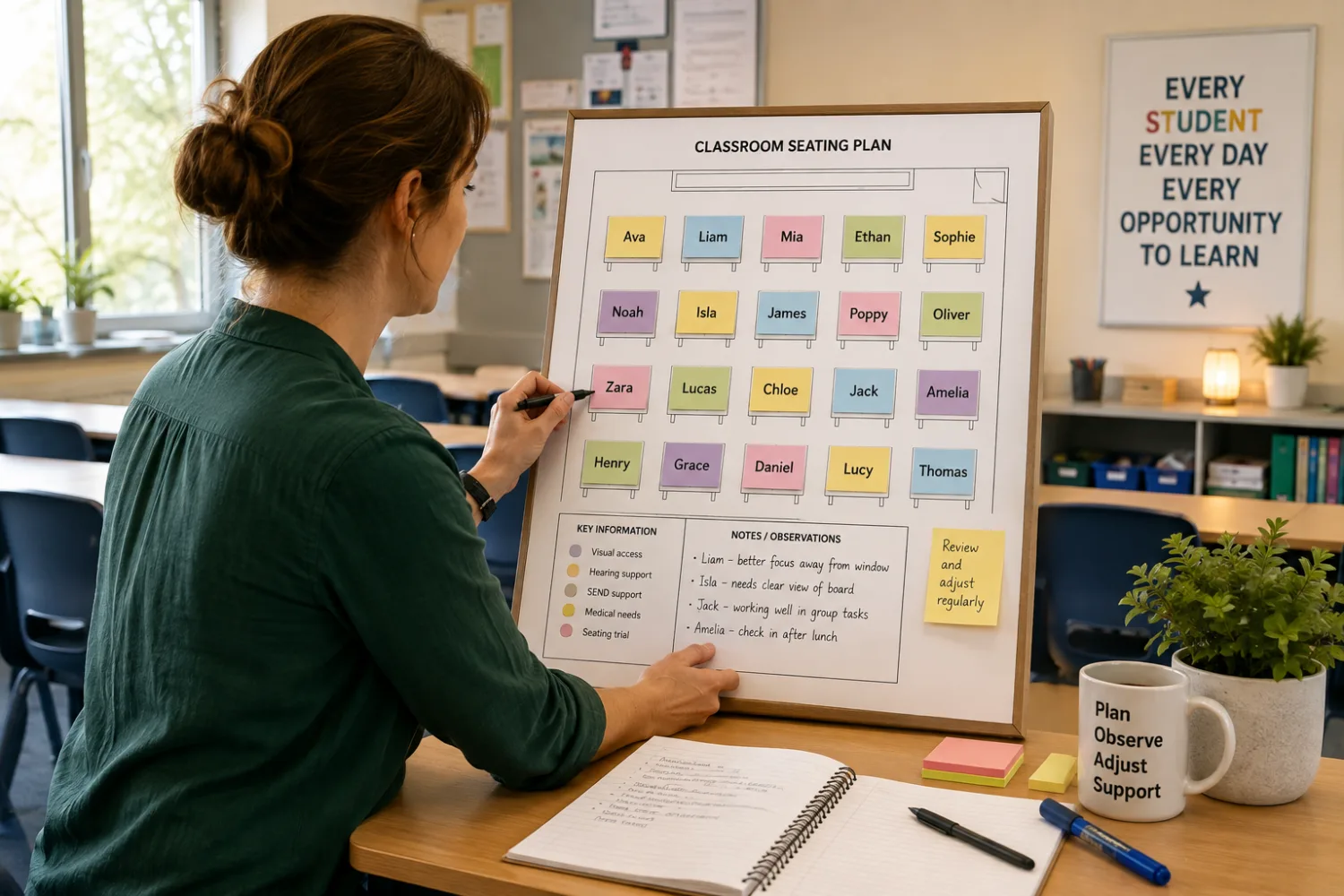
A seating plan can dramatically speed up name learning because it gives every name a physical location.
Instead of remembering thirty unrelated pieces of information, you begin to remember:
“Amelia sits second row, left.”
“Joshua is beside Daniel.”
“Priya is near the window.”
The combination of face, location and name creates several memory cues instead of one.
Keep the first seating plan stable for a few lessons if you can
If pupils change seats every lesson during the first week, learning names becomes much harder.
That does not mean the seating plan should remain fixed permanently.
Use it as temporary structure while you learn the class.
Once you know more about how pupils work together, change it where there is a reason.
The AllSchools guide to making seating plans that can change as you learn more explains how to treat the first plan as a working hypothesis rather than a permanent judgement.
Print a copy you can annotate
A simple working plan might include:
- first name;
- surname initial where necessary;
- pronunciation note;
- preferred name;
- brief essential classroom information where appropriate.
Do not turn the seating plan into a page of labels about behaviour, attainment or personality.
Its purpose here is mainly to connect person, name and place.
Look at the pupil before looking at the plan
This matters.
If you automatically read the seating plan before addressing anybody, you can become very good at reading names without actually remembering them.
Instead:
- look at the pupil;
- try to retrieve the name;
- pause briefly;
- check the plan if necessary;
- use the name.
The small effort involved in trying to remember strengthens the memory.
Use temporary name cards if they help
Folded desk cards can be particularly useful with a new class.
Ask pupils to write the name they want you to use in large letters.
Name cards are not a sign that you have failed to learn the class. They are simply scaffolding.
Remove them once you no longer need them.
Use names actively throughout ordinary teaching
The fastest way to remember names is active retrieval.
Do not wait until the end of the lesson to discover how many names happened to stick.
Use names when greeting pupils
If practical:
“Morning, Ellie.”
“Come in, Hassan.”
“Good morning, Mia.”
Even if you can only confidently greet five pupils by name during the first lesson, that is five extra repetitions.
Use the name when responding to an answer
Instead of:
“Yes, correct.”
try:
“Yes, Noah—that is exactly the point.”
Or:
“Interesting idea, Ruby. What made you think that?”
You are strengthening the name-face connection while acknowledging the pupil's contribution.
Use names when circulating
These interactions are particularly useful because they involve pupils who may not volunteer answers.
For example:
“How are you getting on, Zara?”
“Show me what you've tried, Isaac.”
“You're on the right track, Grace.”
Try to use a few names deliberately during each circulation around the room.
Use names as pupils leave
The end of a lesson gives you another retrieval opportunity:
“See you tomorrow, Freya.”
“Thanks, Lewis.”
“Good work today, Aisha.”
Greeting and dismissal together create two natural name-learning points without adding anything to lesson time.
Use names naturally, not constantly
There is no need to sound like a salesperson who has just been taught the importance of using the customer's name.
“So, Oliver, what do you think, Oliver? Good answer, Oliver.”
quickly sounds strange.
Names are most effective when they add clarity, acknowledgement or personal connection.
Follow a five-day name-learning routine
If you want to learn a class quickly, it helps to have a deliberate routine rather than relying on memory alone.
The following five-day approach takes only a few extra minutes each day and can be adapted for primary teachers learning one class or secondary teachers learning several.
Day 1: Build the first face-name connections
Before the lesson:
- Read the register once or twice.
- Look particularly at names you are unsure how to pronounce.
- Have the seating plan or name cards ready.
During the lesson:
- Check pronunciation while taking the register.
- Use as many pupil names as you can naturally.
- Do not worry if you still rely heavily on the seating plan.
- Notice names attached to memorable contributions.
After the lesson:
Close the register.
Write down every name you can remember.
Then compare your list with the actual class.
You might remember 8 out of 30. That is fine.
Now identify five pupils whose names you want to deliberately retrieve next lesson.
The objective on day one is not perfection. It is to create the first set of strong associations.
Day 2: Retrieve before checking
Before pupils arrive:
Look at the empty seats and attempt to name who sits in each one before checking the plan.
Spend perhaps 60–90 seconds doing this.
As pupils enter:
Try to greet several without looking at the register.
If you forget:
“Remind me—it's…”
Let the pupil supply the name, then repeat it.
During the lesson:
Make a deliberate effort to use the names of pupils you failed to remember yesterday.
You might privately choose six targets before the lesson.
This prevents the confident, talkative pupils from receiving all the repetitions.
After the lesson:
Try the blank-list exercise again.
You may now remember 15 or 20.
Day 3: Focus on the names that are not sticking
By the third lesson, some names will feel automatic.
Do not spend your memory effort on those.
Identify the pupils whose names still produce hesitation.
They are often:
- quieter pupils;
- pupils sitting in less visible areas;
- pupils who have been absent;
- pupils with similar names;
- pupils you have interacted with less frequently.
During the lesson:
Create one normal interaction with each target pupil.
For example:
“Daniel, which example did you choose?”
“Everything clear so far, Niamh?”
“Thank you, Yusuf.”
You are not inventing praise or asking pointless questions merely to use a name. You are deliberately making ordinary teaching interactions more evenly distributed.
At the end:
Look around the room as pupils leave and try to name everyone mentally.
Day 4: Remove some of the scaffolding
By day four, challenge yourself to rely less on the seating plan.
You might place it on the desk rather than holding it.
Try:
- taking the register while looking mainly at pupils;
- greeting without checking names first;
- cold calling or directing questions using remembered names;
- identifying pupils when circulating without looking at the plan.
When you cannot remember, check.
There is no benefit in turning memory practice into guesswork.
If several pupils have similar names, deliberately practise distinguishing them.
For example:
“Sophie sits beside Amelia; Sophia sits near the window.”
Small relational cues can help.
Day 5: Test whether you really know the class
Before the lesson, take a blank sheet of paper.
Draw a rough version of the classroom.
Write pupils' names into their seats from memory.
Then check the real plan.
This immediately reveals remaining gaps.
During the lesson, try to use names without relying on visible prompts.
At the end, ask yourself:
- Which names are now automatic?
- Which still require effort?
- Which quieter pupils have I barely interacted with?
- Whose pronunciation do I still need to check?
- Am I using certain pupils' names mainly when correcting them?
By this point, many primary teachers will know most or all of the class.
A secondary teacher with several groups may not, and that is entirely reasonable. Repeat the same cycle the next time you see each class.
If you teach many classes, use micro-sessions
A secondary teacher may not have time to rehearse 180 names at once.
Do not try.
Before each class arrives, spend one minute on that class only.
After they leave, spend another minute retrieving names.
Two focused minutes repeated across several lessons are more manageable than one huge memorisation session at the end of the day.
Do not keep testing after the names are secure
The routine is temporary.
Once you recognise pupils automatically, stop rehearsing names as a separate task and use the mental capacity for the thing that matters more: learning about the pupils behind those names.
Connect names with something meaningful
Memory improves when information is connected to other information.
A name on a register is abstract.
A name attached to an interaction is easier to remember.
Connect pupils with contributions
You might remember:
“Ben was the pupil who explained the denominator misconception.”
or:
“Leila noticed the pattern in the graph.”
or:
“Rory had an interesting question about the source.”
This gives each name an additional anchor.
Use subject-related information rather than trivia
Traditional name games sometimes ask pupils to remember an arbitrary fact:
“I'm Jessica and I like jelly.”
That may work as a memory technique, particularly with younger pupils, but you can often learn more useful information at the same time.
For example:
“I'm Maya and the topic I liked most last year was electricity.”
or:
“I'm Harry and I find extended writing difficult.”
Only use this where appropriate and avoid forcing pupils to publicly disclose difficulties.
Avoid memory hooks based on sensitive or embarrassing characteristics
Do not mentally reduce pupils to:
- “the very tall one”;
- “the pupil with the scar”;
- “the badly behaved one”;
- “the child with ADHD”.
Use neutral contextual information such as seating position, contribution, subject interest or a classroom interaction.
Learn surnames too where useful
In some classes, several pupils share the same first name.
Knowing surnames also helps with:
- registers;
- school information systems;
- parent communication;
- distinguishing pupils across classes;
- finding work or records quickly.
You do not necessarily need to address pupils by surname, but recognising the full name is valuable.
Make an extra effort with quieter pupils and accurate pronunciation
The pupils whose names teachers learn first are often the pupils who speak most.
That creates an obvious problem.
By the end of week one, you may know every pupil who has called out and still hesitate over the names of children who quietly complete everything you ask.
Deliberately retrieve quieter pupils' names
Use low-pressure interactions:
“How are you getting on, Sara?”
“Have you got what you need, Theo?”
“Which answer did you choose, Erin?”
These interactions help you learn names while also ensuring that your attention is not dominated by the most vocal pupils.
Do not use names only when correcting behaviour
If one pupil mainly hears:
“Charlie, stop talking.”
“Charlie, turn around.”
“Charlie, that's enough.”
their name gradually becomes associated with correction.
Look for ordinary interactions too:
“Thank you, Charlie.”
“What did you get for question four, Charlie?”
“That's clearer, Charlie.”
This does not mean manufacturing praise.
It means allowing the pupil's name to exist outside moments of difficulty.
Keep working on pronunciation
Some teachers worry so much about mispronouncing an unfamiliar name that they avoid using it.
That makes learning harder and can leave the pupil feeling conspicuously unnamed.
Ask:
“I want to make sure I'm saying your name properly. Can you say it again for me?”
Repeat it back.
If necessary, make a private phonetic note.
Do not replace a name because it is difficult for you
Teachers routinely learn:
- specialist vocabulary;
- scientific terminology;
- new software;
- historical names;
- authors' surnames;
- technical acronyms.
A pupil's name deserves the same effort.
Accept correction without defensiveness
If a pupil says:
“It's pronounced differently.”
the useful response is:
“Thank you. Say it again for me.”
Then try again.
Be open when you forget or get a name wrong
You will forget names.
That is not a professional failure.
The more classes you teach, the more likely it is.
Ask again rather than bluffing
Simply say:
“Remind me of your name—I want to make sure I get it right.”
Then immediately use it:
“Thanks, Layla. Show me what you've written.”
The retrieval becomes stronger because you have just connected the answer with an interaction.
Avoid elaborate ways of hiding that you forgot
Teachers sometimes develop elaborate avoidance techniques:
“Could you answer this?”
“What do you think?”
“Can someone on this table explain?”
These are fine occasionally, but if you are avoiding a particular pupil's name because you cannot remember it, ask.
Do not turn your mistake into the pupil's problem
Avoid comments such as:
“You all look the same from the back.”
or:
“Your names are impossible.”
The difficulty belongs to the person learning, not to the child whose name is being learned.
Correct mistakes briefly
If you use the wrong name:
“Sorry—Sofia, not Sophie.”
Then continue.
A straightforward correction is normally better than a long apology that turns a tiny mistake into a classroom event.
Use names to strengthen questioning and participation
Once you know names, questioning becomes much easier to manage deliberately.
Usually ask the question before naming the pupil
A useful sequence is:
- ask the question;
- give thinking time;
- then select somebody.
For example:
“Why do you think the character makes that decision?”
Pause.
“Maya?”
Everyone has a reason to think because nobody knows who will be asked until after the question.
Use names to distribute participation
Knowing the class lets you notice whether you repeatedly choose:
- the same confident pupils;
- the pupils nearest the front;
- those whose hands go up fastest;
- one side of the classroom;
- pupils whose names you happened to learn first.
That final point matters.
Teachers can unintentionally ask more questions of pupils whose names they remember easily. Learning everybody's name therefore supports more equitable participation.
Use names to follow up previous thinking
Once you recognise pupils reliably, you can make useful connections:
“Yesterday, Noah suggested that the character was acting out of fear. Has today's chapter changed your view?”
or:
“Amira, you used a different method for this last lesson. Would it work here?”
That communicates that contributions do not disappear the moment the lesson ends.
Do not use names to create unnecessary fear
Cold calling can be useful when classroom culture makes it safe to think aloud, hesitate and make mistakes.
It becomes less useful when the main purpose appears to be catching pupils who were not listening.
Use names to invite thinking rather than create a constant threat of embarrassment.
Use names for behaviour calmly and precisely
Knowing names makes behaviour correction clearer.
Instead of addressing half the room:
“Can everyone stop talking?”
you can address the actual issue:
“Jamie and Oliver, I need you listening now. Thank you.”
Keep the tone neutral where possible
A pupil's name does not need to be shouted across the classroom.
Often a quiet:
“Daniel.”
combined with eye contact is enough to redirect attention.
Use names before behaviour escalates
Names can support low-level redirection:
“Mia, back to question three.”
“Aaron, pens down and eyes this way.”
“Sophie, chair facing forward please.”
These instructions are clearer than a whole-class reminder when only one or two pupils need correction.
Do not publicly attach a behavioural identity to the name
Avoid statements such as:
“Here we go again, Jack.”
or:
“I was warned about you, Lewis.”
A new year or new class gives pupils an opportunity to establish a fresh relationship with the teacher.
Use what you need to know from previous information, but do not allow a pupil's name to arrive already attached to a public reputation.
The AllSchools guide to what every teacher should know about their new class covers how to use previous information without allowing it to become a permanent judgement.
Avoid an automatically irritated tone
Teachers can eventually develop a particular way of saying the names of pupils who frequently need correction.
The pupil hears:
“Ryan…”
and knows from the tone alone that the interaction is negative.
Reset when you can.
Use the pupil's name normally in positive, neutral and instructional interactions too.
Use names to notice pupils, not just manage them
The greatest value of learning names may be in ordinary moments rather than formal questioning or behaviour management.
Notice effort
“You stuck with that difficult question, Evie.”
Notice improvement
“That's much clearer than your first explanation, Marcus.”
Notice uncertainty
“You look unsure, Hawa. Which step is causing the problem?”
Notice absence and return
“Good to have you back, Leo.”
Notice pupils who might otherwise disappear into the class
Some pupils make themselves easy to notice.
Others:
- rarely volunteer;
- complete work quietly;
- cause no behaviour problems;
- rarely ask for help;
- sit somewhere less visible.
Knowing their names makes it easier to deliberately include them.
For example:
“How did you approach that, Ethan?”
or:
“I haven't heard your view yet, Fatima. What do you think?”
That is different from calling on pupils constantly. It simply prevents quietness from becoming invisibility.
Let praise remain specific
Knowing a name allows you to say:
“Good work, Thomas.”
But even better is:
“Thomas, that second paragraph is much clearer because you've used evidence to support the point.”
The name makes the feedback personal.
The specificity makes it useful.
Do not confuse knowing names with knowing pupils
Learning thirty names is an important beginning.
It is not the same as understanding thirty pupils.
A name does not tell you:
- what the pupil knows;
- what they have forgotten;
- what they find difficult;
- how confident they are;
- how they respond to challenge;
- what support they need;
- how they interact with peers;
- what motivates them.
That picture develops through teaching.
Use the first two weeks to connect names with learning
As you observe pupils, begin building richer associations:
“Emily explains ideas confidently but hesitates with extended writing.”
“Zain understands the concept but rushes calculations.”
“Lucy rarely volunteers but gives strong answers when asked.”
“Marcus asks for reassurance before beginning even when he understands the task.”
This is much more useful than simply remembering who is “good”, “quiet” or “difficult”.
The AllSchools guide First-Day Activities That Reveal What Pupils Know Without Feeling Like a Test offers practical ways to begin gathering useful information from normal classroom activities.
Expect your first impressions to change
The pupil who says nothing in lesson one may become one of your most confident contributors.
The pupil who appears exceptionally confident may turn out to be masking uncertainty.
Two pupils who seem incapable of working beside one another may settle once routines are established.
The goal of learning names quickly is not to categorise pupils quickly.
It is to make it easier to notice them accurately over time.
Frequently asked questions
How quickly should a teacher learn pupils' names?
There is no fixed standard. A primary teacher may learn most of one class within several days, while a secondary teacher teaching hundreds of pupils will naturally need longer. Aim for steady progress rather than pretending to know names you have forgotten.
What is the fastest way to learn a class's names?
A stable seating plan combined with active retrieval is one of the most practical methods. Look at the pupil, attempt to remember the name, check the plan only if necessary and then use the name naturally.
Can I learn 30 pupil names in a week?
Many teachers can, particularly when they see the class every day. A deliberate five-day routine of reviewing the seating plan, retrieving names, greeting pupils and testing yourself after lessons can make the process substantially faster.
What if I teach 150 or 200 pupils?
Work class by class. Spend a minute reviewing one group's names immediately before they arrive and another minute retrieving them afterwards. Expect the process to take longer for classes you see less frequently.
Are name cards useful?
Yes. Temporary desk cards can make the first few lessons much easier. They should be viewed as scaffolding rather than something a teacher must avoid.
Should pupils sit in the same seats until I know their names?
Keeping seats reasonably stable initially helps, but do not preserve an arrangement that clearly causes an access, learning or behaviour problem merely for the sake of memorising names.
What should I do if I keep forgetting one pupil's name?
Deliberately create a few normal interactions with that pupil and retrieve the name each time. Quieter pupils often take longer to learn simply because teachers have fewer reasons to naturally use their names.
What if I cannot pronounce a pupil's name?
Ask them. Repeat the pronunciation and make a private phonetic note if necessary. Keep practising rather than avoiding the name or replacing it with something easier for you.
Is it rude to ask a pupil their name again?
No. It is generally much better to ask than repeatedly use the wrong name. “Remind me of your name—I want to get it right” is enough.
Should teachers use surnames?
This depends on school culture and personal practice. Knowing surnames is useful even when pupils are normally addressed by first name, especially where several pupils share a first name.
Can using pupils' names help behaviour?
Yes. Names allow teachers to give specific, calm directions rather than making vague whole-class corrections. They work best when pupils also hear their names in neutral and positive contexts rather than only when something has gone wrong.
Should I use a pupil's name before or after asking a question?
Often it is useful to ask the question first, allow thinking time and then select the pupil. That encourages the whole class to consider the question rather than only the pupil whose name was announced first.
What if I accidentally call a pupil by the wrong name?
Correct yourself briefly and continue. Teachers make mistakes while learning a new class. A straightforward correction and genuine effort to remember next time are usually enough.
Why does learning names matter so much?
Names make classroom interactions more precise and personal. They support questioning, feedback, behaviour, participation and the teacher's ability to notice pupils who might otherwise remain in the background.
You do not need a remarkable memory to learn pupils' names.
You need a system and repeated retrieval.
Look at the register before the lesson. Use a seating plan. Learn how pupils want their names pronounced. Try to retrieve a name before checking it. Use names when greeting, questioning, helping and saying goodbye. Test yourself after lessons. Pay particular attention to pupils whose names are not sticking.
For the first five days, make the process deliberate.
Then allow it to disappear into normal teaching.
And when you forget, ask.
Within a surprisingly short time, the register stops looking like a list of unfamiliar names and starts looking like your class.
That shift matters.
Because once you can say:
“Ella, show me how you worked that out,”
or:
“Amir, I noticed you kept going with that even when it was difficult,”
you are doing more than demonstrating that you remembered a name.
You are showing the pupil that you noticed them.