
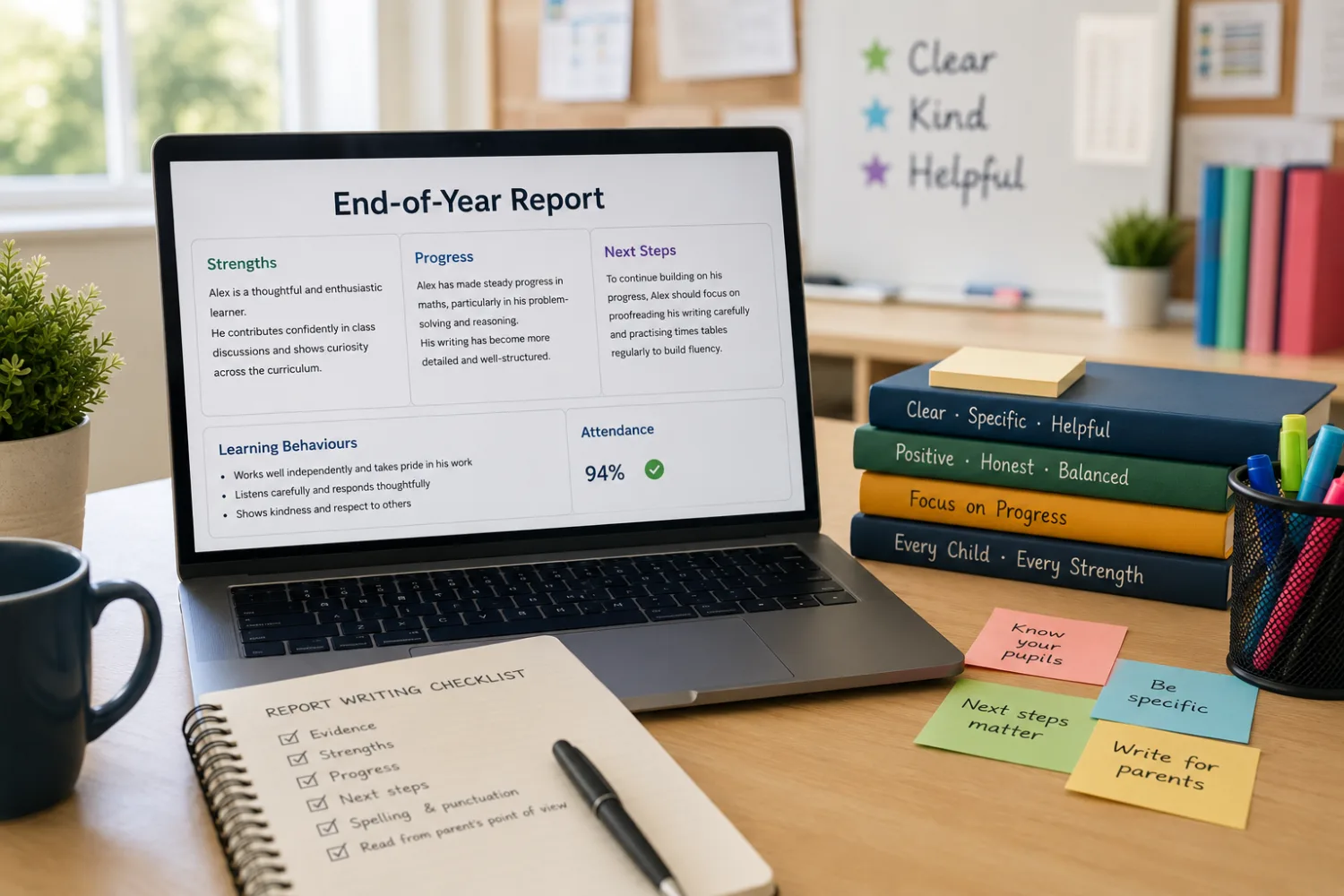
End-of-year reports matter. For many parents, they are the clearest written summary they receive of how their child is doing at school. A good report can reassure, explain, celebrate progress, flag concerns and point families towards useful next steps.
But reports are also one of the most time-consuming tasks in the school year. They often arrive at the worst possible moment: assessments, transition, trips, sports days, exam season, behaviour pressure, end-of-year events, staffing changes and tired pupils all competing for attention.
The challenge is not simply writing reports quickly. It is writing them efficiently without making them bland, inaccurate or unhelpful. Parents can usually spot a copy-and-paste report. Teachers can usually feel when a report-writing system is wasting time. Schools need a better middle ground: reports that are personal enough to be useful, clear enough for parents to understand, and manageable enough for staff to complete without losing evenings and weekends unnecessarily.
This guide explains how teachers and school leaders can write end-of-year reports faster without losing quality. It covers preparation, structure, comment banks, workload, tone, proofreading, common mistakes and practical templates.
Start with the purpose of the report
The fastest way to write better reports is to be clear about what they are for.
An end-of-year report should usually tell parents:
- what the pupil has achieved;
- how they are progressing;
- where their strengths are;
- what they still need to improve;
- how they approach learning;
- whether there are concerns about attendance, effort, behaviour or confidence;
- what the next step should be.
It does not need to describe every topic taught. It does not need to include every assessment detail. It does not need to prove how hard the teacher has worked. It should give parents a clear, fair, useful picture of their child.
When the purpose is unclear, reports become too long, too generic or too full of school language. When the purpose is clear, writing becomes easier.
Quality does not mean length
Longer reports are not automatically better. A short, accurate, specific report is more useful than a long paragraph full of vague praise.
Compare these two comments:
Oliver has had a good year and has worked hard across the curriculum. He has made progress in many areas and should continue to try his best next year.
This sounds positive, but it tells the parent very little.
Oliver has grown in confidence when explaining his maths reasoning. He now uses diagrams to help solve multi-step problems, but he still needs to practise recalling multiplication facts quickly so that this does not slow him down.
The second comment is not much longer, but it is far more useful. It names the subject, strength, progress and next step.
Good report writing is not about saying more. It is about saying the right thing clearly.
Use a simple structure for every comment
Teachers lose time when every report begins from a blank page. A simple structure speeds up writing and improves consistency.
A useful structure is:
- Strength: what the pupil does well.
- Progress or evidence: how you know.
- Next step: what would help them improve.
For example:
Aisha writes with imagination and is beginning to choose vocabulary more deliberately. Her recent narrative work showed stronger description and clearer paragraphing. Next year, she should focus on checking punctuation carefully when editing her work.
This structure works because it is balanced. It is neither a list of praise nor a list of problems. It gives parents something concrete to understand.
Prepare before report season starts
Reports take longer when teachers have to reconstruct a whole year from memory. The best time-saving happens before the writing begins.
Throughout the year, keep brief notes that will help later. These do not need to be extensive. A few words can be enough:
- “Excellent oral explanations in science.”
- “Avoids extended writing unless scaffolded.”
- “Much more confident reading aloud.”
- “Homework inconsistent since February.”
- “Strong practical work, needs written accuracy.”
- “Kind group leader in project work.”
If you teach many pupils, quick notes after assessments, parents’ evenings, intervention reviews or pupil progress meetings can save hours later.
For schools reviewing pupil progress before reports, How to Run a Pupil Progress Meeting Efficiently may help keep evidence focused and useful.
Do not write reports from raw data alone
Assessment data can help, but it should not write the report for you. A grade, test score or tracker judgement does not explain the child behind it.
For example, two pupils may both be “working at expected standard”, but one may be very secure and ready for greater challenge, while the other may be just meeting the standard with significant support. One may have made excellent progress from a low starting point. Another may be coasting.
Parents need the meaning behind the data. If your school uses language such as “working towards”, “working at expected standard” or “greater depth”, make sure the report explains what this means in practical terms.
For parent-facing context, link families to What “Working at Expected Standard” Actually Means where appropriate.
Create a comment bank, but do not let it write the report
Comment banks can save time, but they can also produce lifeless reports if used badly. The trick is to use them as building blocks, not finished comments.
A good comment bank contains flexible phrases that can be personalised quickly. It should help teachers avoid rewriting common ideas from scratch while still allowing accuracy.
For example, instead of a complete generic comment such as:
She has worked hard this year and made good progress in English.
Create adaptable sentence stems:
- “[Name] has become more confident when…”
- “A particular strength this year has been…”
- “Recent work shows improvement in…”
- “The next step is to…”
- “To build on this progress, [name] should…”
- “With continued practice in…, [name] will be better able to…”
These stems speed up writing without removing professional judgement.
Build subject-specific phrase banks
Generic comments are usually slow because they need heavy editing to sound meaningful. Subject-specific banks are faster because they already point towards real learning.
English
- “uses evidence from the text more confidently”
- “is beginning to explain the effect of language choices”
- “writes with clear ideas but needs to organise paragraphs more carefully”
- “should focus on proofreading for sentence punctuation”
- “has improved reading fluency and expression”
Maths
- “uses written methods accurately when steps are modelled”
- “is developing confidence with reasoning questions”
- “needs quicker recall of multiplication facts”
- “should practise explaining how an answer was reached”
- “has shown stronger understanding of fractions this term”
Science
- “uses scientific vocabulary with increasing accuracy”
- “records observations carefully during practical work”
- “needs to develop explanations using evidence”
- “is beginning to identify patterns in results”
- “should revise key concepts regularly to improve recall”
General learning behaviours
- “contributes thoughtfully to class discussion”
- “works well independently once the task is clear”
- “benefits from checking instructions before starting”
- “has become more resilient when work is challenging”
- “should ask for help earlier when unsure”
These phrases are not reports by themselves. They are ingredients.
Personalise with one precise detail
A report does not need five personal details to feel personal. Often, one precise detail is enough.
For example:
Hannah has shown real curiosity in history, especially during our work on the Industrial Revolution, where she asked thoughtful questions about working conditions.
That single detail makes the comment feel authentic. It also reassures parents that the teacher knows the child’s learning, not just their data.
Personal details can include:
- a topic where the pupil showed interest;
- a skill that improved;
- a piece of work that stood out;
- a learning behaviour that changed;
- a specific barrier they are overcoming;
- a contribution to class or group work.
The detail should be true, relevant and brief.
Use “specific but safe” language
Reports are official documents. They should be honest, but they should not be careless, sarcastic, emotional or overly blunt.
Instead of:
Leo is lazy and does not care about homework.
Write:
Leo’s homework has been inconsistent, which has limited his opportunity to practise key skills. Completing tasks more regularly would help him consolidate learning from class.
Instead of:
Mia talks too much and distracts everyone.
Write:
Mia is sociable and enthusiastic, but she now needs to focus on listening carefully during teacher instruction and allowing others to work without interruption.
This language is clear without being personal or inflammatory.
Avoid vague praise
Praise is important, but vague praise does not help parents or pupils.
Weak praise:
- “has had a lovely year”
- “is a pleasure to teach”
- “tries hard”
- “has made good progress”
- “works well”
Better praise:
- “has become more willing to attempt challenging questions before asking for help”
- “listens carefully to feedback and uses it to improve written work”
- “explains mathematical reasoning clearly to a partner”
- “has grown in confidence when reading aloud”
- “uses practical equipment carefully and records observations accurately”
Specific praise is faster to write once you get used to it because it follows evidence rather than mood.
Make next steps practical
Every report should include a next step, but it should be realistic. Parents and pupils should be able to understand what improvement would look like.
Weak next steps:
- “work harder”
- “improve writing”
- “revise more”
- “focus better”
- “be more independent”
Better next steps:
- “proofread each paragraph for full stops and capital letters before handing work in”
- “practise multiplication facts three times a week to improve fluency”
- “use evidence from the text before explaining an inference”
- “check the task instructions before asking for help”
- “complete homework on the day it is set rather than leaving it until the deadline”
A next step should be small enough to act on. If it sounds like a whole-school improvement plan, it is too broad.
Use a balanced tone for pupils who are struggling
Reports for pupils who are struggling can take the longest because teachers want to be fair. The comment needs to be honest without crushing confidence.
A useful structure is:
- Start with a genuine strength or positive behaviour.
- Name the difficulty clearly.
- Explain the next step or support.
For example:
Ella contributes thoughtful ideas during class discussion and shows good understanding when talking through a task. She finds it harder to record these ideas in extended writing, especially when organising paragraphs independently. Using a brief plan before writing will help her develop clearer written responses.
This comment does not hide the issue, but it avoids making the child sound incapable.
Write differently for parents, not for inspectors
Reports should be understandable to parents. Avoid unnecessary school jargon, assessment shorthand or curriculum language that families may not recognise.
Instead of:
He is developing inference skills but needs greater independence when retrieving evidence to support analytical responses.
You might write:
He is beginning to read between the lines more confidently, but he needs to practise choosing short quotations that prove his ideas.
The second version says the same thing more clearly.
For more on how parents interpret report language, see A Parent’s Guide to School Reports and Grades: What They Really Mean.
Batch similar reports together
One practical way to write faster is to batch similar pupils or subjects. This does not mean giving pupils identical reports. It means reducing the mental switching cost.
For example, write all reports for pupils who:
- are secure and need challenge;
- are close to expected standard but need fluency;
- are strong orally but weaker in writing;
- have improved effort significantly;
- struggle with homework consistency;
- need support with confidence;
- have attendance affecting progress.
You can then adapt a relevant structure for each pupil. This is much faster than jumping from one entirely different profile to another.
Set a time limit per report
Reports expand to fill the time available. A time limit helps prevent overworking one comment while leaving others rushed.
For example:
- primary class teacher report: set a realistic block per pupil depending on school expectations;
- secondary subject report: aim for a short, precise comment rather than a mini essay;
- tutor comments: focus on attendance, organisation, contribution and wellbeing patterns.
If one report is taking far longer than the others, note why. It may need a separate conversation, pastoral note, SENCO input or parent meeting rather than a longer written comment.
Do not solve every issue in the report
Some concerns are too complex for an end-of-year report. If a child is persistently absent, very anxious, significantly behind, repeatedly dysregulated, or showing signs of unmet need, the report should not be the first time parents hear about it.
Use the report to summarise, not surprise.
If a concern is serious, there should usually have been earlier communication through parents’ evening, phone calls, meetings, SEN reviews, attendance work or pastoral support.
For schools and teachers thinking about parent communication, How to Talk to Your Child’s Teacher When You’re Worried gives useful insight into how parents may experience difficult conversations.
Be careful with copy and paste
Copy and paste can save time, but it can also create embarrassing mistakes. Wrong names, wrong pronouns, wrong subjects, repeated comments between siblings, and mismatched targets can quickly damage parent trust.
If you use reusable comments, build in a checking routine:
- search for old names;
- check pronouns;
- check subject references;
- check that the target matches the pupil;
- read the first and last sentence together;
- make sure the tone fits the grade or judgement.
A report can be partly templated, but it must never feel careless.
Use technology carefully
Digital tools can help with report writing by organising notes, checking spelling, suggesting sentence stems or speeding up formatting. But the teacher remains responsible for accuracy, tone, confidentiality and professional judgement.
If your school allows AI or writing tools, follow school policy and data protection rules. Do not paste identifiable pupil information into tools unless the school has explicitly approved the system for that purpose. Do not let a tool invent progress, evidence or personality traits.
Used safely, technology may help turn bullet points into clear sentences. Used carelessly, it can create generic, inaccurate or unsafe comments.
A sensible approach is:
- use your own evidence first;
- use tools only to improve wording or structure where permitted;
- remove personal data unless the system is approved;
- check every sentence yourself;
- do not include anything you would not be willing to discuss with a parent.
Create a school-wide style guide
Report writing becomes slower when every teacher has to guess the expected style. Schools can reduce workload by giving staff a short, practical style guide.
This might include:
- expected comment length;
- tone and formality;
- whether to use first name or preferred name;
- how to refer to grades or standards;
- how to write next steps;
- phrases to avoid;
- how to mention attendance or homework;
- how to flag significant concerns;
- proofreading expectations;
- deadlines and checking process.
A style guide prevents inconsistency and reduces unnecessary rewriting by senior leaders.
School leaders should reduce duplication
School leaders can make report writing much faster by removing duplication. Teachers should not have to enter the same information into multiple systems, write comments that repeat grades already shown clearly, or produce lengthy narratives where a concise comment would be better.
Before report season, leaders should ask:
- What information do parents actually need?
- Which parts of the report are rarely read or used?
- Are teachers duplicating data already visible elsewhere?
- Can comment length be reduced without losing clarity?
- Are deadlines realistic?
- Is the checking process proportionate?
- Do staff have examples of good comments?
- Can the system be improved before writing begins?
DfE workload resources encourage schools to address workload issues such as data management, feedback and marking. The same principle applies to reports: collect and write what is useful, not what has simply always been done.
Use a “three sentence” model for shorter reports
Where school policy allows concise comments, a three-sentence model works well:
- Sentence 1: attainment or strength.
- Sentence 2: progress or evidence.
- Sentence 3: next step.
Example:
Daniel has made steady progress in science and is particularly confident during practical work. He records observations accurately and is beginning to use scientific vocabulary more consistently. His next step is to explain results in more detail by linking them to the key concept being studied.
This is clear, specific and manageable.
Use a “strength, concern, support” model for pupils needing help
For pupils with significant gaps, use:
- Strength or positive learning behaviour.
- Specific concern.
- Support or next step.
Example:
Grace approaches practical tasks with interest and is willing to contribute ideas verbally. She is currently finding written explanations difficult, especially when she needs to organise several ideas in sequence. Next year, she will benefit from using planning frames and rehearsing explanations orally before writing.
Use a “challenge” model for high attainers
Reports for high-attaining pupils can become repetitive if every comment says they are excellent. Focus on depth, independence and next challenge.
Example:
Amir works with accuracy and independence in maths, often choosing efficient strategies without prompting. He explains his reasoning clearly and is beginning to make links between different areas of the curriculum. To develop further, he should take more time to explore alternative methods and justify why one approach is most effective.
This avoids the trap of giving high attainers no meaningful next step.
How to write about effort
Effort comments should be specific. “Needs to try harder” is rarely helpful.
Instead, identify the behaviour:
- starts tasks slowly;
- gives up when work becomes challenging;
- does not complete homework regularly;
- does not use feedback;
- rushes written work;
- avoids asking for help;
- needs reminders to stay focused;
- works well in class but not independently at home.
Then write the next step:
Tom understands new concepts well during lessons, but he sometimes rushes independent tasks and this leads to avoidable errors. Taking time to check each answer before moving on would help him show his understanding more accurately.
How to write about behaviour
Behaviour comments should be factual and linked to learning. Avoid labels such as “naughty”, “disruptive” or “poor attitude”. Describe the pattern and the expected change.
Example:
Sophie is enthusiastic and enjoys discussion, but she needs to improve the consistency of her listening during teacher instruction. Waiting until the appropriate time to contribute will help her and others make better progress.
If behaviour is serious, the report should not be the only communication. There should be existing behaviour records, pastoral support or parent contact.
Related school guidance includes How to Reduce Behaviour Incidents in the Summer Term.
How to write about attendance
Attendance can affect progress, but it must be handled carefully. Avoid blaming language, especially where absence may be linked to illness, anxiety, SEND, family circumstances or other sensitive issues.
Example:
Frequent absence has made it harder for Jacob to build confidence with new maths topics, as he has missed some key teaching and practice. Regular attendance next term will help him consolidate routines and fill gaps more steadily.
If attendance is a significant concern, it should be handled through the school’s attendance process, not only through a report comment.
For related guidance, see Attendance Strategies That Actually Improve Persistent Absence.
How to write about SEND without reducing the child to a need
For pupils with SEND, reports should focus on learning, progress and support without defining the child only by their difficulty.
Good SEND-aware comments are specific about barriers and strategies:
Max has made progress in completing independent tasks when instructions are broken into smaller steps. He benefits from checking the first example with an adult before continuing. Continuing to use visual prompts and short task lists will help him work more independently next year.
This is more useful than simply saying a pupil “needs support”. It tells parents what works.
Useful related articles include Neurodiversity in the Classroom and SEN Support vs EHCP: What Is the Difference?.
Proofread in layers
Trying to proofread everything at once is slow and unreliable. Use layers.
First check accuracy:
- name;
- pronouns;
- subject;
- grade or standard;
- specific evidence;
- next step.
Then check tone:
- Is it fair?
- Is it professional?
- Could a parent misread it?
- Does it sound too harsh or too vague?
Then check mechanics:
- spelling;
- punctuation;
- grammar;
- repeated words;
- missing full stops;
- copy-and-paste errors.
This method is faster than rereading the same comment ten times without a focus.
Read reports from the parent’s point of view
Before finalising, ask yourself: if I were this parent, would I know what this means?
A parent should not need to decode the report. They should understand:
- Is my child doing well?
- What are they good at?
- What are they finding hard?
- Are there any concerns?
- What can help next?
If the report leaves those questions unanswered, it needs sharpening.
Know when a report should trigger a conversation
Sometimes a written report is not enough. If a comment raises a significant concern, consider whether parents need a conversation before or after the report is issued.
This may apply where:
- a child has fallen significantly behind;
- attendance is seriously affecting progress;
- behaviour has become a pattern;
- there are SEND concerns;
- the child is anxious or withdrawn;
- homework is persistently missing;
- the report may surprise the parent.
Reports should support communication, not replace it.
How schools can make the whole process faster next year
The best time to improve report writing is just after report season, while frustrations are fresh.
Ask staff:
- Which parts took longest?
- Which parts felt useful to parents?
- Which comments were duplicated elsewhere?
- Were deadlines realistic?
- Did the system create avoidable errors?
- Were leaders’ checks proportionate?
- Did teachers have enough guidance?
- Could the format be shorter or clearer?
Small changes to report design can save hundreds of staff hours across a school.
A practical report-writing workflow
Here is a simple workflow teachers can adapt.
Step 1: Sort pupils into groups
Group pupils by broad profile: secure, improving, struggling, inconsistent effort, high attaining, confidence issue, attendance issue, SEND support, homework concern.
Step 2: Choose the main message
For each pupil, decide the one thing the parent most needs to know.
Step 3: Use a structure
Write strength, evidence and next step. Do not start from a blank page.
Step 4: Add one personal detail
Include a topic, skill, piece of work or learning behaviour that makes the comment specific.
Step 5: Check accuracy
Check names, pronouns, subject details and targets.
Step 6: Proofread once for tone
Make sure the comment is clear, fair and parent-friendly.
Step 7: Submit and note follow-ups
If a report raises a concern that needs conversation, note who will contact the parent and when.
Example report comments
Primary reading
“Lily has become a more fluent and expressive reader this year. She is beginning to use evidence from the text to explain her ideas, especially when discussing characters’ feelings. Her next step is to practise explaining unfamiliar vocabulary in her own words.”
Primary maths
“Noah has made steady progress in maths and is now more confident using written methods for addition and subtraction. He sometimes finds multi-step word problems difficult, especially when deciding which operation to use. Practising how to underline key information in a question will help him solve problems more independently.”
Secondary English
“Amara writes thoughtful responses and is increasingly confident when analysing language. Her recent work on poetry showed a stronger use of evidence to support her ideas. To develop further, she should focus on explaining the effect of quotations in more detail rather than moving quickly to the next point.”
Secondary science
“Ben is engaged during practical science and records observations carefully. He now needs to strengthen his written explanations by linking results to scientific vocabulary more precisely. Revising key terms regularly will help him show his understanding more clearly in assessments.”
Effort concern
“Maya understands new ideas quickly during class discussion, but her written work does not always reflect this because tasks are sometimes rushed. Taking more time to complete and check independent work will help her produce work that matches her ability.”
Confidence concern
“Ethan has the knowledge to contribute well but often waits for reassurance before starting. He has made progress in attempting tasks independently when the first step is clear. Continuing to use the example provided before asking for help will build his confidence next year.”
Common report-writing mistakes to avoid
- Writing comments that are too generic.
- Using grades or standards without explaining what they mean.
- Giving praise without evidence.
- Giving targets that are too broad.
- Using harsh or judgemental language.
- Copying comments without personalisation.
- Surprising parents with serious concerns.
- Writing far more than the format requires.
- Repeating the same point in several sections.
- Leaving proofreading until the final deadline.
Final thoughts
Writing end-of-year reports faster does not mean lowering standards. It means using better systems.
Teachers write better reports when they know the purpose, use a clear structure, prepare evidence in advance, personalise with one precise detail, write practical next steps and avoid unnecessary length. School leaders help by setting clear expectations, reducing duplication, providing examples and designing a process that respects workload.
A good report does not need to be long. It needs to be accurate, specific, balanced and useful.
Parents want to know how their child is doing, what they should celebrate, what needs attention and how to help. If the report answers those questions clearly, it has done its job.
Frequently Asked Questions
How can teachers write reports faster?
Use a consistent structure, prepare brief notes throughout the year, batch similar pupil profiles, use flexible sentence stems, set time limits and proofread in layers. Avoid starting every comment from a blank page.
Do report comments need to be long?
No. A concise, specific comment is often more useful than a long generic one. Quality comes from accuracy, evidence and clear next steps, not length.
Are comment banks a good idea?
Yes, if they are used carefully. Comment banks should provide sentence stems and useful phrases, not complete generic reports. Teachers should personalise comments with accurate evidence.
What should every report comment include?
A strong report comment usually includes a strength, evidence of progress or current performance, and a practical next step.
How do you make reports sound personal?
Add one precise detail, such as a topic the pupil enjoyed, a skill they improved, a piece of work they completed well or a learning behaviour that changed.
How should teachers write about pupils who are struggling?
Be honest but balanced. Start with a genuine strength, name the specific difficulty and give a clear next step or support strategy. Avoid labels or harsh language.
How should reports mention behaviour concerns?
Describe the behaviour pattern and its effect on learning. Keep the tone factual and professional. Serious behaviour concerns should already have been discussed with parents before the report.
How can schools reduce report-writing workload?
Schools can reduce workload by shortening unnecessary comments, avoiding duplicated data entry, providing clear style guidance, using proportionate checking processes and reviewing whether the report format is useful to parents.
Can teachers use AI to write reports?
Only if school policy allows it and data protection rules are followed. Teachers should not enter identifiable pupil information into unapproved tools. Any AI-assisted wording must be checked carefully for accuracy and tone.
What is the best report-writing structure?
A simple structure is strength, evidence and next step. For pupils needing support, use strength, concern and support. For high attainers, focus on strength, depth and next challenge.
Should reports include targets?
Yes, but targets should be practical and specific. “Improve writing” is too broad. “Proofread each paragraph for full stops and capital letters” is clearer and more useful.
What should teachers check before submitting reports?
Check names, pronouns, subject details, grades or standards, targets, tone, spelling, punctuation and copy-and-paste errors. Make sure each comment matches the pupil accurately.