It is upsetting to hear that your child keeps getting into trouble at school. One phone call might be manageable. A second warning may make you concerned. But when the same pattern repeats — behaviour points, detentions, complaints, lunchtime incidents, removed lessons, suspensions, or messages saying your child is disruptive — it can quickly become exhausting.
You may feel embarrassed, defensive, angry, confused or worried. You may wonder whether your child is being unfairly targeted, whether the school is too strict, whether something is wrong at home, whether your child has additional needs, or whether you have somehow failed as a parent.
Most of the time, the answer is not as simple as “bad child” or “bad school”. Children get into trouble for many reasons. Some are testing boundaries. Some are copying peers. Some are anxious, overwhelmed, bored, embarrassed, tired or falling behind. Some are reacting to friendship problems or bullying. Some have unmet needs around attention, communication, sensory processing, learning, mental health or emotional regulation.
This guide explains how to respond if your child keeps getting into trouble at school, how to work out what may be behind the behaviour, how to speak to teachers, when to ask about SEND or wellbeing support, and what to do if things escalate.
First, try not to panic
A child getting into trouble does not automatically mean they are on a terrible path. Behaviour is communication, but it is not always clear communication. A child may not understand why they acted as they did. They may feel ashamed and deny everything. They may blame the teacher. They may say everyone else was doing it. They may laugh because they feel embarrassed. They may say they do not care because caring feels too painful.
As a parent, your first job is not to excuse the behaviour. But it is also not to explode before you understand it. Your first job is to slow the situation down enough to ask: what is actually happening here?
That does not mean there should be no consequences. Schools need safe, calm classrooms, and children need to learn that behaviour affects other people. The Department for Education’s guidance on behaviour in schools explains that schools are expected to create calm, safe and supportive environments where pupils can learn. But consequences alone rarely solve repeated behaviour if the underlying cause is not understood.
Look for the pattern behind the behaviour
One isolated incident may be exactly that: a poor choice, a bad day, an argument that got out of hand. Repeated behaviour is different. If your child keeps getting into trouble, look for patterns.
Ask yourself:
- Does it happen in a particular lesson?
- Does it happen with a particular teacher?
- Does it happen at break or lunchtime?
- Does it happen during transitions, such as moving between rooms?
- Does it happen during writing, reading, maths, PE or group work?
- Does it happen when your child is tired, hungry or anxious?
- Does it happen around certain friends?
- Does it happen after online conflict or friendship drama?
- Does it happen more after weekends, holidays or changes in routine?
Patterns matter because they help you move away from vague labels like “naughty”, “defiant” or “disruptive” and towards practical problem-solving. A child who gets into trouble only during written work may need learning support. A child who struggles mainly at lunchtime may need help with friendships or unstructured time. A child who is fine in the morning but falls apart in the afternoon may be tired, hungry or overloaded.
If school behaviour seems linked to learning difficulties, our guide on how to know if your child is falling behind at school may help you think through the academic side of the problem.
Do not rely only on your child’s version — or only on the school’s
Children do not always give the full picture. This is not always deliberate lying. They may be embarrassed, confused, frightened of consequences, or genuinely seeing the situation from their own emotional viewpoint.
Schools do not always have the full picture either. A teacher may see disruption in class but not know about bullying at lunchtime. A behaviour log may record “refused to work” but not show that the child could not read the instructions. A detention may follow “rudeness”, but the background may include anxiety, overload, social pressure or feeling humiliated.
Try to gather both perspectives. You can take school concerns seriously without assuming your child is entirely wrong. You can listen to your child without immediately deciding the school is unfair.
A useful phrase is:
“I need to understand what happened from everyone’s point of view.”
How to talk to your child after an incident
The worst time to have a deep conversation is often immediately after school when everyone is upset. If your child is angry, ashamed or overwhelmed, they may not be able to reflect properly. Give them time to calm down, then talk when the atmosphere is less charged.
Try not to begin with, “Why did you do that?” Many children cannot answer that question, and it can make them defensive. Instead, use calmer, more specific prompts.
- “Talk me through what happened before the teacher spoke to you.”
- “What were you feeling at that point?”
- “Was the work too hard, too easy, confusing or boring?”
- “Were you trying to make someone laugh?”
- “Did you feel embarrassed, angry, worried or treated unfairly?”
- “What could you do differently next time?”
- “What would help you avoid this happening again?”
Keep the conversation focused on behaviour, not character. “That choice was not okay” is different from “You are always a problem.” Children who feel labelled as the bad one often start acting as though there is no point trying to change.
Separate excuses from explanations
Parents sometimes worry that looking for reasons means letting the child off. It does not. There is an important difference between an excuse and an explanation.
An excuse says: “I could not help it, so I should not be responsible.”
An explanation says: “This is what made it harder, so we need a better plan.”
For example, if your child shouted at a teacher because they were embarrassed about not understanding the work, shouting still needs to be addressed. But the plan should also include academic support, a way to ask for help privately, and strategies for managing embarrassment. Otherwise, the same situation may happen again.
Ask whether your child understands the school rules
Some children know exactly what the rules are and choose to push them. Others do not fully understand expectations, especially if rules vary between classrooms, adults or situations. This can be particularly true for younger children, autistic pupils, pupils with ADHD, children with language difficulties, and children who struggle to read social cues.
Ask your child to explain the rule in their own words. Not “Do you know the rule?” but “What is the rule about talking during independent work?” or “What are you supposed to do if someone annoys you at lunch?”
If they cannot explain the expectation clearly, they may need it taught more explicitly. Children often need adults to model and practise what good behaviour looks like in real situations, not just tell them what not to do.
Speak to school early, before the pattern becomes fixed
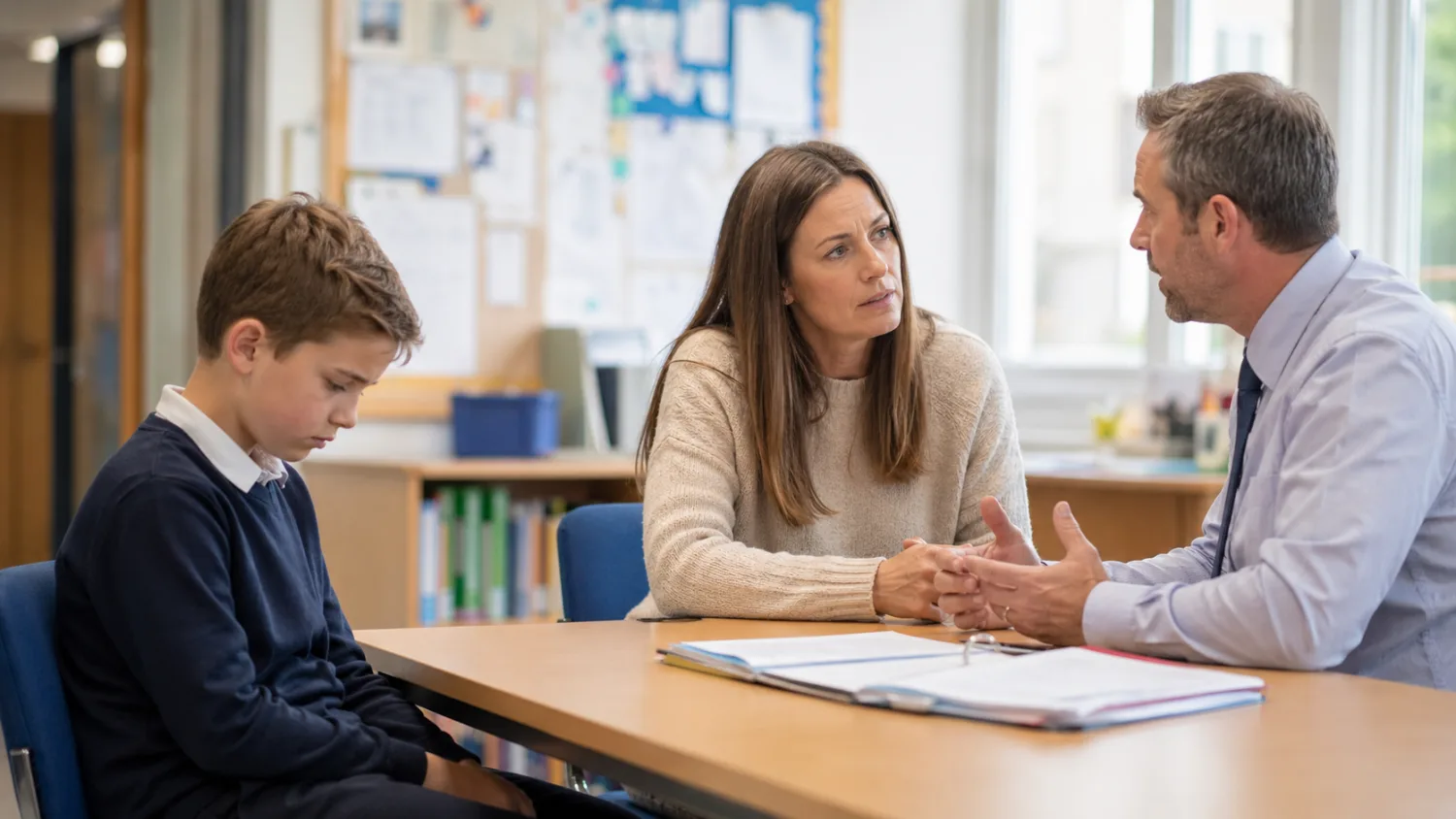
If your child keeps getting into trouble, do not wait until the situation becomes a crisis. Ask for a meeting with the class teacher, form tutor, head of year, pastoral lead, SENCO or behaviour lead, depending on your child’s age and the seriousness of the concerns.
Try to approach the meeting as a shared problem-solving conversation. You do not need to agree with every school decision, and you can challenge things respectfully if needed. But it usually helps to start with curiosity rather than blame.
You might say:
“I’m concerned that this is becoming a pattern. I’d like to understand what you are seeing in school and agree what we can do together.”
Or:
“At home we are seeing a lot of distress after these incidents. Can we look at what is happening before the behaviour, not just after it?”
If you are unsure how to prepare for a school conversation, our guides on how to prepare for parents’ evening and questions to ask teachers may help you organise your thoughts, even if the meeting is not a formal parents’ evening.
Questions to ask the school
When behaviour keeps repeating, general comments such as “they need to make better choices” are not enough. You need detail. The detail is what helps everyone understand the pattern.
Useful questions include:
- What exactly is happening?
- When does it happen most often?
- What usually happens immediately before the behaviour?
- What happens immediately after?
- Is it happening across all lessons or mainly in certain situations?
- Are there friendship or bullying concerns?
- Could the work be too hard, too easy or unclear?
- Does my child seem anxious, angry, overwhelmed or attention-seeking?
- What strategies have already been tried?
- What seems to help, even a little?
- Could there be an unmet learning need, communication need or SEND need?
- How will we know if the plan is working?
Ask for examples. “Disruptive” could mean calling out, refusing work, distracting others, leaving the seat, arguing, swearing, throwing things, walking out, using a phone, or shutting down. Each needs a different response.
When behaviour may be linked to falling behind
Children often misbehave in areas where they feel least confident. A pupil who cannot read the text may joke around. A child who cannot start the writing task may sharpen pencils, annoy others or refuse to work. A teenager who feels lost in maths may decide it is better to be removed from the lesson than to sit there feeling exposed.
This is not manipulation in the simple sense. It is self-protection. Looking careless can feel safer than looking incapable.
Signs that behaviour may be linked to learning include:
- incidents happen mostly during reading, writing, maths or independent work
- your child says the work is “boring” but cannot explain it
- homework causes anger or avoidance
- teachers mention lack of effort but also weak understanding
- your child rushes, guesses or refuses to begin
- they behave better when an adult sits beside them
- they have become less confident over time
If this sounds familiar, it may be worth reading our guide on what to do if your child is struggling academically before hiring a tutor.
When behaviour may be linked to SEND
Repeated behaviour problems can sometimes be a sign that a child’s needs are not being met. This does not mean every child who misbehaves has SEND. It does mean SEND should be considered when behaviour is persistent, intense, unusual for the child’s age, or not improving despite normal support.
Possible underlying needs may include ADHD, autism, dyslexia, developmental language disorder, sensory processing difficulties, anxiety, trauma, attachment needs, speech and language needs, hearing or vision difficulties, or working memory challenges.
For example, a child with ADHD may call out, interrupt, forget rules or act before thinking. An autistic child may become distressed by noise, changes, social confusion or perceived unfairness. A child with language difficulties may seem rude or non-compliant when they have not fully understood. A dyslexic child may avoid written tasks. A child with anxiety may appear oppositional when they are actually panicking.
If you suspect additional needs, ask to speak to the SENCO. You can ask what observations have been made, whether your child is receiving SEN Support, whether any screening or assessment is appropriate, and what reasonable adjustments could help.
For more detail, see our guides on SEN Support and EHCPs, early signs of ADHD, autism in schools, neurodiversity in the classroom and dyslexia in schools.
The government also has information for parents on support for children with special educational needs and disabilities.
When behaviour may be linked to anxiety or school avoidance
Anxiety does not always look like fear. In children, it can look like anger, refusal, avoidance, silliness, control, perfectionism, shutting down or lashing out. A child who feels overwhelmed may not say, “I am anxious.” They may say, “I hate this school,” “the teacher is stupid,” “I’m not doing it,” or “I don’t care.”
If behaviour incidents are linked to entering school, certain lessons, separation from you, tests, social situations, assemblies, PE, lunchtime or changes in routine, anxiety may be part of the picture.
YoungMinds has helpful parent advice on challenging behaviour and on school anxiety and refusal. You may also find our AllSchools guide on school anxiety and emotionally based school avoidance useful if your child’s behaviour is linked to distress about school.
When friendship problems or bullying are behind the behaviour
Some children get into trouble because they are reacting to social pressure. They may be trying to impress a group, avoid being picked on, retaliate after teasing, or cope with exclusion. Sometimes the child who finally shouts, pushes or swears is the one who gets caught, while the build-up is less visible to adults.
This does not mean the behaviour is acceptable. It does mean adults need to ask what happened before the incident.
Ask school whether there are known friendship issues, peer conflicts, group dynamics, online messages, bullying concerns or problems during less supervised times. Breaktime, lunchtime, corridors, toilets, buses and group chats can all affect behaviour in lessons.
If bullying may be involved, our guide on dealing with bullying explains what parents can do and how to raise concerns with school.
What parents can do at home
Home cannot control everything that happens in school, but it can help. Children need boundaries, routine and emotional connection. They also need adults who believe they can improve.
Start by making expectations clear and simple. Choose one or two behaviours to focus on, not everything at once. For example, “This week we are focusing on speaking respectfully to adults” or “This week we are focusing on starting work when asked.”
Then talk through what the child should do instead. “Don’t be rude” is less helpful than “If you feel angry, ask for a minute, take three breaths, and use the phrase we practised.”
At home, you can support behaviour by:
- keeping sleep and morning routines as steady as possible
- checking whether hunger, tiredness or screen use are affecting mood
- giving your child a calm chance to talk after school
- praising small improvements, not only perfect behaviour
- helping your child practise words they can use when frustrated
- agreeing simple, predictable consequences
- avoiding long lectures when emotions are high
- staying in communication with school
If homework often triggers arguments, our guide on helping your child with homework without the stress may help you reduce conflict around learning at home.
Use consequences carefully
Consequences can be useful when they are clear, proportionate and linked to the behaviour. But harsh or unpredictable punishments can make things worse, especially if the child already feels hopeless or misunderstood.
A useful consequence teaches responsibility. For example, if your child has upset another pupil, they may need to repair the harm. If they used their phone inappropriately, phone boundaries may need to change. If they refused homework, a calm plan may be needed for completing it earlier with support.
Try not to remove every positive activity for a long period. Children who are struggling with behaviour often need more chances to experience success, not fewer. Sport, clubs, hobbies, movement and positive adult attention can all support emotional regulation.
Help your child repair, not just regret
Saying sorry is important, but it is not always enough. Some children say sorry quickly to escape discomfort. Others refuse to apologise because they feel ashamed. The deeper skill is repair: understanding the impact, taking responsibility, and doing something to make the situation better.
You might ask:
- Who was affected by what happened?
- What do you think they felt?
- What could you do to put things right?
- What will you do differently next time?
- What help do you need from adults?
Some schools use restorative conversations as part of behaviour support. These can be helpful when they are done calmly and not used as a forced apology exercise.
Ask for a behaviour support plan if incidents continue
If behaviour problems are repeated, ask school whether a written support plan would help. This does not need to be complicated, but it should be specific.
A good plan might include:
- the main behaviour concern
- known triggers
- early warning signs
- what adults will do before behaviour escalates
- what your child can do when they feel overwhelmed
- how success will be noticed
- what consequences will apply
- who will communicate with parents
- when the plan will be reviewed
Ask school what support happens before sanctions. If a child is repeatedly punished but no adult can explain the prevention plan, the approach may not be complete.
What if your child is being removed from lessons?
Some schools use removal rooms, internal isolation, reflection rooms or similar systems when behaviour disrupts learning. These may be part of the school behaviour policy. However, if your child is regularly removed from lessons, it is important to ask what is being done to prevent the behaviour and keep them learning.
Repeated removal can sometimes create a cycle: the child misses teaching, falls further behind, feels more embarrassed, and then misbehaves again. Ask school how missed work is being addressed and whether learning gaps are contributing to behaviour.
What if your child is suspended?
A suspension is serious, but it is not the same as a permanent exclusion. It means your child is temporarily excluded from school for a fixed period. The school should follow proper procedures and provide information about the reason, length of suspension and your rights.
The government has a parent guide on school behaviour and exclusion, and statutory guidance on school suspensions and permanent exclusions. The guidance explains the responsibilities schools and other bodies must follow. It also makes clear that, for most pupils, suspension and permanent exclusion may not be necessary because other strategies can manage behaviour, though exclusions may sometimes be used as a last resort.
If your child has been suspended, our guide on what happens if your child is suspended from school explains the parent process in more detail.
After a suspension, ask for a reintegration meeting. This should not simply be a warning. It should look at what happened, what support is needed, what the child needs to do differently, and how adults will reduce the chance of it happening again.
When to seek extra help
It may be time to seek extra help if behaviour is escalating, becoming unsafe, affecting attendance, damaging your child’s confidence, causing repeated exclusions, or putting them at risk of losing their school place.
You may want to speak to:
- the school SENCO
- the pastoral lead or head of year
- your GP
- school nursing services
- local family support services
- SENDIASS if SEND may be involved
- CAMHS or local children’s mental health services if there are serious wellbeing concerns
- an educational psychologist, where appropriate
The NSPCC offers broad support and advice for families, and the NHS has information on children and young people’s mental health. If your child is talking about self-harm, suicide, feeling unsafe, or not wanting to be alive, seek urgent help through your GP, NHS 111, local crisis services or 999 if there is immediate danger.
What if you think the school is being unfair?
Sometimes parents feel their child is being labelled or punished unfairly. Perhaps other children were involved but only your child was sanctioned. Perhaps the school has not addressed bullying. Perhaps staff are not making reasonable adjustments. Perhaps the behaviour policy is being applied inconsistently.
If you feel this is happening, stay calm and gather evidence. Ask for the school behaviour policy. Ask for incident details. Ask what investigation took place. Ask how your child’s views were considered. Ask whether SEND, bullying, anxiety or learning needs have been explored.
Try to resolve the issue with the school first. If you still feel the situation has not been handled properly, you may need to use the school complaints process. Our guide on school complaints explains when to raise a concern informally and when to make a formal complaint.
What if your child says the teacher hates them?
This is a common thing for children to say when they feel criticised, embarrassed or misunderstood. Sometimes it means the relationship really has become strained. Sometimes it means the child dislikes being corrected. Sometimes it means they are struggling in that lesson and personalising the discomfort.
Do not dismiss it, but do not accept it as the whole truth immediately. Ask for specifics:
- What does the teacher do that makes you feel that?
- When does it happen?
- Are other pupils corrected in the same way?
- What do you think the teacher would say happened?
- Is there anything that would help you feel more comfortable in that lesson?
Then speak to school. A child does not need to love every teacher, but they do need to feel reasonably safe, respected and able to learn.
How to help your child believe they can change
Children who repeatedly get into trouble may start to see themselves as the problem. They may say, “I’m always in trouble anyway,” or “teachers hate me,” or “I can’t behave.” That mindset is dangerous because it removes hope.
Help your child separate identity from behaviour. They are not “a bad kid”. They are a child who is struggling with certain behaviours in certain situations. Behaviour can change. Skills can be learned. Trust can be rebuilt.
Notice tiny improvements. A day with fewer reminders. A lesson completed. A moment when they walked away instead of arguing. A time when they told the truth. A repaired friendship. These small signs matter because they show your child that change is possible.
For schools: parents need clarity, not just complaints
Although this guide is written for parents, schools can also take something from it. When contacting parents about behaviour, clarity helps. Parents need to know what happened, what led up to it, what has already been tried, what the consequence is, and what support will happen next.
A message that simply says “your child was disruptive again” may leave parents anxious and defensive. A more useful conversation explains the pattern and invites partnership.
Schools also benefit from asking whether behaviour is linked to learning gaps, attendance, SEND, mental health, bullying, family stress or unstructured times of day. Behaviour policies matter, but so does understanding the child behind the incident.
A simple action plan for parents
If your child keeps getting into trouble at school, start with a clear, steady plan.
- Stay calm enough to gather facts. Do not ignore the behaviour, but do not react only from embarrassment or anger.
- Look for patterns. Identify when, where and with whom the behaviour happens.
- Listen to your child. Their version may not be complete, but it matters.
- Speak to school. Ask for detail, not vague labels.
- Check for underlying causes. Consider learning gaps, SEND, anxiety, bullying, tiredness, friendship issues or home stress.
- Agree a support plan. Make sure it includes prevention, not only sanctions.
- Review progress. If nothing changes, ask what needs to be adjusted.
- Seek extra help if needed. Do not wait until exclusions escalate.
Final thoughts
When your child keeps getting into trouble at school, it can feel personal. It can feel as though every phone call is a judgement on your parenting or your child’s character. But repeated behaviour problems are usually a sign that something needs to be understood more clearly.
Your child still needs boundaries. They need to know that their actions affect other people. But they also need adults who are willing to ask what is driving the behaviour and what skills or support are missing.
The goal is not to excuse poor behaviour. The goal is to help your child learn better ways to cope, communicate, participate and repair when things go wrong.
If you stay curious, work with school, ask the right questions and seek help early, it is often possible to change the pattern before it becomes your child’s identity.
Frequently asked questions
Why does my child behave badly at school but not at home?
School places different demands on children. There are more people, more noise, more rules, more transitions, more waiting, more academic pressure and more social complexity. A child who seems calm at home may struggle in a busy classroom or playground. It is also possible that your child is using all their energy to cope at home and then finding school harder, or the other way round.
Why does my child behave well at school but badly at home?
Some children hold everything together at school and release their emotions at home, where they feel safest. This can happen with anxiety, masking, sensory overload, friendship stress or tiredness. It does not mean the behaviour at home is acceptable, but it may mean your child is exhausted or overwhelmed by the end of the day.
Should I punish my child again at home if school has already punished them?
It depends on the situation. Sometimes a school consequence is enough, and the parent’s role is to talk, reflect and plan. In more serious cases, a home consequence may be appropriate too. Try to avoid piling on punishments without helping your child understand what went wrong and what they should do differently next time.
What should I do if my child says everyone else was doing it?
They may be right, partly right or avoiding responsibility. A useful response is: “I’ll ask school what they saw, but we still need to talk about your choice.” Children need to learn that peer pressure may explain behaviour, but it does not remove responsibility.
Could repeated behaviour problems be a sign of ADHD?
They could be, especially if your child often acts impulsively, struggles to wait, calls out, forgets instructions, loses things, finds organisation difficult, or has trouble regulating emotions. But ADHD is not the only possible explanation. Speak to the school SENCO or your GP if you think ADHD or another additional need may be involved.
Could behaviour problems be linked to autism?
Yes, in some cases. Autistic children may struggle with sensory overload, unexpected change, social confusion, anxiety or feeling that rules are unfair or unclear. This can sometimes look like defiance. If autism may be part of the picture, ask school what they observe and whether SENCO involvement would be helpful.
What if my child keeps getting detentions?
Ask school for the pattern behind the detentions. Are they for homework, lateness, talking, refusal, uniform, phone use, conflict or disruption? Repeated detentions should lead to a conversation about what needs to change and what support is needed, not just more of the same consequence.
What if my child has been suspended?
Ask for the reason in writing, read the school’s information carefully, and attend the reintegration meeting. A suspension should lead to a plan for returning safely and reducing the chance of repeat incidents. You may also want to read the government’s parent guide on school behaviour and exclusion, as well as your school’s behaviour policy.
Can I ask for the SENCO to be involved?
Yes. If behaviour is persistent, unusual, escalating, linked to learning difficulties, or not improving with normal behaviour strategies, it is reasonable to ask whether the SENCO should be involved. This does not mean your child will automatically be identified as having SEND, but it allows school to consider whether additional needs are contributing.
What if I think the school is treating my child unfairly?
Ask for details of incidents, the behaviour policy, what investigation took place, and how your child’s view was considered. Keep communication calm and written where possible. If the issue is not resolved through normal conversations, you can use the school’s complaints process.
Should I move my child to another school?
Sometimes a school move helps, especially if relationships have broken down completely or the current setting cannot meet your child’s needs. But moving school does not automatically solve behaviour problems if the underlying issues are still present. Before deciding, try to understand what is driving the behaviour and what support would be needed in any setting.
When should I seek outside help?
Seek extra help if behaviour is escalating, unsafe, affecting attendance, leading to repeated suspensions, linked to serious anxiety or low mood, or causing major stress at home. Start with school, your GP, the SENCO, pastoral staff or local family support services. If there is any immediate risk of harm, seek urgent help.