
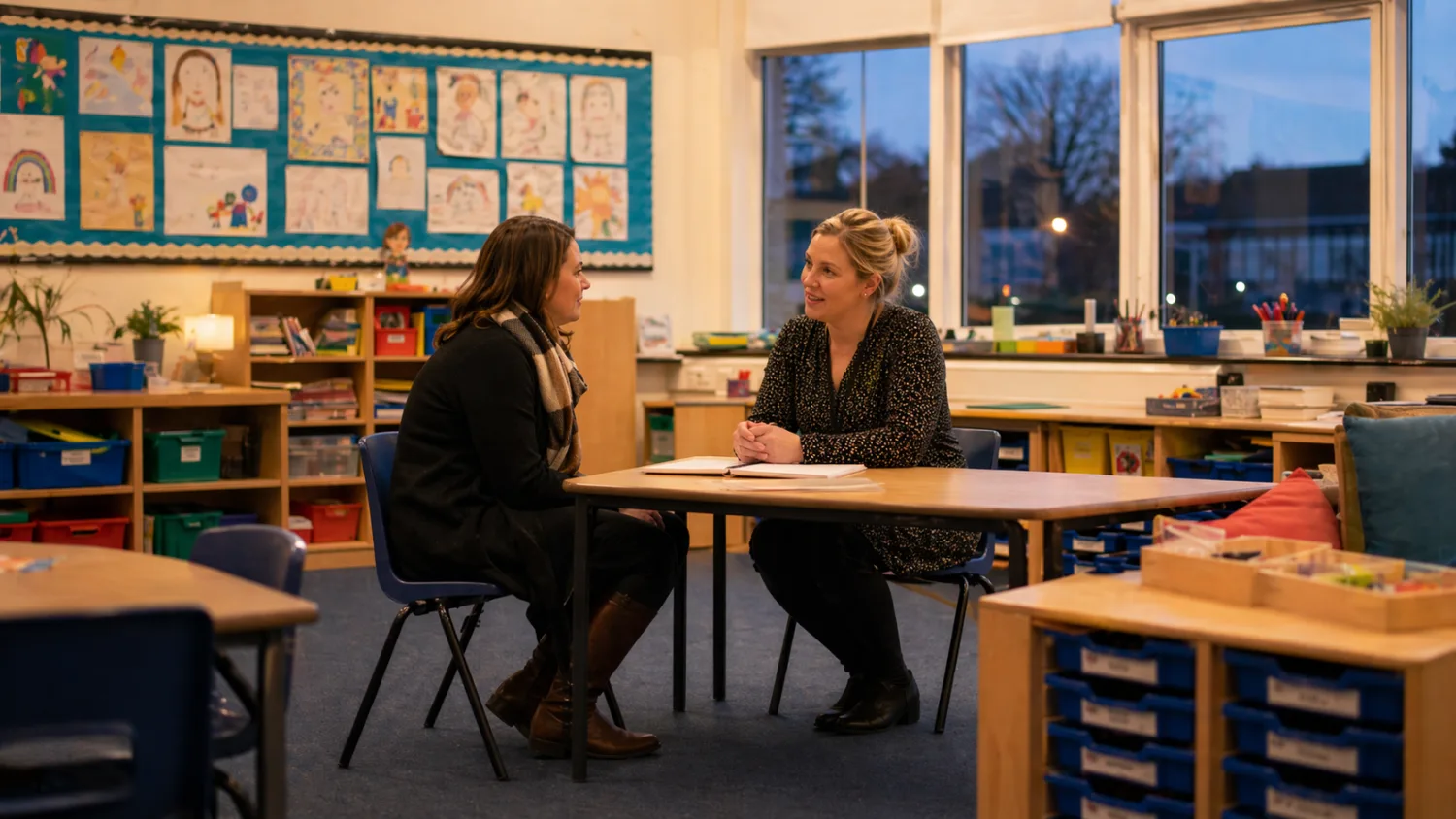
Parents’ evening often goes by faster than you expect. You arrive with good intentions, sit down, exchange a few polite words, hear some general feedback, and then suddenly the appointment is over. Afterwards, many parents realise they never actually asked the questions they cared about most.
That is why it helps to think ahead. You do not need to walk in with a long interrogation list or try to squeeze twenty different topics into a ten-minute slot. But having a few well-chosen questions in mind can make the conversation far more useful. The right question can move a meeting from vague comments such as “They’re doing fine” or “They need to focus a bit more” into something clearer, more specific and more helpful.
This guide will help you decide what to ask at parents’ evening, depending on what you most want to understand about your child’s experience at school. Some questions are useful for almost every family. Others matter more if you are worried about confidence, friendships, behaviour, academic progress or wellbeing.
If you want help with the bigger picture of how to approach the meeting itself, you can also read our guide on how to prepare for parents’ evening. This article focuses specifically on the questions that help you get beyond general feedback and into a more meaningful conversation.
Why the right questions matter
Teachers often meet a large number of parents in a single evening, and because time is short, feedback can sometimes begin in broad terms. A teacher might say your child is “settling well”, “doing okay”, “capable but easily distracted”, or “making steady progress”. Those comments are useful starting points, but they are not always enough by themselves.
The right questions help you understand what those phrases actually mean in practice. They help you find out not only whether your child is coping, but how they are coping. They can reveal strengths you did not know were visible in school, and they can also gently uncover concerns that may not show up in homework, reports or everyday chats at home.
Children are often very different in school and at home. Some look confident at home and stay quiet in class. Some appear happy in school but come home worn out and irritable. Some are achieving well but lack confidence. Others are cheerful and sociable but quietly falling behind. Good questions help you see more of the whole picture.
Start with the broadest and most useful question
If you ask only one question at parents’ evening, make it one that opens the door to the teacher’s overall view of your child. Something like “How is my child getting on overall?” may sound simple, but it gives the teacher room to talk about progress, attitude, classroom behaviour, effort, confidence and social development in one answer.
It is often better than starting with a narrow question too early, because it lets you hear what stands out most from the teacher’s perspective. Sometimes the answer confirms your expectations. Sometimes it brings up something you would not have thought to ask about.
Once you have that broad picture, you can use more targeted questions to dig deeper into the areas that matter most.
Questions to ask about academic progress
For many parents, the first concern is whether their child is learning well and making the progress they should be making. That is a perfectly reasonable place to start. But rather than asking only “Are they doing well?” it helps to ask questions that invite clearer, more practical answers.
Useful questions include:
- How is my child doing academically at the moment?
- What are their strongest subjects right now?
- Which areas do they find more challenging?
- Are they making the progress you would expect for their age or stage?
- What would help them improve most over the next term?
- Are they working confidently, or do they still need a lot of reassurance?
- Do they rush, hesitate, avoid certain tasks, or lose focus at particular points?
These kinds of questions are especially useful because they move beyond a general impression and into patterns. If a teacher says your child is doing well in reading but struggles to organise their writing, that gives you something concrete to understand. If they say your child knows the material but lacks confidence in maths, that tells a different story from simply hearing that maths is “a bit weaker”.
If you are trying to understand the language schools use around attainment, reports and expectations, our guides on school reports and grades and the UK curriculum and key stages may help alongside this one.
Questions to ask about effort, attitude and classroom habits
Sometimes academic ability is not really the main issue. A child may be capable, but inconsistent. They may understand the work, but give up quickly, drift off, avoid challenge or depend heavily on adult prompting. That is why it is often useful to ask not just what your child can do, but how they approach learning day to day.
You might ask:
- How does my child approach their work in class?
- Do they seem confident to get started independently?
- Do they ask for help when they need it?
- Are they easily distracted, or generally able to stay focused?
- Do they put effort in even when something feels difficult?
- How do they respond to mistakes or challenge?
These questions can be especially revealing because they touch on habits that shape progress over time. A child who is quietly underachieving because they fear getting things wrong may need a different kind of support from a child who is making mistakes because they rush. A child who lacks stamina may need something different again. Parents’ evening is often the first moment when those patterns become clearer.
Questions to ask about confidence
Confidence can be surprisingly hard to judge from home. Some children sound knowledgeable and chatty in familiar settings but are reluctant to speak in class. Others appear relaxed at school yet privately worry a great deal about getting things wrong. That is why it is worth asking directly how your child comes across in the classroom.
Questions that help here include:
- Does my child seem confident in class?
- Do they contribute their ideas, or tend to stay quiet?
- Do they seem comfortable answering questions or speaking in front of others?
- Are there situations where they hold back more than others?
- Do they seem more confident in some subjects than others?
If the teacher says your child is quiet, it can help to ask what kind of quiet they mean. Some children are simply thoughtful and observant. Others are quiet because they are uncertain, anxious or reluctant to draw attention to themselves. Those are very different things, and it helps not to assume they mean the same.
Questions to ask about behaviour and self-regulation
Behaviour is one of those areas where a little specificity goes a long way. Broad terms like “chatty”, “fidgety”, “silly” or “needs to make better choices” can mean many different things depending on the child and the classroom. If behaviour is mentioned, or if you already have concerns, it is worth asking questions that help you understand the pattern rather than hearing only a label.
Good questions might be:
- How does my child behave in class and around school?
- Are there particular times of day or activities they find harder?
- Do they struggle more with transitions, sitting still, listening, group work or unstructured times?
- How do they respond when corrected or redirected?
- Have you noticed any recent changes in behaviour, focus or mood?
These questions make space for a more useful conversation. Behaviour usually tells you something. A child who becomes disruptive when work gets harder may be protecting themselves from feeling exposed. A child who struggles mainly during transitions may be finding changes of routine difficult. A child who behaves well in lessons but finds playtimes overwhelming may need something different again. The more clearly you understand the setting and pattern, the more effectively home and school can respond.
Questions to ask about friendships and social wellbeing
For many parents, one of the most important things to understand is how their child is getting on with other children. Friendship issues can affect confidence, attendance, behaviour and overall happiness at school, but they do not always show up in a school report. Sometimes children hide worries. Sometimes teachers notice patterns parents never hear about. Sometimes a child’s own view is very different from what adults see.
If you want to understand the social side of school better, you could ask:
- How is my child getting on socially with others?
- Do they seem to have friends they feel comfortable with?
- How do they manage group work, pair work and playtimes?
- Do they tend to join in easily, or hang back?
- Have you noticed any friendship difficulties or social tensions?
These questions matter because a child can be coping academically while still finding school lonely, stressful or socially draining. Equally, some parents worry a great deal about friendships when the school view is actually far more reassuring. Asking in a calm, open way can help you understand whether there is a real concern, a temporary wobble or simply a mismatch between what your child feels and what adults are seeing.
If confidence or social hesitation is a wider theme, you may also find our guide on helping shy children build confidence at school useful.
Questions to ask about wellbeing and emotional state
Academic progress matters, but so does how your child feels in school. Some children are happy but stretched. Some are coping outwardly while quietly feeling overwhelmed. Some are masking worries very effectively. That is why it can be helpful to ask questions that get beyond behaviour and into emotional presentation.
You might ask:
- Does my child seem happy and settled in school?
- Have you noticed any signs of anxiety, frustration or withdrawal?
- Do they seem comfortable asking for help when they are upset or unsure?
- Have there been any changes in mood, confidence or engagement recently?
- Is there anything about the school day they seem to find especially stressful?
These questions are particularly useful if home life has changed, if your child has become more emotional recently, or if they seem fine on the surface but something feels slightly off. Teachers may not see everything, of course, but they can often tell you whether your child seems at ease, emotionally flat, unusually sensitive, socially tired or different from their usual self.
Questions to ask if your child seems bored or under-stretched
Not every concern at parents’ evening is about struggling. Sometimes parents suspect their child is not being challenged enough. Perhaps homework seems very easy, perhaps your child says school is boring, or perhaps progress appears steady but you suspect they could do more if stretched further.
If that is on your mind, try asking:
- Is my child being stretched enough in class?
- Do they seem engaged and challenged by the work?
- Are there areas where they could be pushed a little further?
- How do they respond when work is more demanding?
- Do they show curiosity, initiative or deeper thinking in certain subjects?
This helps avoid the conversation becoming a simple “Are they bright?” discussion. What matters is whether they are engaging deeply, thinking hard and continuing to grow, not just whether they complete work quickly.
Questions to ask if your child is struggling
If you already suspect your child is finding school hard, parents’ evening can be a really important checkpoint. In that situation, it often helps to ask more focused questions, not because you want to make the meeting heavy, but because you need clearer information.
Questions might include:
- Where do you see my child struggling most at the moment?
- Is the difficulty mainly confidence, understanding, focus, organisation or something else?
- How long has this been noticeable?
- What support is already being given in school?
- What would be most useful for us to reinforce at home?
- Do you think a longer follow-up conversation would help?
These questions matter because “struggling” can mean many different things. Without specifics, it is very hard for parents to know what kind of support is actually needed. The goal is not to leave with a vague sense that things are difficult. The goal is to understand what the difficulty looks like and what should happen next.
Questions to ask about homework and learning at home
Homework often becomes a flashpoint in family life, and parents’ evening can be a useful chance to reset expectations if needed. Some children cope well with homework in school but resist it at home. Others seem to manage the tasks, but only with a lot of parental prompting and tension. If homework is becoming stressful, it is worth asking about it directly.
You could ask:
- How is my child managing homework compared with their classwork?
- Does homework seem appropriate for their current level?
- Is there a particular way you would like us to support at home?
- Are there common mistakes parents make when helping?
- What matters most: accuracy, independence, effort or routine?
This can be especially useful because parents sometimes assume they should be doing more at home, when in fact the teacher may be more concerned with consistency, confidence or independence than with getting every answer perfect.
Questions to ask if your child has additional needs
If your child has SEND, receives support, is awaiting assessment or you suspect they may need more help, parents’ evening can be a useful place to ask how things look in school right now. This does not mean trying to fit an entire SEND review into a short slot, but it can help you understand what the school is noticing and whether further discussion is needed.
Questions might include:
- How is my child managing with the support currently in place?
- What seems to help them most in class?
- What situations do they find most difficult?
- Are you noticing the same patterns we see at home?
- Would it be useful to arrange a longer conversation about next steps?
If you are navigating that wider picture, our guide to SEN support and EHCPs for parents may be useful too.
You do not need to ask everything
One of the biggest mistakes parents make is trying to ask too many questions. It is understandable. Parents’ evening feels important, and when time is short there is a temptation to cram in everything at once. But a long list can leave you with lots of quick answers and not much real understanding.
It is usually better to pick the questions that matter most for your child right now. If the main concern is confidence, ask more about confidence than attainment. If the issue is friendship, make space for that. If everything seems generally fine, focus on what is going well and what would help your child grow further.
Parents’ evening works best when you use questions to deepen the conversation, not overload it.
How to ask follow-up questions without sounding confrontational
Sometimes the first answer you get is too broad to be truly useful. That does not mean the teacher is avoiding the issue. It often just means they have started with a summary. A calm follow-up question is usually enough to get more clarity.
If a teacher says your child “needs to focus more”, you might ask what that looks like in class and whether it happens in particular subjects or times of day. If they say your child is “doing well”, you might ask what they are doing especially well and where they could still be stretched further. If they say your child is quiet, you might ask whether that seems like personality, lack of confidence or uncertainty about the work.
Follow-up questions are often where the most useful information emerges. They turn general comments into something you can actually understand and act on.
Questions to avoid
Not every question helps. Questions that invite comparison with other children, demand guarantees or put the teacher immediately on the defensive usually lead to less useful conversations. For example, asking whether your child is one of the “best” in the class is rarely helpful. Asking why another child is getting more attention or why your child was not chosen for something also tends to close the conversation down rather than open it up.
Likewise, very broad questions such as “Is everything okay?” can be too easy to answer with a polite summary. It is not that such questions are wrong, just that they often do not get you very far.
The best questions are grounded, open and genuinely curious. They focus on your child’s experience, not on comparison, blame or performance.
A simple way to choose your questions before you go
If you are not sure what to prioritise, think in three layers. First, what do you most want to understand: progress, confidence, behaviour, friendships or wellbeing? Second, what does your child say or show at home that might need checking against the school view? Third, what would make you feel that the appointment had been worthwhile by the time you leave?
Once you know that, choose two or three questions that fit. That is usually enough. You can always ask for a follow-up conversation later if something bigger emerges.
Final thoughts
The best questions to ask at parents’ evening are not the cleverest or the most impressive. They are the ones that help you understand your child more clearly. They help you see how school experiences line up with what you notice at home. They help you move beyond labels like “fine”, “quiet”, “trying hard” or “easily distracted” into something more useful, more human and more specific.
You do not need a perfect script. You do not need to cover everything. But walking in with a few thoughtful questions can completely change the quality of the conversation and help you leave with a much clearer sense of what is going well, what may need attention, and how best to support your child next.
If you want the broader context around timings, mindset and making the most of the meeting itself, read our companion guide on how to prepare for parents’ evening.