
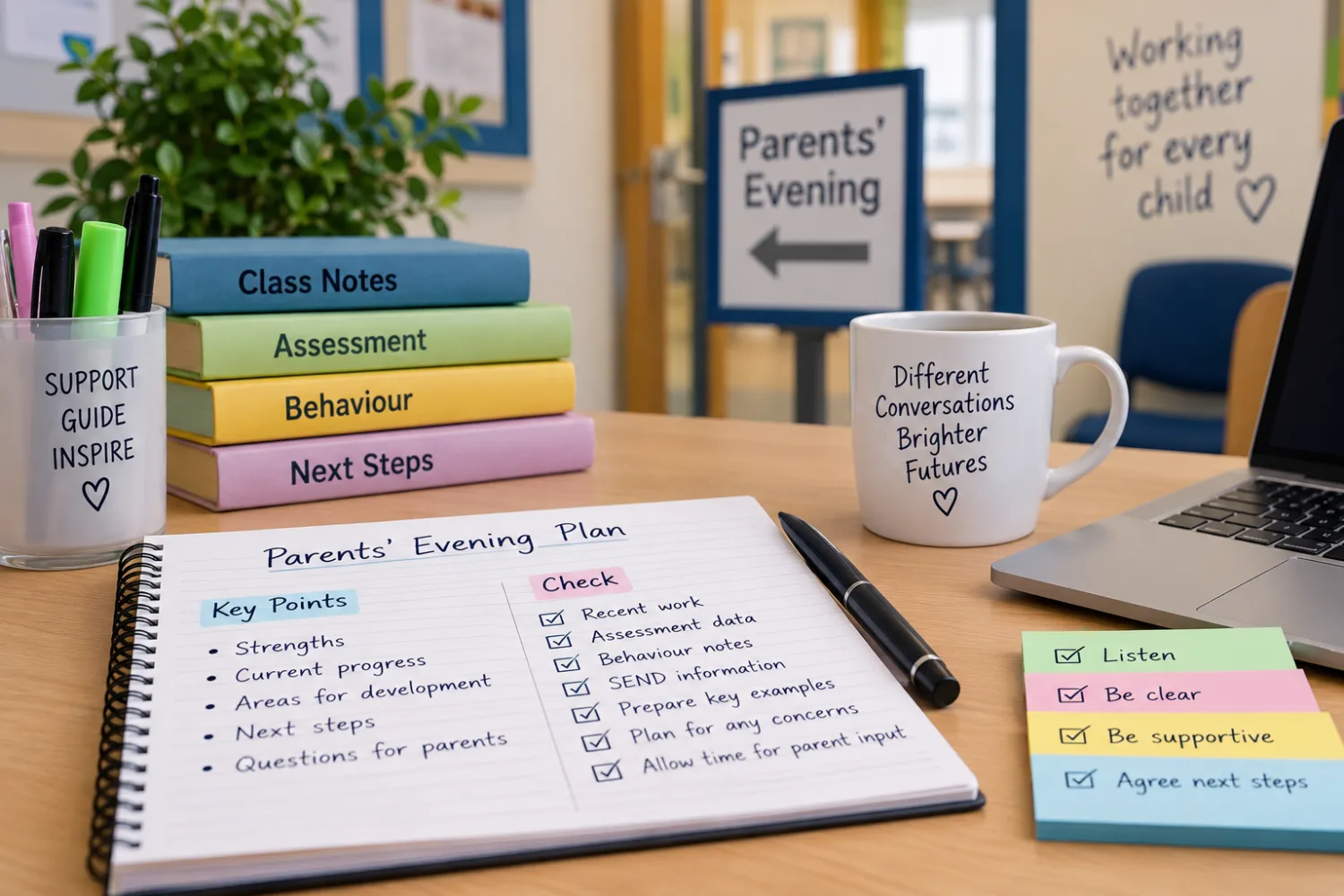
The first parents' evening with a new class can arrive surprisingly quickly.
You have taught the pupils for several weeks.
You have assessment results, seating-plan notes, homework records, behaviour information, observations from lessons and perhaps a few conversations with colleagues.
Some pupils already feel very familiar.
Others are still difficult to summarise.
Then you look at the appointment list and realise you may need to explain each pupil clearly in five or ten minutes.
The answer is not to write a miniature report for every child.
It is to turn the information you already have into a few useful points that answer the questions families are most likely to care about:
- How is my child getting on?
- What are they doing well?
- Is anything getting in the way?
- What should happen next?
Good preparation makes these conversations more useful and also makes the evening much less exhausting for the teacher.
Research on parental engagement suggests that communication is more useful when it is personalised, positive, linked to learning and genuinely two-way rather than simply broadcasting information at families.
This guide explains how to turn your first weeks of notes into a clear parents' evening plan without spending hours writing scripts you will never use.
Start by gathering the information you already have
Do not begin with a blank document and try to remember every pupil from scratch.
You probably already have most of the information you need.
Gather useful sources
Depending on your role and school systems, these might include:
- your seating plan;
- lesson notes;
- baseline or early assessment information;
- books or recent work;
- homework records;
- attendance and punctuality information where relevant;
- behaviour records;
- SEND information;
- previous teacher information where appropriate.
You do not need every data point
The purpose is not to reproduce the school information system verbally.
You are looking for patterns.
For each pupil, ask:
“What would I say if their parent walked into the room right now and asked how things are going?”
Your answer is probably the beginning of the meeting.
Reduce each pupil to four useful headings
One of the easiest ways to prepare efficiently is to use the same structure for everyone.
You might use:
Strength.
Current picture.
Development point.
Next step.
For example
Strength: Very strong verbal contributions and good subject vocabulary.
Current picture: Understands the work well but written responses are often shorter than her verbal answers suggest.
Development point: Needs to explain ideas more fully in writing.
Next step: Use sentence prompts initially, then reduce support as confidence grows.
Another pupil might look completely different
Strength: Works carefully and is consistently well prepared.
Current picture: Secure understanding but rarely volunteers answers.
Development point: Confidence in contributing.
Next step: Build participation through paired rehearsal and targeted questioning.
Four short prompts are usually more useful on the night than a paragraph of prose.
Use specific evidence rather than general impressions
Your notes may currently contain phrases such as:
“doing well”
“quiet”
“needs to focus”
“good pupil”
These may make sense to you.
They are less useful to a parent.
Turn impressions into observations
Instead of:
“He's doing really well.”
you might say:
“He understands new maths methods quickly and is beginning to explain why they work rather than only giving the answer.”
Instead of:
“She needs to focus.”
say:
“She usually starts well, but during longer independent tasks she becomes distracted and often leaves the final questions unfinished.”
Use one good example
You rarely need five examples to prove a point.
One recent piece of work, assessment or classroom observation is usually enough to make your comment concrete.
This keeps the discussion grounded without turning it into a presentation of evidence against the pupil.
Separate learning, behaviour and organisation
These three areas often become blurred in teacher notes.
A pupil may appear to be struggling academically when the real problem is that they rarely begin work promptly.
Another may seem poorly organised but actually not understand the task.
Ask three separate questions
Learning: What do they understand?
Behaviour for learning: What do they do during lessons?
Organisation: Can they manage equipment, homework and deadlines?
This creates much clearer conversations
For example:
“His understanding is actually strong. The issue is that he loses a lot of working time because he talks before starting independent tasks.”
That is much more informative than:
“He needs to improve his effort.”
Do not turn habits into personality labels
Avoid describing pupils as:
- lazy;
- careless;
- unmotivated;
- naughty;
- disorganised.
Describe what happens instead.
Behaviour can change.
A personality label sounds permanent.
Check whether your first impression has changed
The first parents' evening often comes at exactly the point when teachers are beginning to understand the class properly.
That means some September assumptions will have changed.
Look back at your earliest notes
You may have written:
“very quiet”
and now realise the pupil is confident in small groups.
You may have thought another pupil was academically secure because they answered frequently, then discovered through written work that their understanding is patchy.
You may have initially worried about a pupil's behaviour but seen significant improvement.
Use the most recent pattern
Do not allow week-one behaviour to define a pupil at week seven.
If something has improved, say so.
For example:
“The first couple of weeks were difficult, particularly around transitions, but we've seen a real improvement and he is now settling much more quickly.”
That gives parents a current picture rather than a historical charge sheet.
The AllSchools guide A Six-Week Review Checklist for a New Class is useful when reviewing how your understanding of pupils has changed since September.
Identify the appointments that need more preparation
You do not need to spend equal preparation time on every family.
Some conversations will be straightforward.
Others deserve more thought beforehand.
Flag pupils where you expect to discuss
- significant lack of progress;
- persistent behaviour concerns;
- attendance;
- possible SEND needs;
- friendship or pastoral concerns;
- a substantial difference between home and school reports.
Check the facts before the meeting
If you plan to say:
“Homework is frequently missing,”
check how frequently.
If you plan to discuss attendance, check the current information.
If behaviour is a concern, identify the pattern rather than relying on memory of the most frustrating incident.
Know what you have already tried
Parents will reasonably ask:
“What has the school done so far?”
Be ready to explain.
For example:
- changed seating;
- checked instructions individually;
- used a visual prompt;
- provided additional practice;
- spoken with pastoral staff.
This moves the conversation towards problem-solving.
Plan the opening sentence for difficult conversations
You do not need to script the whole appointment.
But if a meeting involves a significant concern, it can help to know how you will begin.
Start clearly but calmly
For example:
“There are lots of things Noah contributes positively, but there is one pattern I wanted us to look at tonight because it is starting to affect his learning.”
Or:
“I wanted to talk particularly about Maya's written work, because what she can explain verbally is currently much stronger than what she is recording independently.”
Avoid dramatic build-up
You do not need:
“Unfortunately, I do have some serious concerns…”
unless the concern genuinely warrants that level of language.
Do not hide the issue behind excessive praise either
A parent should not spend four minutes wondering why you are describing how friendly their child is before discovering there is a significant academic problem.
Be balanced and clear.
If you are anticipating a particularly challenging discussion, see How to Handle a Difficult Parent Conversation Without It Escalating.
Prepare one useful next step, not a shopping list of targets
A parent can remember:
“We need to help her check her written answers more carefully.”
They are unlikely to remember seven separate targets delivered in six minutes.
Choose the priority
If a pupil needs to improve:
- spelling;
- paragraphing;
- handwriting;
- vocabulary;
- proofreading;
decide which one matters most right now.
Make the next step concrete
Instead of:
“He needs to be more independent.”
try:
“We're asking him to attempt the first question himself before asking an adult to check it.”
Be clear about who does what
A next step may belong mainly to:
- the pupil;
- the teacher;
- school support staff;
- the family;
- a combination.
Do not make every school problem into a home intervention.
Evidence on parental engagement suggests communication is most productive when families receive clear, personalised information and practical ways to support learning rather than vague requests to “help more at home”.
Leave space for what the parent knows
Your notes contain the school version of the child.
Parents may bring information you cannot see.
Build one question into your plan
For example:
“How are things feeling from your side?”
or:
“Is there anything she has been saying about school at home that would be useful for me to know?”
The answer may change your interpretation
You may discover that:
- a pupil is spending two hours on homework you expected to take twenty minutes;
- they are worried about friendships;
- there has been a family change;
- they are anxious about making mistakes;
- they love your subject but rarely show it.
Two-way communication matters
EEF guidance emphasises communication that listens to families as well as informs them, with positive, personalised discussion linked to learning.
The first parents' evening is therefore partly an information-gathering exercise for you too.
Plan how you will manage the appointment time
The first few meetings often run long because teachers are trying to be helpful.
By the eighth appointment, the timetable is fifteen minutes behind.
Know the shape of the conversation
A simple structure might be:
- specific strength;
- current progress;
- main development point;
- parent perspective;
- next step.
You do not need to announce these stages.
They simply keep you focused.
Use your notes as prompts, not a script
Looking continuously at a sheet while speaking can make the meeting feel impersonal.
A few keywords should be enough.
Know when to schedule a second conversation
If a parent raises:
- a complex SEND issue;
- a safeguarding matter;
- serious bullying;
- a significant attendance problem;
- a complaint needing investigation;
you probably cannot resolve it properly in the remaining four minutes.
You can say:
“I don't want to rush this. Let me make sure the right person is involved and we can arrange a proper conversation.”
The AllSchools guide How to Run an Effective Meet-the-Teacher Evening covers the meeting itself in more detail.
Create a one-page preparation sheet
The fastest preparation method is often a simple grid.
For each pupil, record
| Pupil | Strength | Current picture | Main next step | Anything to ask/check |
|---|---|---|---|---|
| Example A | Strong ideas in discussion | Writing lacks detail | Develop explanations | Ask how long homework takes |
| Example B | Excellent effort | Secure but lacks confidence | Contribute more independently | None |
| Example C | Good subject knowledge | Work often unfinished | Improve task focus | Check whether pattern occurs elsewhere |
Use symbols if they help you prepare
You might mark:
- a pupil needing a longer follow-up;
- a parent communication issue;
- something requiring clarification before the evening.
But keep the sheet secure and follow your school's data-protection arrangements.
Do not write comments you would be embarrassed for somebody else to read
Even shorthand should remain professional.
Write:
“Needs frequent prompts during independent work.”
Not:
“Absolute nightmare after lunch.”
Professional notes produce professional conversations.
Do a final check on the day
Preparation does not need to become another large workload exercise.
Once your sheet is ready, a short final review is enough.
Before the evening, check
- any assessment information you intend to mention;
- attendance where relevant;
- important SEND information;
- recent behaviour developments;
- which appointments may need follow-up.
Have recent work available where useful
You do not necessarily need every exercise book stacked beside you.
But being able to show one example can make an explanation much easier.
Review pupils you know least well
If you cannot yet say something meaningful about a pupil, do not invent a generic comment.
Look at their work.
Ask another relevant teacher where appropriate.
Observe them more deliberately before the meeting.
“Quiet and fine” should not become the default report for pupils who simply attract less teacher attention.
Frequently asked questions
How much should I prepare for each pupil?
A few concise prompts are usually enough: one strength, the current learning picture, one development point and a sensible next step. Complex cases may require additional preparation.
Should I write a script for parents' evening?
Usually not. Scripts can make conversations sound mechanical and take a long time to prepare. Use short prompts that allow you to speak naturally.
What if I do not know a pupil very well yet?
Review their work and deliberately observe them before the meeting. Avoid filling the gap with vague comments simply because the pupil is quiet or compliant.
Should I start every meeting with something positive?
A specific strength is a useful opening in most cases, but do not use artificial praise to delay a significant concern. Be balanced and clear.
How many targets should I give parents?
Usually one main priority is more useful than a long list. The target should be specific enough that the pupil and family understand what improvement looks like.
Should I mention every behaviour incident?
No. Discuss meaningful patterns. A parents' evening should not become a chronological reading of the behaviour log.
What if behaviour has improved?
Say so. Do not allow early problems to define your current description of the pupil.
Should I discuss attendance?
Where it is relevant to learning or wellbeing, yes, using accurate current information and following your school's approach. Complex attendance difficulties may require a separate conversation.
What if the parent raises a serious concern?
Listen and record the relevant information. If it involves safeguarding, follow the school's safeguarding procedure. If it requires investigation or a longer discussion, arrange appropriate follow-up rather than trying to resolve it hurriedly.
What if a parent disagrees with my assessment?
Ask what they are seeing at home and return to specific evidence from school. Home and school can genuinely see different aspects of the same child.
Should pupils attend parents' evening?
This depends on school policy, age and the type of meeting. Where pupils attend, it can be useful to frame targets as actions they understand and can take ownership of.
How do I stop appointments overrunning?
Use a consistent structure, prioritise one main message and move complex discussions to a separate follow-up rather than trying to solve everything inside one appointment.
Should I contact some parents before the evening instead?
Yes, if an issue is urgent or significant enough that waiting for parents' evening would be inappropriate. Parent meetings should not be used to delay necessary communication.
The first parents' evening becomes much easier when your notes stop being a collection of observations and start becoming a small number of clear messages.
You do not need to tell parents everything you know.
You need to tell them what matters.
Look for the pupil's strengths.
Work out what the evidence says about their learning now.
Identify the biggest thing that would help them progress.
Prepare carefully where the conversation may be difficult.
Then leave enough room to hear what the family knows too.
Your notes are not the meeting.
They are simply the preparation that allows you to look up from the page and have a useful conversation about the child sitting at the centre of it.