Every teacher knows the sinking feeling of needing to set cover. You may be ill, on a course, attending a meeting, taking pupils on a trip, dealing with an unexpected family emergency, or simply trying to prepare for a planned absence without creating more work than the lesson itself.
Cover lessons are often treated as a necessary inconvenience: something to keep pupils occupied until the “real” teacher returns. But a good cover lesson can do much more than fill time. It can protect learning, support behaviour, reduce stress for the colleague covering the class, and make your return far easier.
The best cover work is not necessarily the most ambitious. In fact, the opposite is often true. A cover lesson works when it is clear, self-contained, realistic and robust enough to survive the messiness of a real school day. It should make sense to a non-specialist, be accessible to pupils without constant teacher explanation, and leave you with something useful afterwards.
This guide is written for UK teachers, subject leaders and school staff who want cover lessons that genuinely work in classrooms, not just on paper.
What makes a cover lesson fail?
Most poor cover lessons do not fail because the teacher did not care. They fail because they were written for an ideal version of the lesson: a subject specialist in the room, pupils who remember exactly where they left off, technology that works, books that are easy to find, and a class that responds to instructions the way they would for their usual teacher.
Cover lessons have to be designed for a different reality. The person taking the class may not know the subject. They may not know the pupils. They may have received the work five minutes before the bell. They may be moving between rooms. They may not have access to your shared drive, visualiser, seating plan, usual routines or specialist vocabulary.
Pupils also behave differently in cover. Some become anxious because the routine has changed. Some test boundaries. Some decide the work does not matter because their usual teacher is absent. Some genuinely do not understand the task but are reluctant to ask a cover supervisor for help.
A cover lesson fails when it relies too heavily on the absent teacher being there.
The aim of cover work is continuity, not perfection
A good cover lesson should keep learning moving, but it does not have to replicate the lesson you would have taught yourself. That distinction matters.
If you try to set the exact lesson you would have delivered, you may end up leaving instructions that are too complicated, too dependent on explanation, or too risky for someone unfamiliar with the class. The result is often frustration for everyone: the covering teacher feels exposed, pupils become unsettled, and you return to half-finished work that tells you very little.
Instead, think of cover as a bridge. The lesson should connect pupils to the curriculum, consolidate something valuable, and make it easier for you to continue when you return. Sometimes that means retrieval practice. Sometimes it means structured reading. Sometimes it means rehearsal, extended writing, problem-solving, vocabulary work, or carefully chosen independent practice.
The question is not “What would I have taught if I were there?” The better question is: “What can pupils usefully do without me?”
Start with the class, not the content
Before deciding the activity, think about the group. A strong cover lesson for a settled Year 10 GCSE class may be completely unsuitable for a lively Year 8 class last lesson on a Friday. A task that works beautifully for confident readers may collapse for a class with weak literacy or high levels of additional need.
Ask yourself:
- Can this class work independently for more than ten minutes?
- Do they need the task broken into short stages?
- Are there pupils who will struggle to start without adult support?
- Are there pupils who may finish quickly and need extension work?
- Is reading level likely to become a barrier?
- Are there behaviour triggers the covering adult needs to know?
- Does the class need quiet individual work, paired work, or a highly structured routine?
Cover work should be pitched for the class you actually have, not the class you wish you had. If a group struggles with focus, you may find useful ideas in Improving Focus in the Classroom. If working memory is a common barrier, the guide on working memory strategies for primary and secondary pupils may also help you design clearer, more manageable tasks.
Choose the safest type of learning for cover
Some lesson types are naturally easier to cover than others. Brand-new content, practical experiments, complex discussion, sensitive topics and activities requiring close teacher judgement can all work brilliantly with the usual teacher, but they may be poor choices for cover unless the covering adult is a subject specialist.
For most cover lessons, the safest options are:
- Retrieval practice: pupils revisit prior learning through questions, quizzes, timelines, diagrams, definitions or short written responses.
- Structured reading: pupils read a carefully chosen text and answer guided questions.
- Independent practice: pupils apply a method or skill they have already been taught.
- Vocabulary work: pupils define, use, sort, match or explain key terms.
- Planning or drafting: pupils prepare for a future piece of work using a scaffold.
- Review and improvement: pupils correct, redraft, annotate or improve previous work.
- Knowledge organisers: pupils use a knowledge organiser to complete low-stakes tasks.
The Education Endowment Foundation highlights explicit instruction and scaffolding as important parts of high-quality teaching. In a cover context, that means pupils need clear modelling, examples and structure built into the materials because the person in the room may not be able to provide specialist explanation.
Keep the task self-contained
A cover lesson should not require pupils to remember a long chain of previous instructions. It should not depend on a particular book being in a particular place, a video being available, or a website login working unless there is a simple backup.
A self-contained cover lesson includes everything needed to complete the task. That might mean a printed sheet, a short reading extract, the relevant diagram, a list of key terms, worked examples, sentence starters, success criteria and extension questions.
This can feel like extra preparation, but it often saves time later. A self-contained task is less likely to collapse, less likely to create behaviour issues, and less likely to leave you with a pile of unusable work.
Write instructions for the adult, then for the pupils
Cover work needs two layers of instruction. The covering adult needs to know how the lesson should run. Pupils need instructions they can follow independently.
Do not assume that the adult will translate your plan into pupil-friendly language. They may be supervising several cover lessons that day. They may have no subject background. They may not know whether “complete the worksheet” means ten minutes or fifty.
For the covering adult, include:
- the class, room and period;
- where pupils should sit, if relevant;
- the overall purpose of the work;
- the exact resources needed;
- a simple timing structure;
- what pupils should produce by the end;
- what to do if pupils finish early;
- any pupils who need particular support or monitoring;
- any behaviour or safeguarding information that is appropriate to share;
- where completed work should be left.
For pupils, write instructions as if you are not there, because you are not. Use short sentences. Number the steps. Put the most important instruction first. Avoid vague phrases such as “research”, “revise”, “make notes” or “continue with your work” unless pupils know exactly what that means.
A simple cover lesson structure that works
Most cover lessons benefit from a predictable structure. This helps pupils settle quickly and helps the covering adult manage the room.
A reliable structure is:
- Do Now task: 5 minutes of silent retrieval or starter questions.
- Main task: 25 to 35 minutes of structured independent work.
- Extension task: meaningful extra work for early finishers.
- Exit task: 5 minutes to summarise, reflect, correct or hand in evidence.
This is not exciting, but it is effective. Cover lessons do not usually need novelty. They need clarity.
Make the first five minutes easy
The first five minutes of cover matter enormously. If pupils enter the room and there is uncertainty, the covering adult has to establish order before any learning can happen. A clear starter reduces that risk.
The starter should be visible, immediate and low-friction. Pupils should not need to ask, “What are we doing?” They should be able to sit down and begin.
Good starters include:
- five recap questions from recent lessons;
- a key vocabulary matching task;
- correcting common mistakes;
- labelling a diagram;
- ordering events, stages or processes;
- writing three things they remember about a topic;
- retrieving definitions from memory before checking notes.
Avoid starters that require a long explanation, cutting and sticking, logging into devices, or group movement. Those may be fine in your own lesson, but they create unnecessary risk in cover.
Do not set “research” unless you define the outcome
Research tasks are a classic cover choice, but they often produce weak learning. Pupils may copy from the first search result, get distracted online, write beautifully presented nonsense, or spend the lesson choosing fonts and images.
If you set research, define the output tightly. For example:
- “Find three causes, three effects and one example.”
- “Complete the table using the source provided.”
- “Write a 120-word explanation answering this question.”
- “Create five quiz questions and answers based on the text.”
- “Use the information sheet only. Do not use the internet.”
In many cases, it is better to provide the information yourself and ask pupils to process it. Reading, selecting, explaining, comparing and applying are usually more valuable than vague searching.
Leave a model answer or example
If pupils need to produce written work, calculations, analysis, annotations or explanations, include a model. This does not have to be long. Even one example can prevent confusion.
For example, instead of saying:
Answer the questions in full sentences.
Show them:
Question: Why did the character feel isolated?
Model answer: The character feels isolated because she is physically separated from the group and because the writer describes her as “silent” and “unnoticed”. This suggests that other people do not recognise her feelings.
For maths, science or technical subjects, a worked example is often essential. For humanities and English, sentence starters and paragraph structures can help pupils produce better work without the usual teacher prompting them.
Make the work easy to check when you return
Cover work should leave a trace. If pupils spend the lesson doing something you cannot quickly review, it becomes difficult to know whether the lesson worked.
That does not mean you need to mark everything in detail. In fact, you should avoid creating unnecessary marking. The Department for Education’s workload resources are clear that schools should think carefully about reducing unnecessary workload. A good cover task should give you useful information without generating an unmanageable marking pile.
Try to set work that can be checked quickly:
- a completed quiz;
- a short written paragraph;
- a labelled diagram;
- a completed table;
- a corrected piece of work;
- five self-marked answers with corrections;
- an exit ticket showing what pupils understood.
The best question to ask is: “What will I learn from this work when I return?”
Plan for early finishers
Early finishers can make or break a cover lesson. If the first pupils finish after twenty minutes and have nothing meaningful to do, the covering adult has to improvise. That is when noise, wandering, off-task behaviour and low-level disruption often begin.
Do not write “read quietly” unless you know pupils have suitable reading material and the class can handle it. A better extension task is linked to the learning and easy to begin.
Useful extension tasks include:
- write three quiz questions for next lesson;
- create a glossary of key terms;
- explain the hardest idea from the lesson in 50 words;
- complete a challenge question;
- improve one answer using the success criteria;
- draw and label a diagram from memory;
- write a “common mistakes” warning for another pupil.
Make extension work part of the sheet, not an afterthought hidden in the teacher instructions.
Plan for pupils who get stuck
Just as early finishers need a plan, stuck pupils need one too. If the only instruction is “ask the teacher”, the lesson may not work with a non-specialist cover supervisor.
Build help into the task. You could include:
- a word bank;
- sentence starters;
- worked examples;
- a “first step” hint;
- a reduced challenge section;
- a checklist;
- a page reference;
- a partially completed table;
- key vocabulary definitions.
If pupils struggle with writing, it may be worth adapting the task so they can still show understanding without becoming stuck at the first sentence. This guide may help: How to Support Pupils Who Struggle with Writing.
Be careful with technology
Technology can be useful in cover, but it can also create the fastest route to a failed lesson. Devices not charged, passwords forgotten, blocked websites, missing headphones, slow loading, pupils on the wrong tab, and unclear digital submission instructions can all waste time.
If you use technology, make sure there is a backup. For example:
- print the key instructions;
- include a paper version of the task;
- avoid relying on a video unless it is essential;
- make sure links are short or already posted somewhere pupils can access;
- tell the covering adult what to do if devices are unavailable;
- avoid open-ended internet tasks unless the class can manage them.
If mobile phones are a common issue in your school, you may also find Dealing with Mobile Phones in the Classroom useful when thinking about cover routines.
Write cover that a non-specialist can supervise
In some schools, cover is taken by subject teachers. In others, it is taken by cover supervisors, teaching assistants, senior leaders, supply teachers or colleagues from completely different departments. Your plan should not depend on specialist knowledge unless you know a specialist will be there.
This does not mean dumbing the work down. It means making the learning route explicit.
For example, instead of writing:
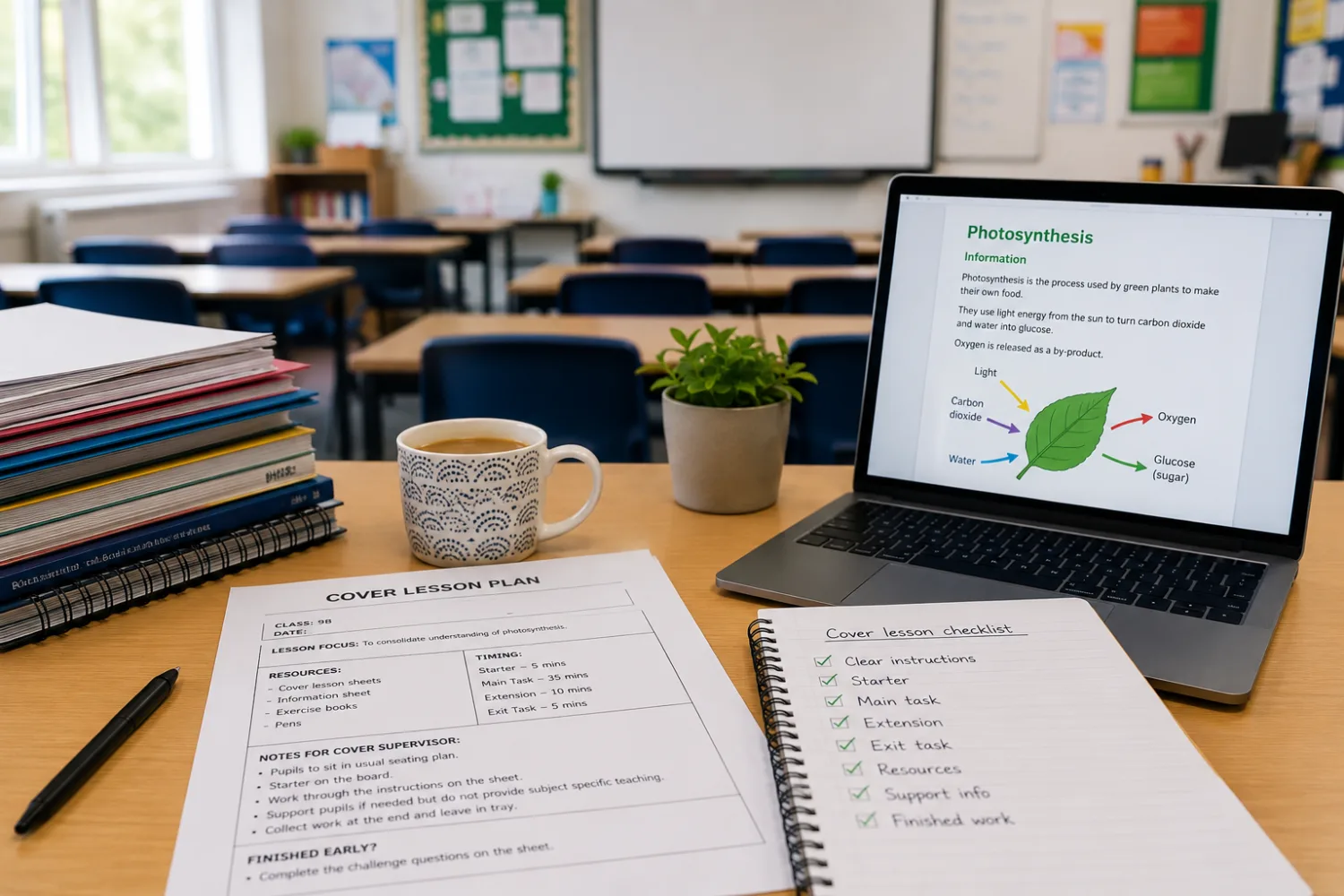
Students complete questions on photosynthesis.
Write:
Pupils are revising photosynthesis, which we studied last week. They should use the information box at the top of the sheet to answer questions 1 to 8. Question 9 is a challenge. If pupils are stuck, ask them to reread the information box and underline the sentence that helps. They do not need a further explanation from you.
This gives the covering adult confidence. It also makes it less likely that pupils can claim, “We haven’t been taught this,” as a way of avoiding the work.
Leave behaviour notes, but keep them professional
Cover staff need relevant information, not character judgements. A note saying “This class is awful” helps nobody. A note saying “Seat Jayden near the front; he works well with adult proximity but can distract others if seated at the back” is useful.
Include information that helps the covering adult prevent problems:
- seating plan details;
- pupils who should not sit together;
- pupils who may need help starting;
- pupils with access arrangements or support plans;
- usual routines for equipment, silence, group work or devices;
- how to record completed work or behaviour concerns.
Keep the tone factual and respectful. If your school is working on behaviour consistency, the article How to Reduce Behaviour Incidents in the Summer Term has ideas that also apply to cover lessons.
Make cover inclusive without making it complicated
Inclusive cover work does not mean creating five different lessons. It means removing unnecessary barriers so more pupils can access the task independently.
Simple adjustments can make a big difference:
- use clear fonts and enough spacing;
- avoid overcrowded worksheets;
- define key vocabulary;
- break tasks into numbered steps;
- include examples before independent work;
- provide sentence stems for written responses;
- offer a challenge task rather than making the whole sheet too hard;
- make the expected amount of work clear;
- avoid unnecessary copying from the board.
Where pupils have specific plans or reasonable adjustments, follow the school’s normal systems. A cover lesson should not remove support that pupils usually rely on.
Use cover as consolidation, not punishment
It can be tempting to set dull or heavy work because “they just need to get on with it”. But pupils quickly sense whether cover work matters. If it feels like punishment or busywork, motivation drops and behaviour becomes harder.
That does not mean cover has to be entertaining. It means pupils should understand the purpose. Tell them why the task matters:
- “This will help you prepare for next lesson’s assessment.”
- “This revises the key knowledge you need for the next topic.”
- “This will become the plan for your paragraph when I return.”
- “This checks whether we need to revisit anything before moving on.”
Purpose improves compliance because pupils can see that the work is not random.
What to set for different subjects
The best cover lesson depends on subject and phase, but some patterns work well.
English
Use a short extract with guided questions, vocabulary work, annotation prompts, a model paragraph and a final written response. Avoid asking pupils to “analyse the text” without a structure. Give them a focus, such as character, atmosphere, viewpoint or a specific language technique.
Maths
Set practice on a method pupils have already learned. Include worked examples and answers for self-checking where appropriate. Avoid brand-new methods unless the covering teacher is a maths specialist. Mixed retrieval can work well if the questions are carefully chosen.
Science
Use diagrams, key vocabulary, structured reading, retrieval questions and application tasks. Avoid practical work unless it has been specifically risk assessed and the covering adult is suitable. A good science cover lesson often asks pupils to explain processes, interpret data or correct misconceptions.
History, geography and RE
Structured reading, source analysis, timelines, comparison tables and explanation paragraphs work well. Provide the information pupils need. Do not rely on open internet research unless the outcome is tightly controlled.
Languages
Use vocabulary retrieval, translation practice, sentence building, reading comprehension and short writing tasks. Include examples and word banks. Avoid tasks that require accurate pronunciation from a non-specialist adult.
Art, design and technology
Set design analysis, planning, annotation, evaluation, research from a provided source, or low-risk drawing tasks. Avoid practical making if specialist supervision, tools or safety routines are required.
PE
If practical PE cannot run, use tactics analysis, rules, fitness planning, evaluation of performance, anatomy, leadership tasks or written reflection. Make sure the task is appropriate for the space available.
A cover lesson template you can reuse
The easiest way to improve cover across a department is to use a consistent template. This reduces cognitive load for the absent teacher, the covering adult and the pupils.
Cover lesson information for the adult
- Class: [Class name]
- Room: [Room]
- Lesson focus: [One-sentence summary]
- Resources: [Sheets, books, devices, equipment]
- Routine: Pupils should enter, sit in their normal seats and begin the starter immediately.
- Timing: Starter 5 minutes; main task 35 minutes; extension/exit task 10 minutes.
- Support: [Names or general notes, following school policy]
- Behaviour notes: [Factual, useful notes only]
- Finished work: [Where to leave it]
- If pupils finish early: [Extension task]
Cover lesson instructions for pupils
- Complete the starter in silence in the first five minutes.
- Read the information box carefully.
- Complete questions 1 to 6 in your book or on the sheet.
- Use the model answer to help with question 7.
- If you finish, complete the challenge task at the bottom.
- In the final five minutes, complete the exit question and hand in your work.
This kind of template may feel basic, but basic is often what makes cover successful.
Example: a strong cover lesson
Here is a simple example for a secondary history class.
Lesson focus
To consolidate understanding of the causes of the English Civil War.
Starter
Answer five retrieval questions from memory:
- Who was king in 1642?
- What is Parliament?
- Name one religious tension from this period.
- What does “taxation” mean?
- What is one reason people disagreed with the king?
Main task
Read a one-page information sheet on political, religious and financial causes. Complete a table with three columns: cause, evidence, why it increased tension.
Model answer
One cause was money. Charles I needed money to rule, but Parliament did not always agree to give him the taxes he wanted. This increased tension because it made Parliament feel that the king was trying to rule without listening to them.
Independent task
Write one paragraph answering: “Which cause of the English Civil War was most important?” Use the sentence starters provided.
Extension
Rank the three causes from most to least important and justify your order.
Exit task
Write one question you still have about the English Civil War.
This lesson works because it is clear, self-contained, connected to prior learning, and easy to review afterwards.
What to avoid setting as cover
Some tasks look convenient but often cause problems. Be cautious with:
- “Finish off previous work” unless pupils know exactly what to do and all have the right work available.
- Open-ended research without a defined output.
- New content that requires specialist explanation.
- Group projects with unclear roles.
- Practical work requiring specialist supervision.
- Videos without questions, timestamps or a backup task.
- Poster work where presentation overtakes learning.
- Tasks that require lots of printing, cutting, sorting or equipment at short notice.
These tasks are not always wrong, but they need careful structure. If you would need to explain it for five minutes in your own lesson, it probably needs simplifying for cover.
How departments can make cover less painful
Cover improves dramatically when it is not left entirely to individual teachers under pressure. Departments can reduce workload by preparing shared cover banks, common templates and retrieval resources.
A good department cover bank might include:
- topic-based retrieval quizzes;
- knowledge organiser tasks;
- reading comprehension sheets;
- vocabulary practice;
- common misconception tasks;
- exam-style practice for older pupils;
- extension questions;
- self-contained lessons for predictable absence periods.
The important point is quality control. A folder full of random old worksheets is not a cover bank. A useful cover bank is organised by year group, topic, difficulty and purpose. It should be easy to find something suitable quickly.
This also supports workload. If every absence requires a teacher to create something from scratch while unwell or overloaded, the system is not sustainable. Schools should think carefully about cover expectations as part of wider workload and wellbeing culture.
How to make cover meaningful when you are unexpectedly absent
Unexpected absence is different. If you are ill or dealing with an emergency, you may not have the time or energy to produce a polished lesson. In that situation, the aim is to provide the safest useful work, not the perfect lesson.
For emergency cover, keep it simple:
- use a retrieval quiz from recent learning;
- set a reading and questions task;
- use a knowledge organiser activity;
- ask pupils to improve or redraft previous work;
- set independent practice on something already taught;
- use a department-approved backup lesson.
If you are too unwell to set detailed work, the school should have systems to support that. Teachers should not feel forced to produce elaborate lessons while ill.
How to follow up after cover
The lesson is not quite finished when you return. A short follow-up helps pupils understand that cover work matters.
You do not need to spend the whole next lesson going through it. Instead, try one of these:
- collect one key question and address common gaps;
- use the exit tickets to decide the next starter;
- ask pupils to self-mark using answers;
- choose one misconception to reteach;
- give five minutes for pupils to improve one answer;
- refer back to the cover task when introducing the next lesson.
This sends a powerful message: work completed in cover is still part of learning. If pupils know cover work will never be mentioned again, they quickly learn not to value it.
How cover lessons affect parents and pupils
Parents do not usually see the detail of cover lessons, but they do notice patterns. If a child repeatedly says, “We did nothing because the teacher was away,” or “It was just a random worksheet,” it can affect confidence in the school’s routines. For pupils who are anxious, behind or easily unsettled, repeated weak cover can make school feel less predictable.
This does not mean every absence needs a perfect lesson. It means continuity matters. When cover is calm, structured and purposeful, pupils are less likely to feel that learning has stopped because their usual teacher is not there.
For a parent-facing perspective on school communication, you may find How to Talk to Your Child’s Teacher When You’re Worried useful. It shows the kinds of concerns parents may raise when learning, behaviour or wellbeing feels disrupted.
A quick checklist before you submit cover
Before sending cover work, ask yourself:
- Can pupils start within two minutes?
- Can a non-specialist understand the task?
- Is the lesson connected to current learning?
- Are instructions numbered and clear?
- Is there a model or example?
- Is there support for pupils who get stuck?
- Is there meaningful extension work?
- Is the task realistic for the time available?
- Does it avoid unnecessary technology risks?
- Will I be able to review the work quickly when I return?
If the answer is yes to most of these, the lesson is likely to work.
Final thoughts
A good cover lesson is not a performance. It is a practical piece of teaching design. It respects the pupils, supports the colleague in the room, protects curriculum time, and reduces the mess you return to afterwards.
The best cover work is clear enough for a non-specialist, structured enough for pupils to follow, and meaningful enough to matter. It does not try to do everything. It does one useful thing well.
When cover lessons work, everyone benefits. Pupils stay calmer. Cover staff feel more confident. Teachers return to less chaos. And learning continues, even when the usual teacher cannot be there.
Frequently Asked Questions
What should a cover lesson include?
A cover lesson should include a clear starter, a main task, extension work, simple pupil instructions, adult instructions, required resources, timing guidance and a clear expectation for what pupils should produce by the end.
How long should cover work take to complete?
It should fill the full lesson, but not be so long that most pupils cannot finish anything meaningful. A good approach is to set a core task that most pupils can complete, plus extension work for early finishers.
Should cover lessons introduce new content?
Usually, cover is better used for consolidation, retrieval, practice or structured reading. New content can work if the task is very clear and self-contained, but it should not depend on specialist teacher explanation unless a specialist is covering the lesson.
Is it okay to set a video as cover?
Yes, but only if it has a clear purpose, questions, timings and a backup plan. A video without a structured task often leads to passive watching or poor behaviour.
What is the best cover task for a difficult class?
Use a highly structured, independent task with a quick starter, short steps, visible outcomes and extension work. Avoid group work, open-ended research or tasks that require lots of movement or equipment.
How can I reduce marking after a cover lesson?
Set tasks that can be self-marked, quickly checked or sampled. Retrieval quizzes, exit tickets, completed tables, short paragraphs and corrected answers can all give useful information without creating a heavy marking load.
What should I leave for a supply teacher?
Leave the lesson purpose, resources, timings, pupil instructions, seating information, behaviour notes, support notes, extension tasks and instructions for where completed work should go. Keep it clear and concise.
Should cover work be differentiated?
It should be accessible. You do not always need multiple versions, but you should include scaffolds such as sentence starters, word banks, examples, hints and challenge tasks. Follow any individual pupil support plans or access arrangements.
What if pupils say they have not been taught the work?
This is why cover work should include enough information, examples and instructions for pupils to continue independently. If the work depends entirely on prior teaching, make sure it is genuine retrieval or practice, not something pupils can only complete with you present.
How can departments improve cover quality?
Departments can create shared cover banks organised by topic and year group, use common templates, prepare retrieval tasks, and agree what good cover should look like. This reduces workload and improves consistency.
Should I follow up cover work when I return?
Yes, even briefly. Use it as a starter, review one common misconception, ask pupils to improve one answer, or collect exit tickets. Pupils are more likely to take cover seriously if they know it matters afterwards.
What should emergency cover look like?
Emergency cover should be simple and safe: retrieval questions, structured reading, knowledge organiser work, independent practice or redrafting. It does not need to be elaborate, especially if the teacher is unwell.