
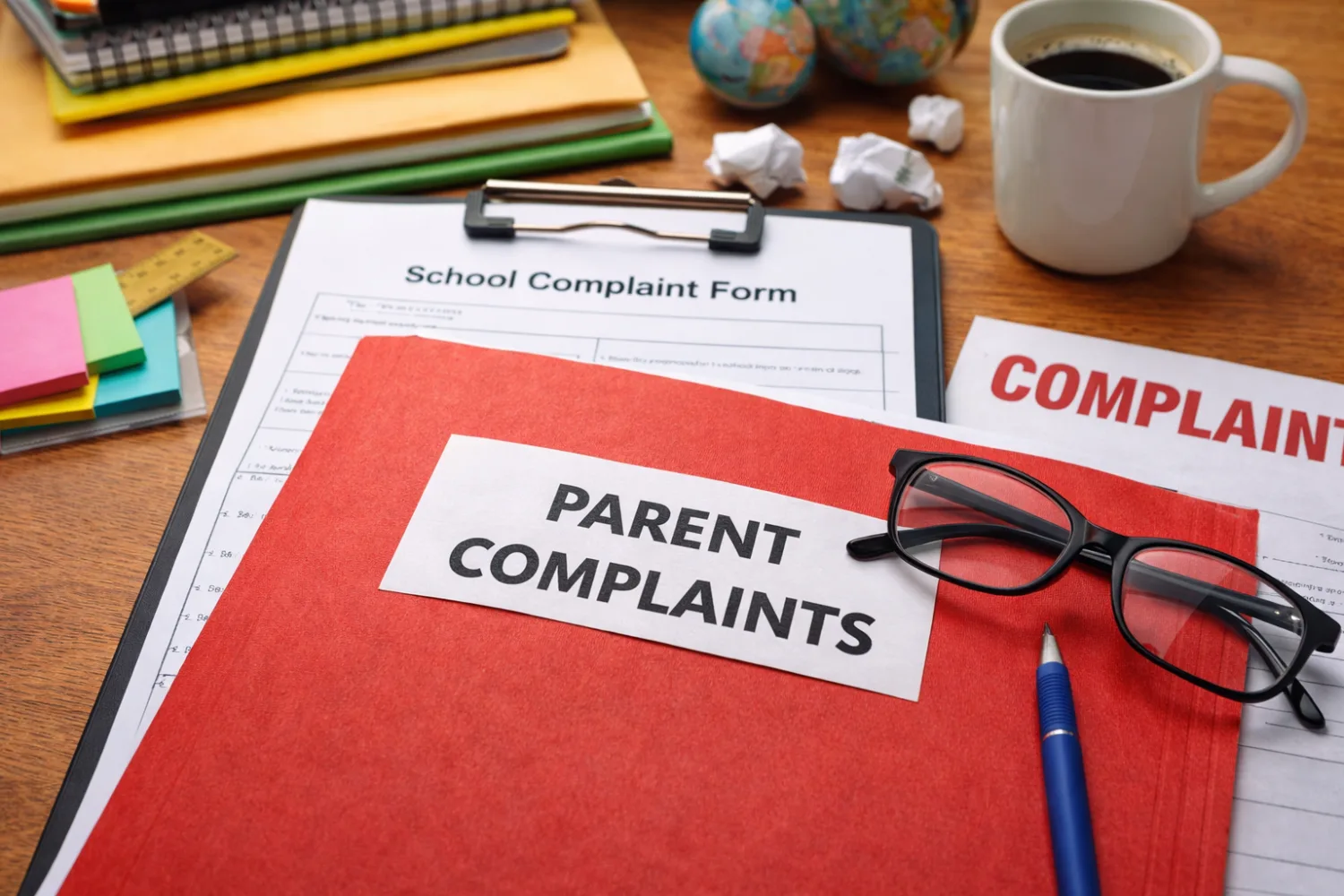
Parent complaints are part of school life. Most schools do not expect to avoid them entirely — but many are now dealing with a volume, intensity and frequency that feels very different from even a few years ago.
For school leaders and staff, the challenge is not just resolving complaints. It is doing so without overwhelming already stretched teams, damaging relationships with families, or creating a culture where every issue escalates into something formal.
Handled well, complaints can strengthen trust and improve communication. Handled poorly, they can drain time, erode staff confidence and create a cycle where small concerns quickly turn into major conflicts.
This guide focuses on how schools can manage parent complaints in a way that is clear, consistent and sustainable — without burning out the people responsible for responding to them.
The reality schools are dealing with
Many schools are not just seeing more complaints. They are seeing different complaints.
Issues that might once have been raised informally are now more likely to arrive as long emails, copied widely, sometimes written in a tone that assumes the worst before a conversation has even begun. Social media and messaging groups can amplify concerns quickly, and expectations around response times have shifted.
At the same time, staff workload has not reduced. Complaints are often handled on top of teaching, safeguarding responsibilities, administrative work and day-to-day school life.
The result is predictable: staff feel under pressure, parents feel unheard, and both sides can become more defensive than they intend to be.
Why complaints escalate more than they need to
Most complaints do not start as formal complaints. They start as concerns.
They escalate when those concerns are not addressed early, clearly or consistently. That might be because the wrong person responds, the response is delayed, the message is unclear, or the parent feels their point has not been understood.
Once a concern becomes a formal complaint, it is harder to resolve quickly. The tone shifts, expectations rise, and both sides may feel they need to defend their position rather than solve the problem.
That is why the most effective complaint strategies focus less on handling formal complaints and more on preventing unnecessary escalation in the first place.
Clarity reduces volume
One of the simplest ways to reduce complaints is to remove avoidable confusion.
Parents are more likely to raise concerns when expectations are unclear: homework policies that vary between classes, behaviour systems that are not consistently applied, communication that arrives late or in different formats depending on the teacher.
Clear, consistent communication does not eliminate complaints, but it reduces the number that come from misunderstanding rather than genuine issues.
Schools that invest time in making expectations visible and predictable often find that complaint volume drops without any change in policy.
Our article on improving parent communication explores this in more detail.
Early responses matter more than perfect responses
One of the biggest drivers of escalation is delay.
When parents feel ignored, they are more likely to repeat, expand or escalate their concern. A short, timely acknowledgement is often more effective than a delayed, comprehensive response.
This does not mean replying instantly to everything. It means acknowledging concerns early, setting expectations for when a fuller response will follow, and ensuring parents feel the issue has been seen.
Silence creates space for assumptions. And those assumptions are rarely generous.
Not every complaint needs the same level of response
One of the fastest ways to burn out staff is to treat every complaint as if it requires the same depth of investigation.
Some issues can be resolved quickly with a short explanation or correction. Others require a more structured response. A smaller number require formal investigation.
Without clear internal triage, schools risk over-handling minor issues and under-handling serious ones.
Having a shared understanding among staff of what should be handled informally, what should be escalated, and who is responsible at each stage can reduce both workload and inconsistency.
Consistency matters more than strictness
Parents are often less frustrated by the outcome of a complaint than by inconsistency.
If one parent receives a detailed response in two days and another waits two weeks for a short reply, the perception of fairness quickly breaks down. The same applies when policies are applied differently depending on the situation or the staff involved.
Consistency does not mean rigidity. It means that similar issues are handled in broadly similar ways, and that staff have a shared approach rather than individual interpretations.
Protecting staff time (without ignoring parents)
One of the hardest balances for schools is responding to parents without creating an expectation of constant availability.
Clear boundaries help here. That might include published response times, guidance on appropriate channels for communication, and expectations around when staff are available.
Without boundaries, staff can feel they are expected to respond to emails at all hours, which is not sustainable and often leads to rushed or less effective replies.
Boundaries, when communicated clearly and applied consistently, tend to reduce pressure rather than increase it.
Supporting staff to handle difficult conversations
Not every complaint is straightforward. Some involve strong emotions, repeated contact, or challenging communication styles.
Staff need support in handling these situations, not just instructions to “deal with it”. That might include guidance on tone, escalation routes, and when to involve senior staff.
It also means recognising that emotional labour is part of complaint handling. Responding calmly to a difficult message takes effort, especially when staff are already under pressure.
Schools that acknowledge this tend to have more resilient teams than those that treat complaints as purely administrative tasks.
When to move from concern to formal complaint
For schools as well as parents, recognising this transition is important.
Some issues should be resolved informally. Others need to be handled through a formal complaints process. The difficulty comes when the boundary between the two is unclear.
If a concern has been raised and not resolved, or if the issue is serious enough to require formal investigation, moving into the formal process can actually bring clarity rather than escalation.
Our guide to school complaints and concerns outlines how this looks from a parent perspective, which can help schools anticipate expectations.
What staff need from leadership
Complaint handling is not just an individual skill. It is a whole-school system.
Staff are more likely to manage complaints effectively when they know:
• what the school’s expectations are
• when to escalate
• who will support them
• that they will not be left to manage difficult situations alone
Without that clarity, staff either over-escalate everything or try to manage too much themselves, both of which increase pressure.
What parents are usually looking for
It is easy to assume that parents want a specific outcome. Often, what they want first is to feel heard.
A response that shows the concern has been understood — even if the outcome does not fully align with what the parent hoped for — is often enough to prevent escalation.
Where complaints become difficult is when parents feel dismissed, misunderstood or ignored. That is when tone becomes as important as content.
When complaints become patterns
Some complaints are isolated. Others are repeated.
If the same issues are being raised regularly — about communication, behaviour handling, homework, or specific processes — that is usually a sign of a wider system issue rather than individual parent behaviour.
Looking for patterns in complaints can help schools address root causes rather than responding to each issue in isolation.
What not to do
There are a few approaches that consistently make complaints harder to manage.
One is responding defensively from the start. Another is delaying responses in the hope the issue will go away. Another is allowing complaints to move between staff without clear ownership.
It also helps to avoid over-promising in early responses. Setting expectations you cannot meet creates a second problem on top of the first.
A more sustainable approach
Handling complaints well is not about eliminating them. It is about managing them in a way that is predictable, fair and sustainable for both staff and parents.
The schools that tend to cope best are not the ones with no complaints. They are the ones where concerns are addressed early, processes are clear, staff are supported, and expectations are consistent.
That combination does not remove pressure entirely. But it does prevent complaints from becoming the kind of ongoing drain that leads to burnout.
Quick takeaways for schools
Respond early
A short acknowledgement is often enough to prevent escalation.
Be consistent
Consistency builds trust more effectively than strictness.
Set boundaries
Clear expectations protect staff time and improve response quality.
Support staff
Complaint handling is emotional as well as administrative.
Look for patterns
Repeated complaints often point to system issues, not isolated problems.
Handled well, complaints do not just reduce over time — they become easier to manage. And that is what ultimately protects both staff wellbeing and the relationship between schools and families.