
Many CPD providers have something genuinely useful to offer schools. They have strong trainers, practical content, real expertise and good intentions. Yet a large number still struggle to get in front of school leaders in the first place.
The problem is usually not the quality of the training. It is the way the offer is positioned, targeted and presented.
Schools are busy. Senior leaders are constantly balancing staffing, behaviour, attendance, outcomes, safeguarding, budgets, inspection pressures and day-to-day operations. They are not sitting around waiting for another generic message about “high-impact professional development.”
If your outreach sounds vague, if your training feels disconnected from real school priorities, or if your offer creates more work than it solves, it is very easy for it to be ignored.
The CPD providers who get traction are usually the ones who understand a simple truth: schools do not buy training just because it sounds good. They buy training when it feels relevant, timely, practical and worth the staff time.
This guide explains how CPD providers can get in front of school leaders, how to position a school-friendly offer, and how to build the kind of credibility that leads to real conversations and repeat work.
If you want another route to visibility while building your outreach, you can also register as a school supplier on AllSchools so schools can discover your service more easily.
Why many CPD providers struggle to get noticed
A lot of CPD marketing sounds almost identical.
It talks about empowering staff, unlocking potential, delivering impactful professional development and driving improvement. None of that is wrong, but much of it is too broad. It does not help a school leader quickly understand what the training is actually for, why it matters now, or whether it is worth giving staff time to.
Weak positioning:
“We provide high-impact CPD that empowers educators and transforms teaching and learning.”
Stronger positioning:
“We help primary and secondary schools improve classroom practice in specific areas such as behaviour routines, adaptive teaching, workload reduction and SEND support through practical CPD sessions staff can actually use the next day.”
The second version feels more grounded because it connects training to real school priorities.
That is what leaders respond to.
School leaders are not buying “training.” They are buying a result
This is one of the most important mindset shifts for CPD providers.
A school leader is rarely looking for CPD as an abstract good. They are usually looking to solve a problem, improve a practice, support a priority or build confidence in a team.
That might mean:
- improving behaviour consistency
- strengthening adaptive teaching
- supporting SEND practice
- helping middle leaders lead better
- reducing unnecessary workload
- improving attendance culture
- preparing staff for curriculum or pastoral changes
- supporting early career teachers
So if your CPD offer begins and ends with “we provide training,” you are already on the back foot.
If it begins with “we help schools tackle this specific issue in a practical way,” you are in a much stronger position.
Start by getting much clearer about your offer
Many CPD providers try to sound flexible by listing everything they can cover. In practice, that often makes them harder to place.
The school leader reading your email or website is usually trying to answer one basic question:
What are these people actually best at?
Ask yourself:
- What are our strongest CPD topics?
- Which kinds of schools are we most relevant to?
- Who is the training really for: teachers, middle leaders, pastoral staff, support staff, senior leaders?
- Do we work best in primary, secondary or both?
- Is our training one-off, ongoing, strategic or practical?
- What school problem does each offer solve?
Real-world example:
One provider says they offer CPD in teaching, leadership, SEND, wellbeing, curriculum, behaviour, coaching and school improvement. That sounds broad, but it can also sound unfocused.
Another provider says they specialise in practical CPD for primary schools around behaviour routines, classroom consistency and staff confidence. That is much easier for a headteacher or deputy to understand and remember.
Broad capability is fine. But clear entry points win more attention.
Think like a school leader reading your message at 6:15pm
This is a useful test.
School leaders are busy. They are often reading messages quickly, between other tasks, with limited patience for vague marketing language.
If your email or website page does not quickly answer these questions, you may lose them:
- What is this CPD about?
- Who is it for?
- Why might it matter to our school?
- Is it practical or just theoretical?
- What will staff actually leave with?
- How hard is it to organise?
The providers who get noticed usually make these answers obvious.
Lead with a real school priority
The easiest way to make CPD feel more relevant is to connect it directly to a pressure schools already recognise.
Examples of stronger entry points:
- How to improve behaviour consistency across classrooms
- Practical SEND strategies staff can use straight away
- Helping middle leaders lead teams more confidently
- Reducing workload without lowering standards
- Supporting classroom routines for less experienced teachers
- Improving attendance conversations with families
- Helping staff respond better to anxiety and dysregulation
Those are easier for a school leader to connect to than broad claims about quality professional development.
The goal is not to sound trendy. It is to sound useful.
Make the training feel practical, not abstract
One reason some CPD providers lose traction is that their offer sounds too conceptual.
School leaders often worry that training will be:
- interesting but not actionable
- full of theory and short on practical use
- detached from classroom reality
- inspiring on the day but forgotten by next week
So it helps to emphasise what staff will actually take away.
Better language might include:
- practical strategies staff can use immediately
- clear routines, scripts or frameworks
- real classroom examples
- adaptable tools rather than generic advice
- training grounded in school reality
Simple example:
A provider offering behaviour CPD is more persuasive when they say, “Staff will leave with practical routines for starts of lessons, transitions and low-level disruption,” than when they say, “We explore the principles of relational behaviour culture.”
The principles may matter. But schools usually buy the practical outcome first.
Be specific about who the training is for
Not all school leaders are looking for the same kind of CPD.
Some offers are aimed at classroom teachers. Others are best for pastoral teams, senior leaders, middle leaders, teaching assistants or whole-staff groups.
If you do not make that clear, the offer can feel vague.
Examples:
- CPD for early career teachers on classroom routines and confidence
- CPD for middle leaders on leading meetings, feedback and accountability
- CPD for TAs on supporting pupils without over-scaffolding
- CPD for SEND teams on practical inclusion and regulation strategies
- CPD for senior leaders on attendance culture and implementation
The more clearly you define the audience, the easier it becomes for the right person to self-identify.
Know which school leaders you are actually trying to reach
“School leaders” is often too broad as a target.
The right contact depends on what your CPD is about.
You may be trying to reach:
- Headteachers: whole-school priorities, culture, strategic training
- Deputy or assistant heads: teaching and learning, behaviour, curriculum, assessment, staff development
- SENDCOs: SEND and inclusion-focused training
- Pastoral leads: wellbeing, behaviour, attendance, safeguarding-adjacent staff development
- Subject leads: subject-specific curriculum CPD
- Trust education leads: MAT-wide CPD and consistent practice across schools
Real-world example:
A provider offering practical classroom behaviour CPD might get most traction from deputy heads or assistant heads. A provider offering literacy subject training may be better off approaching English leads or teaching and learning leads. A provider offering multi-school leadership development may need trust-level contacts rather than single schools.
Who you contact should reflect the problem you solve.
Decide whether schools or MATs are the better first route
Some CPD providers are best off winning work school by school. Others are better positioned to work across MATs from the start.
School-first may make sense if:
- your offer is highly tailored
- you are still building proof and testimonials
- your work depends heavily on school context
- you are a smaller provider with limited delivery capacity
MAT-first may make sense if:
- your CPD is highly repeatable
- your training supports consistency across multiple schools
- you can deliver well at scale
- your offer aligns with trust-wide priorities
If you are weighing this up, our guide on MATs vs Individual Schools: Who Should Suppliers Target First? can help you think through the decision properly.
Use school language, not corporate training language
This matters more than many providers realise.
Schools do not usually respond well to corporate-style training language. Terms like “transformational leadership journey,” “bespoke talent acceleration,” or “high-performance educational ecosystems” may sound polished, but they often create distance rather than trust.
School leaders usually respond better to language that feels grounded, calm and real.
Less effective:
“We deliver transformative capacity-building experiences that unlock whole-school excellence.”
More effective:
“We help school teams strengthen classroom practice, leadership confidence and day-to-day consistency through practical CPD that fits the realities of school life.”
The second version sounds more trustworthy because it sounds more human.
Show that your CPD respects staff time
School leaders are very aware that CPD takes staff time, attention and energy.
That means they are not just asking, “Is this good training?” They are also asking, “Is this worth giving people time for?”
Your offer should therefore show respect for staff workload.
It helps to make clear:
- how long the session is
- whether it works as an inset, twilight or series
- how interactive it is
- what people will leave with
- whether follow-up is available
- how easy it is to organise
Simple example:
A deputy head may be more likely to explore your offer if they can quickly see, “90-minute twilight session, practical classroom takeaways, suitable for all teaching staff, minimal setup needed,” than if they have to dig around for basic details.
Clarity reduces friction.
Give school leaders confidence that staff will not roll their eyes
This may sound blunt, but it matters.
One hidden concern many school leaders have is whether staff will actually find the training useful or whether it will be another session full of ideas that do not survive contact with real classrooms.
That is why it helps to show that your CPD is:
- grounded in school reality
- practical rather than preachy
- respectful of staff experience
- designed to help, not just impress
Real-world example:
A provider who says, “This session gives staff three or four realistic routines they can adapt immediately,” often feels more credible than one who promises to “redefine pedagogy.”
School leaders know their staff are more likely to value the first kind of session.
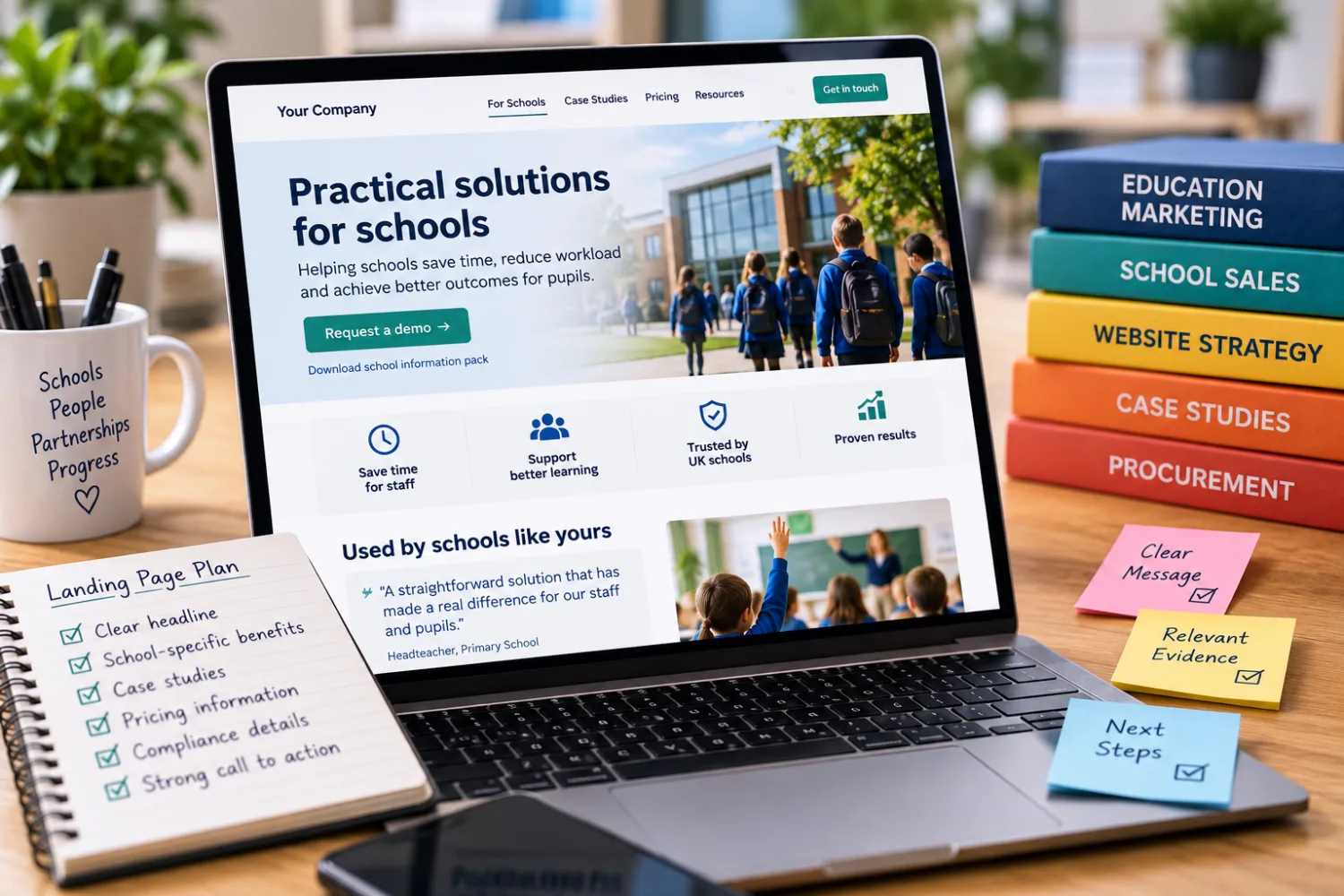
Make your website school-facing, not just trainer-facing
Many CPD providers have websites that focus heavily on their biography, philosophy and credentials. Those things can help, but they should not dominate the page.
A school leader landing on your website usually wants to know:
- what topics you cover
- who the training is for
- what the session format is
- what practical outcomes schools can expect
- what kinds of schools you work with
- how to enquire
If those answers are hard to find, the site may feel more like a personal brand page than a school-ready CPD service.
A strong school-facing page makes your offer easier to understand and easier to trust.
Build better outreach than “we offer CPD” emails
Generic outreach is one of the main reasons good CPD offers get ignored.
If you email schools saying only that you provide staff training, you sound like dozens of other providers.
Your outreach should quickly connect your training to a practical school need.
Weak outreach:
“We offer bespoke CPD for schools and would love to support your staff team.”
Stronger outreach:
“We support primary and secondary schools with practical CPD in areas such as classroom behaviour, adaptive teaching and SEND strategies. Schools often work with us when they want staff training that is grounded in day-to-day classroom reality and leads to clear next steps rather than just theory. If helpful, I can send a short overview of the sessions most relevant to your team.”
That gives the school a reason to read on.
Use the right kind of proof
Not all testimonials help equally.
School leaders are often reassured by proof that shows not just that the training was enjoyable, but that it was relevant, practical and well delivered.
Good school-facing proof often includes comments like:
- staff found it practical and usable
- the session was well pitched for the team
- the provider understood our context
- the training led to useful conversations or follow-up actions
- organisation and communication were straightforward
Examples of strong testimonial language:
- “Staff left with strategies they could apply immediately.”
- “The training felt rooted in real classroom experience rather than generic advice.”
- “The session was well organised, practical and highly relevant to our current priorities.”
That sort of proof helps leaders imagine the training in their own school.
Make your offer easier to buy
Some CPD providers make schools work too hard to understand what to do next.
Try to make it easy for a leader to move from interest to conversation.
That might mean having:
- a simple overview PDF
- clear topic pages
- example session formats
- pricing guidance or a clear quote route
- straightforward contact details
- brief case studies
Simple example:
A school leader who can quickly download a one-page summary of your behaviour CPD, see likely formats and understand what staff will get is much more likely to engage than one who has to email back just to ask basic questions.
The easier you make the first step, the more conversations you create.
Think in terms of recurring trust, not just one-off sessions
Many strong CPD providers first enter a school through one inset, one twilight or one leadership session. But the long-term opportunity usually comes from becoming a trusted option when future needs arise.
That is why it helps to think beyond the first booking.
Ask yourself:
- How can we make this first experience easy and useful?
- How can we leave the school wanting to work with us again?
- How can we communicate like a partner rather than a seller?
A school that trusts you for one session may invite you back for another topic, recommend you internally, or connect you to colleagues in other schools or across a trust.
That is often how CPD providers grow sustainably.
Common mistakes CPD providers make
- using vague “high-impact CPD” language
- trying to cover too many topics without a clear entry point
- failing to connect training to real school priorities
- making the training sound too theoretical
- contacting the wrong leaders
- being unclear about format, timing or outcomes
- assuming school leaders will work hard to decode the offer
- using corporate language instead of school language
- not collecting practical school-specific testimonials
- offering CPD that sounds like more workload, not more support
Most of these are fixable with clearer positioning and simpler communication.
A simple example of stronger positioning
Imagine two CPD providers contact a school.
Provider A says they deliver bespoke, high-impact professional development to transform teaching and learning across the organisation. The language is polished, but the school leader still does not know what topic the training focuses on, who it is for or what staff will actually leave with.
Provider B says they provide practical CPD for primary and secondary schools in areas such as behaviour consistency, adaptive teaching and middle leadership. They explain that most sessions are delivered as inset or twilight training, are grounded in classroom reality, and give staff clear next steps they can actually use.
Provider B will usually feel more credible, more relevant and easier to act on.
Where directories help
CPD providers do not get in front of school leaders only through cold outreach. Schools also discover providers through search, recommendations, articles, local reputation and directories.
That means visibility matters.
If your service supports schools, it can help to join the AllSchools supplier directory. A strong profile gives school leaders another way to find your offer, understand your focus and contact you when the timing is right.
That discoverability can work alongside your outreach rather than replacing it.
Final thoughts
If you want to get in front of school leaders as a CPD provider, the key is not louder marketing. It is clearer relevance.
School leaders usually respond to CPD that feels:
- linked to a real priority
- practical rather than vague
- respectful of staff time
- easy to understand
- well matched to their context
The more your offer sounds like something that will genuinely help a school, rather than simply another training product, the stronger your chances become.
And if you want to make your CPD offer easier for schools to discover while you build those relationships, register as a school supplier on AllSchools.