Teachers often talk about motivation dips — especially in January and February — and pupils know the feeling well. But sometimes what looks like low motivation isn’t a motivation problem at all. It’s burnout.
Secondary pupils today are navigating an academic world that demands energy, resilience, planning, self-regulation, attention control, memory, social management and increasingly sophisticated written output — all while they are constructing their identities and negotiating friendships. Adults underestimate how cognitively heavy that really is.
Burnout, in this context, doesn’t look like collapse or crisis. It looks like quiet depletion.
What Burnout Looks Like in Teenagers (Hint: It Doesn’t Look Like Laziness)
Teenagers rarely say, “I’m burned out.” Partly because the language is adult, and partly because it’s hard to distinguish psychological tiredness from ordinary school fatigue. Instead, burnout shows up in small behaviours:
-
homework starts but doesn’t finish
-
essays stay in draft form
-
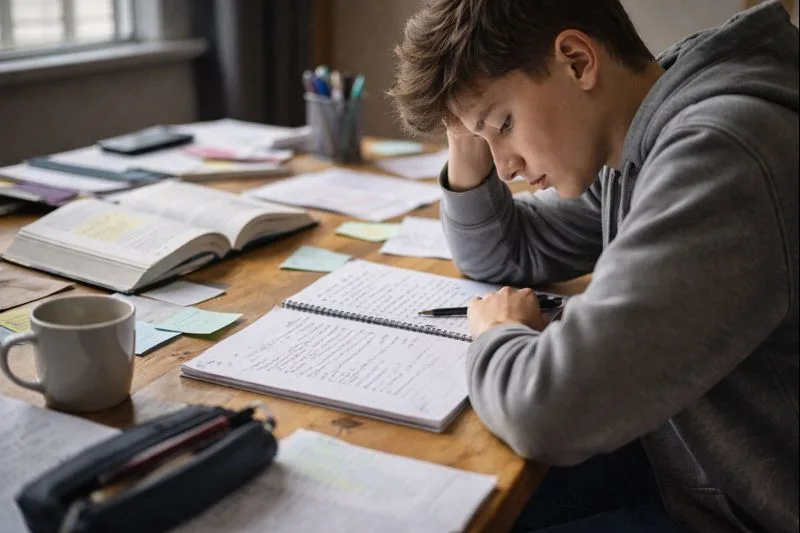
revision becomes performative (highlighters, not learning)
-
social energy tanks after school
-
enthusiasm collapses even for subjects pupils normally enjoy
One Year 11 pupil described it simply:
“I don’t hate Biology. I’m just too tired to care about it right now.”
That sentence contains no laziness — only depletion.
Burnout Isn’t a Lack of Motivation — It’s a Lack of Resources
Motivation asks, “Do I want to do this?”
Burnout asks, “Do I have the energy to do this?”
Those are different questions with different interventions.
A pupil might care deeply about exam results and still struggle to begin tasks because the cognitive and emotional resources required are temporarily unavailable. That explains why pupils who appear unmotivated are sometimes the ones who care the most — caring is taxing.
This connects to the January school slump explored in The Motivation Dip in Schools, but burnout stretches beyond winter and into exam season.
Social Burnout Matters Too (Especially Post-Primary)
Secondary is a social explosion: identity shifts, friendship recalibration, status hierarchies, romantic dynamics and peer performance. Burnout isn’t just academic; it’s social.
A pupil may spend all day emotionally navigating school and arrive home without enough cognitive bandwidth to revise Macbeth. Teachers never see the depletion — they see only the missing homework.
When a parent says, “If you’ve got energy for friends, you’ve got energy for revision,” the pupil knows the truth is the opposite: friends often use up that energy.
Why Burnout Often Peaks in Year 10–11
The GCSE years are structurally mismatched with adolescent neuropsychology. Cognitive load increases steeply just as hormone-driven volatility is at its peak. Executive function is still developing. Working memory is variable. Organisational systems are fragile. And then comes exam pressure layered on top.
Some pupils respond by pushing harder and harder until output collapses. Others withdraw early as an act of self-protection. Both are burnout responses, not motivation choices.
This aligns with the cognitive load issues discussed in Working Memory Challenges for Secondary Teachers — when working memory is overwhelmed, motivation becomes irrelevant.
Burnout vs Anxiety vs Avoidance (They Interact, Not Replace)
One mistake adults make is assuming anxiety and laziness are opposites. More often, anxiety produces avoidance, and avoidance produces burnout as tasks accumulate. Avoiding the essay tonight reduces stress instantly; avoiding it for two weeks increases stress exponentially.
External reference: psychologists like Suniya Luthar and Jeremy Jamieson have noted how high-achievement anxiety in adolescence doesn’t always show up as striving — sometimes it appears as shutdown.
Burnout and anxiety often feed each other in loops.
A Real Scenario: The “It Doesn’t Matter Anymore” Moment
A Year 10 pupil begins to underperform in Maths. At first, they panic. After a few months, they say something chilling:
“I don’t care anymore. I’ll just take whatever grade I get.”
Teachers recognise this as disengagement. But neurologically, it’s self-preservation. If the pupil cares, they are vulnerable. If they stop caring, they are safe. The problem isn’t want; it’s overwhelm.
Often, pupils care again the moment they feel competent. Competence and confidence follow progress — which is why micro-progress interventions (small past paper wins, tiny clarity gains, short explanations) matter more than motivational speeches.
How Burnout Interacts With SEN & Neurodiversity
Pupils with ADHD, autism, dyslexia and working memory difficulties are especially vulnerable to burnout because the cost of learning tasks is higher. A typical pupil may use 20 units of cognitive effort; a neurodivergent pupil may use 60 for the same task. Burnout isn’t fairness — it’s arithmetic.
The Education Endowment Foundation has repeatedly highlighted the role of mentoring and executive function support for pupils who struggle not with intelligence, but with self-regulation.
Burnout is not about difficulty. It’s about demand vs capacity.
What Helps (And Why It Works)
The secret to supporting burnout isn’t motivation boosts. It’s pressure redistribution.
-
clarity reduces cognitive demand
-
rehearsal reduces uncertainty
-
confidence reduces anxiety
-
mentoring reduces overwhelm
-
flexible deadlines reduce shame
-
and small wins rebuild competence
This is why tutors and mentors often matter in spring, as explored in What Tutors & Mentors Can Do Right Now That Pays Off in June — not because they teach content better, but because they help pupils carry it.
Burnout and Behaviour: A Misinterpreted Link
Teachers frequently see burnout as:
-
rudeness
-
apathy
-
silliness
-
refusal
But behaviour is communication. A pupil who stops trying is rarely saying, “I don’t care about learning.” More often, they’re saying, “Learning hurts right now.”
External research from the Child Mind Institute notes that adolescent burnout often hides beneath irritability rather than sadness — adults misread the signal and respond with discipline rather than support.
Summer Exams Reward Fluency, Not Heroic Effort
Burnout pupils often push themselves into heroic revision in May. They collapse in June. Sustainable effort in the spring is always more powerful than panic in the summer.
This concept echoes the idea of momentum rather than motivation, explored earlier in How to Study When You Don’t Feel Like It — burnout pupils don’t need hype; they need to protect momentum.
The Final Thought
Burnout in teenagers is not failure. It’s feedback.
It’s feedback that the system demands more energy than the pupil can currently supply. It’s feedback that curriculum pace, assessment volume, social intensity and identity development are colliding. And it’s feedback that pupils need adults who can distinguish between “won’t” and “can’t”.
Motivation is a choice. Burnout is a state.
Supporting one requires encouragement.
Supporting the other requires compassion, clarity and time.